When Spawn #1 launched in May 1992, it sold 1.7 million copies: a record for an independent/creator-owned comic that still stands (source: Comichron, Wikipedia). It was the founding statement of Image Comics, launched by seven star artists who walked out of Marvel. For collectors, though, #1 remains very affordable: an eBay median of €15 across all editions (102 active listings, June 24, 2026, via our estimator): a direct consequence of that colossal print run.
The original Spawn series isn't just a comic: it's the birth certificate of the modern creator-owned model. Todd McFarlane, then a Marvel superstar, left the publisher to co-found Image and publish his own characters. Spawn became the showcase for that gamble.
This analysis sticks to the verifiable: documented sales figures (Comichron, Wikipedia) and a real-time eBay median via our estimator. When a figure can't be verified, we state it qualitatively rather than inventing it.
1992: why McFarlane left Marvel
Todd McFarlane was one of Marvel's most bankable artists. He drew The Amazing Spider-Man from #298 (1988) through #328 (1990), then launched the adjectiveless Spider-Man title whose #1 (1990) sold roughly 2.5 million copies (source: Wikipedia): a monthly-comic sales record at the time. But in November 1991, frustrated by editorial constraints, he left the title after issue #16.
In 1992, McFarlane co-founded Image Comics with six other star artists who had left Marvel (among them Jim Lee, Rob Liefeld, Marc Silvestri, Erik Larsen). The idea: own your creations rather than work on publisher-owned characters. Early Image titles were distributed through Malibu.
The Spawn #1 phenomenon: 1.7 million copies
Spawn #1 shipped in May 1992, Image's second release after Rob Liefeld's Youngblood the month before. The sales figures were spectacular (source: Comichron):
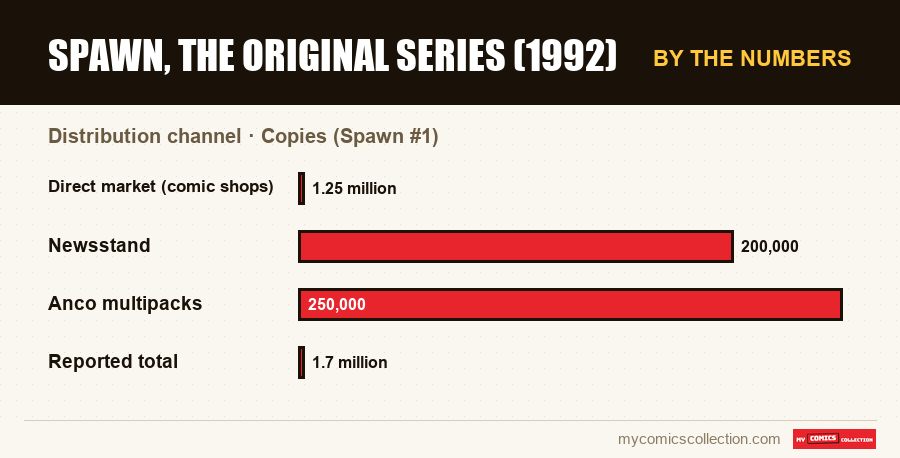
| Distribution channel | Copies (Spawn #1) |
|---|---|
| Direct market (comic shops) | 1.25 million |
| Newsstand | 200,000 |
| Anco multipacks | 250,000 |
| Reported total | 1.7 million |
For the full year 1992, Spawn #1 ranked 8th in units ordered at Diamond (source: Comichron). That 1.7-million total remains, by documented record, the high mark for an independent / creator-owned comic.
What that print run means for collectors
The logic is unforgiving: a comic that sold 1.7 million copies is not rare. That's exactly what current values confirm.
- Spawn #1-€15 median (102 active eBay listings, June 24, 2026, all editions and grades combined). The range runs from ~€9 (low grade) to ~€37 at the top end via our estimator.
- Spawn #9 (1993): €13 median (100 listings). Yet this is the first appearance of Angela, co-created by Neil Gaiman; the issue stays accessible despite its importance and the famous rights dispute that followed (Gaiman retained Angela; the character moved to Marvel in 2013).
- Spawn #100 (2000): €47 median (17 listings): clearly higher, but on a thinner volume, so check live before relying on it.
- Spawn #300 (2019): €25 median (30 listings). An anniversary issue; it was actually #301 that made Spawn the longest-running creator-owned series (passing Cerebus and its 300th), earning a Guinness World Record.
Medians = active eBay listings, all editions and grades combined (our estimator, eBay.fr + eBay.com), as of June 24, 2026.
Where the value actually hides in the first series
If the "all editions" median is low, the standout value is elsewhere:
- Grade. On a comic this widely printed, the gap is made in high-grade CGC: raw copies are everywhere, certified 9.8 slabs far less so. Always check condition before buying.
- Story keys. #1 (first appearance of Spawn / Al Simmons) and #9 (first Angela) concentrate the historical interest of the original series.
- Liquidity. With ~100 active listings at any time on #1 and #9, these are easy issues to buy at the right price: the opposite of a rare grail.
Own a Spawn #1 or another issue from the original series? Get a free valuation with our tool based on real eBay sales to find its low, median and high value.
Benchmarks for collecting the first Spawn series
A print run this massive changes how you collect: you are not looking for a scarce issue, but for the right edition, the right condition and the right milestones in the story. Here is how to find your way.
Three channels, three kinds of copies
Spawn #1 was distributed through three circuits: specialty shops (the direct market), newsstands and multipacks sold in bundles. A newsstand copy carries a barcode, whereas a direct edition shows an illustration in that spot. Before buying, look at the corner of the cover: it is the simplest way to know which circuit a copy comes from, and to set aside listings that do not say.
The milestones to spot in the first series
- Spawn #1 (May 1992): the birth of Spawn and Al Simmons, the second Image release after Youngblood.
- Spawn #9 (1993): the first appearance of Angela, co-created with Neil Gaiman. In the dispute that followed, Gaiman kept the character, who moved to Marvel in 2013.
- Spawn #100 (2000) and Spawn #300 (2019): two anniversary issues. Issue #301 is the one that made Spawn the longest-running creator-owned series, ahead of Cerebus, which earned it a world record mention.
The publisher's context
To place the series, keep its author's path in mind: McFarlane drew The Amazing Spider-Man from #298 (1988) to #328 (1990), then launched the Spider-Man title, which he left after #16, in November 1991. He co-founded Image in 1992 with six other star artists, including Jim Lee, Rob Liefeld, Marc Silvestri and Erik Larsen. Reading the first Spawn series is therefore also reading a founding act of the creator-owned model.
How to build a useful collection
A print run of this scale calls for different reasoning than a rare key. Start with a good copy of #1 and #9, which concentrate the historical interest. Then complete with the anniversary issues. If you are aiming for a certified copy, check the condition on every photo: raw copies are countless, copies in very high grade far fewer, and the grade makes the difference.
Finally, keep in mind that this issue is easy to buy: there is almost always a listing for every budget. That lets you take your time, compare several copies and wait for the right condition rather than buy the first one available.
Frequently asked questions
About 1.7 million, a record for an independent or creator-owned comic. That total comes from a print run split between the direct market, newsstands and multipacks.
Precisely because of that colossal print run: a comic that sold 1.7 million copies is not rare. The exceptional value lies rather in certified high grades.
Tired of editorial constraints, he left Spider-Man after #16, in November 1991. In 1992 he co-founded Image with six other star artists in order to own his own creations.
It features the first appearance of Angela, co-created by Neil Gaiman. Despite its importance and the rights dispute that followed, the issue remains accessible.
It is the issue that made Spawn the longest-running creator-owned series, ahead of Cerebus and its issue 300. Issue #300 is the anniversary issue, but it is #301 that crossed that line.