How many Fantastic Four comics are there? We count eight volumes of Fantastic Four since November 1961, from the founding series by Stan Lee and Jack Kirby to the volume launched in 2025, for ten successive blocks. The first runs from #1 to #416; the historical volume is then resumed from #500 to #588, then from #600 to #611 and from #642 to #645. The sum 416 + 13 + 70 explains the return to #500 in 2003.
The Thing, the Torch, Mr. Fantastic and the Invisible Woman have been through eight volumes, and every relaunch has shaken up the counter. The title lost its article, changed its name, disappeared, resurfaced under another name, took back its historical number, then dropped it again: counting the single issues means choosing a rule and sticking to it.
As always in this guide, only verified information (creators, issue numbers, dates) is stated as fact; the analysis is our own, with no reproduction of protected pages or dialogue.
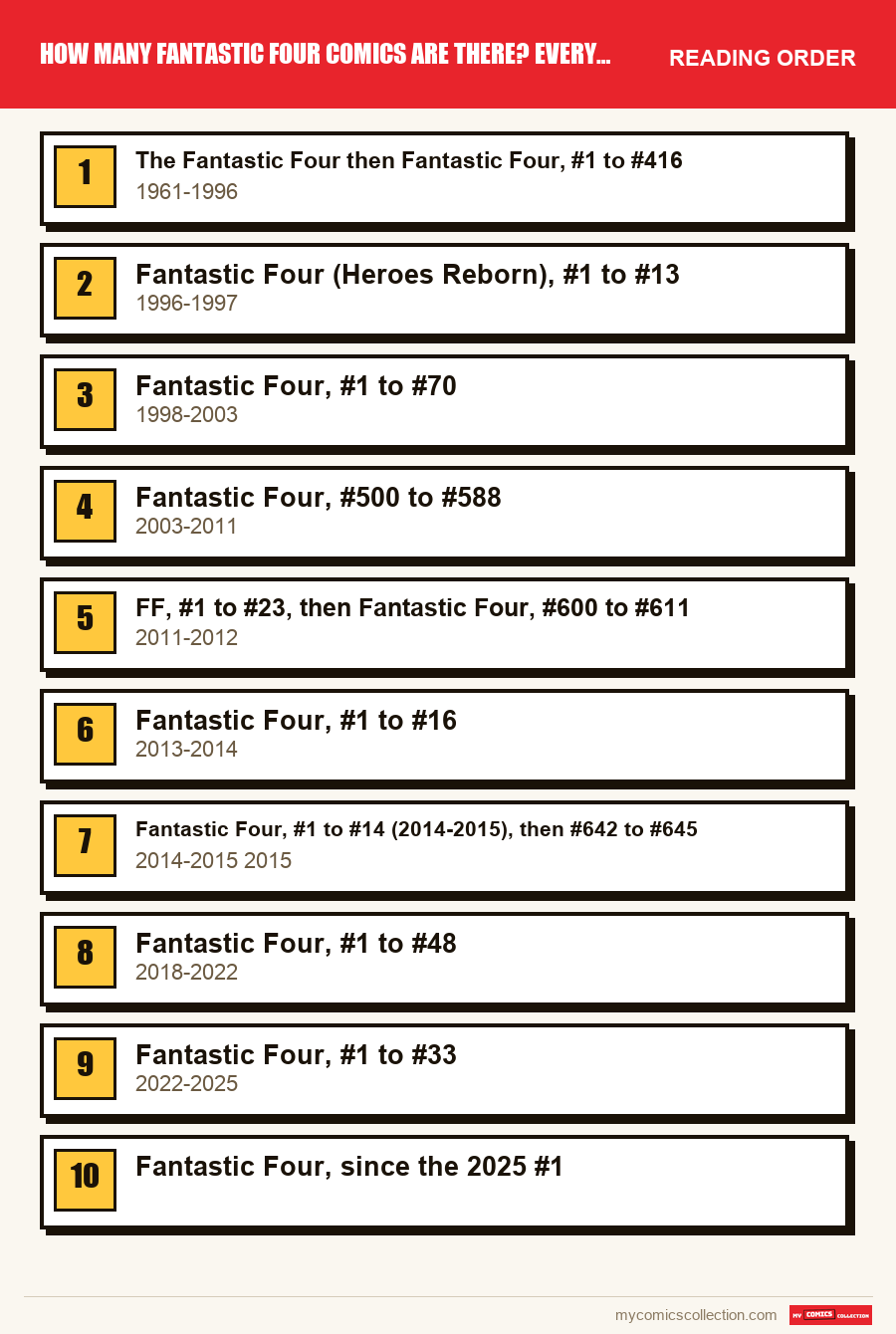
Series 1: The Fantastic Four then Fantastic Four, #1 to #416 (1961-1996)
The series begins in November 1961 under the title The Fantastic Four. The article disappears with #16, dated July 1963, and the title stays Fantastic Four to the end. Stan Lee and Jack Kirby built most of the mythology, with Kirby drawing the first one hundred and two issues.
What follows is a relay of creators: Roy Thomas, Gerry Conway and Marv Wolfman writing, John Romita Sr., John Buscema, Rich Buckler and George Pérez drawing, Joe Sinnott inking. John Byrne wrote and drew the series from #232 in July 1981 and left it in 1986, Steve Englehart wrote issues 304 to 333, and Walt Simonson took over the writing at #334 in December 1989 and kept it until #354 in July 1991, drawing part of those issues himself. Tom DeFalco then wrote up to #416, with Paul Ryan on art for most of it, and then Carlos Pacheco on the last two issues.
The volume stops in September 1996 and has twenty-seven annuals.
The numbers give the measure of this volume: Kirby draws one hundred and two issues out of four hundred and sixteen, a little under a quarter, John Byrne holds the series for five years, from 1981 to 1986, and Walt Simonson for a little under two years, from late 1989 to summer 1991. In a collection, these three periods make up three distinct projects that you can tackle separately.
For its value and context, see the 1961 first issue and the analysis of the original series.
Series 2: Fantastic Four (Heroes Reborn), #1 to #13 (1996-1997)
In November 1996, the series started over at #1 in a recreated universe, for the duration of the Heroes Reborn initiative. Jim Lee and Brandon Choi signed the first twelve issues, with Jim Lee drawing most of them, alongside Brett Booth and Ron Lim; James Robinson wrote #13 with Mike Wieringo on art.
The series ended in November 1997 after thirteen issues. It still counts in the arithmetic of the total, because the following relaunches take it into account to get back to the historical numbering.
Series 3: Fantastic Four, #1 to #70 (1998-2003)
January 1998: a new start, with Scott Lobdell writing and Alan Davis drawing the first three issues. Chris Claremont then wrote issues 4 to 32 with Salvador Larroca, who drew up to #34. Carlos Pacheco, Jeph Loeb and Karl Kesel followed one another, then Mark Waid and Mike Wieringo took issues 60 to 70 in the fall of 2002.
The volume shows double numbering from #42 in June 2001, the matching issue of the historical lineage being #471. It ends in August 2003 at #70, that is, at #499 of the lineage.
Series 4: Fantastic Four, #500 to #588 (2003-2011)
September 2003: the series picks up #500, which the sum in the next section justifies. Mark Waid wrote issues 500 to 524, with Mike Wieringo and Mike McKone among the artists. J. Michael Straczynski and McKone signed issues 527 to 541, and Dwayne McDuffie and Mark Millar came next, with Bryan Hitch, Paul Pelletier and Dale Eaglesham on art.
Jonathan Hickman takes issues 570 to 588, opening a project that he would continue under another title. Issue #587, published in January 2011, tells the death of Johnny Storm. This block has eighty-nine regular issues, from #500 to #588, with three main creative teams: Waid, Straczynski and then Hickman.
Series 5: FF, #1 to #23, then Fantastic Four, #600 to #611 (2011-2012)
After the death of Johnny Storm, the series took the title FF from May 2011. Its issues 1 to 11 also carry the legacy numbers 589 to 599, and the volume has twenty-three single issues in total. For the collector, these twenty-three issues form a separate block, to be told apart from the parent series.
#600, a hundred pages dated January 2012 and released in November 2011, takes back the title Fantastic Four and the original numbering. Jonathan Hickman wrote issues 600 to 611, with Steve Epting, Barry Kitson, Ron Garney, Giuseppe Camuncoli and Ryan Stegman on art, plus a #605.1. Our guide on Hickman and Fantastic Four places this period in context.
Series 6: Fantastic Four, #1 to #16 (2013-2014)
January 2013: a volume 4 starts at #1 under Matt Fraction, joined by Karl Kesel on issues 13 to 16, with Mark Bagley on issues 1 to 13 and then Raffaele Ienco. It has sixteen issues, plus a #5AU, and ends in March 2014. In parallel, a second volume of FF published sixteen issues over the same period, to be counted separately.
Series 7: Fantastic Four, #1 to #14 (2014-2015), then #642 to #645 (2015)
In April 2014, James Robinson launched a new volume with Leonard Kirk on art. It has fourteen issues, plus one annual, and ends in February 2015. The title then takes back the historical numbering with issues 642 to 645, from March to June 2015, again by Robinson and Kirk, before a break of several years.
Do you collect this series?
Track what you own, what you are missing and what your collection is worth. 7-day trial.
Start my trial →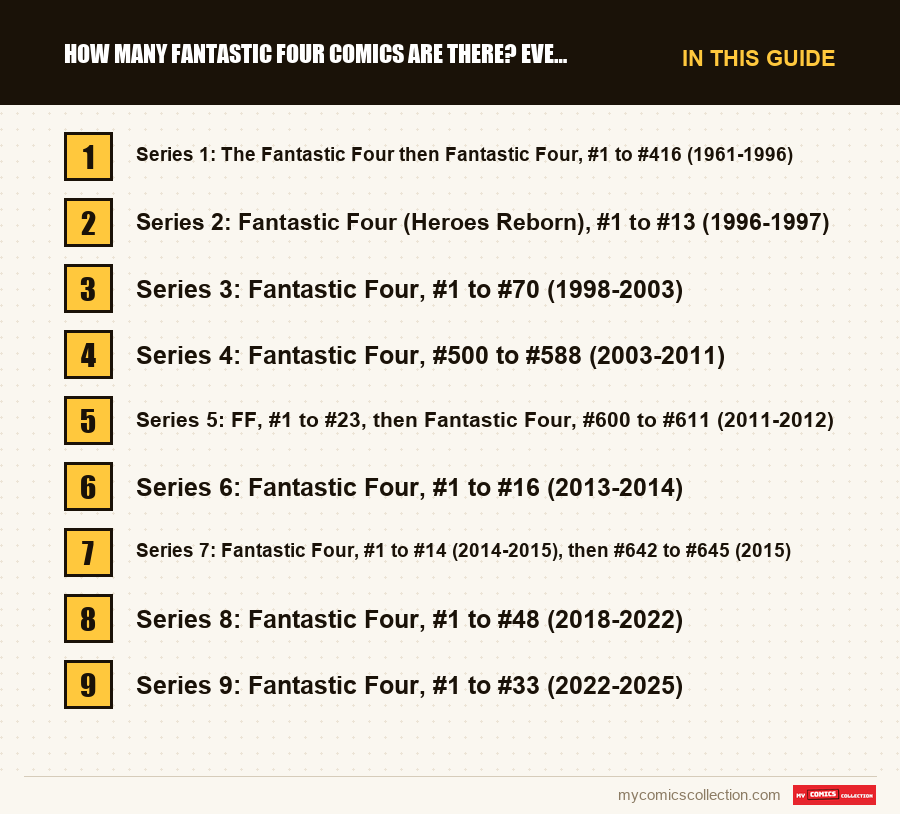
Series 8: Fantastic Four, #1 to #48 (2018-2022)
August 2018: Dan Slott relaunched the series at #1 with Sara Pichelli drawing the first three issues. He wrote it up to #46, David Pepose signed issues 47 and 48, and the volume stopped in October 2022 after forty-eight issues. Aaron Kuder, Paco Medina and Rachael Stott are among the guest artists.
With forty-six issues written by a single writer, this volume reads like a continuous saga. Its count is in the boundary: from #1 to #48, forty-six issues by one writer then two by another, which makes it easy to sort by creative period on the shelf.
Series 9: Fantastic Four, #1 to #33 (2022-2025)
In November 2022, Ryan North took the helm with Iban Coello. Ivan Fiorelli, Carlos Gómez, Steven Cummings and Cory Smith drew stretches of the volume, which runs until June 2025: thirty-three issues and one annual. Ryan North wrote the whole run, which gives this block an author unity comparable to that of Dan Slott's volume, and makes it easy to file in a collection organized by writer.
Series 10: Fantastic Four, since the 2025 #1
July 2025: a new #1, still written by Ryan North, with Humberto Ramos drawing issues 1 to 10 and #15. Patrick Boutin, Andrea Sorrentino and Ramon Rosanas drew other issues. Since the volume is open, we give no final boundary. Like the 2022 one, it is written by Ryan North: two consecutive volumes, one writer, but two separate numberings, each starting at #1, not to be confused on the shelf.
Legacy numbering: the arithmetic of the total
The 2003 #500 can be demonstrated: 416 issues of the founding series, plus 13 of Heroes Reborn, plus 70 of the 1998 volume, make 499. The next issue could therefore only be #500. Carry on: 499 plus the 89 issues from #500 to #588 leads to #588, which the boundaries of this page confirm.
After that, the sum becomes less clear. The twenty-three single issues of FF absorb numbers 589 to 599 through their first eleven issues, the January 2012 #600 finds the original numbering again, and issues 642 to 645 of 2015 serve as the end point before the break. We do not add beyond that: the total depends on the place you give FF, the .1 issues or #5AU and the annuals, and it varies by several dozen.
The modern volumes are easier to calculate: 16 issues for the 2013 one, 14 for the 2014 one, 48 for the 2018 one and 33 for the 2022 one, that is 111 regular issues restarted from #1, without the 2025 volume that is still open. To that you add the four issues 642 to 645 of 2015, which belong to the historical lineage and not to a numbered volume.
Annuals and spinoff series
The first volume has twenty-seven annuals, the 2014 volume one annual, and the 2022 one also one annual. Some hold landmark stories; our guide to the key annuals and specials goes through them.
FF is a spinoff series in its own right, of twenty-three issues in 2011, then sixteen issues in 2013 and 2014. The Mark Waid and Mike Wieringo volume, from #60 to #70, has only eleven issues, but it neatly closes the 1998 volume; it is the kind of short block that is filed by team rather than by series. Other titles orbit the team, but we make no claim to be exhaustive: it is better to note them in a separate list.
Completing the series: where to start
Start by fixing your rule: by volume, by writer, or by era. A short volume like Matt Fraction's sixteen issues or James Robinson's fourteen is finished quickly, and teaches you to read a legacy number on a cover. Save the 1961 volume for last, especially its first issues drawn by Jack Kirby, where condition and authenticity call for the most checks.
The three resumptions of the historical numbering deserve particular attention: the 2003 #500, the 2012 #600 and the 2015 #642 are issues that lists sometimes file in a volume that is not theirs. Check the cover year before shelving them. Issues 589 to 599, incidentally, exist only through the double numbering of FF, not as standalone single issues.
Sort each volume into two lists: the regular run on one side, the annuals, the #5AU and the .1 issues on the other. Then check the cover date and the printed number in the catalog entry, and measure the copy against completed sales. The Fantastic Four collecting guide and the major artists of the series help you sort your search priorities.
Frequently asked questions
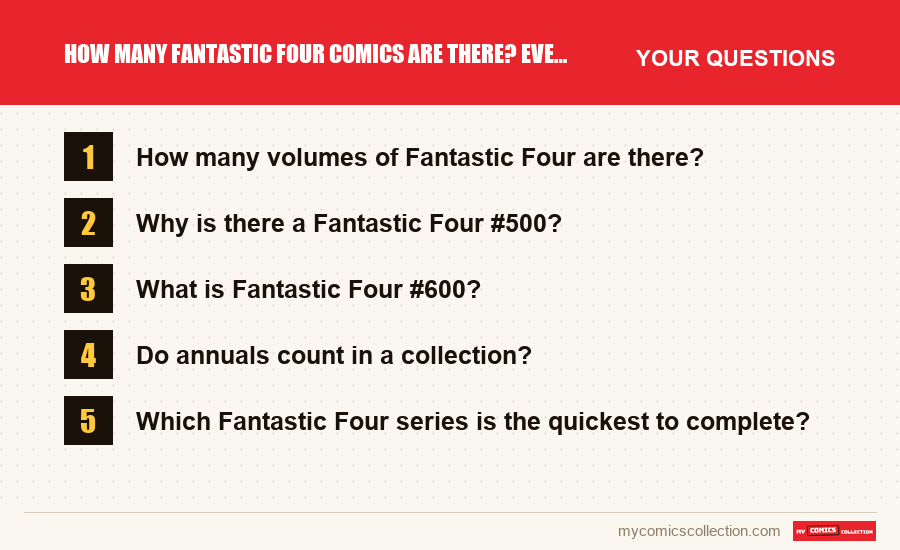
Eight volumes since November 1961 by the volume count, from the first to the one launched in 2025, to which you must add the resumptions of the historical numbering. FF is a neighboring series, counted separately, as are the titles devoted to members of the team.
The first volume stops at #416, the Heroes Reborn interlude weighs thirteen issues, the 1998 volume seventy: 499 in total. September 2003 therefore brings a #500, written by Mark Waid, which reconnects the series to its original lineage.
It is a hundred-page issue dated January 2012, which finds the original numbering again after the FF series. Jonathan Hickman writes the fate of Johnny Storm there, left hanging since #587 in January 2011, and continues up to #611.
They are shelved separately: the 1961 volume has twenty-seven. Consider the series complete when the whole regular run is gathered, then add the annuals one by one, according to the interest of their story and the space available.
Robinson's volume, fourteen issues plus #642 to #645, or Matt Fraction's, sixteen issues, can be wrapped up in a few purchases. The 1961 volume and its four hundred and sixteen issues is best kept for last, when you already master legacy numbers.
Once you have identified your Fantastic Four volumes, get an estimate for the copy you own or are being offered.
Estimate my comic