November 1961. In Marvel's New York offices (then known as Timely/Atlas), Stan Lee and Jack Kirby put the finishing touches on a comic that would change world comic book history.
For informational purposes only: This information is provided for educational purposes only. My Comics Collection is not an investment advisor. Values vary with condition, scarcity and market trends.
November 1961. In Marvel's New York offices (then known as Timely/Atlas), Stan Lee and Jack Kirby put the finishing touches on a comic that would change world comic book history. Fantastic Four #1 isn't just a first issue: it's the Big Bang of the Marvel Universe as we know it today. This is where the revolutionary idea of flawed, human-in-their-failings superheroes was born, characters who squabble and doubt as much as they fight.
In 2026, with the MCU fully integrating the Fantastic Four into Phase 6, the value of FF #1 is higher than ever, and experts anticipate another wave of price increases in the coming months. This complete guide explains what this copy is really worth by CGC grade, how it compares to other Silver Age Marvel keys, and why now might be the time to position yourself on this market.
Fantastic Four #1: the comic that invented Marvel
To understand FF #1's value, you have to grasp what this issue represents in comic history. In 1961, the market is dominated by DC Comics and its iconic but squeaky-clean superheroes (Superman, Batman, Wonder Woman) flawless characters who always triumph. Stan Lee, exhausted by the industry and on the verge of leaving Marvel, decides to try something radically different.
He creates four characters who argue with each other, who have to live with their powers (Reed Richards is distracted by science, Ben Grimm is miserable in his rock body, the Human Torch is a reckless teenager, Sue Storm searches for her place in a male-dominated group). The audience is immediately won over. FF #1 sells better than expected and Stan Lee realizes he's got something new.
This issue also contains the first appearance of the Mole Man, the series' first major villain, and establishes the narrative foundations that will serve as a template for every Marvel comic that follows, including Amazing Fantasy #15 (Spider-Man, 1962) and Incredible Hulk #1 (May 1962, a few months after FF #1).
Historical fact: Fantastic Four #1 (November 1961) is the first comic of the modern Marvel era. It predates Incredible Hulk #1 by six months and Amazing Fantasy #15 (Spider-Man) by a year. Without FF #1, none of the Marvel characters we know would exist in this form.
CGC values for Fantastic Four #1 in 2026
Fantastic Four #1 is one of the best-valued Silver Age keys on the market. Its scarcity in high grade, combined with its historical importance and the MCU catalyst, makes it a first-tier collection investment. Here are current estimates by CGC grade:
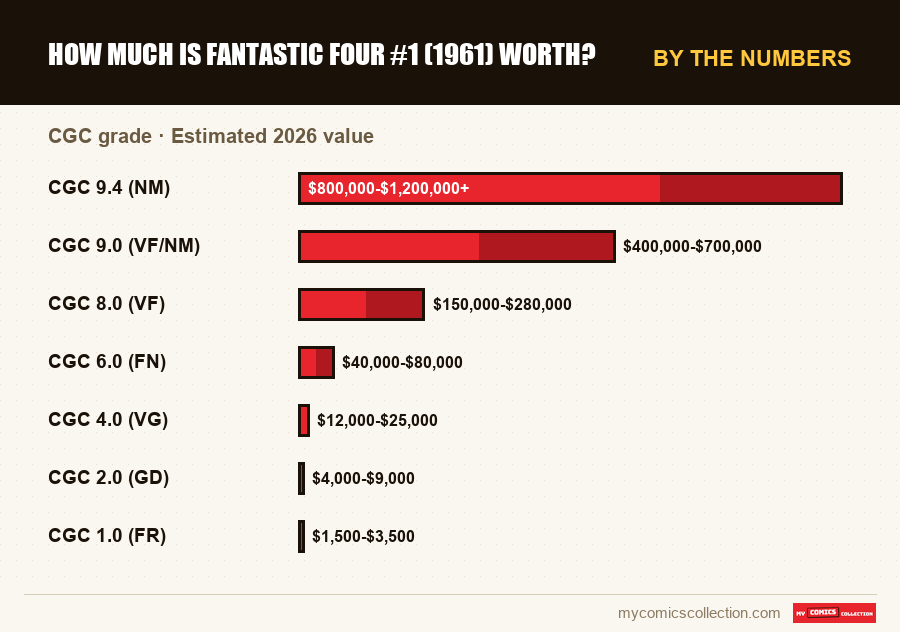
| CGC grade | Condition | Estimated 2026 value |
|---|---|---|
| CGC 9.4 (NM) | Near Mint | $800,000-$1,200,000+ |
| CGC 9.0 (VF/NM) | Very Fine / Near Mint | $400,000-$700,000 |
| CGC 8.0 (VF) | Very Fine | $150,000-$280,000 |
| CGC 6.0 (FN) | Fine | $40,000-$80,000 |
| CGC 4.0 (VG) | Very Good | $12,000-$25,000 |
| CGC 2.0 (GD) | Good | $4,000-$9,000 |
| CGC 1.0 (FR) | Fair | $1,500-$3,500 |
These price ranges are based on sales realized between 2024 and 2026 at Heritage Auctions, ComicConnect and ComicLink. Copies in CGC 8.0 and above are particularly scarce for this title: very few exist in the CGC Census.
The MCU effect: a powerful catalyst for FF #1
The integration of the Fantastic Four into the Marvel Cinematic Universe is one of the most anticipated catalysts in the comics market in years. After years of Fox rights holdings (the 2005, 2007 and 2015 Fantastic Four films left fans cold), Marvel Studios has recovered the rights and is preparing an adaptation worthy of the name.
The MCU effect on original comics is well documented. A few telling examples:
- Amazing Fantasy #15 (Spider-Man): The mere Spider-Man announcement in Civil War in 2016 caused an immediate price jump, and Tobey Maguire's return in No Way Home in 2021 pushed this issue to all-time records.
- Avengers #1 (1963): The 2012 Avengers release multiplied prices for good-condition copies 3 to 4x in a matter of months.
- Incredible Hulk #181 (Wolverine): Every new MCU Wolverine project announcement pulls this issue up.
For Fantastic Four #1, the anticipatory effect has been noticeable since 2022. Savvy collectors have begun positioning on copies in CGC 4.0 to 6.0, anticipating a wave of less specialized buyers arriving after the film's release. This anticipation strategy is risky but potentially very profitable if the MCU film delivers the expected success.
Track your FF #1's value
My Comics Collection alerts you in real time when the market moves on your Fantastic Four key issues. Set up your price alerts and don't miss another opportunity.
Start freeFree trial
Fantastic Four #1 vs. other Silver Age Marvel keys
How does FF #1 stack up against the other Silver Age Marvel founding issues? Here's an objective comparison to inform your collecting strategy:
Amazing Fantasy #15 (1962)
1st app. Spider-Man, Marvel's most popular character
CGC 6.0: ~$100,000+
Fantastic Four #1 (1961)
Birth of the Marvel era, the "Big Bang" of the Marvel universe
CGC 6.0: ~$40,000-$80,000
Incredible Hulk #1 (1962)
1st app. Hulk, short series, significant scarcity
CGC 6.0: ~$20,000-$40,000
Journey into Mystery #83 (1962)
1st app. Thor, very popular post-MCU
CGC 6.0: ~$15,000-$30,000
FF #1 positions itself as the second most valued Silver Age Marvel issue, behind Amazing Fantasy #15, but with significant catch-up potential thanks to the upcoming MCU catalyst. This comic's historical logic, as the precursor to all the others, plays in its favor among collectors who prioritize narrative and chronological importance.
Technical details and FF #1 authenticity
As with any high-value Golden/Silver Age comic, certification and authenticity are absolute non-negotiables for Fantastic Four #1. Here are the points of vigilance specific to this issue.
The cover: mind the blue
FF #1 presents a cover with an intense blue background. Over time, this color tends to degrade and shift toward a dull gray-blue. Copies with vivid, saturated blue are significantly better graded by CGC. When buying, examine the color quality under natural light.
Identify restorations
Replaced staples, tears filled with period-matched paper and retouched colors are the most common forms of restoration on this title. CGC systematically detects them via UV light and physical examination, and grades restored copies separately (a "Restored" or "R" notation).
Check the CGC Census
The CGC Census for FF #1 shows a very limited number of high-quality copies. Fewer than 5 copies are graded CGC 9.0 or above. This objective scarcity is a strong argument for long-term appreciation.
Provenance and history
A copy whose ownership history can be traced (known private collection, documented purchase from a period bookseller) is worth 10 to 20% more than a similar copy without provenance. Provenance reassures buyers and reinforces the item's legitimacy.
Key facts about Fantastic Four #1 (1961)
- 1st appearance of the Fantastic Four and the Mole Man, by Stan Lee and Jack Kirby
- Published November 1961, the first comic of the modern Marvel era
- CGC 9.0: estimated value $400,000-$700,000 in 2026
- Additional upside potential tied to MCU integration of the FF
- Very few copies in high quality in the CGC Census
- Second most valued Silver Age Marvel issue after Amazing Fantasy #15
FAQ: Fantastic Four #1, your most common questions
Silver Age collection continuously valued
Track the valuation of all your Silver Age Marvel comics on a single dashboard. My Comics Collection aggregates data from major auction houses to give you an up-to-date estimate each week.
Try freeOver 15,000 collectors trust My Comics Collection