In short
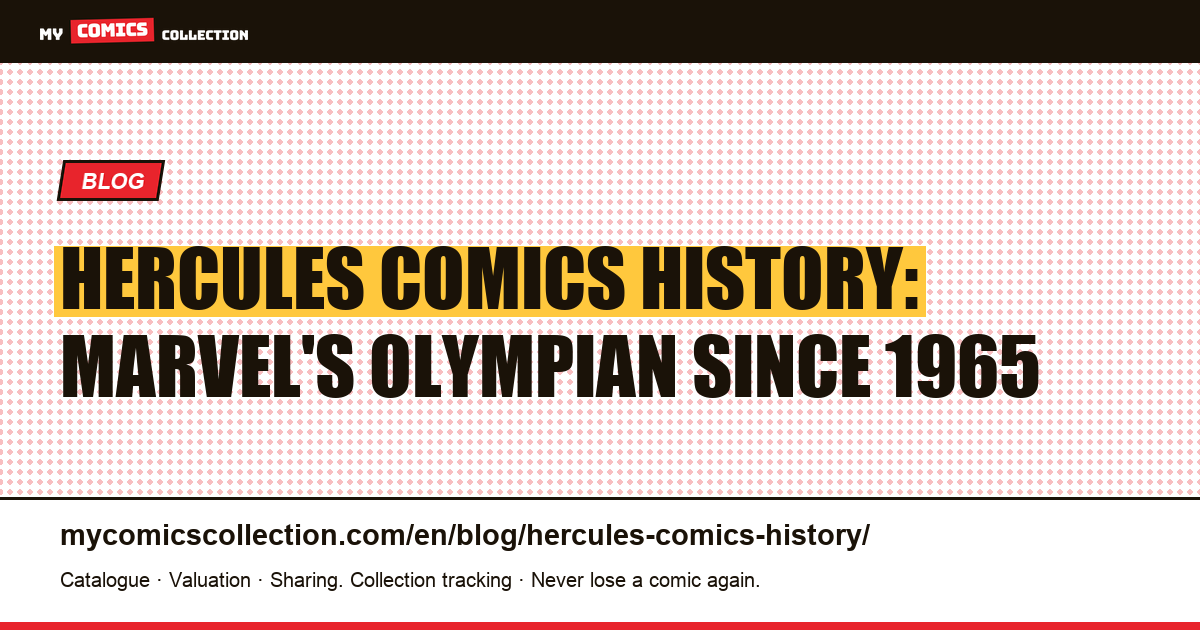
Hercules reaches Marvel's modern universe in Journey into Mystery Annual #1 (October 1965), the character's first formal appearance as Thor's rival, with Stan Lee and Jack Kirby credited as creators of the modern version. He becomes a full Avenger in The Avengers #45, co-founds The Champions in 1975, loses his immortality in 1995, and carries his own title again in The Incredible Hercules (2008) by Greg Pak and Fred Van Lente.
Hercules is one of the few Marvel characters who has been a rival, a teammate, a headliner and a comic-relief lead in different decades, and the numbering of his appearances reflects every one of those turns. This guide follows him in order, from two wartime appearances to the Avengers of the 2020s, and it points out where a collector can go wrong.
Dates, run lengths and creators for the Olympian were each checked, while inkers and cover artists that could not be confirmed stay out. What each era means for a shelf is interpretation, and no figure in dollars appears here.
Two wartime appearances: 1943 and 1945
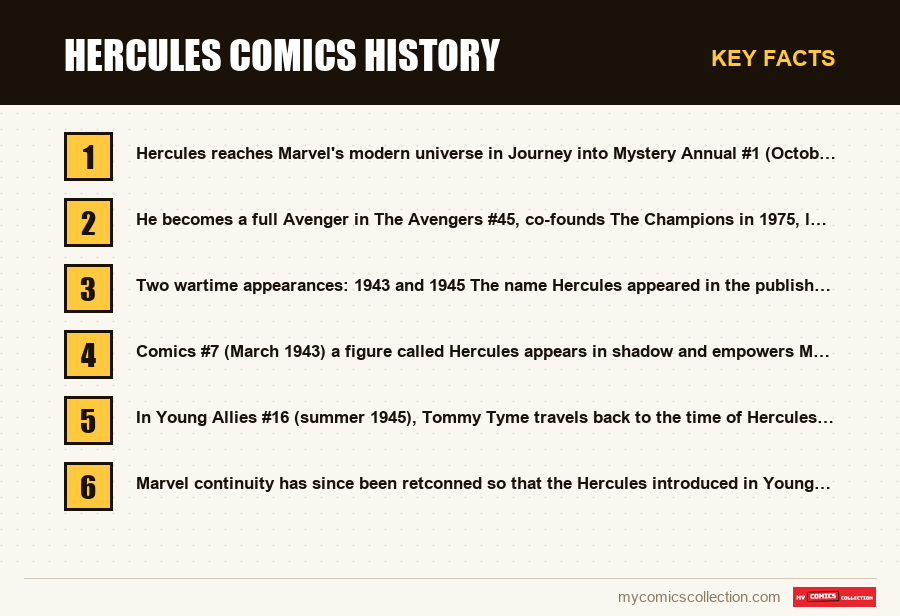
The name Hercules appeared in the publisher's early books long before the modern character. In U.S.A. Comics #7 (March 1943) a figure called Hercules appears in shadow and empowers Martin Burns, who becomes Marvel Boy. In Young Allies #16 (summer 1945), Tommy Tyme travels back to the time of Hercules to witness his fight with Antaeus, with Charles Nicholas credited as artist.
The two books do not carry the same weight. Marvel continuity has since been retconned so that the Hercules introduced in Young Allies #16 is folded into the Silver Age version, while the 1943 figure is simply the mythological hero lending his power to someone else. Neither book is the formal debut, and a listing that calls either one a first appearance needs a second look. Both are worth knowing as footnotes, and both belong in a separate field from the Silver Age debut.
The Avengers cameo and the Thor annual, 1964 to 1965
The modern character's story begins with a cameo. In The Avengers #10 (November 1964), a Hercules appears in the service of Immortus. Stan Lee and Jack Kirby are credited as the creators of the modern version. Years later, Avengers Forever (December 1998 to November 1999) reveals that this figure was an impostor, which is why the later annual is treated as the debut.
That annual is Journey into Mystery Annual #1, dated October 1965, the character's first formal appearance in the Marvel Universe, which establishes him as Thor's rival. The setup is what counts: an outsider from another pantheon, a challenger whose clashes with Thor turn on pride rather than villainy. The issue has its own guide on this site, which covers the object itself, and the rest of this page takes up the story from there.
From guest star to Avenger, 1966 to 1967
The next two years turn the rival into a regular. In The Mighty Thor #126 (March 1966) Hercules becomes a regular guest star, and in Tales to Astonish #79 (May 1966) he fights the Hulk, a battle for which Stan Lee, Jack Kirby and Bill Everett are credited. In The Avengers #38 (March 1967) he appears as a guest of the team, and in #45 he becomes a full member after Goliath announces it at the first Avengers Day. Lee, the writer of the debut annual, is covered on his author page.
For a collector the pattern is simple. Three books mark the progression: the annual for the debut, Thor #126 for the start of the guest-star run, and The Avengers #45 for the membership. Each is a separate stop, and each can be shelved with the series it belongs to. The Hulk fight in Tales to Astonish #79 is a useful cross-reference for readers who follow the green giant as well, and the Hulk hub collects those guides.
The Bronze Age: guest roles and a team book, 1974 to 1978
In the 1970s the character is often a guest. He turns up in Marvel Team-Up #28 (December 1974) and Marvel Premiere #26 (November 1975), and in Marvel Two-in-One #44 (October 1978). The most important book of the decade is The Champions, a team he helps found, whose series ran seventeen issues from October 1975 to January 1978.
The team book matters in the character's history because it puts him on a roster in which he is neither the foil nor the guest, and it is a short run that a collector can complete as a unit. Two-issue guest appearances are better handled as filler for the character's timeline than as targets in themselves.
Bob Layton's alternate universe, 1982 and 1984
Bob Layton wrote and drew two limited series, both set in an alternate universe. The first ran four issues from September to December 1982, and the sequel ran four issues from March to June 1984. They present a 24th century Hercules who deals with exile from Olympus and a series of quests, and they are the clearest example in the history of a Hercules who is the lead of his own story and not a supporting piece for Thor or the Avengers.
The alternate setting is the trap for collectors. The 1982 and 1984 books are separate from the mainstream continuity, and their numbering restarts, so a listing that says only "Hercules #1" can mean more than one book. Only title, year and number together name the book.
Siege and Olympus: the Avengers of the 1980s
The late 1980s return him to the team. The Avengers #270 to #277 (August 1986 to March 1987) contain "Under Siege", the story of the Masters of Evil, and it leads into "Assault on Olympus" in #281 to #285 (July to November 1987), after which Hercules leaves the team. It is the clearest marker of the end of his first period as an Avenger.
Do you collect this series?
Track what you own, what you are missing and what your collection is worth. 7-day trial.
Start my trial →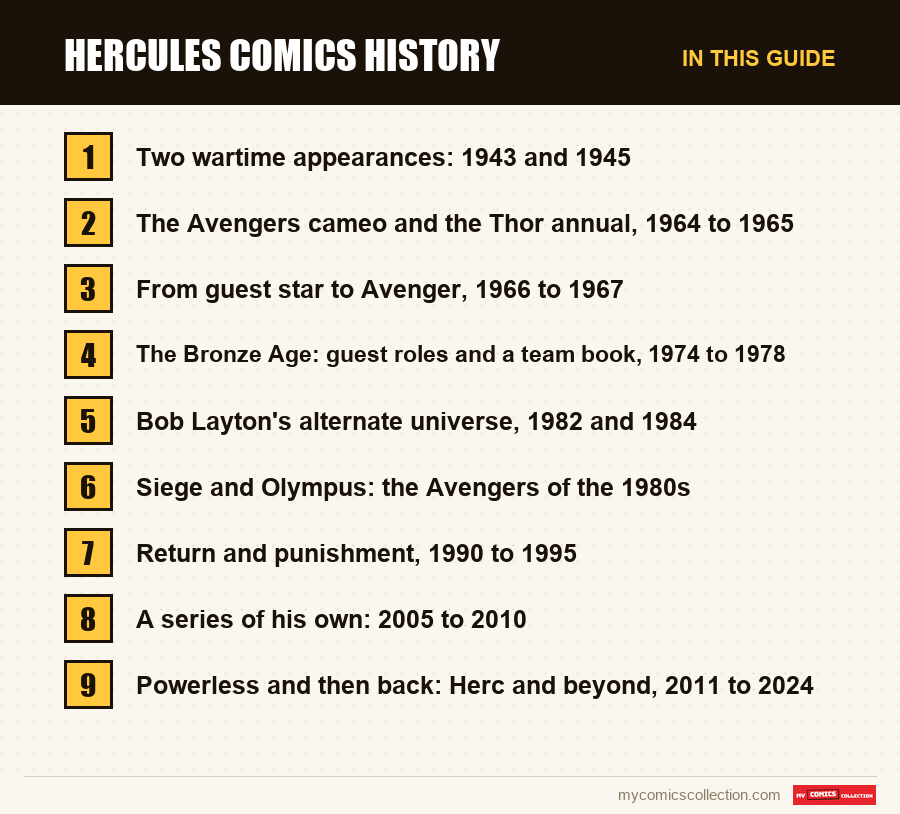
Return and punishment, 1990 to 1995
He appears in Thor #418 and in #419 to #424 (June to October 1990), and he rejoins the Avengers as a reserve member in The Avengers #329 (February 1991), becoming active in #334 to #339 (July to October 1991). The most consequential change of the decade comes in The Avengers #384 (March 1995), when Hercules attacks Zeus and the angered god strips him of his immortality and half his strength and forbids his return to Olympus.
That penalty is the beginning of a long arc in which the demigod is diminished and must regain his place. It does not disappear when the story ends, and it supplies the premise of later series that treat him as a fallen hero. The relationship with Zeus runs under all of it, and anyone who wants the full background of the gods behind him will find the broader Thor story in the history of Thor comics.
A series of his own: 2005 to 2010
A self-titled Hercules limited series ran five issues from June to September 2005, and it was followed by Thor: Blood Oath, six issues from November 2005 to February 2006. The big change comes after World War Hulk. The Incredible Hulk becomes The Incredible Hercules with #113 (February 2008), written by Greg Pak and Fred Van Lente, and the numbering carries on from the Hulk series. The series ends with #141 (April 2010), and Amadeus Cho becomes his sidekick after World War Hulk. For the Hulk side of that story, see the guide to Planet Hulk and World War Hulk.
The run is followed by Hercules: Fall of an Avenger (March and April 2010) and then Prince of Power #1 (May 2010), also by Pak and Van Lente. In Chaos War, a five-issue event, Hercules seals the Chaos King away and spends his power to restore the universe, which leaves him mortal. The numbering is the practical problem: because the series continues the Hulk title's numbering, a shelf organized by character alone will miss it, and a shelf organized by title will place it among Hulk comics.
Powerless and then back: Herc and beyond, 2011 to 2024
Pak and Van Lente launched Herc in 2011, a series in which the hero is powerless but armed with mythical weapons. Neil Edwards is credited as artist. A later Hercules series by Dan Abnett and Luke Ross ran six issues from late 2015 into 2016, and in Civil War II: Gods of War (four issues) he fights the Uprising Storm alongside the ancient heroes and declines an offer from Athena to return to Olympus.
From 2016 the character moves back into team books. He rejoins the Avengers in the aftermath of Civil War II, and in #2 to #8 of the seventh volume of Avengers the team contends with time paradoxes created by Kang, and in 2017 he joins the Underground in Secret Empire. In 2019 he fights beside the Avengers in Avengers: No Road Home. In 2020, in the sixth volume of Guardians of the Galaxy, the Guardians free him, and he begins a relationship with Noh-Varr in #6. In 2024 he joins Captain America's Avengers during "Blood Hunt" and later the AVENG.E.R.S. in the third volume of Avengers Assemble.
The key issues across his history
- The Avengers #10 (1964): the Hercules who serves Immortus, later revealed to be an impostor.
- Journey into Mystery Annual #1 (1965): the first formal appearance, as Thor's rival.
- The Mighty Thor #126 (1966): Hercules becomes a regular guest star.
- Tales to Astonish #79 (1966): the fight with the Hulk.
- The Avengers #45: he becomes a full member after the Avengers Day announcement.
- The Champions #1 (1975): the start of the seventeen-issue team series.
- The Avengers #384 (1995): Zeus takes his immortality and half his strength.
- The Incredible Hercules #113 (2008): Greg Pak and Fred Van Lente take over the former Hulk numbering.
How to follow Hercules in a collection
Start with the pair of debut books, The Avengers #10 and the 1965 annual, and log them in separate fields: one for the earliest appearance of the modern version, one for the formal debut. After that, shelve by series: The Mighty Thor for the guest-star years, The Avengers for the membership and the 1986 to 1991 stories, The Champions for the team run, and then the modern titles.
Two traps deserve attention. The Layton miniseries of 1982 and 1984 sit in an alternate universe and restart their numbering, and The Incredible Hercules continues the numbering of a Hulk series, so a spreadsheet that sorts by number alone will lose both. If you buy collected editions, treat each as its own entry. When a Silver Age original of his lands on your shelf, a free valuation is the next step.
Frequently asked questions
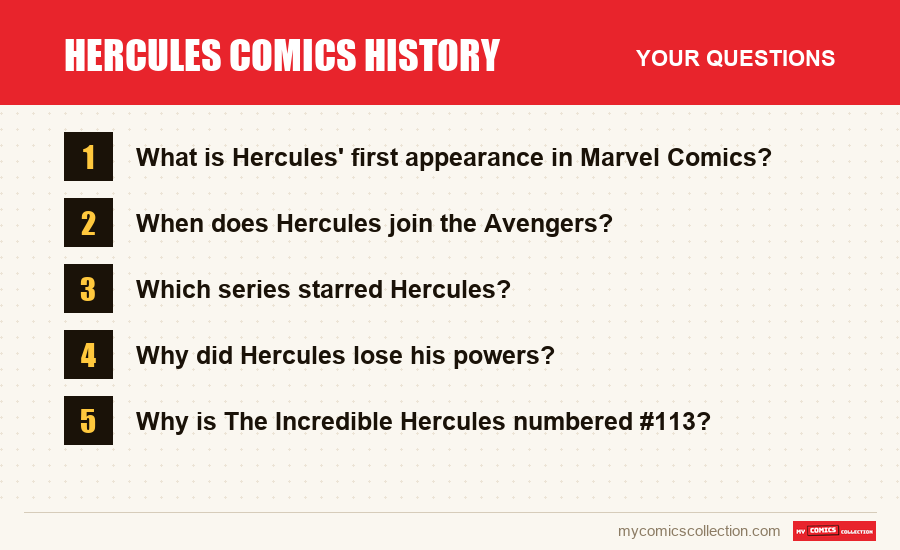
The first formal appearance of the modern character is Journey into Mystery Annual #1, dated October 1965, which presents him as Thor's rival. A figure called Hercules appears earlier in The Avengers #10 (November 1964), but Avengers Forever later revealed him to be an impostor.
He appears as a guest of the team in The Avengers #38 (March 1967) and becomes a full member in #45, after Goliath announces it at the first Avengers Day. He later leaves the team after the "Assault on Olympus" story in #281 to #285 (1987), and he returns as a reserve member in #329 (1991).
He co-starred in The Champions (1975 to 1978), headlined Bob Layton's miniseries of 1982 and 1984, and led The Incredible Hercules by Greg Pak and Fred Van Lente from 2008 to 2010, followed by Prince of Power and Herc. Dan Abnett and Luke Ross later wrote a six-issue series.
Two stories matter. In The Avengers #384 (March 1995), Zeus takes his immortality and half his strength after Hercules attacks him. In Chaos War (2010), Hercules seals the Chaos King away and spends his power to restore the universe, which leaves him mortal. Herc (2011) builds on that second change.
Because it continues the numbering of the Hulk series. After World War Hulk, The Incredible Hulk became The Incredible Hercules with #113 in February 2008, and it ran to #141 in April 2010. Check the title in the indicia before you assume a #113 is a Hulk issue.
If you own a Silver Age Thor or Avengers from the Hercules years, a quick valuation shows what your copy is worth.
Estimate my comic