In short
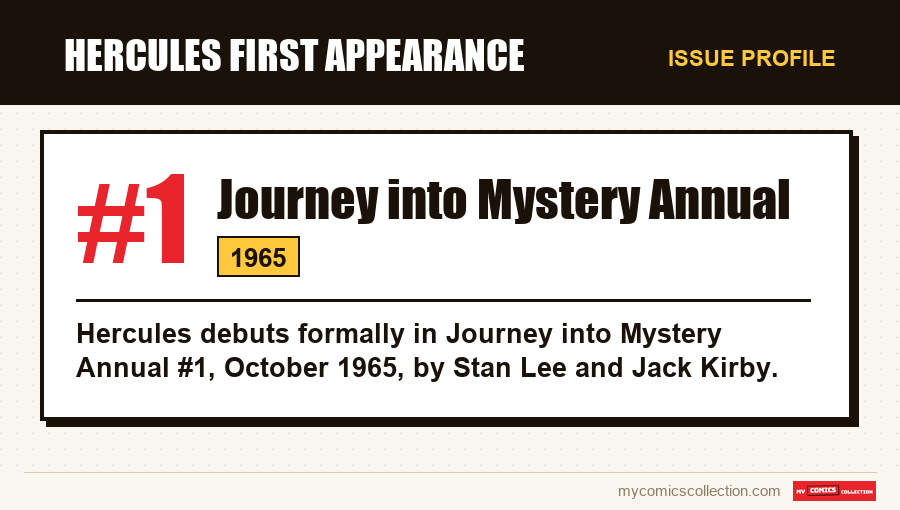
Hercules, the Olympian demigod of Marvel's line, makes his formal entrance in Journey into Mystery Annual #1, an oversized book cover dated October 1965 that Stan Lee wrote and Jack Kirby drew. It features Thor, who crashes through a mystical barrier into Olympus, the home of the Greek gods, and the issue establishes Hercules as Thor's rival. An earlier cameo in The Avengers #10 (November 1964) was later revealed to be an impostor, which is why collectors treat the annual as the true debut.
The demigod has two debut candidates in the Silver Age, and they are not equal. One is a team book from 1964 starring a figure who turned out to be someone else. The other is an oversized Thor annual that introduces the demigod properly. This guide is about that annual as an object: its date, its creators, how it differs from the cameo, and what to inspect on a copy.
Before writing, the October 1965 date, the Lee and Kirby credit, the Avengers #10 cameo and its later explanation, the two reprint volumes and the later appearances were each checked; condition and filing advice is analysis, and amounts are left out because sales move constantly.
The identity of the issue: an annual, not a monthly
Journey into Mystery Annual #1 is dated 1965, and the October 1965 date is the one given for the character's first formal Marvel Universe appearance. It is an oversized annual publication featuring Thor, which means it sits outside the monthly numbering of Journey into Mystery. That alone causes misfiles: the annual has its own number one, and a collector who sorts strictly by monthly issue number will not find it between #111 and #120.
The creators are Stan Lee, the writer, and Jack Kirby, the artist. They are the pair credited with adapting the demigod from the Greek hero Heracles for the Marvel line. Inker, colorist and letterer are best read off the indicia of the copy in hand, since a wrong name travels from one listing to the next.
The book belongs to a series with a clear timeline. Thor's own debut came in Journey into Mystery #83, August 1962, from Stan Lee, Larry Lieber and Jack Kirby. The "Tales of Asgard" backup feature began in #97, dated October 1963, so the annual arrives while Lee and Kirby were building Thor's mythological world issue by issue.
The series itself ended its first run under that title with #125, dated February 1966, and continued as The Mighty Thor on the cover and Thor in the indicia, keeping the numbering. The annual is dated before that change, so it belongs to the Journey into Mystery period and should be filed with it, not with the later Thor annuals.
How Hercules is introduced
The annual is a Thor story first, and Hercules is the guest who gives it its point. The plot sets Thor crashing into Olympus, the home of the Greco-Roman gods, and Thor later encounters Hercules there. From that setup, the demigod is introduced as a rival of the thunder god, a challenger rather than a conventional villain.
That framing explains much of what follows. A rival who comes from a different pantheon allows the writers to stage contests that are about pride more than about villainy. It also lets the book work as a crossover between two mythologies on the same page.
Nothing beyond that needs to be retold here. The point for a collector is the role: Hercules arrives as a challenger from outside Asgard, and the annual is the book that sets that relationship. Later stories take the idea further, turning rival into ally, but the annual is where the rivalry begins.
The Avengers #10 cameo and why it does not count as the debut
The confusion starts with The Avengers #10, dated November 1964. In that issue, the modern version of the character appears as a minion of Immortus. Years later, the miniseries Avengers Forever, published in 1998 and 1999, revealed that this figure was an impostor, a Space Phantom in disguise.
That later explanation is why the annual is treated as the real debut. The figure in The Avengers #10 is not the character who goes on to appear in Thor's book and then in the Avengers' own, so a collector who wants Hercules rather than a disguise points to the annual. The 1964 team book remains collectible for completists of the modern version, and it predates the annual by almost a year.
A useful way to log this in a collection is to keep two fields. One records the earliest appearance of the modern version, The Avengers #10, with a note that the figure was later revealed to be an impostor. The other records the first formal appearance, Journey into Mystery Annual #1. With both fields, a listing that uses either phrase can be matched at once.
There are also earlier figures called Hercules in much older books from the publisher's early years, and they are not the same character. In U.S.A. Comics #7, dated March 1943, a Hercules figure appears in shadow behind a window, giving powers to Martin Burns, who becomes Marvel Boy. In Young Allies #16, dated May 1945, Tommy Tyme travels to the time of Hercules and watches his battle with Antaeus. Neither belongs to the Lee and Kirby character, and a listing that calls them a "first appearance" is describing something different from the 1965 annual.
Why the issue matters to collectors
The annual's weight comes from the character's reach. After 1965, Hercules became a recurring figure across Marvel's line, and the annual is where that began. In The Mighty Thor #126, dated March 1966, he becomes a regular guest star. In Tales to Astonish #79, dated May 1966, he fights the Hulk. In The Avengers #38, dated March 1967, he teams up with the Avengers without yet being a member, and in #45 he becomes a full-fledged Avenger.
The character then carried his own books. The Champions ran from October 1975 to January 1978 and lasted 17 issues, with Hercules among its stars. In 1982 Bob Layton handled both script and art on Hercules, Prince of Power #1 to #4, starring a 24th century version of the character in an alternate universe, and the series was followed by a sequel in 1984. Greg Pak and Fred Van Lente wrote The Incredible Hercules from 2008 to 2010, relaunched as Prince of Power in 2010, and a series titled Herc followed in 2011.
That list is the case for the annual in one paragraph. A character who headlines books across five decades has an audience that keeps arriving, and each new reader eventually asks where it started. The 1965 annual answers that question with a clear Lee and Kirby credit, which is a strong pairing for any shelf built around Silver Age Marvel.
The annual is also part of the Thor story. Collectors who follow the thunder god can read it alongside the guide to the debut issue of 1962, and the Silver Age key issues guide places the annual among the other books that shaped the character in the 1960s. Together they show how a single mythological idea grew into a cast.
Do you collect this series?
Track what you own, what you are missing and what your collection is worth. 7-day trial.
Start my trial →
Reprints, collected editions and commonly confused books
The annual has been reprinted in collected form. Marvel Masterworks: The Mighty Thor volume 3, published in 2001, collects Journey into Mystery #111 to #120 together with Journey into Mystery Annual #1. Essential Thor volume 2, from 2005, also includes the annual. Both are ways to read the story without handling the original, and both belong in a collection log as separate entries from the periodical.
The commonest confusion is with Thor #126. Dated March 1966, that issue is the book where the demigod becomes a regular guest star in The Mighty Thor. It is a famous Hercules issue, but it is not his debut, and the issue has its own guide on this site. A collector who wants the debut needs the annual, and one who wants the start of his run as a guest star needs #126.
A second confusion concerns the later Thor annuals. Because the series was renamed after #125, annuals from the 1960s can look alike on a shelf, with similar cover design and similar oversized format. Checking the cover date and the title in the indicia is the quickest way to separate the 1965 annual from its neighbors.
A third confusion is with modern books that carry the character's name. The 2008 to 2010 Incredible Hercules series and the 1982 miniseries tell very different stories from the annual, and a listing for a collected edition of either does not describe the Lee and Kirby debut. The 24th century setting of the Layton miniseries is the clearest sign that it belongs to a separate thread.
What to check before buying a copy
Begin with identification. Confirm that the book is Journey into Mystery Annual #1, that the date is 1965, and that the cover and indicia agree. Because annuals are oversized, check the dimensions against what you expect and be wary of a listing that cannot confirm the title page. A reprint volume is a different object and is described by its own title and publication year.
Then examine the spine and staples. An annual of this age is a thicker book than a monthly, which puts more strain on the binding and the staples. Look for staple rust, loosening at the centerfold, stress lines and splits along the spine. Ask for a photograph of the interior at the centerfold and of the back cover, because damage often hides there.
Inspect the corners and edges for blunting, chipping and tears, and check the cover surface for creases that show only in raking light. Review the interior pages for tanning and brittleness, comparing the paper tone with the cover. Even page tone and a secure cover are good signs; a bright cover over dark pages deserves a question.
Restoration needs to be settled before purchase. Color touch, spine repair, tear sealing, cleaning and replaced staples can all change a book without changing its number. For an encapsulated annual, the label carries the restoration status, so read it first. For a raw copy, ask the seller directly whether any work was done, and treat a vague reply as meaningful. Verify the label's number against the cover, then confirm the serial with the grading company.
Finally, decide what you are buying for. A copy you plan to read can accept wear that a long term shelf copy cannot. A sound method is to fix the grade you want, compare several recent sales of that exact grade from different sellers, and discard single outliers in either direction. That keeps the decision tied to evidence and away from excitement.
The apparitions that follow, in a sensible order
If you want to follow the character from the annual, take the books in the order the character grew. Start with The Mighty Thor #126 from March 1966 for the rivalry at full strength, then Tales to Astonish #79 from May 1966 for the fight with the Hulk. Continue with The Avengers #38 from March 1967 for the team up and #45 for the moment he joins the team.
From the Silver Age books you can move to Layton's 1982 miniseries for the 24th century version, and to the Pak and Van Lente series for the longest sustained take. The best Hercules comics guide ranks those reads for someone who wants a reading order rather than a debut.
The Avengers years deserve their own mention. In The Avengers #270 to #277, from 1986 to 1987, the "Avengers Under Siege" story brings the Masters of Evil into play, and in #281 to #285 in 1987 the "Assault on Olympus" story ends with Hercules leaving the team. For an Avengers collector, these runs show how the character's role changed over two decades. The Avengers annuals and specials guide covers the team's oversized books.
A tidy log keeps all this manageable. Record title, number, cover date and creators as separate fields, add a field for the role of the character in the issue, and note whether the copy is a periodical or a collected edition. With those fields, the cameo, the debut and the later guest roles stay clearly apart.
Frequently asked questions
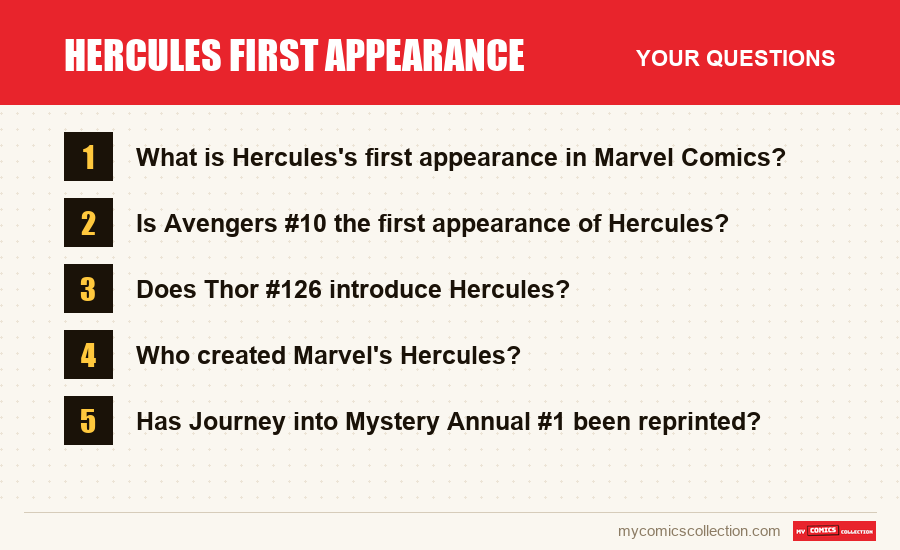
His first formal Marvel Universe appearance is Journey into Mystery Annual #1, dated October 1965, by Stan Lee and Jack Kirby. It establishes him as a rival of Thor. An earlier cameo in The Avengers #10 turned out to be an impostor.
In The Avengers #10, dated November 1964, the modern version of the character appears as a minion of Immortus. The miniseries Avengers Forever, from 1998 and 1999, later revealed this figure to be a Space Phantom impostor, so collectors treat the annual as the real debut.
No. The Mighty Thor #126, dated March 1966, is the issue where he becomes a regular guest star in the title. His formal debut came earlier, in the 1965 annual, and the earlier cameo in The Avengers #10 predates both.
Stan Lee and Jack Kirby created the Marvel version, adapting the Greek hero Heracles. The character debuted formally in the 1965 annual, which Lee wrote and Kirby drew. The thunder god they pitted him against had started out in Journey into Mystery #83, August 1962.
Yes. Marvel Masterworks: The Mighty Thor volume 3, published in 2001, collects Journey into Mystery #111 to #120 along with the annual. Essential Thor volume 2, from 2005, also includes it. Both are reprints, not the original 1965 periodical.
Holding a copy of Journey into Mystery Annual #1 from 1965 and unsure of its grade? Run it through a free valuation.
Estimate my comic