In short
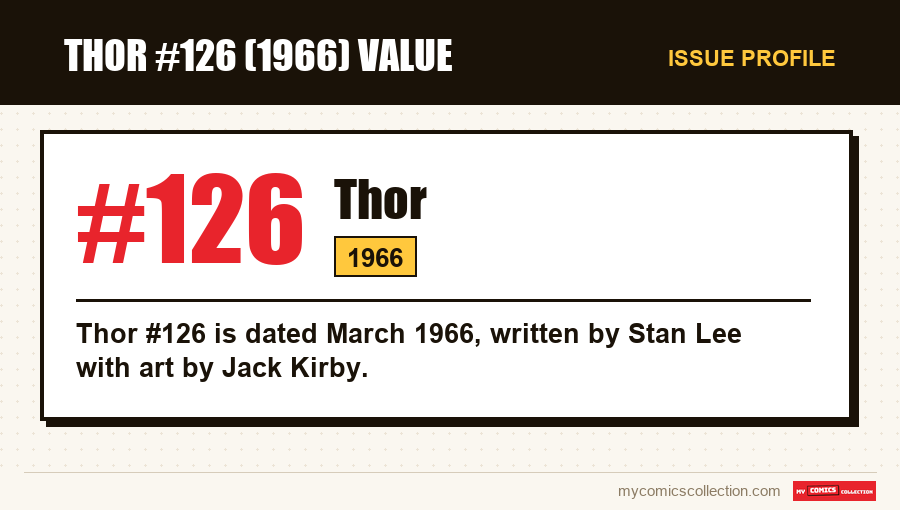
Thor #126 carries a March 1966 cover date. It is the issue where Journey into Mystery, which ended with #125, continued under the title Thor, keeping its numbering. Stan Lee wrote it and Jack Kirby drew it; on the Kirby and Vince Colletta cover, the thunder god trades blows with Hercules. It is not a first appearance: Thor debuted in Journey into Mystery #83 in 1962. Grade and completeness, rather than a debut, set the value of one copy against another.
Few numbers in Marvel's Silver Age confuse as many buyers as #126 of this series. Searches for "Journey into Mystery #126" lead nowhere, because that book does not exist, and searches for "Thor #126" lead to a cover with a thunder god being thrashed by a rival. The issue sits on a seam in the publication record, and a careful collector needs to know exactly where the seam falls before looking at a single copy.
Before writing, the March 1966 date, the credit line and the end of the old series at #125 were each checked; the sections on condition and the market are analysis. It quotes no amounts. Prices change with every auction; the method for reading them does not.
Where the numbering changes hands
Journey into Mystery ran through issue #125. The next issue was cover dated March 1966, numbered #126, and its indicia gives the title as Thor. Most of its covers carry the logo The Mighty Thor, which had become the dominant cover logo with #104 in May 1964. Marvel filed a trademark for the longer title in 1967, and the registration followed in 1970.
The result is a book with two names at once. The indicia, the small legal line inside the book, calls it Thor. The cover calls it The Mighty Thor. Catalogs and grading labels follow the indicia, so a collector who searches for "Mighty Thor #126" can miss results that file the issue under the shorter name. Searching under both is the safe habit, and noting the cover date of March 1966 removes any doubt.
That continuity is why the issue is described as the first one titled Thor and not as a first issue. No numbering restart took place. Volume one went on from #126 to #502, a run of 377 issues, and picked up 18 annuals along the way, so the new title simply inherited the count. A reader who sees "#1" and "#126" in the same conversation about this character is looking at two different series with two different logic.
A practical way to record the book in a personal inventory is to write three fields: title as printed in the indicia (Thor), title as shown on the cover (The Mighty Thor), and the March 1966 cover date. With those three fields, the issue can be found again whether a future listing uses the short name, the long name or only the date. It also keeps #126 from being filed beside a #126 of some other series that merely shares the number.
Credits for the issue
The writer is Stan Lee, who is credited as the writer of this series from #126 through #192. The art is by Jack Kirby. The cover, showing Thor in a fight with Hercules, is credited to Kirby and Vince Colletta, and Colletta is one of the inkers of the first volume.
That crediting fits the larger arc of the run. Lee had taken over the writing of the feature with Journey into Mystery #97 in 1963, and Kirby became its regular artist beginning with #101 in 1964. The partnership lasted until Thor #179 in August 1970, which closes the Lee and Kirby era. Neal Adams then penciled #180 and #181, dated September and October 1970, and John Buscema became the regular penciler after that, drawing the book almost continuously until #278 in December 1978. Collectors who want to see the Kirby years in context can read the Thor key artists guide, and the Stan Lee author page covers the writer.
Colorists and letterers are not named here. Anyone who needs those names should read them off the indicia of the copy on the desk.
What the issue shows: a god, a rival and a father's punishment
The issue opens an extended storyline in which Hercules guest-stars and defeats Thor. The defeat is not a simple matter of strength: Thor is being punished by Odin for loving the mortal woman Jane Foster, so the fight with the Olympian doubles as a family quarrel in Asgard. The conflict does not resolve inside one issue, and a reader who wants it complete has to keep reading.
That setup also changed the cast. With the renaming, Hercules became a major character in the book, and from #126 he turned into a regular guest star. A reader picking up the issue therefore meets not only a rival but a figure who would keep returning to the series.
The cover is the reason the issue is remembered. A figure who normally dominates every fight is shown in a struggle with an equal, on the cover of the character's first self-titled issue. A collector can judge the cover on its own terms as an example of Kirby's staging, and the best Thor covers guide places it among the others.
Hercules and the question of firsts
Collectors sometimes assume that an issue with a famous guest on the cover must be that guest's debut. It is not so here. Marvel's Hercules appeared in The Avengers #10, dated November 1964, as a minion of Immortus, a figure later revealed to be a Space Phantom in disguise. His first formal appearance in the Marvel Universe came in Journey into Mystery Annual #1 in October 1965, an issue that established him as a rival of Thor. Stan Lee and Jack Kirby adapted the character from the Greek god Heracles. Thor #126 followed in March 1966, and it is the issue from which Hercules became a regular guest star in the series.
So the labels to use are "Hercules cover" or "Hercules guest-star issue," not "first Hercules." Using the wrong label in a catalog invites a dispute with the next person who reads it. Keeping the three entries separate, the impostor, the annual and #126, also helps when a collector later chooses which of them belongs in a themed set.
The same caution applies to Thor himself. The thunder god's own entrance happened in Journey into Mystery #83 (August 1962), where Lee plotted, Lieber scripted and Kirby drew. Thor #126 is the first issue to carry the new title and nothing more than that on the question of firsts. The difference matters because a debut trades on a story moment, and an issue like #126 trades on its place in the run, its cover and the physical copy.
Do you collect this series?
Track what you own, what you are missing and what your collection is worth. 7-day trial.
Start my trial →
Why #126 is still a book collectors want
There are three honest reasons. The first is structural: the issue is the doorway to the long run that followed, and anyone assembling Silver Age Thor from the Lee and Kirby period needs it in sequence. The second is graphic: the Hercules cover is a recognizable image. The third is narrative: the Hercules storyline begins here and runs on beyond it, so a reader who wants the conflict complete needs the issues that follow as well.
What the issue does not offer is a first appearance, a death, or a lasting change in the character's status. Those belong elsewhere in the run. Placing #126 correctly means placing it as an important entry in a series, which for many collectors is exactly what they are looking for. The first-series analysis explains how the whole run from #126 to #502 divides into eras, and why the Lee and Kirby stretch holds a particular place in it.
Inspecting a copy of the Hercules issue
Once the identity is clear, go through the book the same way each time. Begin with the March 1966 date and the indicia reading Thor; a different date means a different issue.
- The deep colors of the cover. The Kirby and Colletta scene of Thor facing Hercules relies on dark and saturated areas, where creases and scuffs show up under a raking lamp.
- The spine and staples. Look for color breaks at the fold and for rust or moisture marks around the wire. Wire that looks newer than the paper suggests a repair.
- Corners and edges. Blunting and fraying hurt eye appeal long before a grade drops.
- Interior paper. Browning is expected in a 1966 book. Crumbling margins are not, and they limit any grader.
- Completeness. Check that every story page is present, including the closing pages of the Hercules chapter.
Ask the seller for photographs of all four edges and both covers, with the same questions put to every seller. Precise answers that match the images are a good sign.
Certification, restoration and the logic of comparison
On a certified copy, label color is the first signal: blue for an unrestored universal grade, yellow for a signature series copy, purple for disclosed restoration. Why that color moves the market is spelled out in the purple label guide.
Raw books deserve blunt questions. Has the cover been cleaned? Has color been touched up? Has the spine been reinforced? A Thor #126 that looks sharper than its asking price implies should raise suspicion. The Thor fakes and reprints guide covers identification, and the first print versus reprint guide explains why original printings sit in a class of their own.
To choose between two copies, set grade beside photographs: is the numerical gap visible in the images, and does either book carry restoration? A cleaner copy one step lower can be the better purchase than a higher number with a flaw you can see from across the room.
Reading sold listings works best as a comparison of spread. Collect several results in one grade band for March 1966 copies. If they cluster closely, the grade explains the price; if they scatter, the condition notes and images are doing the work, and those are the details to study.
Issues that follow in the run
Collectors who own #126 usually ask which later books belong beside it. Four entries, all checked against the series record, make a sensible start.
- Thor #134 (November 1966): the High Evolutionary makes his first full appearance, a Lee and Kirby creation first mentioned a month earlier in #133 (October 1966).
- Thor #179 (August 1970): the last issue of the Lee and Kirby run.
- Thor #180 and #181: Neal Adams pencils the two issues that follow the Kirby era.
- The Mighty Thor #337 (November 1983): Simonson becomes writer and artist with this issue, and his tenure on the book is where Beta Ray Bill comes in. See the Thor #337 guide.
Choosing among them is a matter of purpose. A reader building the Hercules storyline needs the books around #126, a student of the Kirby years needs the run up to #179, and a collector of modern firsts looks to #337.
Frequently asked questions
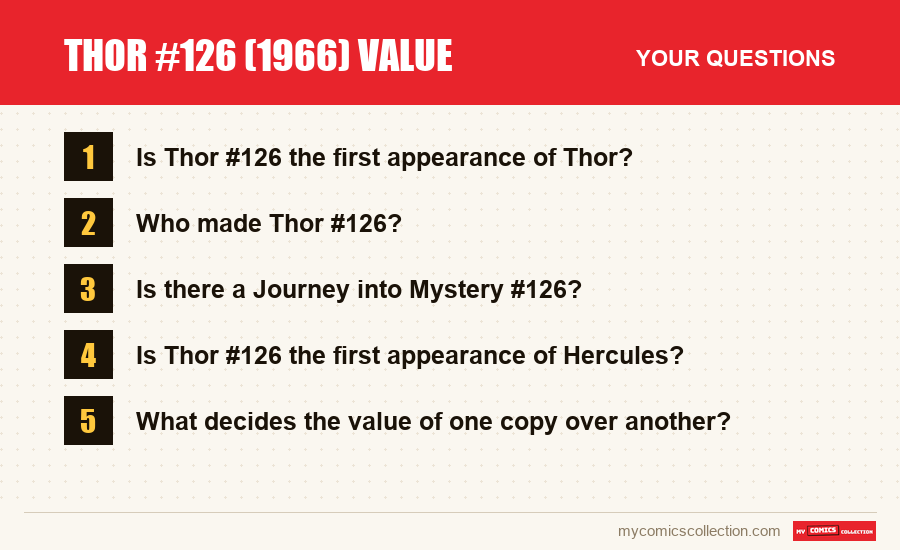
No. His debut was Journey into Mystery #83, dated August 1962. Thor #126 is dated March 1966 and is the first issue under the title Thor, continuing the numbering of Journey into Mystery, which ended with #125.
Stan Lee scripted the issue and Jack Kirby drew it. The cover, with Thor fighting Hercules, is credited to Kirby and Vince Colletta. The issue opens an extended Hercules storyline that runs beyond #126.
No. The original Journey into Mystery series ended with #125. The next issue kept the numbering but changed the title to Thor, so #126 is filed under that name in the indicia, even though most covers show the logo The Mighty Thor.
No. Hercules appeared as a minion of Immortus in The Avengers #10 (November 1964), later revealed as an impostor, and his first formal Marvel Universe appearance was Journey into Mystery Annual #1 (October 1965). Thor #126 is the issue from which he became a regular guest star in the series.
Grade, restoration, completeness and eye appeal. Confirm the March 1966 date, inspect spine, staples, corners, paper and cover, and read the label color on certified copies. Compare sold listings in the same grade band and read the spread between them rather than a single sale.
Holding a copy of Thor #126 and unsure how it compares? Describe its condition and get a grounded estimate.
Estimate my comic