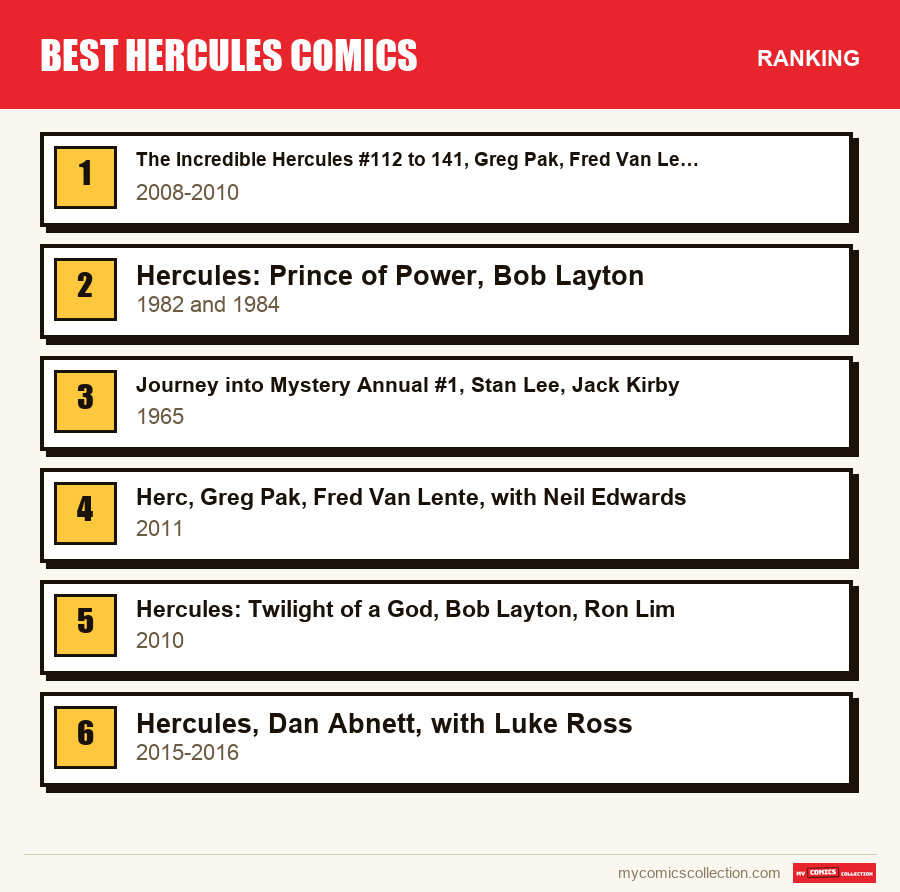
To read the best Hercules comics at Marvel, start with Greg Pak and Fred Van Lente's The Incredible Hercules (2008-2010), the most complete way in, then go back to Bob Layton's Hercules: Prince of Power (1982). Save Journey into Mystery Annual #1 (1965), by Stan Lee and Jack Kirby, for the origin read. Round it out with Herc (2011) and Hercules (2015). Six ranked reads.
Few Marvel characters swing as fast from barroom brawl to epic: Hercules debuted facing Thor's hammer, then headlined several series in very different tones. This guide covers only the Marvel character, not the mythological figure or any other books that share the name. It ranks six reads where he is front and center, and tells you how to order them.
As always in this guide, we only state verified facts (creators, issue numbers, dates); the analysis is our own, with no reproduction of protected art or dialogue.
His first appearance
The first appearance of Marvel's Hercules is Journey into Mystery Annual #1, dated 1965. The lead story, When Titans Clash, is credited to Stan Lee and Jack Kirby; Kirby draws the cover and the story, and Vince Colletta inks the lead story. Thor wanders into Olympus by accident, meets the demigod, and the two fight almost to the last page. Zeus, the demigod's father, also plays a part.
For anyone hunting the original copy, a practical detail: the annual is made up largely of reprints of older Thor stories, and the new story fills only about fifteen pages. It is an issue you buy for that story, not for the reading volume it offers. The story has since been reprinted, so you can read it without tracking down the single issue. The parent series of the period is mapped out in our page on key Thor issues from the Silver Age.
1: The Incredible Hercules #112 to 141, Greg Pak, Fred Van Lente, with several artists (2008-2010)
This series picks up the numbering of The Incredible Hulk, whose issue #112 opens the first arc before the title changes at issue #113. Greg Pak and Fred Van Lente write all thirty issues; the art is shared, with Khoi Pham on the early issues, then Reilly Brown, Rafa Sandoval, Clayton Henry, Rodney Buchemi and others. It follows on from World War Hulk: coming out of that event, Hercules and the young genius Amadeus Cho find themselves outlaws.
The structure helps the reading. The arcs run in sequence: Against the World (#112 to 115), Secret Invasion (#116 to 120), Love and War (#121 to 125), Dark Reign (#126 to 131), then The Mighty Thorcules (#132 to 137), where Hercules takes Thor's place while the series returns to Amadeus Cho's origin, before Assault on New Olympus (#138 to 141). The series mixes present-day action with trips back to the Greek myths.
What this series delivers: a version of Hercules who is both funny and endearing, and a duo, with Amadeus Cho, that holds up for the whole run. Who it is for: anyone looking for a complete way in, from first page to last. How to read it: in order, in trade paperbacks, keeping the key issues of Planet Hulk and World War Hulk close at hand, since it carries on their fallout, along with the Hulk reading guide.
2: Hercules: Prince of Power, Bob Layton (1982 and 1984)
This first miniseries, four issues running September to December 1982, is among Marvel's earliest limited series. Bob Layton writes and draws it. The story is set in the 24th century, outside current continuity: Zeus banishes Hercules into space, where his adventures turn comic, with Apollo's chariot pulled by horses faster than light, a Rigellian Recorder he corrupts through sheer mischief, and a showdown with Galactus for a finale.
A four-issue sequel appeared in 1984, again by Bob Layton: it adds Skyppi, a shy Skrull, and a darker thread around Zeus. A 1988 graphic novel, Full Circle, extends the vein. Both miniseries are gathered in a single collection.
What this story delivers: a festive Hercules, a warrior who treats the galaxy as one big tavern. Who it is for: fans of short 1980s stories, even without any Marvel background. How to read it: on its own, as a parenthesis, since its futuristic setting does not connect to the 2008 series. If Galactus intrigues you, the Galactus reading guide helps you place him.
3: Journey into Mystery Annual #1, Stan Lee, Jack Kirby (1965)
This is the origin story, brief and nervy. About fifteen pages, under the title When Titans Clash, for a meeting that turns into a fight. It sets up the rivalry between Thor and Hercules, which would later become a friendship: what pits the two men against each other in this story has less to do with hatred than with pride.
What this story delivers: the character's DNA, a proud, loud demigod who treats a brawl as a form of politeness. Who it is for: Silver Age Thor readers and collectors, for whom it is an essential reference. How to read it: in a collection that reprints the lead story, with the Thor reading guide at hand if needed. It reads in a few minutes, but it is best read before the modern series, since those constantly play with the memory of this fight.
If you want to understand why Jack Kirby matters so much to this corner of the Marvel universe, the page devoted to the creator details his work.
4: Herc, Greg Pak, Fred Van Lente, with Neil Edwards (2011)
The 2011 series reunites Greg Pak and Fred Van Lente, with Neil Edwards on art for the first issues. The complete collection, Herc: The Complete Series, gathers the ten issues and a #6.1. The hero fights here stripped of his powers, armed with the weapons of mythology.
What this story delivers: Pak and Van Lente's Hercules in a shorter format that reads in one go. Who it is for: readers who finished The Incredible Hercules and want to know what comes next. How to read it: after the 2008 series, in a trade paperback. It also works as a side read for anyone following the Fear Itself event.
Do you collect this series?
Track what you own, what you are missing and what your collection is worth. 7-day trial.
Start my trial →
5: Hercules: Twilight of a God, Bob Layton, Ron Lim (2010)
Four issues, published in 2010, with Bob Layton on script and Ron Lim on art. Layton brings his hero to a distant future, seventy-five years after the first miniseries. Hercules is mentally diminished, his three grandchildren enter the picture, a plot targets the government of his son Arimathes, and a black hole tied to Galactus threatens the galaxy, with a new Silver Surfer in the mix. The story closes on Hercules's sacrifice.
What this story delivers: a grave counterpoint to the 1982 tone, in Layton's own vein. Who it is for: those who read Layton in 1982 and want to know where he takes his hero. How to read it: after Prince of Power and Full Circle, which it assumes you know. It would lose a lot if read first. To place Galactus, see our reading guide to the character.
6: Hercules, Dan Abnett, with Luke Ross (2015-2016)
Six issues, the first of which came out in November 2015 under the All-New, All-Different Marvel banner; the 2016 collection is titled Still Going Strong. Dan Abnett writes; Luke Ross draws most of the series.
What this story delivers: a Hercules relaunched for Marvel's All-New, All-Different wave. Who it is for: anyone discovering Hercules through publishing news who wants a short series with no debt to the past. How to read it: on its own, with no prerequisites. It sits at the bottom of the ranking because it is less memorable than the others, not because it is hard to approach.
Where to start based on your profile
You want a complete, lively series: take The Incredible Hercules, in trade paperbacks, in arc order. You like cosmic comedy: read the 1982 Prince of Power, then the 1984 sequel. You are after the origin story: Journey into Mystery Annual #1, in a collection. You want a short, contemporary read: the 2015 Hercules. You enjoyed Prince of Power: keep going through to Twilight of a God.
If you collect single issues, start with the recent series, which are easier to find in good condition, then work back toward the 1980s. The 1965 annual is a different pursuit: you choose it copy by copy, looking at condition and printing. To place each title relative to the Avengers, with whom Hercules has been close, the Avengers reading guide gives you the map.
One last tip applies to every profile: alternate tones. From one series to the next Hercules moves from farce to tragedy, and reading two very different periods back to back helps you see what stays constant in him, his love of a challenge and his loyalty to his companions. Keep a record of your reading path so you know where to pick up again.
Key issues to know
This checklist tells you what to look for, not what to pay. For a 1965 annual as for a 1982 single issue, only look at completed sales for that exact issue, at a comparable grade.
- Journey into Mystery Annual #1 (1965): first appearance of Marvel's Hercules, by Stan Lee and Jack Kirby; the benchmark key issue.
- Hercules #1 (September 1982): start of Bob Layton's miniseries, one of Marvel's earliest limited series.
- The Incredible Hulk #112: the chapter that opens the Pak and Van Lente series before the title change on the next issue.
- The Incredible Hercules #113: the first issue carrying the new title, with Khoi Pham on art.
- The Incredible Hercules #138 to 141: the final arc, Assault on New Olympus.
- Herc #1 (2011): opening of the series by Pak, Van Lente and Neil Edwards.
- Hercules: Twilight of a God #1 (2010): start of the four-issue sequel by Bob Layton and Ron Lim, set in a distant future.
To set these titles alongside the Thor series, open our page on key Thor issues.
Frequently asked questions
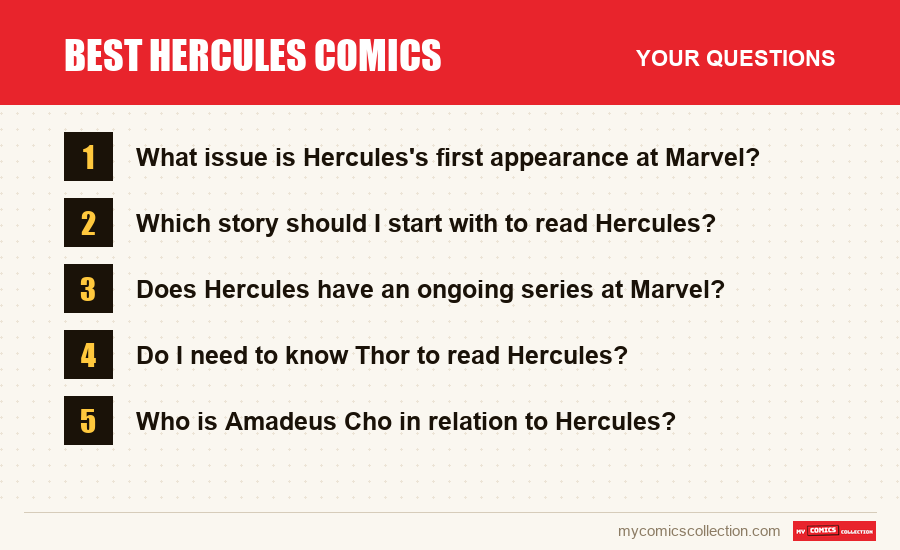
Marvel's Hercules appears in Journey into Mystery Annual #1, dated 1965, by Stan Lee and Jack Kirby. Zeus appears too. The lead story, When Titans Clash, pits Thor against the demigod after an accidental trip to Olympus.
Start with Greg Pak and Fred Van Lente's The Incredible Hercules (2008-2010), which works as a complete series. For a lighter, shorter tone, take Bob Layton's Hercules: Prince of Power (1982). For the origin, keep the 1965 annual.
He has had several series, but of varying lengths. The longest in this selection is The Incredible Hercules, which runs from issue #112 to issue #141 by picking up the numbering of The Incredible Hulk. The others are miniseries or short series, like Herc (2011) or Hercules (2015).
Not for most of the series: The Incredible Hercules and Bob Layton's miniseries read with no prerequisites. The 1965 annual, however, is as much a Thor story as a Hercules one, and its echoes come back in the modern series, where the god of thunder regularly crosses paths with the demigod.
Amadeus Cho is the young genius who tags along with Hercules in The Incredible Hercules (2008-2010). The two end up outlaws coming out of World War Hulk. Amadeus Cho's origin is told in the arc covering issues #132 to 137.
Do you own a Journey into Mystery Annual #1 or an issue of The Incredible Hercules? Get it appraised by comparing its condition to sales that actually closed.
Appraise my comic