
In short
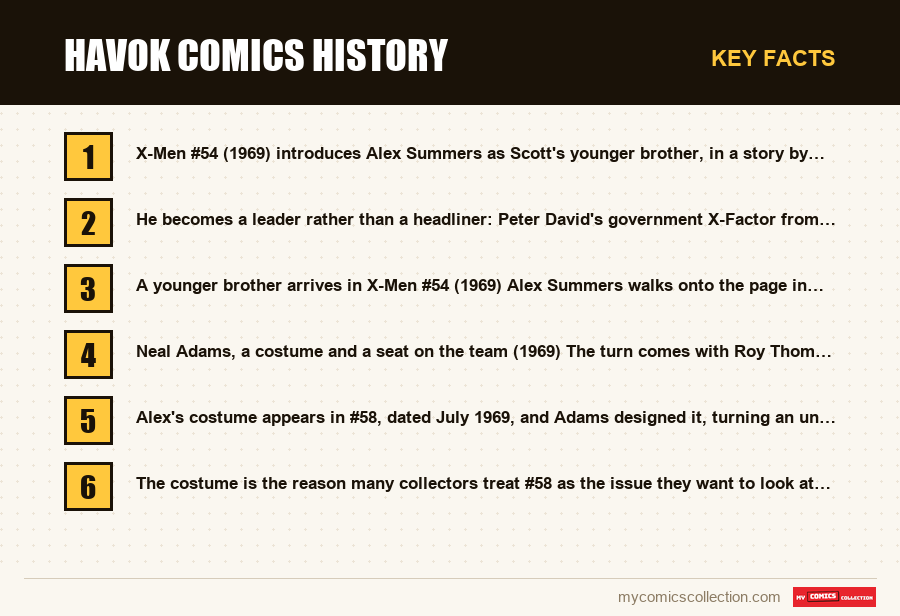
X-Men #54 (1969) introduces Alex Summers as Scott's younger brother, in a story by Arnold Drake and Don Heck, and Neal Adams designs his costume for #58. He becomes a leader rather than a headliner: Peter David's government X-Factor from #71 (1991), the alternate-universe Mutant X (1998), the Vulcan storyline that began in Deadly Genesis (2006), and Rick Remender's Uncanny Avengers (2012), where Captain America asks him to lead the team.
Havok is a character who spent decades defined by someone else's shadow, and that is exactly why his bibliography rewards a chronological read. He has rarely carried a long solo series, so his arc is scattered across team books, miniseries and crossovers, and each of them answers the same question from a different angle: what does a man do when his surname already belongs to a famous brother?
Alex's cover dates, issue ranges and credits were each confirmed before they went into the sections below; what those changes do to him is our reading. No art or dialogue is reproduced.
A younger brother arrives in X-Men #54 (1969)
Alex Summers walks onto the page in X-Men #54, dated March 1969, created by writer Arnold Drake and artist Don Heck. The premise is as simple as a premise can be: he is the younger brother of Scott Summers, the X-Man known as Cyclops. Nothing about the debut announces a future team leader. It announces a family tie, and later writers would use that tie for more than half a century.
That family tie matters for how the character was built. Alex is introduced as someone things happen to, and the pay-off is held back for a few issues: the costume and the membership both arrive within the same year as the debut.
Neal Adams, a costume and a seat on the team (1969)
The turn comes with Roy Thomas and Neal Adams, whose stretch on X-Men gives Alex both a look and a love story. Alex's costume appears in #58, dated July 1969, and Adams designed it, turning an unstable power into something visual. The costume is the reason many collectors treat #58 as the issue they want to look at, while #54 remains the issue they hunt as the debut.
Alex joins the team in #65, dated December 1969. The same Thomas and Adams stretch is where Alex's romance with Lorna Dane begins. Lorna, later Polaris, would become the most durable relationship in the character's life, and it starts in the same handful of issues that dress him as Havok. For this reason the three numbers #54, #58 and #65 are best read as one short arc: arrival, costume, membership.
What changes for the character is the shift from supporting brother to active member, a teammate whose power is a weapon and a risk at once.
Leaving the team, a villain's mask and a long wait (1975 to 1990)
Havok and Polaris belong to the older roster that the new cast of Giant-Size X-Men #1 (1975) displaces. Alex exits the team in X-Men #94, and in the Chris Claremont era that follows he is a background name.
He does come back in a form nobody wanted. In X-Men #97 he appears under the mental control of Erik the Red, and he is restored to normal only in #119 (1979). Twenty-two issues separate control from release, and the pattern is worth noticing: Alex is repeatedly a person whose agency is taken from him.
For a collector, the numbers worth tracking in this era are the minor ones: #94 for his exit, #97 for the control, #119 for the release.
X-Factor and Peter David's government team (1991 to 1998)
X-Factor began in 1986 with the five original X-Men posing as a mutant-hunting business, and its first volume launches with Bob Layton and Jackson Guice credited as creators of the 1980s team. The Havok chapter starts later. With issue #71, dated October 1991, a new government-sponsored team debuts, created by Peter David with Larry Stroman, and the roster includes Havok, Polaris, Multiple Man, Quicksilver, Strong Guy, Valerie Cooper and Wolfsbane. Alex serves as the team's leader.
The detail that trips collectors up is numbering. This is not a relaunch with a new first issue: the 1991 team simply continues the existing series, so Havok's X-Factor starts at #71 and runs through #149 in 1998. Anyone shopping for the stretch should look for issue numbers in that range rather than a volume two, and the team's tone, a Pentagon-backed squad with Lorna beside Alex, is a deliberate contrast to the family drama of the X-Men proper.
For the character, this is a long-form view of Havok as an adult, leading a team beside Polaris. For the wider run of the title, see the best X-Factor runs.
Mutant X and a leader in another universe (1998 to 2001)
When X-Factor wraps, Havok is placed at the center of Mutant X, written by Howard Mackie with Andrew Pepoy inking and a rotating group of pencillers; Tom Raney is also credited as a creator. It ran from 1998 to 2001 across 32 issues plus three annuals, and it began as a planned twelve-issue limited series before sales extended it.
The premise sends Alex into a parallel reality. After a time-machine explosion his spirit takes over the body of his counterpart in that universe, an alternate Havok who has just died. He wakes as the leader of a team called The Six, married to Madelyne Pryor and father of a boy named Scotty. Scotty recognizes that Havok is telling the truth about who he is, and Alex eventually chooses to stay and take his counterpart's place.
The reading advice is to treat Mutant X as a parenthesis. It offers a family that the mainstream version of Alex does not have, and it is a long series built on a supporting character.
Do you collect this series?
Track what you own, what you are missing and what your collection is worth. 7-day trial.
Start my trial →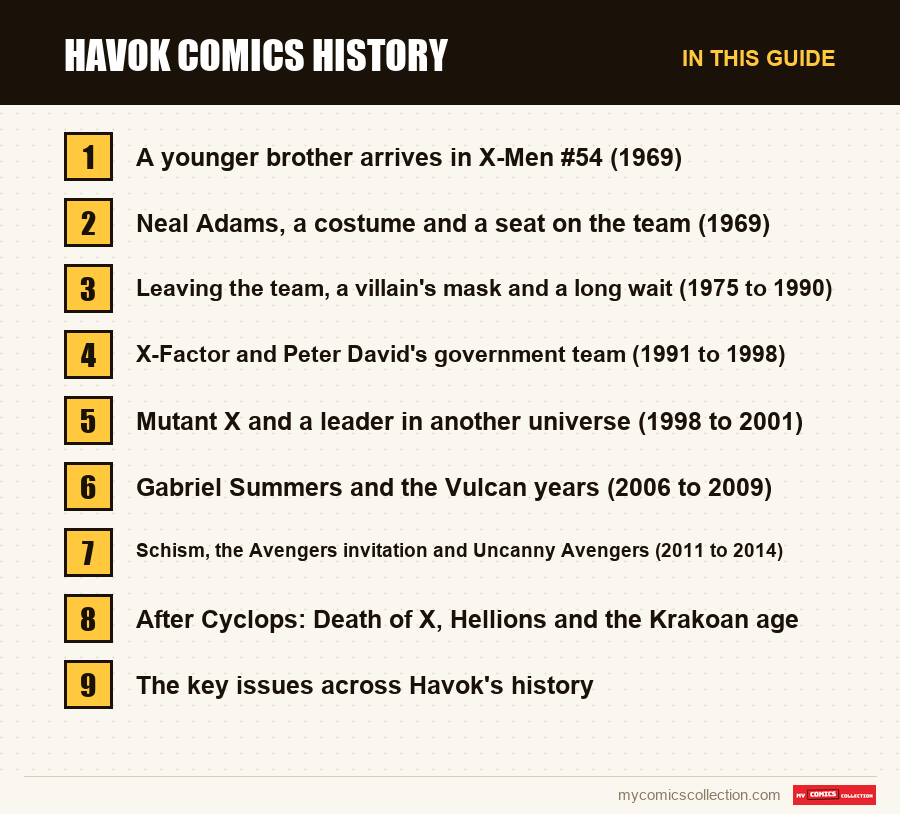
Gabriel Summers and the Vulcan years (2006 to 2009)
Before the Vulcan story, the Polaris relationship goes through a cycle of rupture. Malice, a Marauder, possesses Lorna, which temporarily ends the pairing, and after Decimation she loses her powers and leaves the X-Men. A wedding is later planned, and during the ceremony Alex stops the proceedings and calls off the marriage. Those beats show Alex choosing a person over the team.
Then the family story widens. X-Men: Deadly Genesis, written by Ed Brubaker with artist Trevor Hairsine, ran from January to July 2006, and issue #1 introduces Vulcan, Gabriel Summers, another Summers brother. Vulcan later renounces Cyclops as a brother and, at one point, cannot absorb a powerful blast from Havok, which leaves Vulcan wounded.
The conflict continues in space. Christopher Yost took over the story for X-Men: Emperor Vulcan, which ran from November 2007 to March 2008, and he followed it with Kingbreaker, which sets up Vulcan's part in War of Kings. In the Shi'ar storyline Vulcan kills their father, Corsair, and blasts Havok into a sun. Havok, Polaris and others then form a new team of Starjammers to defeat Vulcan and salvage the Shi'ar empire. Vulcan was seemingly killed in War of Kings and later reappears in the Dawn of X period with no memory of his emperor years.
For the character, the Vulcan years turn a pair of brothers into three, and Alex becomes the brother who has to face the damage.
Schism, the Avengers invitation and Uncanny Avengers (2011 to 2014)
Havok's next change of side comes with X-Men: Schism, the split that divides the mutants between Wolverine and Cyclops. Havok and Polaris join Wolverine's side rather than his own brother's, and in X-Men: Regenesis Lorna's wish to distance herself from her father, Magneto, is part of the choice.
Then comes the role most readers now associate with him. In Uncanny Avengers (2012), it is Captain America who hands Alex a new Avengers team to lead; Rick Remender writes, and the art passes between John Cassaday, Daniel Acuña and Steve McNiven. The first volume ran 25 issues plus an annual, published from 2012 to 2014, and its first storyline sets Red Skull, revealed to be a clone of the original created in 1942, against the team. The Apocalypse Twins then convince the Scarlet Witch that only she can save the mutant race from extinction, and the "Ragnarok Now" arc ends with Wanda killed and Wonder Man sacrificing himself to channel her final spell.
Havok later resigns from the team and rejoins the X-Men, in AXIS #3. For the character this is the high-water mark: he leads a team that includes Avengers, and his surname is no longer the reason. Our guide to the Avengers vs. X-Men reading order covers the event that sits just before it.
After Cyclops: Death of X, Hellions and the Krakoan age
The last chapter is shaped by the loss of his brother. In the Death of X period, Scott dies, and Havok and Emma Frost are seen watching his funeral from afar. Emma later shows Alex his brother's body, a moment that leaves the younger Summers facing the loss without a team between them.
In the Krakoan age, Alex joins the Hellions, a loose group of outcast mutants operating under Mister Sinister. Elsewhere in the same period, he spends time with his family at the Summer House on the Moon.
He has been the brother, the replacement, the exile, the leader and the mourner, and in the Hellions he works under Mister Sinister, a long way from the March 1969 debut.
The key issues across Havok's history
- X-Men #54 (1969): Alex Summers's debut, by Arnold Drake and Don Heck.
- X-Men #58 (1969): his costume appears, designed by Neal Adams.
- X-Men #65 (1969): Alex joins the team, during the Thomas and Adams stretch.
- X-Men #94 (1975): Alex quits the group as the new cast takes over.
- X-Factor #71 (1991): the Peter David government team debuts with Havok as leader.
- Mutant X #1 (1998): Howard Mackie's alternate-universe series begins.
- X-Men: Deadly Genesis #1 (2006): Vulcan, Gabriel Summers, is introduced by Ed Brubaker and Trevor Hairsine.
- Uncanny Avengers #1 (2012): Rick Remender's series puts Havok in charge of the Avengers Unity Squad.
How to follow Havok in your collection
Because Havok has few runs under his own name, the best method is to build by team and era rather than by character. Start with the Uncanny Avengers first volume (25 issues and an annual), then add X-Factor from #71 to #149. Keep three clusters in your inventory: the Adams-era trio of X-Men #54, #58 and #65, the 1990s X-Factor numbers, and the modern leadership books.
Watch the numbering traps. X-Factor in 1991 continues from #71, so a search for a first issue of that team leads nowhere. Uncanny Avengers has four volumes, from 2012, 2015, 2015 to 2018 and 2023, so match volume as well as number. Mutant X runs 32 issues with three annuals, so a complete run is within easy reach. For a deeper where-to-start path, see our guide to the best Havok comics.
Frequently asked questions
The issue to find is #54 of March 1969, the Drake and Heck story where Alex appears as the younger brother of Scott Summers. The costume follows in #58, and he becomes a member in #65.
Neal Adams designed it, and it debuts in X-Men #58, dated July 1969, during the Roy Thomas and Adams stretch on the series. The same pair introduced his romance with Polaris, and Alex joins the team in #65, dated December 1969.
The new government-sponsored team debuts in X-Factor #71, dated October 1991, and Havok is its leader. It was created by Peter David and Larry Stroman and also includes Polaris, Multiple Man, Quicksilver, Strong Guy, Valerie Cooper and Wolfsbane. His run continues through #149 in 1998.
Vulcan is Gabriel Summers, a brother of Cyclops and Havok, introduced in X-Men: Deadly Genesis #1 in January 2006 by Ed Brubaker and Trevor Hairsine. Christopher Yost later wrote his Emperor Vulcan story, and Havok leads the Starjammers against him in the Shi'ar storyline.
Yes. The first volume of Uncanny Avengers, written by Rick Remender, runs 25 issues plus an annual from 2012 to 2014, and it puts Alex in charge of a team at Captain America's request. It is the most direct portrait of him as a leader, and it reads without years of prior history.
Found an X-Men #54 or an Uncanny Avengers #1 in your boxes and wondering what to do with it? Get an estimate before you decide.
Estimate my comic