
To find the best Havok comics (Alex Summers), start with Uncanny Avengers #1 to #25 (2012-2014), written by Rick Remender, where he leads a team, then read X-Factor (1991) by Peter David, where he lives with Polaris. Go back to X-Men #54 (March 1969), his first appearance by Arnold Drake and Don Heck, and then to #56 to #65 by Roy Thomas and Neal Adams, where his costume and his place on the team are set.
Havok is Cyclops' younger brother, and that is precisely what makes his stories hard to shelve: sometimes a replacement, sometimes a leader, sometimes exiled to another reality, he has few series under his own name, and the best reads are moments where he takes the lead in a team title. Here are the ones that truly put him at the center, with what they add to him, who they are for and how to open them.
As always in this guide, only verified facts (creators, issue numbers, dates) are stated as fact; the analysis is our own, with no reproduction of protected pages or dialogue.
His first appearance
Alex Summers debuts in X-Men #54, dated March 1969, an issue scripted by Arnold Drake and drawn by Don Heck. He is introduced as the younger brother of Scott Summers, and the interest of the single issue lies in that simple family tie, which later writers would use for more than fifty years.
His costume appears a few months later, in X-Men #58, dated July 1969. It was designed by Neal Adams, who had settled onto the series from #56 of May 1969. Alex then joins the team in #65, in 1970. For your collection, keep three distinct issues in mind: #54 for the birth, #58 for the costume, #65 for the entry into the team. #54 is the one you hunt as the first appearance; #58 is the one you love to look at.
A word on his powers, because they steer the reading: Alex absorbs energy and releases it as blasts, which makes him a weapon as much as a danger to his teammates. Successive writers have often played on this ambivalence, and it is what gives tension to stories as far apart as Uncanny Avengers and Kingbreaker.
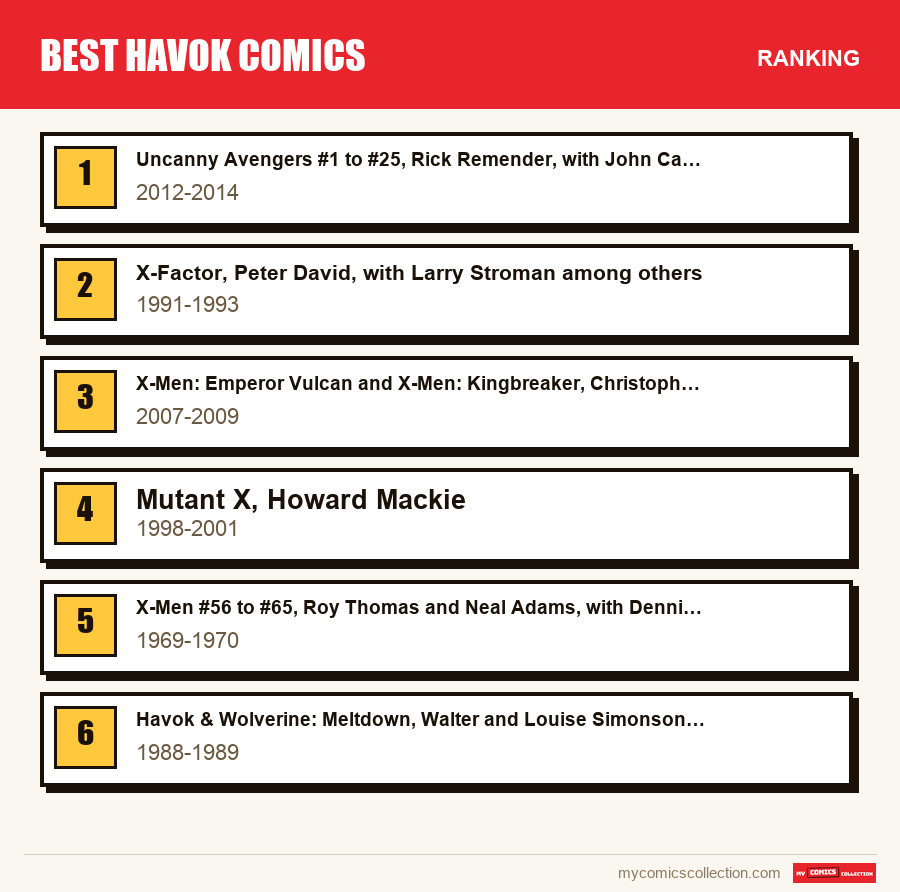
1: Uncanny Avengers #1 to #25, Rick Remender, with John Cassaday, Daniel Acuña and Steve McNiven (2012-2014)
This is the read that makes Havok a front-line character. The premise is set from #1: Captain America asks Alex Summers to lead the new team of Avengers and X-Men, a team that mixes Avengers and mutants. Rick Remender writes the whole series; John Cassaday draws #1, with John Dell on inks, while Daniel Acuña and Steve McNiven take other issues. The series runs twenty-five issues and one annual.
What the series gives Havok is a command post and the doubt that comes with it. He wonders whether he is worthy of the place he was given, and he leaves the team during AXIS #3 to rejoin the X-Men. The thread of the stakes unfolds in two big movements: The Red Shadow (#1 to #5), where the Red Skull takes over Professor Xavier's brain, then The Apocalypse Twins (#6 to #11, with annual 8AU), where Thor faces Apocalypse in the year 1013 before Kang seizes Jarnbjorn.
It is for the reader who wants to see Havok on the front line. How to read it: in order, from #1 to #25, without the tie-ins, keeping in mind that the team pitch is the series' reason for being. If Remender's writing appeals to you, the page Rick Remender: where to start places this series within his body of work.
2: X-Factor, Peter David, with Larry Stroman among others (1991-1993)
In 1991, X-Factor is relaunched as a government team, with Havok and Polaris on the roster alongside Multiple Man and Strong Guy; Peter David writes the series and Larry Stroman is a standout artist. Alex is a full teammate there, far from his older brother's shadow, and that status gives the series its tone.
What this series adds is the couple. Havok and Polaris, together since the days of Roy Thomas and Neal Adams, are treated at an adult level, with the bumps that implies. The series is for the reader who likes humor, offbeat teams and relationships that last. How to read it: from the 1991 relaunch, without trying to connect it to the 1986 X-Factor, whose roster is different. The page on the best X-Factor runs details the whole picture.
3: X-Men: Emperor Vulcan and X-Men: Kingbreaker, Christopher Yost (2007-2009)
These two miniseries carry the Summers family into space. X-Men: Emperor Vulcan (five issues, November 2007 to March 2008) is written by Christopher Yost and drawn by Paco Díaz; Vulcan, the youngest of the Summers brothers, has seized the Shi'ar throne, and Havok forms a new team of Starjammers to stop him, with Rachel, Polaris, Korvus, Ch'od and Raza. Vulcan ends up capturing him.
X-Men: Kingbreaker (four issues, 2008-2009) is written by Christopher Yost, with Dustin Weaver and then Paco Díaz on art. In #4, Vulcan fails to absorb a blast from Havok, whose powers then exceed their usual level. These two stories give Alex the role of expedition leader, very far from the team life of X-Factor.
They are for those who love space opera. How to read them: in publication order, Emperor Vulcan first; you can ignore the rest of the Shi'ar saga. If the family story interests you, the page on Cyclops' origin carries it further.
4: Mutant X, Howard Mackie (1998-2001)
Published from 1998 to 2001, Mutant X runs thirty-two issues and three annuals; Howard Mackie writes it, with several artists, and Tom Raney is among the creators. The series was meant to be a twelve-issue miniseries and turned into a regular series in the face of sales.
The starting point is unusual: Havok dies in an explosion, but his mind passes into the body of his double from a parallel reality, dead at the same instant. He wakes up in the Mutant X universe, where he leads The Six, a team of mutants, is married to Madelyne Pryor and is the father of Scotty Summers. In this world, Scott was taken by the Shi'ar along with his parents and only Alex escaped, which makes him the leader of the mutants. He first tries to get home, then takes his double's place.
It is for readers who like alternate realities and want to see Alex in the role that is usually his brother's. How to read it: from #1 to #32, without expecting any link to the main continuity.
Do you collect this series?
Track what you own, what you are missing and what your collection is worth. 7-day trial.
Start my trial →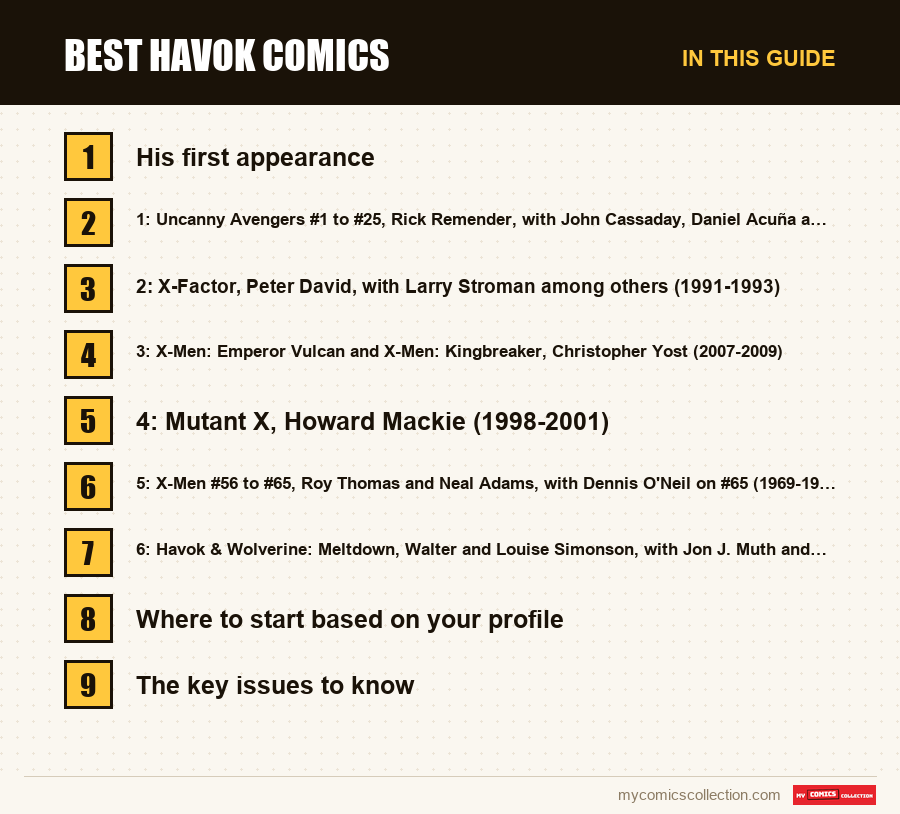
5: X-Men #56 to #65, Roy Thomas and Neal Adams, with Dennis O'Neil on #65 (1969-1970)
Roy Thomas writes and Neal Adams draws the issues that follow Alex's first appearance. Adams begins on #56 of May 1969, with Tom Palmer on inks; he draws Havok's costume in #58 and plots #65, scripted with Dennis O'Neil, his last work on the series. In this period, the code name Havok and the romance with Polaris take shape.
What opens up here is the foundation of everything that follows, and it is a Silver Age read, with its pace and its conventions. It is for the collector of the period and the reader who wants to see where the costume and the couple come from. The series stops with #66 of March 1970 before its revival. How to read it: continuously, after the previous entries, because the style is older. Neal Adams' work is detailed on the dedicated hub.
6: Havok & Wolverine: Meltdown, Walter and Louise Simonson, with Jon J. Muth and Kent Williams (1988-1989)
This four-issue miniseries appears under Marvel's Epic imprint. The Simonsons write it; Jon J. Muth paints Havok and Kent Williams paints Wolverine, which gives the whole an art-book look. Havok and Wolverine head to Mexico and get caught up in a dangerous affair where Alex disappears and Wolverine decides to find him.
It is for fans of beautiful objects more than readers of stories. How to read it: on its own, like a four-part one-shot. The Wolverine hub places it among the rest of his adventures.
Where to start based on your profile
You are discovering the character. Open Uncanny Avengers #1, then read straight through to #25. You will find Alex in a leadership position, with a tension that stands on its own without prior reading.
You like couple stories. Go straight to X-Factor with Peter David, then read the best Polaris comics, where the same couple is seen from the other side.
You like family sagas. Chain Emperor Vulcan and Kingbreaker. The Summers family is Captain Christopher Summers, alias Corsair, an Air Force officer turned test pilot, Katherine Anne, Scott the eldest, Alex and Gabriel the youngest. The Cyclops reading guide completes the picture.
You want something strange. Mutant X is made for you, to be read as a parenthesis.
You collect debuts. Look for X-Men #54, #58 and #65, then compare offers by relying on condition and completed sales rather than listings. To place the whole series, the X-Men reading guide will save you detours.
The key issues to know
These landmarks rest on creators and dates, not on a price guide figure.
- X-Men #54 (March 1969). His first appearance, by Arnold Drake and Don Heck.
- X-Men #58 (July 1969). His costume, drawn by Neal Adams.
- X-Men #65 (1970). His entry into the team.
- X-Factor #71 (October 1991). The government relaunch, with Havok and Polaris in the cast.
- Mutant X #1 (1998). Havok at the head of a team in another reality.
- X-Men: Deadly Genesis #1 (January 2006). The appearance of Vulcan, his younger brother, by Ed Brubaker and Trevor Hairsine; Havok is not the central character of the miniseries.
- X-Men: Emperor Vulcan #1 (November 2007). The formation of the Starjammers led by Havok.
- Uncanny Avengers #1 (2012). The start of his command.
Another collecting landmark: these are team issues, not solo-series issues. Look for them for the scene or arc they contain, and check each artist's credit before paying more for one issue than another.
Shelving method: sort Havok by role rather than by date. A "Cyclops' brother" shelf (X-Men #54 to #65 and the two space miniseries), a "team leader" shelf (Uncanny Avengers and X-Factor) and a "variations" shelf (Mutant X and Meltdown). This avoids mixing up an issue where he is the engine of the plot with one where he is just a teammate among others.
Frequently asked questions
Alex Summers debuts in X-Men #54, dated March 1969, with a script by Arnold Drake and art by Don Heck. His costume, drawn by Neal Adams, appears in #58 of July 1969, and he joins the team in #65 in 1970.
To see him at the center, Uncanny Avengers #1 to #25, written by Rick Remender from 2012 to 2014, is the most accessible: he leads the team there. For his relationship with Polaris, it is X-Factor under Peter David's pen, relaunched in 1991.
Yes. Alex Summers is the younger brother of Scott, alias Cyclops, and the older brother of Gabriel, alias Vulcan. Their parents are Christopher Summers, alias Corsair, and Katherine Anne.
No, it is a parenthesis. Published from 1998 to 2001 and written by Howard Mackie, the series carries Alex to an alternate reality where he leads The Six and has a son. Read it on its own, after the main reads, as a variation on the character.
Yes, since the days of Roy Thomas and Neal Adams, in the late 1960s. They return together to the X-Men and side with Wolverine during Schism. For the Lorna Dane side of the reading, open the best Polaris comics.
Do you own an X-Men #54 or an issue from the Neal Adams era? Have it appraised before you shelve it.
Appraise my comic