
To read the best Polaris comics (Lorna Dane), start with X-Factor from #70 (1991), where Peter David places her alongside Havok, then go back to X-Men #49 to #52 (1968-1969), written by Arnold Drake, which holds her first appearance, with Magneto claiming to be her father. Round it out with Uncanny X-Men #249-250 (1989) and All-New X-Factor (2014-2015) to measure everything the character has gone through.
Polaris is Magneto's daughter and the heir to his magnetic powers, but her path is anything but a straight line: unstable, by turns ally and adversary of the X-Men, possessed, stripped of her powers and then restored, she has often been told through the men around her, Magneto on one side, Havok on the other. Here are the reads that truly put her at the center, in the order that helps you understand her, with what each one brings and when to open it.
As always in this guide, only verified information (creators, issue numbers, dates) is stated as fact; the analysis is our own, with no reproduction of protected artwork or dialogue.

Her first appearance
Lorna Dane debuts in X-Men #49, cover-dated October 1968. Arnold Drake writes the issue, Jim Steranko draws the following one; Mesmero, who appears in this same issue, uses a machine to draw mutants whose powers lie dormant toward San Francisco. Iceman finds the disoriented young woman and shelters her, before Mesmero and his Demi-Men go on the attack.
At this stage, she has neither a code name nor a costume. The name Polaris is only given to her in X-Men #97 (February 1976), while she acts under the control of Erik the Red. This detail matters for a collection: the birth issue and the naming issue are two distinct comics, and only the first fixes the date of origin.
On the collecting side, reading #49 goes with reading #50, drawn by Steranko, whose style is the visual argument of the arc. Issue #49 remains the one you hunt for the first appearance; #50 is the one that reveals what Lorna can do. The two complement each other, and that is the order in which to open them.
1: X-Men #49 to #52, Arnold Drake with Don Heck, Jim Steranko, and Werner Roth (1968-1969)
The arc spans four issues, all written by Arnold Drake. The artists change from one issue to the next: Don Heck and Werner Roth on #49 and #52, Jim Steranko alone on #50, Steranko with Werner Roth on #51. In #50, Mesmero awakens Lorna's magnetic powers and proclaims her queen of the mutants; the last page reveals that Magneto is still alive.
In #51, Magneto claims to be Lorna's father and demands her obedience. In #52, Iceman investigates and learns that her biological parents died in a plane crash, which frees her from that bond. Later, the Magneto of this arc will be presented as a robot, in X-Men #58, which reopens the question of her parentage, settled only in 2003. The rest is told by Roy Thomas and Neal Adams, who then set up the romance between Lorna and Alex Summers, a.k.a. Havok, a bond that will structure her entire trajectory.
Who should we recommend this read to? To Silver Age fans who want to see Lorna's beginnings and Steranko's staging in #50. It is not a comfortable entry point, since the story is dense and dated, but it reads on its own. Read it in the order of the four issues rather than in excerpts, because each episode overturns the previous one. To understand Magneto's role at that date, see his first appearance.
2: Uncanny X-Men #249-250, Chris Claremont and Marc Silvestri (1989)
Both issues are written by Chris Claremont and drawn by Marc Silvestri, with Dan Green on inks for #249 and Steve Leialoha on #250. Issue #249, "The Dane Curse," opens just as the X-Men have buried Storm: a call from Polaris draws them to Punta Arenas, Chile, and Havok answers her call. In #250, Zaladane takes her powers, which frees her from Malice, the Marauder who was inhabiting her.
Polaris is at the heart of the plot here, and she grows in size and strength during the power transfer. The two-parter has real unity: the first issue sets up the threat, the second resolves it and leaves Lorna transformed, which makes it a good weekend read. This read is for those who enjoy Claremont and the Silvestri period, as well as Uncanny X-Men fans who already know the team. Our page on Chris Claremont puts this period in perspective.
3: X-Factor #70 and following, Peter David and Larry Stroman (1991)
Peter David writes X-Factor from #70, with Larry Stroman on art. The series becomes a team attached to the American authorities, featuring Havok, Polaris, Quicksilver, Wolfsbane, Multiple Man, and Strong Guy. The cover of the October 1991 issue lists them. Polaris is reunited with Havok there, and their already long-standing relationship is picked up in a dry-humored tone that David masters.
She remains a member of the team until the end of the first series, with #149 in 1998. The reader finds Polaris in a stable setting, after years of possessions and imposed roles. If you only read one run to discover the character, this is the one that offers the most material, because David gives his characters time to talk.
This run also works as an entry point for a reader who knows Magneto: Lorna appears in an office and political context, far from the epic of the 1960s, and the contrast shows how much the character can change register without losing her identity. The cast also includes Quicksilver, which brings the series closer to Magneto's universe, which we discuss in our Magneto reading guide.
Who is it for? Readers who prefer team series to big events, and those who like sharp dialogue. See also our ranking of the X-Factor runs to place this period among the others.
4: X-Factor #243, Peter David and Leonard Kirk (2012)
Cover-dated November 2012, this issue belongs to the "Breaking Points" arc. Peter David writes it, Leonard Kirk draws it, Jay Leisten inks it. The issue revisits Lorna's origin and the plane crash that killed her adoptive parents: a flashback shows Magneto finding her alive in the wreckage, then having Mastermind alter her memories.
The interest lies in how David rereads decades of contradictory continuity. Some critics at the time judged the retcon late, but the issue remains a direct landmark for anyone who wants to understand the link between Lorna and Magneto. Since it sits in the middle of an arc, a reader discovering the series will do better to read it in a trade paperback rather than in isolation.
This read assumes you have read the previous picks. It is therefore for the reader who already knows the character's story and is looking for the missing piece of the puzzle.
Do you collect this series?
Track what you own, what you are missing and what your collection is worth. 7-day trial.
Start my trial →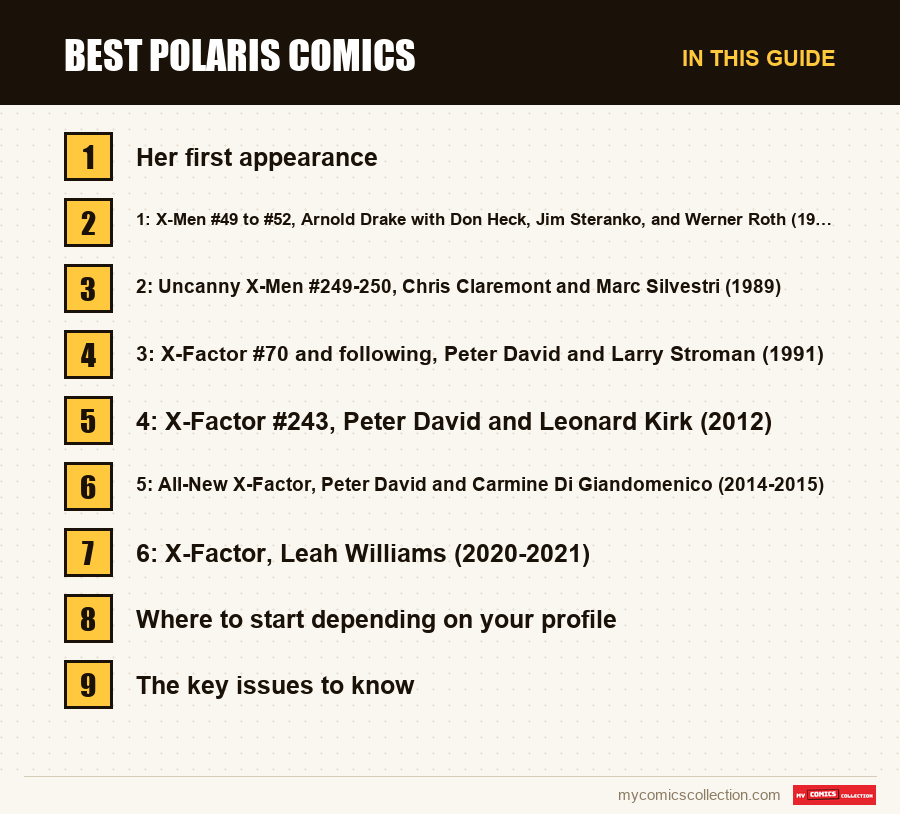
5: All-New X-Factor, Peter David and Carmine Di Giandomenico (2014-2015)
The series runs twenty issues, from March 2014 to March 2015. Peter David writes it, Carmine Di Giandomenico draws it. The concept: Serval Industries, a private company, buys the X-Factor name and funds a team featuring Polaris, Gambit, Quicksilver, Danger, Warlock, and Cypher. Polaris leads a corporate-funded team there, with Quicksilver at her side.
The series ends on an arc tied to the Axis event, and breaks down into three collected editions: "Not Brand X" (#1-6), "Change of Decay" (#7-12), and then "Axis" (#13-20). It is a lighter read than #243, suited to anyone who wants to see Lorna as a team leader, in a register close to that of the 1991 series, and it has the merit of reading in three collected editions.
6: X-Factor, Leah Williams (2020-2021)
Ten issues, from July 2020 to June 2021, written by Leah Williams, with several artists on the interior pages and David Baldeón on covers. In the Krakoa era, Northstar demands that the Five, the mutants who bring the dead back to life, resurrect his sister Aurora and puts together a team to get proof of it: Polaris helps him assemble it, without being its leader. The group also includes Rachel Summers, Prodigy, Daken, and Eye-Boy.
Once Aurora is brought back, the team investigates missing mutants. The series is for the reader already settled into the Krakoa era: it is poorly understood without House of X, and its quick ending leaves some plots hanging.
Where to start depending on your profile
If you are discovering Polaris, dive in with X-Factor from #70 (1991): Peter David and Larry Stroman show her within a team, alongside Havok, without requiring you to read the previous decades. If you prefer self-contained stories, take Uncanny X-Men #249-250, two issues that stand on their own.
Silver Age fans will read X-Men #49-52 first, then #58 to understand why the parentage with Magneto stays uncertain for decades. Modern readers who want the Krakoa era will go straight to the 2020 X-Factor, provided they have read House of X.
For a collector who wants to limit purchases, three landmarks are enough: X-Men #49, Uncanny X-Men #249, and X-Factor #70. They cover the character's birth, liberation, and stability.
The key issues to know
The first landmark is X-Men #49 (October 1968), her first appearance. Next come #50, where she discovers her powers, #51, where Magneto says he is her father, and #58, which reveals that this Magneto was a robot. X-Men #97 (February 1976) is the issue where she receives the name Polaris. Uncanny X-Men #249 and #250 (1989) make up her big moment of the Claremont period.
For the later periods, keep in mind X-Factor #70 and #71 (1991), where she joins Peter David's team, X-Factor #243 (November 2012), All-New X-Factor #1 (2014), and X-Factor #1 of 2020. In 2021, a public vote organized by the publisher picked Polaris to join the X-Men team, a sign of her lasting popularity.
The buying method is the same everywhere: tell apart the first appearance, the issue that changes the character, and the good read. For the issues of the 1960s, condition and the original printing make the difference; for more recent stories, a trade paperback is enough.
Frequently asked questions
In X-Men #49, cover-dated October 1968, written by Arnold Drake. Lorna Dane does not yet carry the name Polaris there, which she only receives in X-Men #97 (February 1976). The same issue also introduces Mesmero, which strengthens its appeal for collectors.
Yes, but the answer took decades to arrive. In X-Men #51 (1968), a Magneto claims to be her father; he will be revealed as a robot in #58. The parentage is only established in 2003, in Uncanny X-Men, through a DNA test.
Start with X-Factor from #70 (1991), by Peter David and Larry Stroman, where she is part of a stable team with Havok. If you prefer a self-contained story, Claremont and Silvestri's Uncanny X-Men #249-250 (1989) reads in two issues.
Polaris controls magnetism: she generates force fields, manipulates metal, and flies using magnetic fields. In Uncanny X-Men #250, the power transfer with Zaladane also gives her added size and strength, a secondary mutation.
She has mostly lived in team series: X-Factor in 1991, All-New X-Factor in 2014, then X-Factor in 2020, where she helps Northstar put the team together. Those series are where her main roles are found.
Do you own an issue featuring Polaris, from X-Men #49 to Uncanny X-Men #249? Estimate it before getting it graded or selling it.
Estimate my comic