
In short
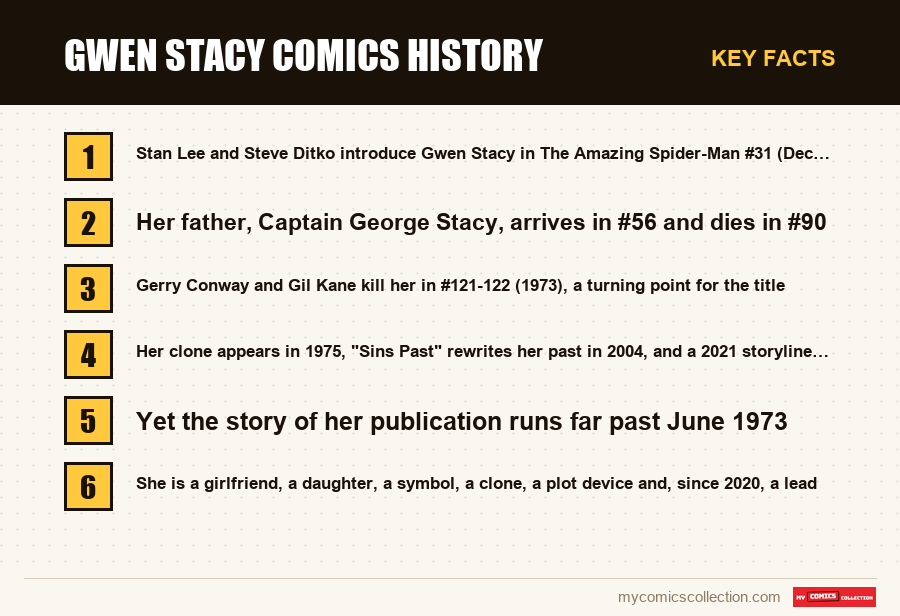
Stan Lee and Steve Ditko introduce Gwen Stacy in The Amazing Spider-Man #31 (December 1965) as Peter Parker's college sweetheart. Her father, Captain George Stacy, arrives in #56 and dies in #90. Gerry Conway and Gil Kane kill her in #121-122 (1973), a turning point for the title. Her clone appears in 1975, "Sins Past" rewrites her past in 2004, and a 2021 storyline undoes that rewrite. She has since led her own miniseries.
Few supporting characters are remembered mainly for how they left the page, and Gwen Stacy is the clearest case in Marvel's history. Yet the story of her publication runs far past June 1973. She is a girlfriend, a daughter, a symbol, a clone, a plot device and, since 2020, a lead. This timeline follows her through each of those states.
Every name, number and cover month in this timeline was read against the printed record of the 1965 to 2022 run, while the verdict on what each decade does to Gwen is our own interpretation. Nothing from the pages is quoted.
A classmate in 1965: the debut in The Amazing Spider-Man #31
Her opening scene falls in the December 1965 number, #31, which Lee scripts and Ditko draws for The Amazing Spider-Man. She is introduced as the primary love interest in Peter Parker's life at that point, which matters because it places her at the start of the series' college period rather than in the high school years that opened the book. Author pages for the creators: Stan Lee and Steve Ditko.
What the debut does for the character is modest. She enters as part of a new setting, a place where Peter is a student first and a masked hero second, and the book treats her as one of several people who make that setting feel different from the old neighborhood. There is no tragedy in the issue and no hint of one. The first chapter of her publication history is simply an introduction, and that is worth stating plainly because the later weight of the character can make the debut look heavier than it was.
Romita takes over the art and the Stacy family takes shape
Beginning with #39, John Romita Sr. replaced Ditko as the primary artist and also became a co-plotter on the series. The change in look and in storytelling affects every supporting character, and Gwen is no exception: the Romita years are when the book builds a larger cast around Peter and decides what each person is for. The John Romita Sr. page follows his career beyond this book.
The cast widens in these years, and the story of how Mary Jane Watson's place in it evolves belongs to the Mary Jane Watson comics history. And in #56, dated January 1968, Gwen's father, Captain George Stacy, appears. He gives Gwen a family with a stake in Spider-Man's world, since a police captain stands for the law in the same city as the hero.
This is the point at which Gwen stops being only a girlfriend and becomes a daughter. The distinction is the engine of what follows. A character with no family can leave a story without cost. A character whose father is a public figure in the same city can be hurt by the same events that hurt the hero, and the writers of the next few years use that hook.
The death of Captain Stacy and Gwen's departure for Europe
George Stacy's death arrives in #90 (1970): falling debris kills him while Spider-Man and Doctor Octopus fight. It sets in motion the first major change for Gwen: she blames Spider-Man.
The consequences run through several issues. Gwen leaves for Europe. She hopes Peter will ask her to marry him and stay, but his guilt about the death holds him back in #93. The relationship is rekindled once Gwen returns to New York, in #98. Looking only at the sequence, a modern reader can see how the title was starting to treat consequences as lasting: a death in one issue shapes the emotional map for the next eight.
June and July 1973: "The Night Gwen Stacy Died"
Issues #121 and #122, published in June and July 1973 under the title "The Night Gwen Stacy Died," are the center of the character's history. Gerry Conway wrote the story and Gil Kane penciled it. Romita, still penciling the book, first raised the idea of killing Peter's girlfriend during a plotting session with Conway, and Conway and editor Roy Thomas agreed; Conway found Mary Jane the more interesting of the two women. Romita's own comment on the decision, that they would really shake up the fans, is the clearest statement of the intention.
In the story, the Green Goblin, Norman Osborn, takes Gwen to a bridge and she falls from it. The Goblin's own end follows in the second chapter. A longer treatment of the issue itself is in the #121 death guide, and the sequel is covered in the #122 guide; the point to make here is where the story sits in her career. It is not the only chapter of her publication history, but it is the one that gives every later chapter its meaning. Every use of Gwen after June 1973 is a response to the fact that the series killed her.
The creative handover frames the period. Gerry Conway had taken over the book after Stan Lee, and the death is one of the clearest statements of what that era of the series intended to be: willing to end storylines that previous readers considered permanent. The legacy of that choice is why the issue is still read as a before-and-after line for the title.
For the character, the effect is to freeze her. Gwen is no longer someone the book can develop; she is someone it can remember. The stories that follow are of two kinds, those that look back at her and those that bring something of her back, and the remaining sections cover both.
1975: the clone and the first return
The first return comes in The Amazing Spider-Man #144, cover dated May 1975. Stan Lee, who had disliked the death, insisted that Conway bring Gwen back. Conway agreed on condition that he could write her out whenever he wanted. The result is a clone, created by the Jackal: healthy, but without any memory of her death. The clone leaves at the end of the storyline, with #149 cited for her departure.
The publication history here is more interesting than the plot. A character who had been killed to change the tone of a series is brought back within two years, at the request of the person who had created her, and the writer who killed her has to find a way to retract the retraction. Conway's condition, keeping control over when she would exit, is what protects the original decision. The clone is allowed to appear, but the story is arranged so that the original death still stands.
The 1980s and 1990s: virus, memory and clones
In 1988, during "The Evolutionary War," the High Evolutionary discovers that Miles Warren had not perfected cloning at all: the so-called clone was a young woman given a virus carrying Gwen's DNA. A 1995 retcon gives that woman a false life as Joyce Delaney. By then Gwen works as an echo, a face that unsettles Peter without ever returning.
In 1994 Marvel approaches her differently. Marvels #4 (April 1994), by Kurt Busiek and Alex Ross, retells her death through the photographer Phil Sheldon, and the outside perspective is the point: it frames the death as a public event in the Marvel universe, not only a private loss for Peter. That is a different use of the character from the clone stories, and it is closer to how her death is remembered by readers than the earlier retellings.
The same period brings the large clone storyline of 1994-1995. Within it, another Gwen clone appears in The Amazing Spider-Man #399 (March 1995) and dies of clone degeneration in Spider-Man #56, while Joyce returns, married to a Warren clone named Warren Miles, in Spider-Man #61 (August 1995). Following the thread across titles is a task of its own, and the clone saga key issues page handles it. For Gwen's own history, the point is that the 1990s turn her from a memory into a motif. She is a character the series can restage whenever it wants to question what is real about Peter's past.
Do you collect this series?
Track what you own, what you are missing and what your collection is worth. 7-day trial.
Start my trial →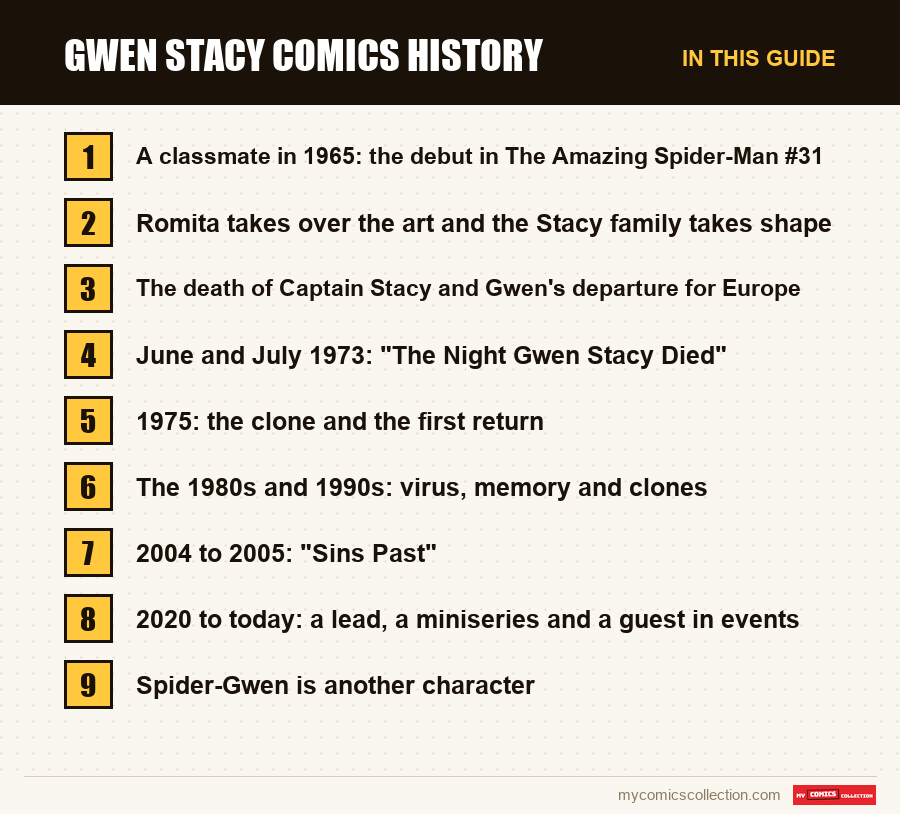
2004 to 2005: "Sins Past"
"Sins Past" ran through The Amazing Spider-Man #509 to #514, cover dated August 2004 to January 2005, written by J. Michael Straczynski. The story claims that Gwen had an affair with Norman Osborn and gave birth to twins, Sarah and Gabriel Stacy. Sarah is unmasked as one of the twins in #511 (October 2004), Mary Jane's knowledge of the secret comes out in #512 (November 2004), and Gabriel becomes the Gray Goblin in #514 (January 2005).
This is the most controversial chapter of her history, because it changes how she is remembered rather than how she is used. Everything before it adds events to her life, such as a trip to Europe, a death and a clone. This storyline adds a hidden past, and it does so about a character who by then had been dead for more than three decades. For a reader of the book, the choice raised the question of who owns the memory of a dead character, and the answer given by the book's later history is that the readers did not accept the change.
The reversal came in 2021, in Nick Spencer's run on The Amazing Spider-Man, during the "Sinister War" event. The retcon erases the affair: an A.I. backup of Harry Osborn reveals that Norman never fathered the twins, that Harry had hypnotized Norman and Mary Jane, and that Mendel Stromm created Sarah and Gabriel in a lab. In other words, "Sins Past" is a story that the series itself later disowned. For collectors, the practical consequence is that the six issues are a record of a debate, not a record of canon, and a collector of the Gwen thread decides whether that makes them essential or optional.
The related history of the Green Goblin identity is covered in the Green Goblin comics history, which is the best companion for the Osborn side of this story.
2020 to today: a lead, a miniseries and a guest in events
The most recent period gives Gwen her own book. The Gwen Stacy miniseries, by Christos Gage and Todd Nauck, began with #1 in February 2020, and it concluded with Giant-Size Gwen Stacy in 2022. The material was collected in 2024 as Gwen Stacy: Beyond Amazing.
She also appears in event stories. In A.X.E.: Judgment Day, the Progenitor briefly resurrects her for Peter, in The Amazing Spider-Man vol. 6 #10 (2022). The scene works as a nod to the long tradition of the series bringing her back for a moment and then letting her go, and it shows how the character is now used: as a reference point that gives an event its emotional edge.
Spider-Gwen is another character
A separate Gwen exists on another Earth: the spider-powered alternate version, introduced in 2014 in the Edge of Spider-Verse series and later given her own books. She is a different character, with a different history, and her publication path is told in the Spider-Gwen comics history and indexed on the Spider-Gwen hub. The mix-up is the most common error in searches for the main Gwen Stacy.
The key issues across her history
- The Amazing Spider-Man #31 (December 1965): the debut, by Stan Lee and Steve Ditko.
- The Amazing Spider-Man #56 (January 1968): Captain George Stacy appears, which gives Gwen a family.
- The Amazing Spider-Man #90 (1970): Captain Stacy dies during a fight with Doctor Octopus, and Gwen blames Spider-Man.
- The Amazing Spider-Man #121 (June 1973): the death story begins, by Gerry Conway and Gil Kane.
- The Amazing Spider-Man #122 (July 1973): the conclusion of "The Night Gwen Stacy Died."
- The Amazing Spider-Man #144 (May 1975): the Jackal's clone of Gwen, brought back at Stan Lee's request.
- Marvels #4 (April 1994): Kurt Busiek and Alex Ross retell her death through the photographer Phil Sheldon.
- The Amazing Spider-Man #509 (August 2004): "Sins Past" begins, written by J. Michael Straczynski.
How to follow Gwen Stacy in a collection
Follow her through The Amazing Spider-Man in publication order and separate the books that are about her from the books that merely carry her. Issues #31, #56, #90, #121 and #122 are the backbone, and #121-122 is a pair, so decide whether you want one chapter or both. The 2022 Judgment Day scene sits in volume 6 of the title, which is not the volume of the 1960s and 1970s books. Keep "Sins Past" apart as a block of six issues, and treat the main series and the alternate Gwen as two separate collecting projects.
Frequently asked questions
Her debut is The Amazing Spider-Man #31, dated December 1965. Stan Lee wrote the issue and Steve Ditko drew it. She is introduced as Peter Parker's primary love interest during his college years, and the debut is a quiet supporting appearance.
Her death is told in The Amazing Spider-Man #121 and #122, published in June and July 1973 under the title "The Night Gwen Stacy Died." Gerry Conway wrote the story and Gil Kane penciled it. The Green Goblin, Norman Osborn, is the character responsible for her death.
Only through copies and brief returns. A clone made by the Jackal appears in The Amazing Spider-Man #144 (May 1975) and leaves again, other clones appear in the 1994-1995 storyline, and the Progenitor briefly resurrects her in The Amazing Spider-Man vol. 6 #10 (2022).
"Sins Past" ran in The Amazing Spider-Man #509-514 (August 2004 to January 2005), written by J. Michael Straczynski. It claimed Gwen had an affair with Norman Osborn and twin children. Nick Spencer's 2021 "Sinister War" storyline undid that claim, so the story is no longer part of the accepted history.
No. Spider-Gwen is a separate, spider-powered version of Gwen from another Earth, introduced in 2014 in the Edge of Spider-Verse series. The main Gwen Stacy is the character who debuts in 1965 and dies in 1973. Their books, numbering and collecting paths are different.
If you hold any of the Gwen Stacy books from 1965 to 1975, a free valuation shows where your copies stand.
Estimate my comic