In short
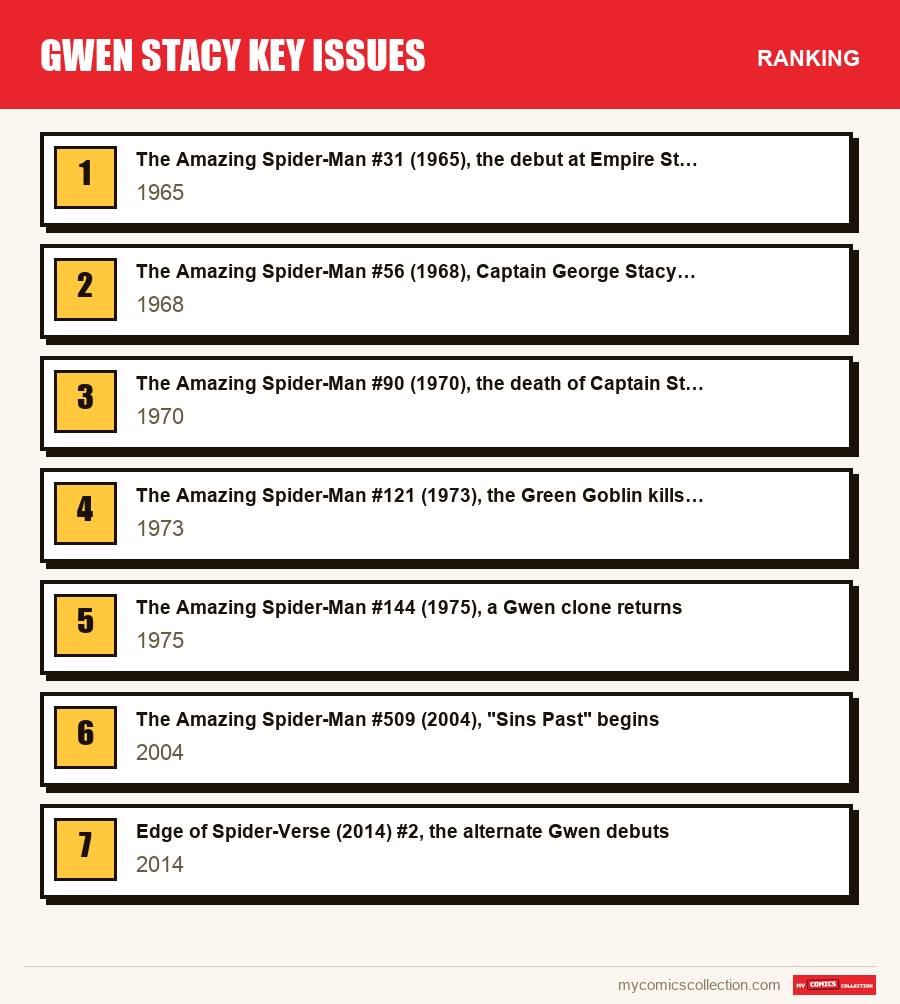
The Gwen Stacy key issues start with The Amazing Spider-Man #31 (December 1965), her debut by Stan Lee and Steve Ditko, and peak with #121 (June 1973), where Gerry Conway and Gil Kane tell her death. Between them sit the issue that introduces her father, the issue that kills him, and the clone story of 1975. Later picks include "Sins Past" (2004) and Edge of Spider-Verse #2 (2014) for the alternate Gwen.
Gwen Stacy is a character whose importance is split across five decades, which makes a key-issue list harder to rank than a list for a villain. Her debut is quiet, her death is among the most discussed events in the title, and several books that matter to her story are about other people. This guide ranks seven books in reading order and explains what each adds, who made it and what to check before you buy.
Each credit, cover date and plot point below comes from reference pages on the title and its cast. The ranking, the collecting order and the buying notes are analysis, offered as method rather than as a price forecast.
1: The Amazing Spider-Man #31 (1965), the debut at Empire State University
This December 1965 issue carries her debut, with Stan Lee scripting and Steve Ditko on art. Peter Parker starts college in the story, and Gwen appears among his new classmates alongside Harry Osborn. Professor Miles Warren also debuts here, and the Master Planner arc begins.
It ranks first for the simplest reason: nothing else in the list exists without it. It ranks below the death issue in demand because the debut is a quiet supporting appearance inside a bigger adventure story. The full breakdown, including the arc titles and reprint volumes, is in the dedicated guide to Amazing Spider-Man #31, so this entry stays brief.
What to know before buying: the book is a mid-1960s newsstand title, so check the spine, the staples and the cover for restoration. A graded copy needs its label read for restoration notes as well as the grade. For a lower-cost way into the story, the arc is available in collected editions, but verify the page range of the specific printing.
2: The Amazing Spider-Man #56 (1968), Captain George Stacy arrives
Gwen's father, NYPD Captain George Stacy, devised by Stan Lee and John Romita Sr., makes his entrance in #56, dated January 1968. Romita had taken over the art from Steve Ditko with #39, so this is a Lee and Romita era book.
The issue earns a place because it gives Gwen a family, and the family becomes the engine of everything that follows. Without a police father who respects Spider-Man, the later loss has no force. Collectors who think of the debut as the whole story miss that Gwen's emotional arc is built over a dozen issues, and #56 is the first brick.
Buying notes for #56: it introduces a supporting figure rather than Gwen herself, so expect lighter demand than for her debut. It is a sensible secondary pickup when you already own #31 and want the connective tissue. Check for the same defects as any book from the late 1960s: spine stress, cover gloss changes and tanned pages.
3: The Amazing Spider-Man #90 (1970), the death of Captain Stacy
Issue #90, cover dated November 1970, closes the story that begins in #89, the first Spider-Man storyline penciled by Gil Kane, with Stan Lee as writer. Caught in the wreckage of a Spider-Man and Doctor Octopus clash, Captain Stacy covers a child and dies under the collapsing concrete.
For Gwen, the consequence is the point. Holding Spider-Man to blame, Gwen moves to Europe in #93 and only comes back to New York in #98. The story sets up the guilt Peter carries and the distance between the two of them. It is also widely described as a turning point because it showed readers that permanent changes could happen in the series.
What to know before buying: #90 reads best with #89, so price the pair together before committing to one book. For a graded copy, check that the label names #90 and not the opening chapter, and on a raw copy read the indicia and the cover date before trusting a listing title.
4: The Amazing Spider-Man #121 (1973), the Green Goblin kills Gwen
Issue #121 (June 1973) opens "The Night Gwen Stacy Died": Gerry Conway scripted, Gil Kane penciled, John Romita Sr. and Tony Mortellaro inked, and Roy Thomas edited. The Green Goblin, Norman Osborn, kidnaps Gwen and throws her from a bridge, and the story concludes in issue #122 with the Goblin's apparent death. Romita is the one who proposed Gwen when the team discussed killing a member of the supporting cast.
This is the book most collectors mean when they say the Gwen Stacy key issue. It ends the long relationship story that began in #31, and it is remembered as a point where the series stopped being safe. Stan Lee was upset by the death afterward, which is part of the story's reputation.
What to know before buying: because this is the story most buyers ask about, it is where condition detail matters most. Inspect the spine and corners, ask about restoration, and decide whether you want #121 alone or the pair with #122. The dedicated death guide for #121 covers the story in more detail than this ranking can.
5: The Amazing Spider-Man #144 (1975), a Gwen clone returns
In May 1975, issue #144 shows a clone of Gwen, made by the Jackal. Gerry Conway wrote it, after Stan Lee asked him to bring Gwen back.
The issue matters for two reasons. It links Gwen to the Jackal storyline, which ties back to Miles Warren, a character who debuted in the very same issue as Gwen. And it opens the clone thread that the series revisited for decades, notably in the 1990s clone storyline covered in the Spider-Man clone saga key issues guide.
What to know before buying: this issue is sometimes confused with the later Jackal reveal issues, so confirm the number and the May 1975 date in the listing. Its demand is driven by the clone storyline more than by Gwen alone, so it appeals most to collectors building the clone thread as well as the Gwen thread.
Do you collect this series?
Track what you own, what you are missing and what your collection is worth. 7-day trial.
Start my trial →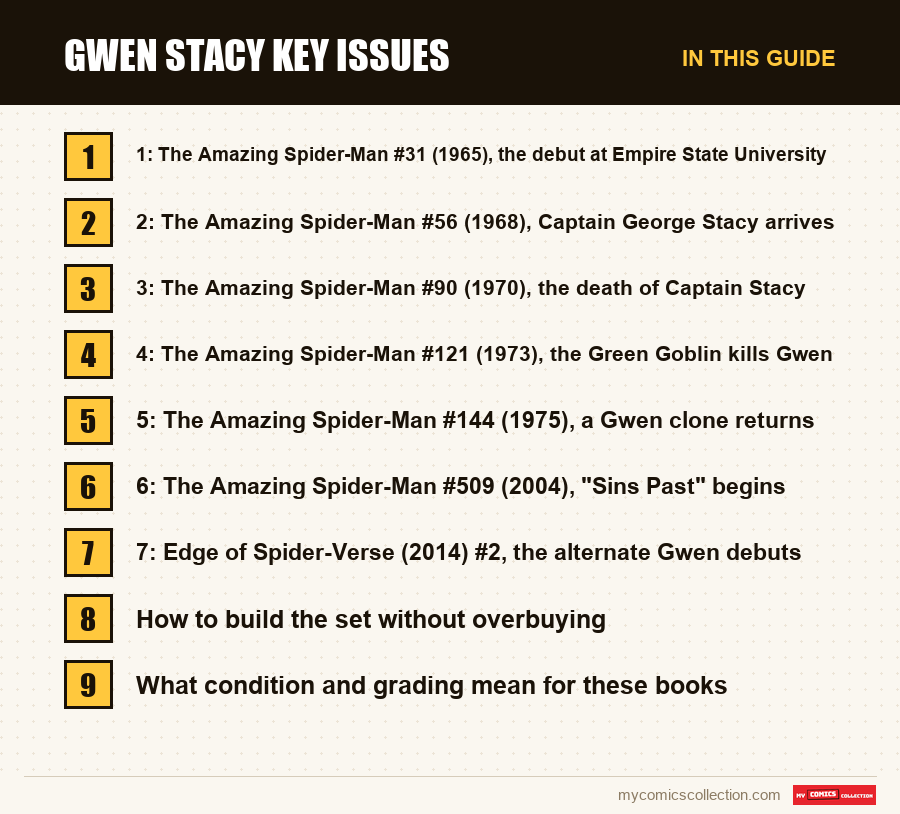
6: The Amazing Spider-Man #509 (2004), "Sins Past" begins
"Sins Past" runs through issues #509 to #514, with cover dates from August 2004 to January 2005, written by J. Michael Straczynski. The story, told largely in flashbacks, claims that Gwen had an affair with Norman Osborn and gave birth to twins, Sarah and Gabriel. It was controversial for the way it changed her character.
The storyline was undone in the main continuity during Nick Spencer's run, in the 2021 event "Sinister War," which revealed that Norman Osborn never fathered the twins and never had an affair with Gwen. For collectors, this makes the story a complicated entry: it was a major talking point and it is no longer part of the accepted history.
What to know before buying: issues from 2004 are modern books, so the main question is not restoration but whether the copy is clean and free of corner and spine wear. The run is most useful to completists who want every significant rewriting of Gwen's history, and it is fair to say that opinions about the story remain divided.
7: Edge of Spider-Verse (2014) #2, the alternate Gwen debuts
Cover dated September 2014, Edge of Spider-Verse #2 introduces the spider-powered alternate version of Gwen. Dan Slott first conceived the character, Jason Latour wrote the character and Robbi Rodriguez designed her. She is not the Gwen Stacy of the main universe; she is a separate character who grew into her own series.
The reason this entry belongs on a Gwen Stacy list is that the search term overlaps. Collectors looking for "Gwen Stacy key issues" frequently land on this book, and the right answer is to treat it as a related branch rather than the main line. For the full story of the alternate Gwen, use the Spider-Gwen key issues list instead of reading it here.
What to know before buying: the issue has a number of cover variants, so identify the exact printing and cover artist in the listing. Because it is a modern book, condition issues are mostly about sharp corners and flat covers. Decide first whether you are collecting the main Gwen, the alternate Gwen, or both.
How to build the set without overbuying
The cleanest approach is to buy in the order of the story and stop where your interest stops. Start with #31 as the foundation. Add #56 and #90 if you want the family storyline, because those two books explain why Gwen's last years carry weight. Buy #121 when you are ready to commit to a high-demand, condition-sensitive book, and add #122 if you want the complete story of the night.
A second approach follows the Jackal. Take #31 for Miles Warren and Gwen, then #144 for the clone, then move into the clone material in the later series. This route reads as a different set from the family route, and the two overlap only at the debut.
For modern coverage, treat "Sins Past" as a completist add-on and Edge of Spider-Verse #2 as a different character. Those two purchases are less about the historical Gwen and more about how later creators reinterpreted her name.
Three traps are worth naming. First, do not buy a listing that says "Gwen Stacy first appearance" without checking the issue number against #31 and the date against December 1965. Second, do not assume a graded label with a high number means an unrestored book; read the restoration line. Third, remember that collected editions are an honest way to own the story, and a hardcover or omnibus can sit beside the single issues you chose for the shelf.
For anyone who also follows the other love interest of the era, Mary Jane Watson key issues covers the character who debuted in issue #42 in November 1966 and became the other half of the triangle. Reading both lists together shows how the two storylines were meant to be read against each other.
What condition and grading mean for these books
Books from 1965 to 1975 are newsstand magazines produced on inexpensive paper, so the same few defects recur. Spine stress, cover creases, tanned or brittle pages and subscription folds show up across the whole list. A copy that is clean on the front can still have a split along the spine, so photographs of the spine and staples are as useful as a photograph of the cover.
When a seller offers a graded copy, the label usually records the numeric grade, a page-quality note and any restoration. The three describe different things, and a high grade with a restoration note is a different purchase from a lower grade that is entirely original. Treat the label as a summary and check the holder for cracks or discoloration.
If the book is raw, request sharp photos of both covers, the spine, the staples, each corner and the opening and closing interior pages. Most disputes after a sale come from details a clear photograph would have shown. And if the book will leave your hands later, keep the same photographs for your own records.

Frequently asked questions
Most lists point to The Amazing Spider-Man #121 (June 1973), where the Green Goblin kills Gwen, and to #31 (December 1965), her debut. The first is the story people remember; the second is the book that introduces her. Both are covered in this list.
Conway scripted the two-part "The Night Gwen Stacy Died" (#121 and #122, June and July 1973) and Kane penciled it. John Romita Sr. and Tony Mortellaro inked it, and Romita is the one who proposed Gwen as the character to kill.
The Jackal's clone of Gwen turns up in issue #144 (May 1975). Later stories revisited her in flashbacks and in a revival during the "Clone Conspiracy" event of 2016 and 2017, which ends with her sacrificing herself. Each return belongs to a different story and creative team.
No. Nick Spencer's run revealed during "Sinister War" in 2021 that Norman Osborn never fathered the twins of "Sins Past" and never had an affair with Gwen. The 2004 story is therefore best treated as a controversial chapter that was later erased.
Choose by goal. Single issues suit collectors who want the original books and are ready to inspect condition closely. Collected editions suit readers who want the story. Many collectors do both, pairing a few key singles with an omnibus or Masterworks volume for reading.
Holding a Gwen Stacy key issue such as The Amazing Spider-Man #121 or #144? Get an estimate based on its grade.
Estimate my comic