In short
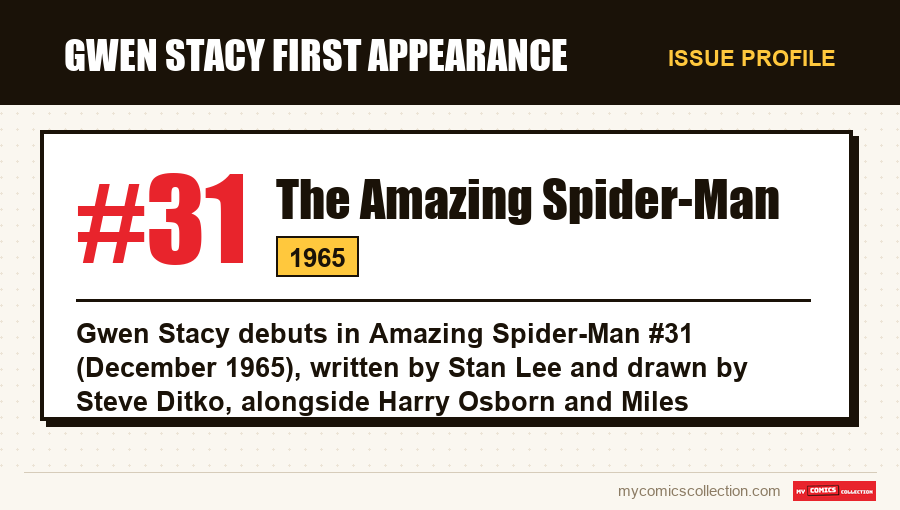
Issue #31 of The Amazing Spider-Man, dated December 1965, is where Gwen Stacy walks onto the page, in a script by Stan Lee with art by Steve Ditko. She appears as a classmate at Empire State University on Peter Parker's opening day there, in the same issue that introduces Harry Osborn and Professor Miles Warren. The story is part one of the three-part arc "If This Be My Destiny...!", which runs through #33.
Most collectors who hunt for this book talk about Gwen alone, yet the cover of #31 sells a Spider-Man adventure, not a romance. The issue opens a campus chapter, a mystery about a criminal boss called the Master Planner, and a medical emergency at home. Gwen is one thread among several, which is exactly why the issue repays a close read before you buy.
Credits, cover dates, the three arc titles and the reprint volumes named below were each confirmed on reference pages for this arc. Observations about condition, handling and collecting order are analysis based on how the book is built and how it is usually graded, not data from any one sale.
What the cover and the credits of issue #31 tell you
The book is The Amazing Spider-Man volume 1, issue #31, cover date December 1965. Lee supplied the script and Ditko the artwork. Reference pages for the arc also list Art Simek as letterer and Stan Goldberg as colorist, with Lee serving as editor. The story title printed inside is "If This Be My Destiny...!", the same title the whole three-issue arc carries.
Ditko's credit matters for a practical reason. He plotted and drew the series from issue #1 through issue #38, and John Romita Sr. took over as penciler with #39. Issue #31 therefore sits in the late Ditko stretch, when the artist's angular, anxious figures were still defining what Peter Parker looked like. Gwen as she appears here is a Ditko design, and she looks quite different from the glamorous version Romita would draw a few years later.
The cover date is December 1965, which is the date you should use when you search listings or file the book in a catalog. Issues #32 and #33 carry January 1966 and February 1966 dates, so a collector building the arc buys across the turn of a year.
How Gwen Stacy is introduced in the story
Peter Parker begins his studies at Empire State University in this issue, and his opening day is a mess. He is distracted by his Aunt May's sudden illness while Spider-Man is busy stopping masked men who work for the Master Planner. On campus he meets a group of well-off classmates, among them Harry Osborn and Gwen Stacy.
The introduction is brief and deliberately understated. Gwen is a student, not yet the center of the book, and she registers as one face in a social circle that Peter feels outside of. Stan Lee intended her as the main love interest of the era, yet her father, NYPD Captain George Stacy, did not arrive until issue #56 in January 1968. In other words, #31 gives you the person, but the family and the relationships that make her important come over the following years.
Harry Osborn debuts in the same story. His friendship with Peter develops over later issues. In #31 itself, Peter's aloof manner on that first day is what catches Gwen's interest, a small beat that the series would build on for years, and the reason Harry and Gwen are so often named together when this issue is described.
Everything else printed in issue #31
A first-appearance book is easier to appreciate once you know what else you are paying to hold. Issue #31 also introduces Professor Miles Warren, the faculty member who is later revealed as the Jackal. That connection has direct consequences for Gwen: the Jackal's later scheme, built around a clone, is the reason her name resurfaces in the mid-1970s.
The central plot concerns the Master Planner, a masked boss whose men Spider-Man fights while trying to understand who is behind them. The issue closes with the mystery unresolved. The reveal that the Master Planner is Doctor Octopus comes in issue #32, titled "Man on a Rampage!", and the finale in #33 is titled "The Final Chapter!".
The domestic stakes run underneath all of this. Aunt May is hospitalized with an unknown illness in #31, in #32 Peter learns that the radioactive blood he gave her in a transfusion back in issue #10 is poisoning her, and #33 delivers the famous sequence in which Spider-Man lifts the heavy machinery pinning him and brings the cure home. If you buy #31 only for Gwen, you are also buying the opening of the arc that ends in one of the most celebrated sequences of the Silver Age.
Who created Gwen Stacy and in what editorial setting
Stan Lee and Steve Ditko are credited as the creators. The surrounding history explains why the issue looks the way it does. By late 1965 the title had been running for a little over two years, and the creative team was moving Peter from high school into college, which required a new supporting cast. #31 is the issue where that cast arrives: Harry, Gwen and Professor Warren in one go.
The same reference history notes that Mary Jane Watson debuts later, in issue #42 with a November 1966 cover date, and that Lee described Gwen as the intended central romantic figure while readers gravitated to Mary Jane. That tension is the background for why Gwen's story is read today as a prelude to something else. For the collector it means the debut issue of Gwen carries a second kind of weight: it is the starting point of a love triangle that defined the series for the rest of the decade.
Because Ditko left the book after #38 (July 1966) and Romita Sr. took over with #39, Gwen's look changed within a year of her debut. Collectors who care about the original design should therefore pay attention to which issues are Ditko-drawn. Any appearance up to #38 is Ditko-drawn, and #31 is the one where the design is unmistakably new.
Why #31 is a key issue and what followed
The book is a key issue because it holds the debut of three characters who shaped the next sixty years of the series. Gwen Stacy leads to the story told in issues #121 and #122 in 1973, where the Green Goblin kills her; for that story see the dedicated guide to Amazing Spider-Man #121. Harry Osborn becomes Peter's close friend and, later, a central figure in the Green Goblin saga. Miles Warren feeds into the Jackal storyline and the clone events that followed in the mid-1970s.
The character's afterlife is long and uneven. A Gwen clone appears in issue #144 with a May 1975 cover date. The 2004 to 2005 story "Sins Past" (issues #509 to #514, written by J. Michael Straczynski) rewrote her backstory with an affair and twins, and a later storyline in 2021 erased that version. A separate alternate-universe Gwen arrived with Edge of Spider-Verse #2 in 2014 and became a franchise of her own. None of those events changes what is in #31, but they explain why the demand for the book is broad and why the debut keeps being discussed.
It is also worth knowing the character's place in the larger map of Spider-Man collecting. The debut is a supporting-cast book, not an origin or a major villain debut, so it is usually discussed alongside the foundations of the run rather than as a headline key. If you are comparing it with the debut of a villain, see the guide to the Green Goblin's first appearance in #14, which is a different kind of purchase.
Do you collect this series?
Track what you own, what you are missing and what your collection is worth. 7-day trial.
Start my trial →
Reprints, collected editions and issues that get confused
If you want the story without the original, several collected editions contain the arc. Reference pages list the original Marvel Masterworks: The Amazing Spider-Man volume 4 from 1991, The Essential Spider-Man volume 2 from 1997, Marvel Visionaries: Steve Ditko from 2005, and The Amazing Spider-Man Omnibus volume 1 from 2007. The arc also appears in Mighty Marvel Masterworks: The Amazing Spider-Man volume 4, titled The Master Planner, published in 2023.
One trap deserves attention. The original Marvel Masterworks line and the smaller Mighty Marvel Masterworks line both have a volume 4 for this title, and the two are different books with different contents. If your goal is to read #31 in a collected form, check the contents line of the specific printing, not the volume number alone.
Issue confusion goes in other directions too. Gwen's debut can be confused with the death story of #121, with the clone issue #144, and with the debut of Spider-Gwen in 2014. That last one is a different character from a different universe, covered in the Spider-Gwen first appearance guide. The Gwen of #31 is the Gwen Stacy of the main Marvel universe, and the alternate version only shares her name and design inspiration.
A subtler confusion involves #33. Because the lifting sequence is so famous, buyers sometimes look for #33 when they want Gwen. Issue #33 does not hold her debut. It is a book with its own market, but it is not what you want if the search term is Gwen Stacy.
What to check before buying a copy
A book from December 1965 has been through decades of handling, and #31 has particular weak points. Start with the spine. Magazines of the period were stapled and then trimmed, and a roll or a stress line along the spine is the most common defect. Look at the spine edge for color breaks, and at the staples for rust or replacement.
Next, check the cover for restoration. Color touch, re-glued spine splits and pressed folds can all be hidden by a good-looking surface. A cover that looks unusually glossy, or a spine that is smoother than the rest of the book, is worth asking about. A seller who answers restoration questions clearly is giving you the most useful information in the listing.
Third, confirm the interior pages. Check that the debut pages with the university scenes are intact, that no coupon or panel has been clipped, and that the centerfold staples have not been pulled out. Fourth, if the copy is graded and encapsulated, read the label as well as the number: the grade, the restoration notes and the page-quality line each describe a different property of the copy.
For comparison, collect the surrounding issues rather than buying one book in isolation. A typical, sensible order is to secure #31, then #32 and #33 as the arc, then #39 for the Romita transition. This avoids the situation where one expensive book sits alone and the story around it is missing. Because pricing moves, use your own recent sold-copy comparisons for the same grade instead of relying on a single listing.
A final practical point concerns listings that describe a copy of #31 as a special or unusual edition. For #31, request a sharp image of the indicia on the first page and of the price box, set them beside a standard December 1965 copy, and walk away if the seller names a difference without showing it.
The next appearances worth reading and owning
After #31, the story of Gwen develops through a handful of issues that are worth knowing by number and date. Issue #56, cover date January 1968, introduces her father, NYPD Captain George Stacy. Captain Stacy is killed in issue #90 (November 1970) amid a Doctor Octopus battle; Gwen holds Spider-Man responsible, departs for Europe in #93 and is back in New York by #98. These are the stepping stones that make the later tragedy land.
Issue #121, cover date June 1973, written by Gerry Conway with Gil Kane as penciler, is the story in which the Green Goblin kills Gwen, and the follow-up in #122 concludes it. Issue #144 (May 1975) returns with a Jackal-made clone of Gwen, and in hindsight the Miles Warren thread planted in #31 pays off there. If you want those picks ranked with buying notes, the companion article on Gwen Stacy key issues does that without repeating this guide's detail on #31.
Together, these books make a tidy set: the debut, the father, the loss, the death and the clone. They also pair well with the larger run covered in the Amazing Spider-Man key issues guide, where the debut of Gwen sits among a dozen other keys of the same era.
A short buying checklist for issue #31
Before you commit to a copy, run through a handful of points. Confirm the cover date reads December 1965 and that the story title is "If This Be My Destiny...!". Compare the spine and staples against photographs of the same grade. Ask directly whether the copy has any restoration. Check that the issue is a complete, uncut book. And decide in advance whether you want a single reading copy, a graded investment copy, or the arc in a collected edition, because each answers a different goal.
If you already own the book and want to know what it is worth, a valuation based on your actual grade and the recent sold data for matching copies is more reliable than any rule of thumb. Describe the condition honestly, photograph the spine, the staples and the cover corners, and note any grading label.
Frequently asked questions
Her debut is The Amazing Spider-Man #31 with a December 1965 cover date, scripted by Lee and drawn by Ditko. The issue also introduces Harry Osborn and Professor Miles Warren, and it is part one of the three-issue arc "If This Be My Destiny...!".
Stan Lee (writer) and Steve Ditko (artist) are the credited creators. Ditko drew the series through #38, and John Romita Sr. took over as penciler with #39, so the original Gwen design in #31 is a Ditko design, later reworked in a more glamorous style.
It is the opening chapter. The Master Planner storyline runs across issues #31 to #33, and the revelation that the villain is Doctor Octopus arrives in #32. Issue #31 introduces the mystery, the campus setting and the new supporting cast together.
No. Spider-Gwen is a parallel-world counterpart introduced in 2014 in Edge of Spider-Verse #2, with Jason Latour and Robbi Rodriguez behind her. Gwen Stacy of the main universe debuted in The Amazing Spider-Man #31 in 1965. Make sure a listing names the right book.
Several do, including Marvel Masterworks: The Amazing Spider-Man volume 4 (1991), The Essential Spider-Man volume 2 and the first omnibus volume. Page ranges differ between printings, so read the contents line of the specific edition before you order it.
Own a copy of The Amazing Spider-Man #31 or another Gwen Stacy key issue? Get an estimate based on its grade and condition.
Estimate my comic