In short
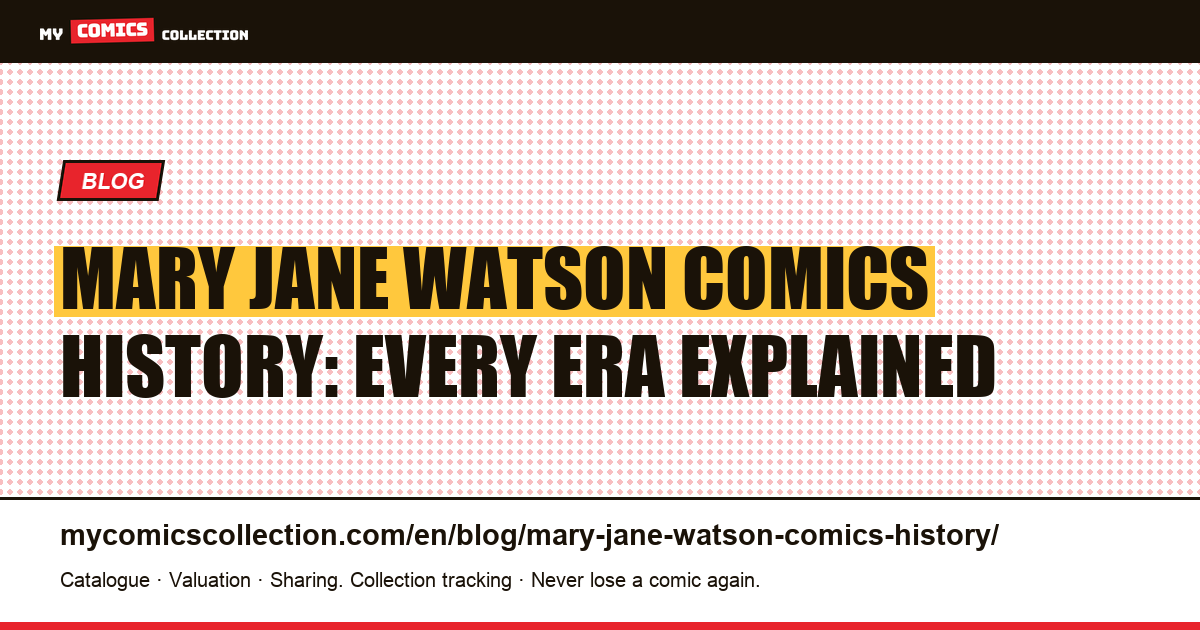
Three Marvel artists and writers share the credit for Mary Jane Watson: Lee, Ditko and Romita Sr. Her name surfaces in The Amazing Spider-Man #15 (1964), a plant hides her face in #25 (1965), and #42 (1966) finally shows it, in Romita Sr.'s pencils. Gerry Conway's run from 1972 moved her toward the center of the book, the 1987 annual married her to Peter Parker, and One More Day (2007) erased that marriage. She has since carried her own books and several identities.
Few supporting characters changed as much as Mary Jane Watson, and almost none changed so slowly at the start. For more than two years she was a name, a joke and a silhouette before she became a person, and the decades after that read like a long argument about what she is allowed to be: a girlfriend, a spouse, a hero in her own right, or a question mark that the main series keeps answering differently.
Every credit and cover year in this timeline was confirmed against the Mary Jane Watson publication record, and the judgments about what shifted for her in each decade are ours, offered without quoting pages or speech balloons.
Before she had a face: Lee, Ditko and a running joke
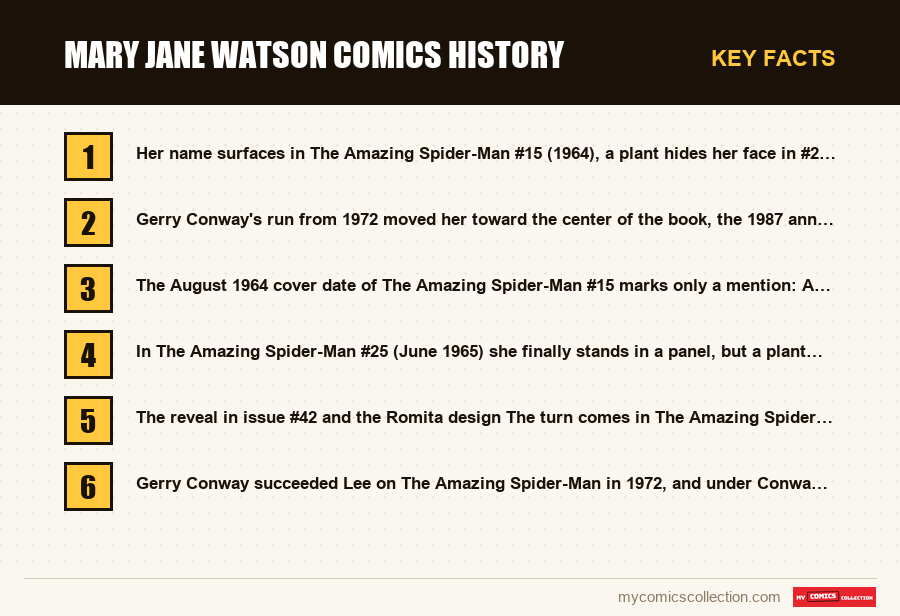
Mary Jane arrived through the supporting cast, not through a launch. The August 1964 cover date of The Amazing Spider-Man #15 marks only a mention: Aunt May keeps trying to set Peter up with her. Nothing is drawn, nothing is said by the character, and the idea sits on the page as a joke about a date that Peter would rather avoid.
The opening stretch of her existence belongs to the Lee and Ditko team, with Romita Sr. joining the creator credit later. In The Amazing Spider-Man #25 (June 1965) she finally stands in a panel, but a plant obscures her face. The staging is deliberate: the creators keep the reader waiting, and the mystery becomes part of the character before she has any personality at all.
The detailed argument over which issue deserves the label lives in our Mary Jane key issues guide; here the point is chronological. She spends about two years as an idea before she is allowed to be a face.
The reveal in issue #42 and the Romita design
The turn comes in The Amazing Spider-Man #42 (November 1966). It is her full face reveal, designed and drawn by John Romita Sr. Romita Sr. used the actress Ann-Margret from Bye Bye Birdie as a guide for the look, which fits the glamorous, red-haired figure that readers still picture.
What matters for the character is the change of register. Under Ditko she was a concealed figure serving a joke. Under Romita Sr. she becomes the most visible woman in Peter's circle, confident, social and a little reckless, and the book pairs her with a very different personality from the quieter women Peter had been drawn toward. The visual identity that the market now associates with her is a Romita creation, built on top of the Lee and Ditko groundwork.
The creators behind this run are easy to follow through the John Romita Sr. author page and the Stan Lee page.
From supporting player to confidante: Gerry Conway and the Gwen Stacy aftermath
The next change belongs to the writer who followed Stan Lee. Gerry Conway succeeded Lee on The Amazing Spider-Man in 1972, and under Conway Mary Jane moved closer to the center of the book. The shift is a matter of tone: she is still lively, but the book starts giving her interior life and a relationship with Peter that carries weight.
The decisive test is the two-part Gwen Stacy tragedy of 1973, The Amazing Spider-Man #121 and #122. Conway scripts, Gil Kane pencils, and Romita Sr. and Tony Mortellaro ink. At the end of that sequence Peter comes home devastated and meets Mary Jane, who has also lost a close friend, and the two comfort each other. The scene is small but structural: she steps from the edge of the cast into the position of the person who stays.
That placement has consequences for everything that follows. Gwen Stacy remains the lost love of the 1960s and early 1970s, and Mary Jane becomes the future, a character defined by resilience instead of idealization. The contrast between the two women is a central axis of the book for years, and the Gwen Stacy story is the hinge on which the switch turns. Our issue #121 guide covers that story from the collecting side.
The 1980s: a secret revealed, a proposal, a wedding
The next major transformation unfolds across the mid-1980s. In The Amazing Spider-Man #257 she admits that she knows Peter's secret identity, and #259 explores her early history. These two issues convert the relationship from a romance between two people with a hidden gap into one between equals who share the central fact of his life, and they lay the groundwork for what follows.
The proposal story runs through The Amazing Spider-Man #290 to #292 (1987), all three written by David Michelinie, who went on to write the series until 1994. The sequence matters for the character because the decision is framed as hers to make: she is not simply waiting to be chosen, she is weighing the cost of living with his double life.
The wedding itself appears in The Amazing Spider-Man Annual #21 (1987), with David Michelinie and Paul Ryan among its contributors. It fixed her status for two decades. The marriage then became one of the central themes of "Kraven's Last Hunt," a reminder that the character's domestic life became a source of dramatic stakes and not just a comfort.
Years of marriage and a character in danger
With marriage settled, the books spent the following years testing it. In The Amazing Spider-Man volume 2 #13 (January 2000) her airplane explodes, an event that separates her from Peter for a stretch, and in Peter Parker: Spider-Man #29 (June 2001) the two reunite. The point is not the specific stakes but the pattern: a character who exists as half of a couple is repeatedly pulled away from that role and then returned to it.
Do you collect this series?
Track what you own, what you are missing and what your collection is worth. 7-day trial.
Start my trial →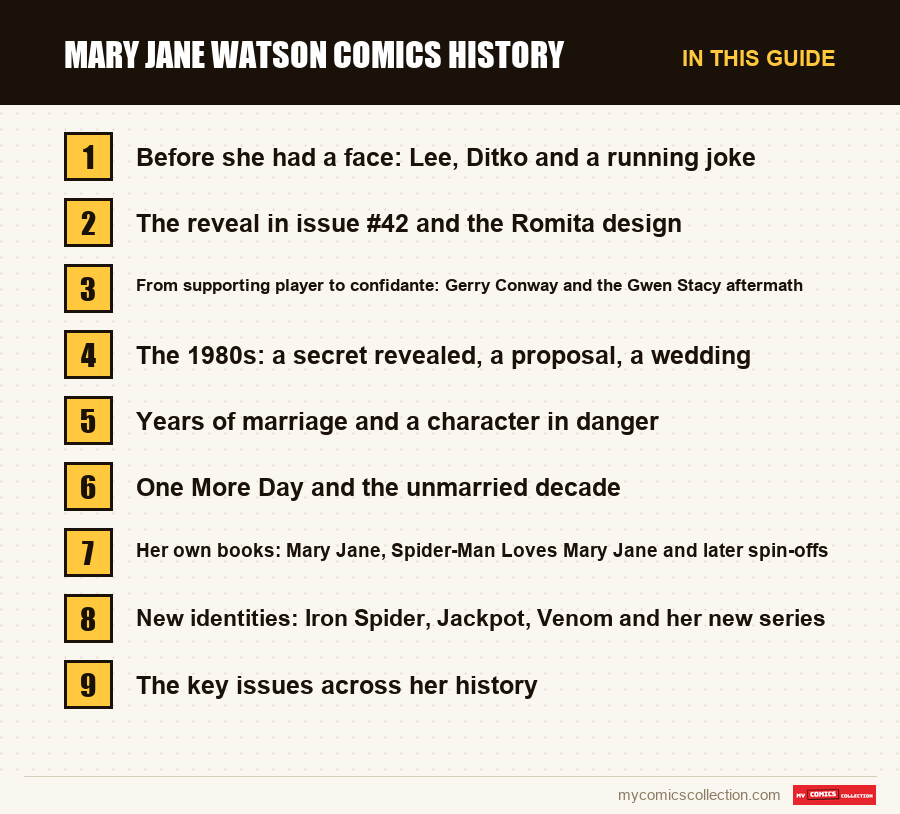
One More Day and the unmarried decade
The marriage ends in 2007. The crossover takes four chapters: The Amazing Spider-Man #544 and #545, plus Friendly Neighborhood Spider-Man #24 and The Sensational Spider-Man volume 2 #41, for the title named One More Day. J. Michael Straczynski and Joe Quesada wrote it, with Quesada on pencils. In the story, Aunt May is shot and Mephisto offers to save her if Peter and Mary Jane give up their marriage; they agree, and the marriage is erased, so they effectively were never married.
The aftermath is the Brand New Day era, which begins with The Amazing Spider-Man #546 in 2008. In the new status quo, Peter and Mary Jane are not a married couple, and the character is reset to something closer to her earlier supporting role. Later, One Moment in Time (2010) returns to the deal and the wedding day, revisiting the choice that cost them the marriage.
The reaction to this change is part of the history. Many readers regard it as a break in the character's development, and the debate continues to shape how she is written. Our reading order for the event lists the issues, and the Dan Slott author page is a useful next stop for the period that follows.
Her own books: Mary Jane, Spider-Man Loves Mary Jane and later spin-offs
Alongside the main series, Mary Jane has carried books of her own. Mary Jane (2004) was a four-issue miniseries written by Sean McKeever, with pencils by Takeshi Miyazawa, inks by Norman Lee, beginning publication in June 2004. It was followed by Spider-Man Loves Mary Jane (2005), a twenty-issue series from December 2005 to July 2007, also written by Sean McKeever. Takeshi Miyazawa drew issues through #15, and David Hahn succeeded him, with Valentine De Landro guest-drawing issues #6 and #7.
Those books sit apart from the main series, with their own writer and artists. For a collector, they are a separate shelf: a complete run in one reasonably short list of issues, written by one writer and drawn by a small team.
Later spin-offs continued the pattern. The Amazing Mary Jane was written by Leah Williams with Carlos Gomez and Carlos Lopez, and Mary Jane & Black Cat was a limited series by Jed MacKay and Vincenzo Carratu. Each time, the question is the same: what does a book centered on her look like when she is not a hero in a costume and not simply a partner? The answers vary, but the existence of a series centered on her is itself a sign of how far the character has traveled since a hidden face in 1965.
New identities: Iron Spider, Jackpot, Venom and her new series
The most recent era is notable for the number of roles she has taken. In The Amazing Spider-Man volume 4 #15 (September 2016) she debuts as Iron Spider, and in volume 6 #31 (August 2023) she debuts as Jackpot. All-New Venom #1 (December 2024), by Al Ewing and Carlos Gomez, presents her as a masked Venom, and #5 (April 2025) unmasks her.
That arc, Venom host and then ex-host, leads to the newest chapter. Her newest book, Friendly Neighborhood Mary Jane, runs five issues, with Ashley Allen writing and Phil Noto drawing; #1 went on sale November 4, 2026. It follows her as she founds a production company and faces a sabotage plot by the Chameleon. The full story of that release is in our issue #1 explainer.
Read as a whole, this era treats Mary Jane as a protagonist in her own right, with powers, costumes and a career, not only as a partner. That is a genuine inversion of the 1966 reveal, where she was defined by being looked at. The books now define her by what she does, and the history of the character, read across six decades, is largely the history of that shift.
The key issues across her history
- The Amazing Spider-Man #15 (1964): the first mention, which starts Aunt May's running attempt to set Peter up with her.
- The Amazing Spider-Man #25 (1965): she appears in a panel with her face hidden by a plant, in a Lee and Ditko issue.
- The Amazing Spider-Man #42 (1966): the face reveal, designed and drawn by John Romita Sr.
- Gwen's death in two parts, 1973: #121 and #122 of The Amazing Spider-Man, closing on a shared grief for Peter and Mary Jane.
- The Amazing Spider-Man #290 to #292 (1987): the proposal story, written by David Michelinie.
- The Amazing Spider-Man Annual #21 (1987): the wedding issue that fixes her status for twenty years.
- The Amazing Spider-Man #544 and #545 (2007): One More Day, by J. Michael Straczynski and Joe Quesada.
- All-New Venom #1 (2024): her debut as a masked Venom, by Al Ewing and Carlos Gomez.
How to follow Mary Jane in a collection
The method is to build around eras rather than a single title. Start with the 1960s sequence, #15, #25 and #42, because it is short and anchors everything else. Then add the Gwen Stacy pair, the proposal issues and the annual. Each step belongs to a different phase of the character, and together they give a compact timeline without needing a long run of back issues.
Numbering is the main trap. The main title restarted its numbering more than once, hence the volume 2, volume 4 and volume 6 labels used in this timeline. Always record the volume with the number, and treat a single issue number as ambiguous until you know which series it belongs to. The same rule applies to the wedding annual, which sits outside the main numbering.
For a character who also appears in separate series, keep those on their own shelf. Mary Jane (2004) and Spider-Man Loves Mary Jane are complete short runs, and the later limited series are each self-contained. Our Spider-Man reading guide helps place the main title's volumes, and the blog index lists related character pages.
Frequently asked questions
Issue #15 of The Amazing Spider-Man (August 1964) only names her. Issue #25 (June 1965) hides her face behind a plant. Issue #42 (November 1966) gives the face reveal, drawn by Romita Sr. Which of those counts as her debut depends on whether you value the mention, the silhouette or the reveal.
Lee, Ditko and Romita Sr. share the creator credit. Lee and Ditko built the early appearances in which she is mentioned or hidden, and Romita Sr. designed and drew the face reveal in The Amazing Spider-Man #42, which defined the look readers still associate with her.
The wedding appeared in The Amazing Spider-Man Annual #21 in 1987. The proposal story had run just before it, in The Amazing Spider-Man #290 to #292, all written by David Michelinie.
In the 2007 crossover by J. Michael Straczynski and Joe Quesada, Mephisto offers to save Aunt May if Peter and Mary Jane give up their marriage. They agree, and the marriage is erased. The change is reflected from Brand New Day, which begins with The Amazing Spider-Man #546 in 2008.
Yes. Sean McKeever wrote the four-issue Mary Jane miniseries in 2004 and the twenty-issue Spider-Man Loves Mary Jane from 2005 to 2007. Later came The Amazing Mary Jane and Mary Jane & Black Cat, and in 2026 the five-issue Friendly Neighborhood Mary Jane by Ashley Allen and Phil Noto.
If a Mary Jane issue from the 1960s or the 1987 wedding annual sits in your boxes, a quick estimate shows where it stands today.
Estimate my comic