
Two series bear the title Ghost Rider: one launched in the seventies, the other in 1990, and the character who bears the name is not the same in both. Each begins with a number 1. On a general auction site, the August 30, 2026 statement on the query “Ghost Rider Ghost Rider 1990 1” shows 127 unverified listings, between $2.10 and $1,000.00, median $38.00, plus 49 listings of verified copies counted separately, between $39.00 and $799.99 $, median $250.00: these are amounts claimed by sellers, not completed transactions. Out of five ads examined closely, only two specified “Vol. 2”. Without mention of volume or year of launch, a “Ghost Rider #1” does not designate any series in particular.
There is a catalog confusion that neither the title nor the number can resolve. When a publisher relaunches a series by giving the name to another character, the cover displays exactly the same letters as before. The title is a brand, not an identity: it survives the change of bearer. As a result, two distinct collections, separated by around fifteen years and worn by two different people, appear under the same label in a list of results. A shopper typing this title into an ad engine gets a mix of both, and nothing in the wording tells them which one they're looking at.
The case is more delicate than a simple renumbering. When a series starts from scratch with the same hero, at worst we get the wrong period: the content remains in the same continuity, the reader finds the character he was looking for. Here, the break concerns the character himself. Buying the wrong number 1 does not mean buying the wrong edition of the same story, it is buying another story, with another protagonist. And as the two series can be read perfectly independently, each presents its bearer of the title to its own readers, nothing in the reading indicates the error. It only appears when counting what we own.
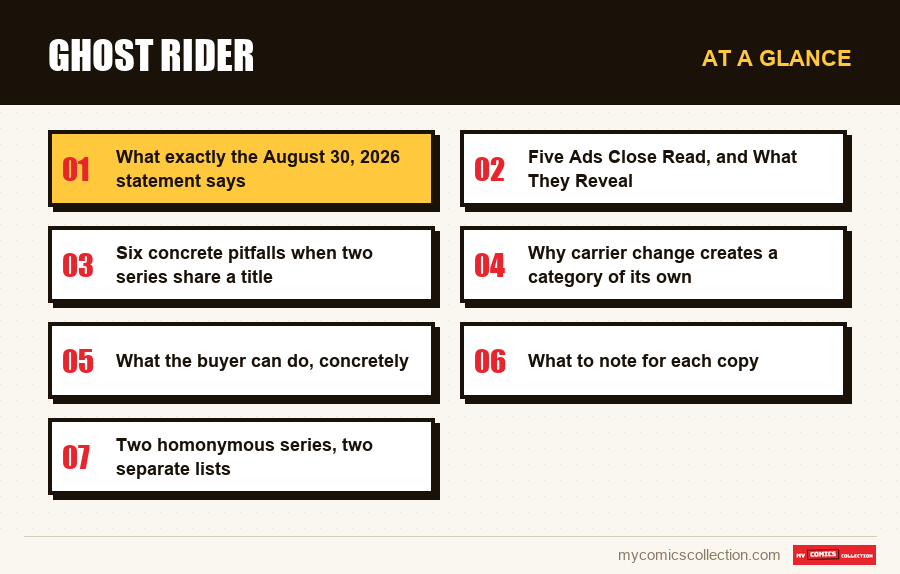
What exactly the August 30, 2026 statement says
The following figures come from a single visit, made on August 30, 2026, on a general auction site oriented to the American market. They describe listings in progress: amounts that sellers are asking for at this moment, not amounts that buyers have accepted. The distinction is decisive. An ad can remain online for months without finding a buyer, and yet its amount continues to appear in the statistics that can be drawn from the results page. As it is a single measurement, taken on a single date, it shows no movement: it is impossible to deduce that anything is rising, falling or stabilizing. We would need at least two spaced readings to speak of a trend, and that is not what we have.
The query « Ghost Rider Ghost Rider 1990 1 » returns 127 announcements of unverified copies. The minimum is $2.10, the median is $38.00, the maximum is $1,000.00. This maximum says almost nothing about the market: it reflects the hope of an isolated seller, the value that a single person attributes to his copy, and all it takes is an ambitious announcement to set it very high. The median is infinitely more telling, because it resists extremes: it indicates the point where half of the requests are located, and $38.00 describes the bulk of the field much better than does the spread of $2.10 to $1,000.00.
Copies verified by a certification body are counted separately, and they must absolutely be left separate: 49 ads, minimum $39.00, median $250.00, maximum $799.99. Mixing these two populations would produce a figure that would correspond to nothing, since an encapsulated and noted copy is not the same commercial object as a booklet described by hand by its seller. What we can observe, however, is that the minimum of verified ($39.00) is just above the median of unverified ($38.00). In other words, the entry level of the verified segment begins roughly where the middle of the unverified segment stands.
Five Ads Close Read, and What They Reveal
A number 2 at $2.10, with the bearer named
The ad is labeled "Ghost Rider #2 [...] Marvel Comics 1990" and shows $2.10. She has the good idea of naming the bearer of the title, and this name is not that of the character who wore the title in the seventies. This is the only element of the wording that allows us to decide: neither the title nor the number was enough.
The same ad, three times, for the same amount
This wording appears twice more, identically, still at $2.10. Three strictly superimposed advertisements, with the same amount, are not three independent offers: they clearly come from the same source which multiplies its publications. Counting ads is not counting sellers.
A prize of your choice covering numbers 12 to 85
“Ghost Rider (1990 Vol. 2) [...] Comics Pick issues (12-85)” is priced at $2.99. The wording makes the effort to explain the volume, which removes the ambiguity about the series concerned. But the amount displayed is a call price: it opens a choice, it does not set the price of the specific number you are looking for.
Thirty-nine numbers behind a single amount
« GHOST RIDER Vol 2 (Marvel 1990) #1-39 - You Pick Issues » starts at $3.00. A single result line covers thirty-nine different numbers, including number 1. This input value weighs in the calculation of the minimum of the sample even though it does not correspond to any identified copy.
Of these five advertisements, two take care to write “Vol. 2”. The other three are satisfied with the title and the year. Two out of five is both a lot and very little: enough to show that some of the sellers are aware of the problem and document it spontaneously, too little for a buyer to be able to count on this mention. In the majority of cases, he will have to piece together the information himself, and the year of launch, when given, then does all the work that the title does not do.
One arithmetic detail deserves to be put in black and white: the two offers to choose from, at $2.99 and $3.00, and the three twin ads at $2.10 occupy the bottom of the scale of 127 results. The minimum of $2.10 therefore does not describe “the price of a 1990 issue 1”; it describes the starting point of a batch and a duplicate announcement. A metric calculated on ads inherits all artifacts from the results page.
This is why it is better to read the median than the limits, and the number of 127 with the reservation imposed by the presence of duplicates: the number of advertisements mechanically overestimates the number of truly distinct offers available at that moment.
Six concrete pitfalls when two series share a title
The title alone does not discriminate
Typing the series name returns the two collections mixed together. The title is identical letter for letter between that of the seventies and the one launched in 1990: no lexical filter can separate them. You must add the year of launch or the mention of volume to the query to hope to reduce the noise.
The year of an issue is not the year of the series
A booklet published a few years after the launch bears a publication date which does not correspond to the year its series started. Searching by date of coverage rather than by year of launch produces false results in both directions: we miss some numbers we're looking for, we get others.
The mention of volume is optional
Two out of five ads say “Vol. 2”. The others do not write it, without bad intention: the seller copies what appears on the cover, and the cover does not mention a volume. The absence of this precision is therefore never a signal of deception, only missing information.
The call price of a lot is not a price
An offer of choice displays the amount of the least requested number in its range. When this range covers thirty-nine numbers, number 1 is almost never the one carrying this amount. Reading the call price as the price of the number sought is the most common error on this type of ad.
Each series has its own number 1
Having “number 1” means nothing until you say which one. Two number 1s exist under this title, worn by two different characters. A collection sheet which only records the rank of the issue will never allow us to know which of the two is sleeping in the box.
Reading does not report error
The two series can be read independently: each sets up its bearer of the title for its own readers. The risk is therefore not of not understanding anything of what we read, but of believing that we are completing a collection when we are only half assembling two. The error is only seen when doing the accounts.
Why carrier change creates a category of its own
Renumbering is a commonplace phenomenon in American comics, and collectors have learned to live with it. One series stops, another takes up the same title, the numbering starts again at 1, and we distinguish the two by their year of launch. The content remains in the same vein: the main character does not change, nor does the universe, and a reader who chooses the wrong volume still comes across the adventures of the hero he was looking for.
The case described here is a bit different. It's not just the numbering that starts again: it's the character that changes. An announcement in the statement says this explicitly, naming for the 1990 issue a bearer of the title who is not the one from the 1970s. The title was therefore passed on, like a function entrusted to another, and the covers continue to display the same word while the protagonist has been replaced.
This configuration has an immediate practical consequence on how to maintain a collection. A collector following "the Ghost Rider series" is actually following two items with no direct continuity connection, each with its own number range, release date, and character. Grouping them together in the same inventory line produces an illusory progression: we add numbers that do not belong to the same set, and the total obtained does not correspond to the completeness of either series.
It is therefore better to treat the 1990 series and that of the seventies as two separate collections from the first purchase. It is a choice of method, not of taste: nothing prevents you from wanting both, but they must be counted separately for the account to mean something. The subject of peak draw illustrates the same principle from another angle: two series launched at different periods were not printed under the same conditions, and one can be common where the other is rare, without the shared title revealing anything about it.
Collecting this series?
Track what you own, what you are missing and what your collection is worth. 7 day trial.
Start my trial →What the buyer can do, concretely
The first thing to do is to give up searching by title alone. It cannot structurally work, since the two series share the same title. Adding the year of launch in the query is the most effective gesture: this is precisely what the statement query does, which adds 1990 to the title. The mention of volume produces the same effect when the seller has taken the trouble to write it, but it is only present in two out of five advertisements and therefore cannot serve as a main filter.
The second is to treat each amount as it is. An ad displays a request, not an agreement: until someone buys, the figure remains a one-sided proposition. A very high amount isolated at the top of the list says nothing about the overall level: it indicates that a particular seller has particular expectations. And when the range is from $2.10 to $1,000.00 on unverified copies, it is the median of $38.00 that describes the visible market, not its bounds.
The third is to discard the lots when looking for a specific number. Choice offers are useful for filling low-cost holes on popular numbers, they are misleading for assessing the price of a coveted number. A spread of thirty-nine numbers showing $3.00 does not promise number 1 at $3.00; it announces the entry price for a selection of which number 1 is probably excluded or surcharged. The detail page alone says what it really is.
The fourth involves reading the wording. Three strictly identical advertisements for the same amount indicate a single source which repeats its publication. This does not make these announcements suspicious, but it distorts the perception of the offer: we think we see three opportunities where there is only one. This question of the discrepancy between what an announcement lets people hope for and what it actually contains is developed in when an ad sells an expectation, which addresses the same mechanism on other labels.
The fifth, finally, consists of not concluding anything about a population based solely on its apparent volume. One hundred and twenty-seven listings seems like a lot, but the sample contains obvious duplicates and lots that do not match any identified copies. The number of truly distinct offers is necessarily lower, without it being possible to say by how much from a single statement.
What to note for each copy
The volume and year the series was launched. This is the only pair of information that really separates the two collections. Write down “1990” or the year the other series was released, and add the volume statement when the seller provided it. Without this field, your file will describe a booklet of which you will no longer know, in six months, which of the two series it belongs to, and the rank of the number will not tell you.
The name of the title holder for this issue. It is the human discriminator, the one that remains readable even when we have forgotten the years. An announcement of the survey gives this explicitly for the 1990 issue; When a seller takes this trouble, copy the information into your file. When it doesn't give it, you will at least know that this field still needs to be checked before considering the entry as complete.
The collection to which you attach the item. Decide explicitly when purchasing whether this issue is part of the 1970s series or the 1990s series, and keep two separate lists. This is what will prevent you from thinking you have completed one set when you are half-way through two. Two separate number ranges, two separate counters, two separate completeness goals.
The actual unit price when the purchase comes from a choice offer. The amount shown at the top of an offer covering thirty-nine numbers, or a range from the twelfth to the eighty-fifth, is not what you paid for your number. Note the amount actually paid for this specific issue, not the call price of the ad line: otherwise your purchase history will be distorted downwards from the first line.
The condition noted by you, upon receipt. The 49 verified copy listings are counted separately because they describe another commercial item, with its own median of $250.00. For an unverified copy, the seller's description is a starting point, not an observation: examine the booklet upon arrival, note what you see in your own words, and date this observation.
By the year of launch or the volume mention, and by nothing else. The title is identical in both cases, and the number 1 exists in each of the two series. In the statement dated August 30, 2026, two out of five advertisements write “Vol. 2” ; the other three are satisfied with the title and the year. If none of these indications appear in the description, you should ask the seller before purchasing.
No. This is an amount claimed by a seller on a current listing as of August 30, 2026, not a completed sale. An isolated maximum measures a single person's ambition, not a market level. The median of $38.00 across the 127 unverified listings is much more representative of what the bulk of sellers are asking at this time.
Because they are not the same commercial object. A copy passed through certification arrives with a standardized condition report, which completely changes the nature of the transaction. Their 49 listings range from $39.00 to $799.99, median $250.00. Mixing them with the 127 unverified ads would produce a composite statistic that would describe neither segment.
No, and that's important. The survey was carried out on a single date, August 30, 2026. A single measurement does not contain any movement information: at least two passages spaced over time, carried out using the same method, are required to speak of evolution. All these numbers describe is the status of the requests displayed at that precise moment.
No, they are read independently of each other: each presents its own bearer of the title to its readers, and each is sufficient in itself. The real risk is not reading wrongly, but counting wrongly: believing we are moving towards the completeness of a series when we are buying alternately from both. This confusion is resolved by inventory, not by reading.
Two homonymous series, two separate lists
When a title covers two distinct collections, the only protection is an inventory which records the volume, the year of launch and the bearer of the title for each copy. My Comics Collection separates the homonymous series, tracks your shortages series by series and keeps the price actually paid rather than the call price of the ad. See also buy Ghost Rider without breaking the bank et the 2007 film versus the comics.