
In short
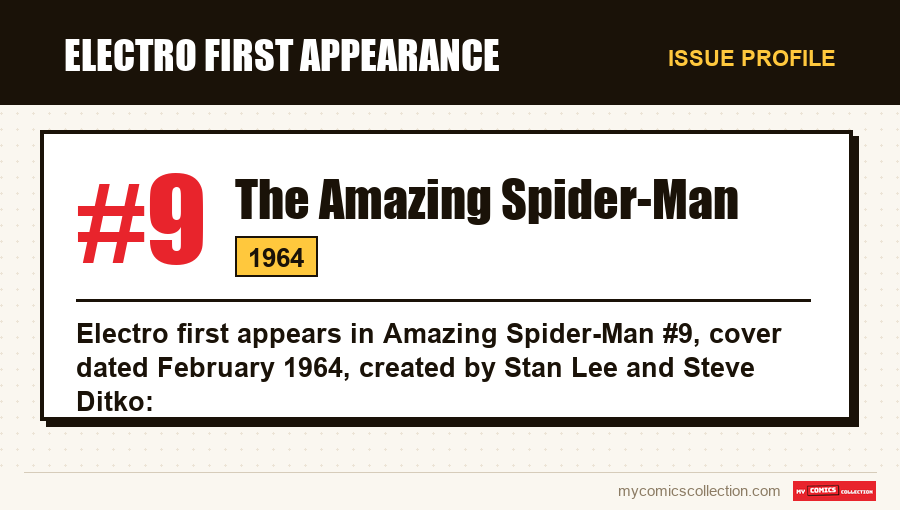
Electro first appears in The Amazing Spider-Man #9, cover dated February 1964, in a story titled "The Man Called Electro!" Stan Lee scripts and Steve Ditko draws. Max Dillon, a lineman and electrical engineer, is struck by lightning while repairing a power line, and the accident turns him into a living electrical capacitor. He debuts as a costumed criminal who challenges Spider-Man, and he later joins the original Sinister Six.
Issue #9 sits in the run of early Amazing Spider-Man numbers where the series was still testing which opponents could carry a story alone. Electro was one of the answers, and the number is now a standard stop for anyone assembling the 1963 to 1964 stretch of the title.
For this page we checked the cover date, the story title, the creative credits and the later appearances named below against published reference material. Everything about how to inspect a copy is our own analysis from the collector's side, and no artwork or dialogue is reproduced.
What #9 is on paper: date, story title and creative team
The Amazing Spider-Man #9 carries a February 1964 cover date. Its story is titled "The Man Called Electro!", with Stan Lee as scripter and Steve Ditko as the artist who created the page layouts and drew the issue. The date matters because some secondary sources and dealer listings drift by a month, and a copy described with a March date is a copy whose listing deserves a second look before you pay attention to anything else.
The series in 1964 was produced under what is now called the Marvel Method: a plot discussion, pages drawn by the artist, then dialogue and captions added by the scripter. At the point of issue #9 the credit box simply reads as a Lee and Ditko book. Ditko's separate plotting credit on the title only begins with issue #25 of June 1965, so a description that credits "plot by Ditko" on #9 is reading later practice backward into this issue.
Reference material describes Ditko as the series penciler for issues #1 to #38 who generally, but not always, inked his own pages. For that reason this page credits Lee and Ditko together and does not name a separate inker for the number. If a dealer description attaches a third name to the interior art of #9, ask for the source behind it.
Start with the front of the book. When you evaluate a copy, the cover is where color, gloss and ink transfer show first, so judge it before you open the book.
How Electro is introduced in this issue
Max Dillon is a lineman and electrical engineer. While repairing a power line, he is struck by lightning, and the accident changes his body into what the story treats as a living electrical capacitor. That single image gives the character his whole identity: an ordinary tradesman, one freak accident, and a power far larger than the person who holds it.
The story then runs on the pattern that early Amazing Spider-Man readers recognize. A new adversary appears, decides that his gift entitles him to a criminal career, and tests himself against the wall-crawler. Spider-Man has to find a way to beat an opponent whose power is electrical, and the contest is built on that problem.
What makes the debut readable today is how little it needs. There is no long origin saga and no cast of supporting players built around the villain. Dillon arrives as a finished design: a costume, a name that explains itself, and a problem that Spider-Man must solve using his wits more than his strength. That economy is one reason the figure was so easy for later writers to pick up.
A short note on tone: the issue plays the menace straight, and the humor comes mainly from the hero's side of the page. If you are coming to the issue from later Electro stories, where the character can be pathetic, tragic or comic, the first appearance reads as a more direct threat than you may expect.
Who created Electro and the editorial moment
Electro is a Lee and Ditko design. The long story of that partnership is told on Steve Ditko: where to start. Issue #9 belongs to the first wave of the title, after Spider-Man's own debut and the early rogues who arrived one at a time.
The editorial context is simple to describe. Marvel in 1964 was launching characters at speed, and a monthly Spider-Man book needed antagonists who could be defined in a sentence and drawn in a distinct silhouette. Electro fits that need: a costume, a name that explains itself, a power that any reader can picture. Ditko drew the villains of this period.
It is worth separating creation from later development. The debut establishes Max Dillon, the lightning accident and the electrical power. Later stories, by other writers and artists, add the team memberships and the long run of rematches. When you read about "Electro's history," treat the ideas in issue #9 as the foundation and everything else as growth on top of it.
Why #9 is a key issue and what followed
The number matters first because it is the debut of a founding member of the Sinister Six. The October 1964 annual puts Electro on a six-man roster; Doctor Octopus, Kraven, Mysterio, the Sandman and the Vulture stand beside him. Annuals as a format are handled in our annuals guide, and the team has its own Sinister Six reading list.
The second reason is that Electro left the Spider-Man book early. Daredevil #2, published in 1964, features him as an opponent of Daredevil, and he went on to lead the Emissaries of Evil, a supervillain team that opposed that hero. The point for a collector is that the character was portable across Marvel titles almost at once, so the debut in #9 is the anchor for appearances in several series.
A third thread runs through Fantastic Four Annual #3, Daredevil Annual #1 and The Amazing Spider-Man #82, all of which are cited among his early appearances. They are useful companions when you want to see how the character was used outside the first Lee and Ditko pass.
Finally, there is a legacy effect. A second Electro, Francine Frye, appears in The Amazing Spider-Man volume 3 #2 (July 2014) by Dan Slott and Humberto Ramos, and takes the Electro identity in volume 4 #17 (October 2016), by Slott and R.B. Silva. Those issues are modern, but they exist only because Max Dillon was established in #9, and that adds a long tail of interest to the original number.
Do you collect this series?
Track what you own, what you are missing and what your collection is worth. 7-day trial.
Start my trial →
Reprints, collections and numbers that get confused
If you want the story without chasing the original, the early run has been collected many times. Volume 1 of Marvel Masterworks: The Amazing Spider-Man is the book that holds #9, along with Amazing Fantasy #15 and issues #1 to #10. It covers 1962 to 1964 and was first published in 1987. Volume 2 picks up at #11, which makes it a different book from the one you need for Electro.
That volume boundary is a common source of mistakes. A buyer who wants Kraven or the Green Goblin looks to volume 2, while a buyer who wants Electro, the Vulture, Doctor Octopus or the Sandman needs volume 1. Check the contents line on the book before you order, since the two volumes sit next to each other in listings.
Two number mix-ups come up most often. The first is mistaking issue #9 for Annual #1, because both are described as "Electro" stories in casual listings; the annual is the Sinister Six story, the monthly is the debut. The second is mixing up the 1964 debut with modern volumes that feature Electro or Francine Frye, because the title was relaunched with new numbering several times. The page on volume and legacy numbering explains how to read those labels.
A reprint of a single story is not the original issue even if the cover is reproduced. Facsimile editions and reprint pages show a modern price box, modern paper and a barcode, so they separate easily from a 1964 copy once you hold them side by side. Describe them in your records as reprints rather than as the issue itself.
What to check before buying a copy
Start with the cover date in the indicia and on the cover: February 1964. Then confirm the title block reads The Amazing Spider-Man and that the issue number is 9. This sounds obvious, but a listing built from a keyword search can mix up neighboring numbers in the run.
Next, look at the spine. Books from this period often show stress lines, splits at the staple points and color breaks along the fold. Those marks tell you how the copy was handled, and they carry more weight in the grade than a surface scuff. Open the center slowly and check that the staples are original, with no rust halos spreading onto the pages.
Then look for restoration. Common signs include color touch on the cover edges, a glossy patch that does not match the rest of the surface, a spine that looks too uniform, and paper that feels slightly different in one corner. Disclosed restoration changes what the book is, so it belongs in the listing text itself.
If the copy is sold in a third-party graded holder, read the label for the exact issue number, the cover date and any note about the pages. Then compare the cover image to the holder's description. A label is a statement about a condition on a certain date, and tilting the case under a light can reveal what the photograph hides.
For ungraded copies, ask for photographs of the front, back, spine, center spread and the corners, all taken in even light. Compare the interior pages with the cover: an interior that is much darker than the cover suggests a copy that was stored upright in a sunny place or in an acidic box. File the seller's description and your own observations together, so the evidence is on hand for insurance or resale.
The appearances that count after #9
Begin with the October 1964 annual, where Electro works as one of six rather than as a lone menace. It is the natural second purchase for anyone who wants the character to make sense in the long run of the rogues gallery.
The second is Daredevil #2 (1964). It matters because it is the moment where Electro is used outside the Spider-Man title, and it gives the number a place in the history of Daredevil's own opponents. It also lets you compare two different artists' take on the same costume within a few months.
The third is The Amazing Spider-Man #82, which is cited as an early appearance and is a convenient way to see the character after the Lee and Ditko era. Read it as a check on how the figure traveled from one creative team to the next.
The fourth is the modern Francine Frye thread, starting with The Amazing Spider-Man volume 3 #2 (July 2014) and moving to volume 4 #17 (October 2016). These issues tell a different story from the debut, so they work as a contrast rather than a continuation.
For the wider run of recommended reading, the page on best Electro comics ranks the stories by audience, and the guide to issue #1 places the title's earliest numbers in order.
Putting #9 in a Silver Age Spider-Man set
Issue #9 works best as one piece of a short sequence. Pair it with the issues around it, so that the shelf shows how a villain debut sat next to the stories that surrounded it. The guide to issue #14 is a good neighbor, since it covers another debut from the same year.
Two copies of one issue deserve two records: one for the stronger cover, one for the stronger interior. That way your records show what you own rather than a single flattened grade. A collection tool is only useful if the entries are specific, so write the exact date, title and condition notes for each copy.
Finally, decide what the issue is for. If it is a reading copy, a complete, clean-reading book with a worn cover does the job. If it is a long-term piece, spend your time on the evidence of originality and the clarity of the restoration record. Either choice is reasonable, and the key is to know which one you have made.

Frequently asked questions
Electro, in the person of Max Dillon, first appears in The Amazing Spider-Man #9, cover dated February 1964. The story is titled "The Man Called Electro!" and was made by Stan Lee and Steve Ditko. He turns up again in Annual #1 of October 1964, on the Sinister Six roster.
Stan Lee and Steve Ditko created Electro. Lee scripted the debut and Ditko drew it. Ditko's own plotting credit starts at issue #25 in 1965, so #9 is a joint Lee and Ditko credit.
Dillon is a lineman and electrical engineer who is struck by lightning while repairing a power line. The accident turns him into a living electrical capacitor, which gives him the ability to produce and control electrical discharges. The debut uses that origin as the whole explanation.
The first Marvel Masterworks volume of the series includes #9, in a lineup running from Amazing Fantasy #15 through The Amazing Spider-Man #10, and it dates from 1987. The second volume begins at #11, so it lacks the Electro debut.
Match the February 1964 date to the number 9, then examine the spine, staples and corners for stress or restoration. Ask for clear photos and set any graded label next to the seller's wording.
Holding a copy of The Amazing Spider-Man #9 and unsure of its grade or restoration status? Get a clear estimate from your own photos.
Estimate my comic