In short
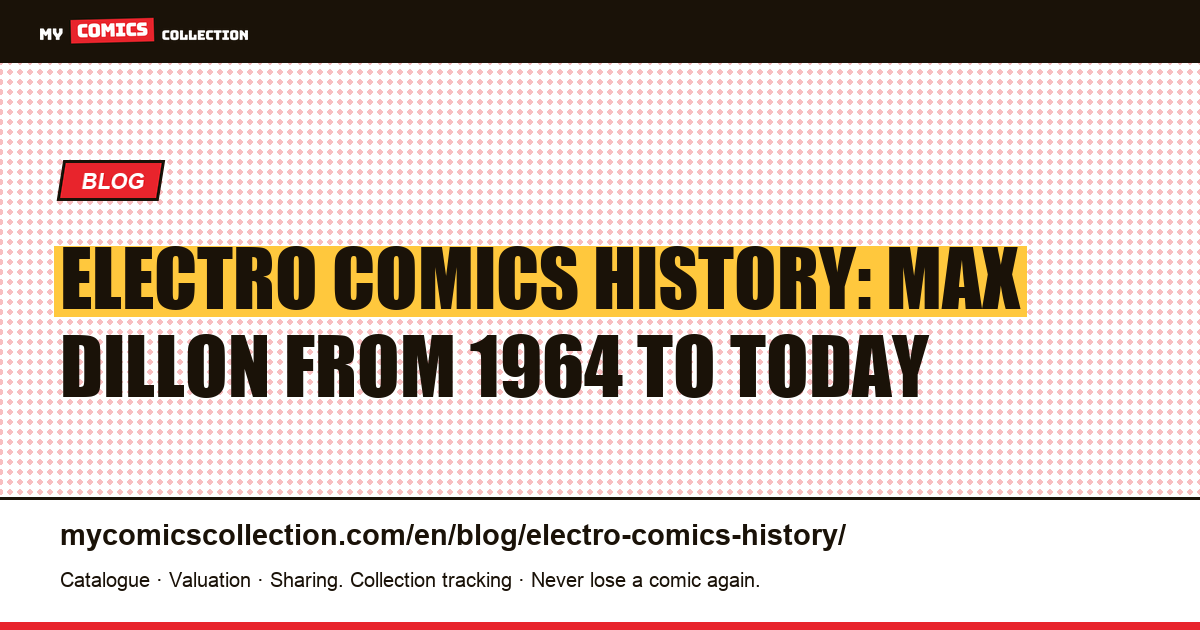
A power-line worker struck by lightning, Max Dillon becomes Electro in issue #9 of The Amazing Spider-Man, dated February 1964, by Lee and Ditko. He joins the original Sinister Six, fights Daredevil and the Frightful Four, is redesigned during The Gauntlet, and is killed in 2016 when Francine Frye takes the name. Doctor Octopus later resurrects Dillon in The Amazing Spider-Man vol. 5 #69 (2021).
Electro began as a straightforward accident story, an ordinary tradesman and a lightning strike, and became one of the most flexible villains in the Spider-Man books. He can anchor a story, join a team, or serve as the proof that a new status quo is dangerous.
The issue numbers, years and creators here were checked against published reference material, and a credit that could not be confirmed is left out. What each stage means for the character is our own reading, and no pages or speech are reproduced.
Creation in The Amazing Spider-Man #9 (1964)
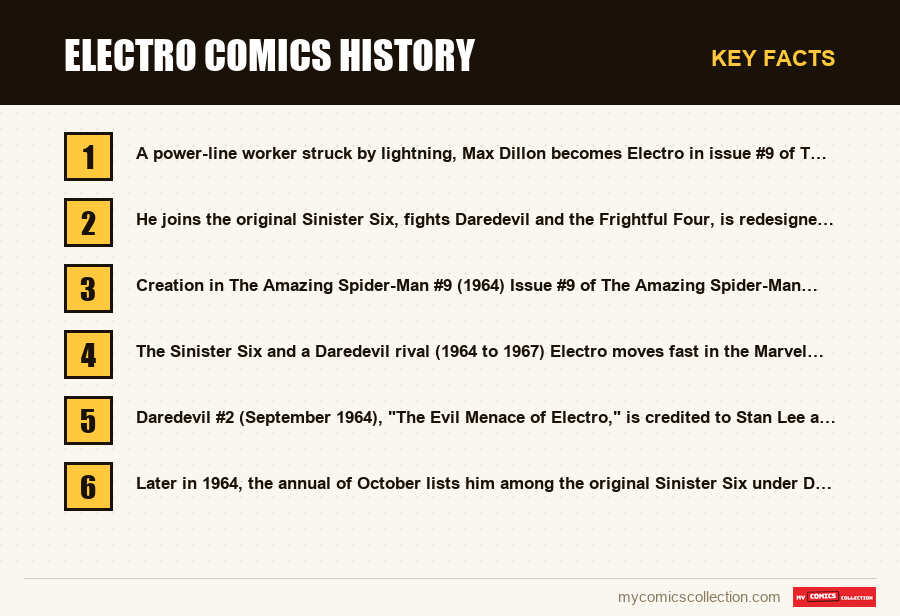
Issue #9 of The Amazing Spider-Man, dated February 1964, is where Dillon enters the Marvel universe, credited to Lee and Ditko. His job is wiring, and a lightning bolt during a line repair rewires him into a walking capacitor. He takes the name Electro and calls himself the Master of Electricity.
The original look is a green and yellow costume with a lightning-bolt mask. The design is worth remembering, because the character will spend much of his later life moving away from it. The debut itself is covered in detail on our issue guide, so this page keeps to what comes after.
What the premise gives the series is a clean problem. Electro is an ordinary worker with a power far larger than he can handle, and water is his weakness when he is fully charged. That combination of a mundane origin, a specific vulnerability and a straight criminal motive makes him easy to place in almost any story.
The Sinister Six and a Daredevil rival (1964 to 1967)
Electro moves fast in the Marvel universe. Daredevil #2 (September 1964), "The Evil Menace of Electro," is credited to Stan Lee as writer, Joe Orlando as penciller and Vince Colletta as inker. It makes the book a cross-title stop for anyone assembling Electro's early appearances.
Later in 1964, the annual of October lists him among the original Sinister Six under Doctor Octopus. In that story he is the first member to fight Spider-Man, at a Stark plant. He later rejoins the group at Doctor Octopus's invitation, which is the pattern for his career as a team player. For the team's organizer, see the Doctor Octopus comics history.
Two more early books round out the decade. Fantastic Four Annual #3 has Electro attack the Fantastic Four at the wedding of Sue Storm and Reed Richards, and Daredevil Annual #1 (September 1967), "Electro and his Emissaries of Evil," is credited to Lee as writer, Gene Colan as penciller and John Tartaglione as inker. The Emissaries of Evil is a team he founds to oppose Daredevil, which shows the character as a leader and not only as a follower.
By the end of the 1960s, then, Electro has appeared as a Spider-Man foe, a Daredevil foe, a Fantastic Four foe and a team founder. That range is the reason he shows up in so many different runs later. Shelving these early books together, the 1964 Electro group spans a monthly, an annual and a Daredevil title, each counted separately. Line them up by cover date and the shift from lone criminal to team player is easy to see.
A hired gun in the 1970s and 1980s: television, the Frightful Four and others
The following decades place him in a supporting role across several series, and the pattern is one of employer and target. In The Amazing Spider-Man #82 he appears on national television, hired by J. Jonah Jameson. Daredevil #87 stages a San Francisco meeting with him, and he rides with the Frightful Four in issue #39 of Peter Parker, the Spectacular Spider-Man.
Fantastic Four #218 uses the Frightful Four in a bait plot, and Falcon #3 and #4 pit Electro against the Falcon. In The Spectacular Spider-Man #157 the Shocker tries to recruit him. Taken together, these issues show a character with no plan of his own, who gets hired for a job, sometimes by a hero's enemy and sometimes by a newspaper publisher, and who tends to lose.
Web of Spider-Man vol. 2 #2 marks the first time Dillon kills anybody, a darker beat for a character long played as a hired loser. In this stage, Electro is rarely the headliner, but he is consistently present, and that steady presence is what keeps him on the roster.
The Sinister Six returns: #334 to #339 (early 1990s)
Electro returns to the Sinister Six across The Amazing Spider-Man #334 to #339. The run is part of the Spider-Man book's early-1990s output, a period when the villain teams were being rebuilt as large events. Electro's role is that of a long-standing member, a character who brings familiarity to a roster.
For collectors, the arc matters because it overlaps with another long story in the same issues. The Vulture's arc with Nathan Lubensky runs through issues #336 to #339, so a single set of numbers carries both characters' appearances.
Marvel Knights, Civil War and New Avengers (2004 to 2008)
In Marvel Knights Spider-Man (2004), Electro works with the Vulture in #2, is beaten at a gas refinery in #3, and appears again in #10 and #11 as part of the Green Goblin's Sinister Twelve. The series treats him as a long-running pawn in Norman Osborn's plans.
In New Avengers #1 he is hired by the Skrull Pagon, posing as Elektra, to free Karl Lykos, and in #4 he faints at the prospect of a beating from Luke Cage. In #48 Wolverine confronts him in an alley and leaves him beaten and unconscious. During Civil War he joins Hammerhead's villain army, cited to Civil War: War Crimes (February 2007). The common thread is that Electro in the 2000s is repeatedly part of a bigger group, whether heroes or villains are running the story.
That crowding is the reason his solo appeal faded in this period. When a character is deployed as an army member again and again, the collecting question becomes which issue gives you the most of him, and the answer is worth checking issue by issue before you buy.
Do you collect this series?
Track what you own, what you are missing and what your collection is worth. 7-day trial.
Start my trial →
The Gauntlet and a new look: #612 and after
The change that matters most in the modern era arrives in The Amazing Spider-Man #612, written by Mark Waid with art by Paul Azaceta. Electro returns with burn scars and a trench coat, and Waid describes his powers as becoming more erratic. His touch becomes lethal, and he forms a group called Power To The People.
The story breaks with the green and yellow costume that had defined the character since 1964. It also changes how Electro is written, because a man whose powers can kill without his intending it is a different problem from a man who simply robs banks. He also appears in #613, #614, #615, #623, #634, #648, #676 and #683, so the character stays active well beyond the redesign issue.
Modern stories show him with blue skin and a bald head. If you collect by look, #612 is the dividing line, and everything before it belongs to the original costume.
Francine Frye takes the name (2014 to 2016)
The Superior Spider-Man also folds Dillon into his Superior Six, a roster shown across issues #5 to #7 of the Team-Up companion book. Dan Slott then turns the name over to someone else.
The writer Dan Slott and the artist Humberto Ramos introduce Francine Frye in July 2014, in issue #2 of the third Amazing Spider-Man volume, as a supervillain fan who befriends Electro and dies of electrocution when she tries to kiss him. In the fourth volume, #16 has Ben Reilly and the Jackal revive her in a clone body. In the October 2016 issue #17, by Slott and R.B. Silva, an attempt to restore Dillon's powers fails, and Frye kisses Dillon, kills him and absorbs his powers, becoming Electro. The cover of that issue is by Alex Ross. The change is not a reboot but a handoff, and the Electro name no longer belongs to Max Dillon alone. Dan Slott's other work is gathered on his author page.
Later, The Amazing Spider-Man vol. 5 #25 has operatives of Mayor Wilson Fisk recruit Electro into an all-female Sinister Syndicate.
Dillon returns and the alternate versions
Doctor Octopus resurrects Dillon with his powers intact in The Amazing Spider-Man vol. 5 #69 (August 2021), so for the 2020s there are two characters entitled to the name. The book is the practical dividing point between the Frye era and the return of the original. Dillon also appears in Devil's Reign #1 and Miles Morales: Spider-Man vol. 2 #6.
Alternate versions are a separate shelf. The Ultimate Marvel Electro is a bald, burn-scarred figure in black leather created by experimentation by Justin Hammer Jr., seen in Ultimate Spider-Man #12 (October 2001) and #17 (March 2002) with art by Mark Bagley. A different version appears in Spider-Man Noir vol. 2 #1 (March 2020).
Read across six decades, the arc is a steady widening of what the name can carry. In 1964 Electro is a single-gimmick criminal with a green and yellow costume. By the Marvel Knights and New Avengers years he is a familiar piece of a larger board, and by The Gauntlet the writers have made his power itself the story. The Frye era then asks a question few Spider-Man rogues face, which is whether the name matters more than the man wearing it, and the resurrection in vol. 5 #69 answers that both can exist at once.
That progression is also a reading plan. Anyone who wants the essentials can follow it in four stops: the debut, the Sinister Six annual, the scarred redesign and the Frye handoff. Everything else on this page is context that explains why those four books matter.
The key issues across Electro's history
- The Amazing Spider-Man #9 (1964): debut of Max Dillon by Lee and Ditko.
- Daredevil #2 (1964): Electro as an early Daredevil foe.
- The Amazing Spider-Man Annual #1 (1964): the original Sinister Six.
- Daredevil Annual #1 (1967): the Emissaries of Evil.
- The Amazing Spider-Man #612 (Waid and Azaceta): the scarred redesign in The Gauntlet.
- The Amazing Spider-Man vol. 3 #2 (2014): debut of Francine Frye.
- The Amazing Spider-Man vol. 4 #17 (2016): Frye kills Dillon and becomes Electro.
- The Amazing Spider-Man vol. 5 #69 (2021): Dillon is resurrected.
How to follow Electro in a collection
Because the volume numbering of The Amazing Spider-Man restarts several times, the most common mistake is a listing that says #17 and means a different volume. Match the volume, the year and the cover date before paying. Francine Frye's key issues are in vol. 3 and vol. 4, while Dillon's resurrection is vol. 5.
For a clean start, take #9, Annual #1 and #612, then add the Frye issues. The Daredevil books are a separate series, so keep their numbering apart from the Spider-Man books when you shelve them. If you want to compare editions, the blog has more guides.
Frequently asked questions
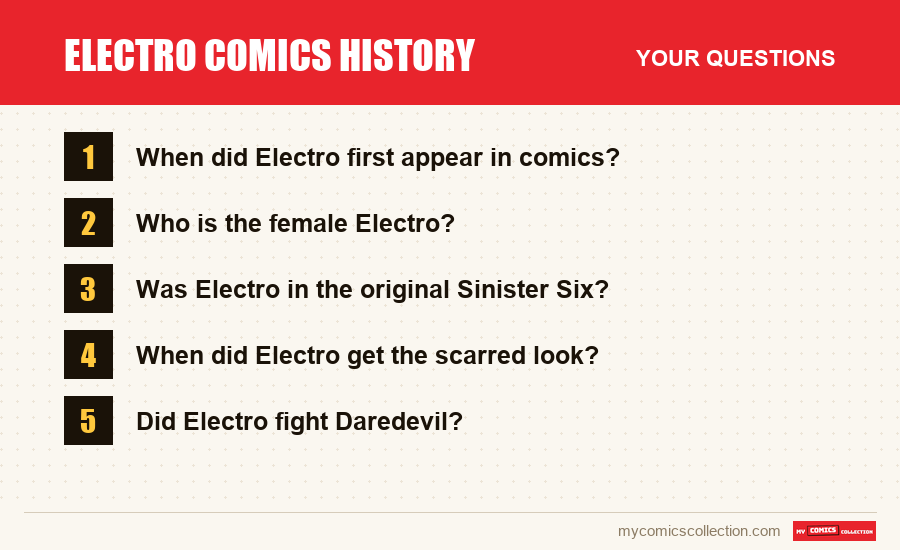
The Electro debut sits in issue #9 of The Amazing Spider-Man, dated February 1964, credited to Lee and Ditko. The story shows a lineman gaining electrical powers after a lightning strike and turning to costumed crime against Spider-Man.
Francine Frye arrives in July 2014 through Dan Slott and Humberto Ramos, in the third volume's second issue. The October 2016 issue #17 of the fourth volume, by Slott and R.B. Silva, shows her killing Max Dillon and absorbing his powers. Dillon returns in volume 5, issue #69.
Yes. Electro sits on the original Sinister Six roster in the 1964 annual. He is the member who meets Spider-Man first, at a Stark plant, and he returns to the group later when Doctor Octopus invites him back.
The redesign arrives in The Amazing Spider-Man #612, written by Mark Waid with art by Paul Azaceta. Electro returns with burn scars and a trench coat, his powers become more erratic and his touch turns lethal.
Yes. Daredevil #2 (September 1964), "The Evil Menace of Electro," is credited to Stan Lee, Joe Orlando and Vince Colletta. Daredevil Annual #1 (September 1967) carries "Electro and his Emissaries of Evil," credited to Lee, Gene Colan and John Tartaglione.
Holding an Electro issue from the 1960s? Get a quick estimate for your copy.
Estimate my comic