
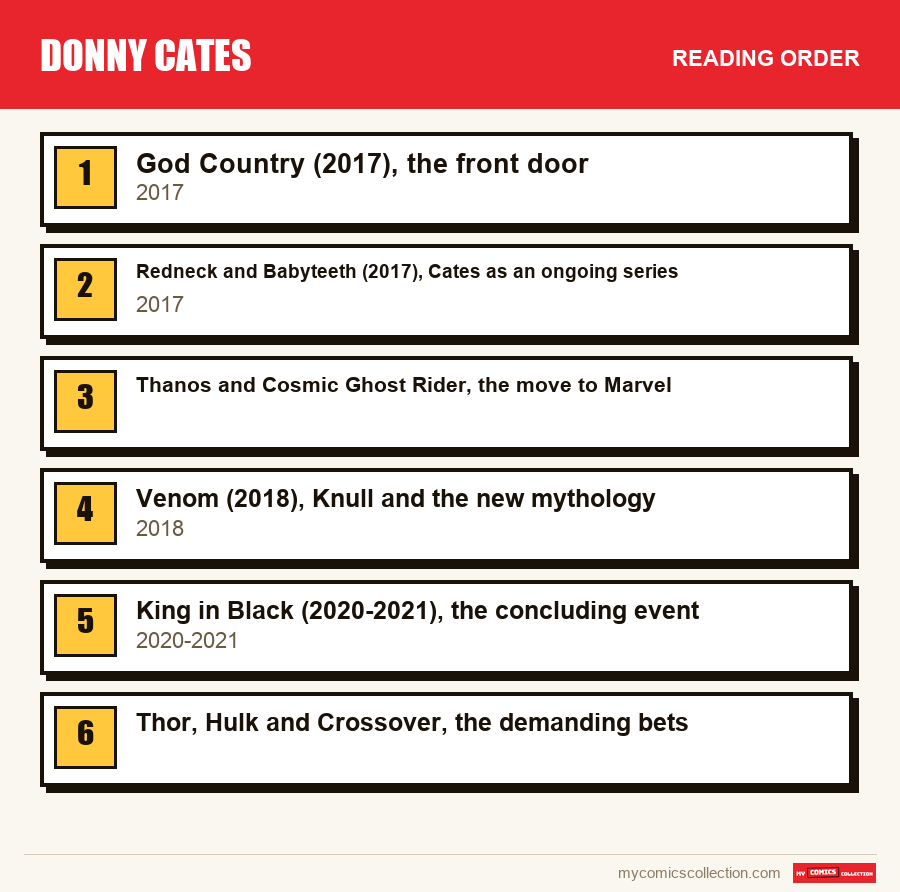
To read Donny Cates, start with God Country (Image, 2017), a closed six-issue miniseries drawn by Geoff Shaw, with no prerequisites at all. Continue with Redneck and Babyteeth, then the Thanos series and the arrival of Cosmic Ghost Rider, the 2018 Venom with Ryan Stegman, King in Black (2020-2021) and finally Thor, Hulk and Crossover. The order runs from the most self-contained to the most dependent on continuity.
A reader who types the name Donny Cates finds Knull, the symbiotes and a cosmic event at the top of the list, yet this writer's style first took shape in stories of cowboys, Texan vampires and fathers who lose their memory. Jumping straight to the big Marvel event is like entering a museum through the last room: you see the spectacle, but you miss the logic that leads to it. This path puts the works back in the order in which they read best.
As always in this guide, only verified information (creators, issue numbers, dates) is stated as fact; the analysis is our own, with no reproduction of protected pages or dialogue.
The ranking of a reading path here follows a single question: how many pages must you have read elsewhere for this one to work? God Country requires none, King in Black asks for a few dozen, and Thor and Hulk assume that you accept the rules of an already established Marvel world. The six steps below follow that slope, and each one says who it is for.
Step 1: God Country (2017), the front door
God Country was published by Image Comics in 2017 in six issues. Donny Cates writes, Geoff Shaw draws, and Jason Wordie handles the colors. The story is set in Texas: an old man suffering from dementia, grown children wearing themselves out to protect him, and a sword from elsewhere that upends the family's balance. The register blends domestic drama and fantasy without ever blending into a shared universe.
Why start here? Because the series is closed. You read a beginning, a middle and an end, you judge the writer's voice on a complete object, and you know in one evening whether this sensibility suits you. Geoff Shaw's thick, nervous line also sets up a duo you will meet again further on, notably on Thanos.
For the collection, the first issue is the natural landmark, but this is the step that demands the most checking: an independent publisher's launch comes out in several printings, and telling the first from the next is done on the issue itself, not from the photo in a listing. Our Image Comics collecting guide details the habits to adopt when facing this kind of launch.
Step 2: Redneck and Babyteeth (2017), Cates as an ongoing series
In that same year, 2017, two open-ended series show what Cates's writing yields when it is no longer limited to six issues. Redneck, at Skybound with Lisandro Estherren on art, follows a family of vampires in rural Texas. Babyteeth, at AfterShock with Garry Brown, revolves around a mysterious pregnancy and a threat from above.
Why read them second? They can be read with no prior knowledge, but they demand patience: each advances in arcs, with staggered revelations and supporting characters who gain depth. This is the step that will tell you whether you follow Cates for the ideas or for the series heroes.
A practical tip: do not start both in parallel. Choose the one whose premise draws you, read the first collected volume, and come back to the other later. These series have different publishers and different release schedules, and their collected editions do not carry the same numbering as the single issues.
Step 3: Thanos and Cosmic Ghost Rider, the move to Marvel
In the Thanos series launched in 2016, Cates takes over from issue 13, with Geoff Shaw on art. The Thanos Wins arc sets up a violent titan, funny in bursts, and above all a new character: Cosmic Ghost Rider, presented as a Frank Castle turned cosmic herald. This creation led to its own miniseries at Marvel in 2018, then to a more clownish tale, Cosmic Ghost Rider Destroys Marvel History, in 2019.
Why in this spot? Because the reading mostly requires knowing Thanos and the Infinity Gems, two notions that any moviegoer has come across. No need to have followed twenty years of Marvel cosmic: the arc is self-sufficient, and its wild tone is the best demonstration of what Cates does with an established character.
On the collecting side, the Thanos series saw a jittery market around issue 13, like anything serving as the first appearance of a popular character. The ranking of Thanos runs places this stretch among the character's other periods, and the ranking of Ghost Rider runs helps explain why a cosmic herald inspired by Castle found an audience. For the rest of the cosmic work, Silver Surfer: Black, released in 2019 with Tradd Moore, is worth a detour for its aesthetic, very far from everything else on the path.
Step 4: Venom (2018), Knull and the new mythology
The 2018 Venom opens with an issue 1 written by Cates and drawn by Ryan Stegman. The duo rewrites the origin of the symbiotes around a god of darkness, Knull, whom the story sets up gradually before showing him in full light. For the first-appearance dispute, which pits issue 3 against issue 4, our file on the key Knull issues sorts out what is established from what is interpretation.
Why step 4 rather than the first? Because the run assumes you accept a relationship between Eddie Brock and his symbiote already well marked out by thirty years of publication. A reader who knows only the films can find their footing, but benefits from a guide: our Venom reading guide sums up the basics in a few pages.
This run is also the easiest to buy in collected form, and the most reasonable solution for a reader: the first volumes gather the opening arcs, and the rest continues without breaking the rhythm. For a collection-minded reading, the selection of the best Venom runs compares this stretch with the older periods. The artist has a dedicated hub, Ryan Stegman, useful for extending the reading toward other collaborations.
Do you collect this series?
Track what you own, what you are missing and what your collection is worth. 7-day trial.
Start my trial →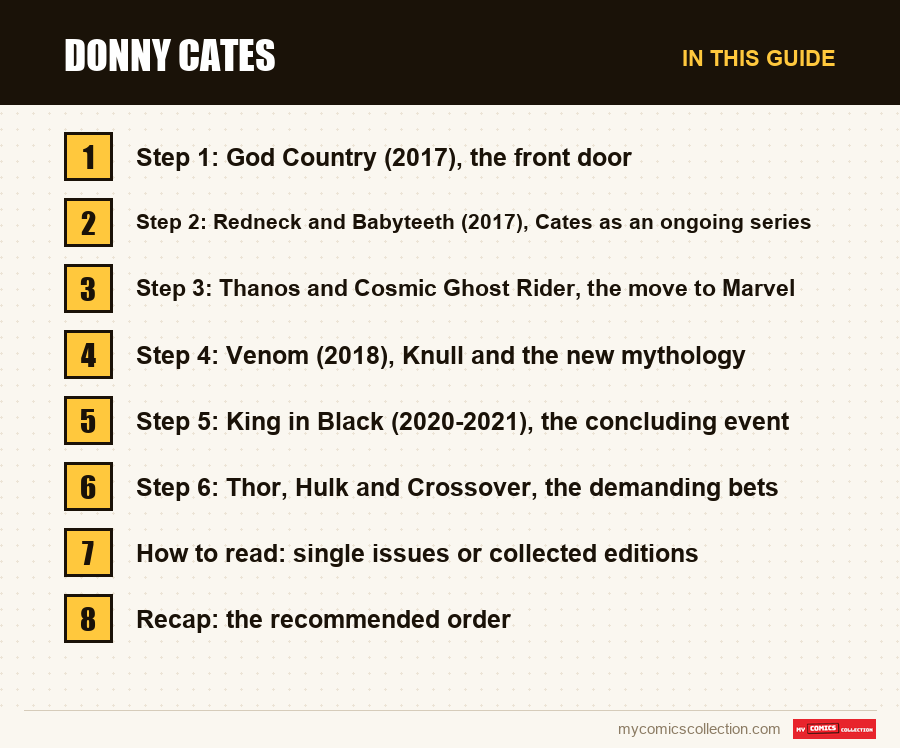
Step 5: King in Black (2020-2021), the concluding event
King in Black comes in five main issues, the first of which was released on December 2, 2020. Cates writes, Ryan Stegman draws, and Knull finally invades Earth. The event comes with a constellation of satellite series at Marvel, which you can ignore on a first pass: the main miniseries is enough to understand what is at stake.
Why so late? Because the saga reaps what the 2018 Venom sowed. Without the early arcs, the scale of the finale seems gratuitous; after them, it takes on the weight of a conclusion. Readers who jump from God Country straight to here are often thrown by the change of scale.
For those who want to prepare the ground, Absolute Carnage (2019), written by Cates and drawn by Ryan Stegman, acts as a bridge between the old Venom and the new. We reveal nothing of the plot: just remember that this saga is part of the build-up and reads better after the start of the run. For a collector, this is also the step where issues pile up fast, between main issues, one-shots and alternate covers.
Step 6: Thor, Hulk and Crossover, the demanding bets
The last tier is three projects that ask you to accept a heavier ambition. Thor (2020), with Nic Klein on art, opens with the Black Winter arc, which confronts a Thor freshly crowned king of Asgard with a threat from beyond the cosmos. Hulk (2021), drawn by Ryan Ottley, commits to a science fiction that embraces its excess. Crossover, launched at Image in 2020 with Geoff Shaw, plays on the border between reality and comic-book fiction.
Why place them here? Each of these titles relies on knowledge of the genre: Thor on Marvel mythology, Hulk on decades of versions of the character, Crossover on the memory of the comics reader. The more you have read, the more the finds can be deciphered. If you pick only one, take the one whose hero is most familiar to you.
For the collection, these are the most recent releases on the path, so the ones whose market value is still to be built. The ranking of Thor runs and the one for Hulk runs give landmarks for judging where these periods stand among the others. A detour through the file on the value of independent comics puts the Image titles in perspective.
How to read: single issues or collected editions
For reading, collected editions are the right choice in almost every case. Cates's series work in arcs of five or six issues, and a volume gathers them naturally. Independent publishers' miniseries, such as God Country, exist in an omnibus edition, which simplifies buying: you keep a single object rather than six single issues.
Collecting is a different exercise. Between 2017 and 2022, everything this writer has signed is too fresh to have an established market value: God Country, Thanos or King in Black are still judged by print run, by the longevity of their series and by alternate covers. No adaptation should be considered a given until the publisher has confirmed it, and we announce none.
Our method comes down to four steps: fix five landmarks (God Country #1, Thanos #13, Venom #3 and #4, King in Black #1), read the credits page of each copy, note several closed sales for the same issue, then discard the extremes. Amounts change too fast to be quoted here. An acquisitions notebook then avoids rebuying in collected form what you already own as single issues. As for language, nothing lets us guarantee that a Cates title exists in French: check the catalogs of French-language publishers before ordering.
Recap: the recommended order
Here is the complete order, from the most self-contained to the most dependent on continuity: God Country (2017), Redneck and Babyteeth (2017), Thanos and Cosmic Ghost Rider, Venom (2018), King in Black (2020-2021), then Thor (2020), Hulk (2021) and Crossover (2020).
If you read only one, take God Country. If you read two, add the first volume of Venom, which shows the mainstream Cates. Readers who do not care about Marvel can stop after step 2 without missing anything of the writer's voice. All the files devoted to Cates are gathered in the author hub, from buying guides to rankings.
Frequently asked questions
With God Country, a six-issue miniseries published by Image in 2017 with Geoff Shaw. It is complete, independent of any continuity, and reads in one or two evenings. If you prefer Marvel, the first volume of the 2018 Venom is the most natural entry point.
Not necessarily, but it is advised. King in Black, five issues launched in December 2020, reaps what the 2018 Venom sowed. Without the opening arcs by Cates and Ryan Stegman, Knull's arrival seems abrupt, whereas it is understood naturally after them.
Yes for the most part. The character is born in the Thanos series by Cates and Geoff Shaw, then gets a miniseries in 2018. Knowing Thanos and the Infinity Gems is largely enough; the rest is discovered along the way, with no deeper Marvel prerequisite.
No, the period is too recent. Issues tied to first appearances, such as Venom #3 and #4 for Knull, move the fastest; the others follow the print run and the series' longevity. Cross-check several closed sales of the same issue before settling on a figure.
Yes, and it is even the best way to discover the writer. God Country, Redneck, Babyteeth and Crossover belong to independent publishers and read without any shared continuity. The Marvel path comes afterward, for those who want to see the writer take on established characters.
Is a Thanos #13 or a Venom #3 lying around in your boxes? Estimate it before deciding whether to keep it or sell it.
Estimate my comic