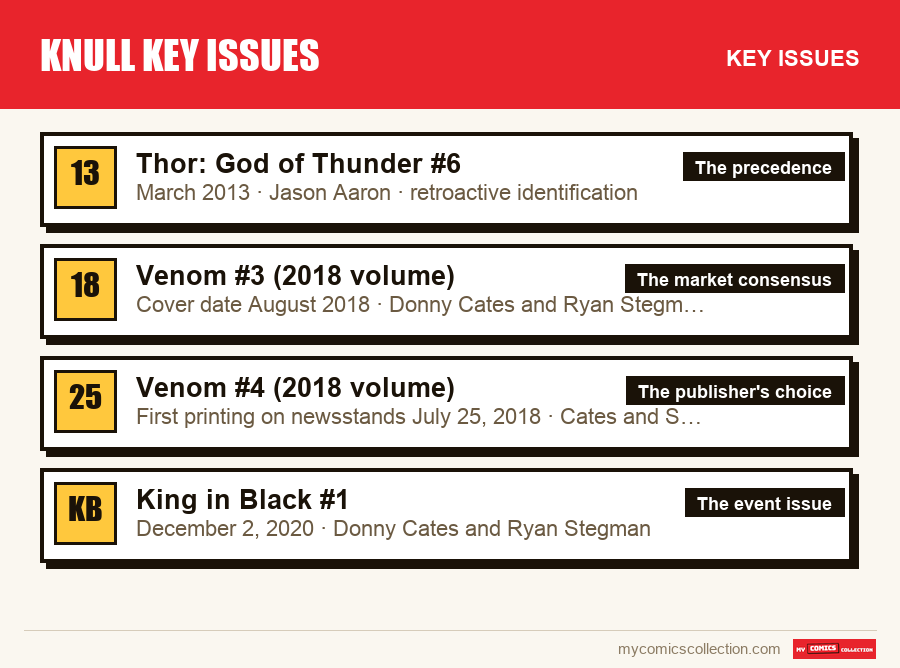
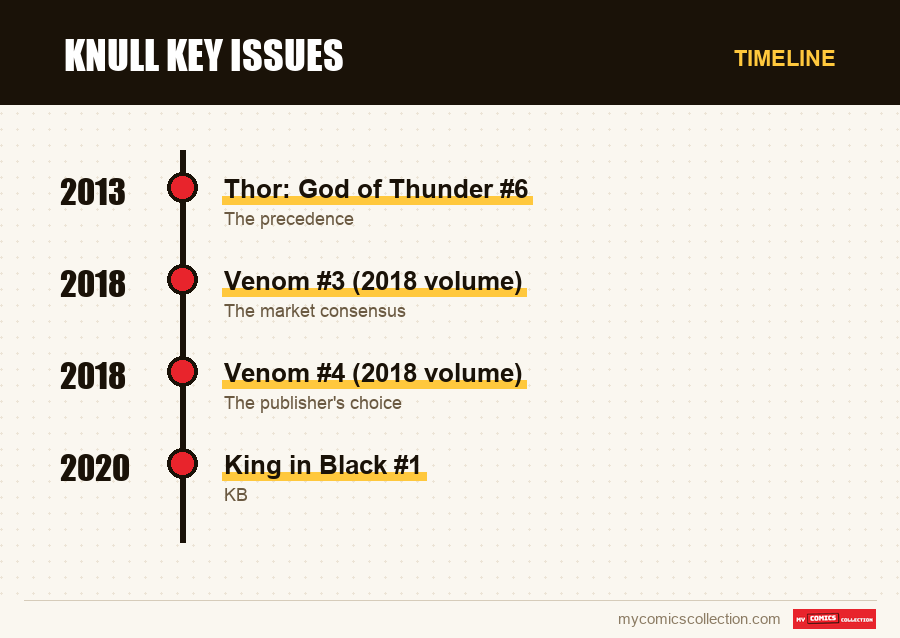
Knull was created by Donny Cates and Ryan Stegman in their Venom series launched in 2018. There is not a single "first appearance" but three answers, each valid in its own register: Thor: God of Thunder #6 (March 2013) contains an anonymous silhouette identified as him five years later, Venom #3 (cover date August 2018) is the issue the market treats as his first appearance, and Venom #4 (on newsstands July 25, 2018) is the one where he names himself and tells his origin to Eddie Brock. The publisher itself presents #4 as his true debut. Add King in Black #1 (December 2, 2020) and, for current events, Venom #250 (October 1st, 2025), which brings him back, and the Knull miniseries of January 2026, his first solo series.
Knull is a textbook case. Ask five collectors about the first issue and you will get three answers, all documented, all defensible, and none completely satisfying. It is not an amateur disagreement: it is the direct consequence of how this character was built, by successive additions, with an identity revealed well after his first printed image.
For a collector, this situation is not a scholarly detail. On a first appearance, the value gap between "the issue where the character is visible" and "the issue where the character is recognized" is often counted in multiples. Buying the wrong issue while believing you hold the right one is the costliest mistake in the hunt for modern keys, and Knull is exactly the kind of character where it happens.
This article takes the problem apart piece by piece, then lists the issues that really matter, distinguishing what is verified from what is interpretation. It is written on October 1st, 2026, the day after the conclusion of the Queen in Black crossover, which has just redrawn the character's place in the Marvel line.
Why "the first Knull" has no single answer
Three mechanisms overlap in this character, and each creates its own candidate for the title.
The first is retroactive attribution. In 2013, Jason Aaron publishes in Thor: God of Thunder an origin of the black sword All-Black the Necrosword, where an entity in dark armor appears who is never named. Five years later, Donny Cates takes up that thread and declares that this entity was Knull. The image existed, the character did not yet. That is the very definition of a retroactive appearance, a subject we cover in detail in our dossier on the value of retroactive first appearances.
The second is the gap between appearance and naming. In the 2018 run, Knull is shown before being identified. The reader sees a figure, a shadow, a silhouette in a nested story, then only in the next issue hears the character introduce himself. The two issues are therefore "firsts" of different nature, and the market has never completely decided between the two.
The third is the question of printings. Like many modern keys, the issues concerned were reprinted with new covers, sometimes in an order that blurs the chronology: a cover showing the character may have come out after a later issue of the story. As a result, even the notion of "first cover" demands watchmaker precision.
These three mechanisms do not contradict each other, they accumulate. A collector who wants "the first Knull" must therefore first decide what they are looking for: the first image, the first name, or the issue other collectors will recognize.
The four issues competing for the title
Here are the candidates, in order of release, with what each actually contains.
Thor: God of Thunder #6
The issue tells the origin of Gorr the God Butcher and that of the sword All-Black the Necrosword. We see an entity in black armor whose identity is not revealed. Five years later, the Venom run establishes that this entity is Knull, and that the Necrosword is his work. This issue therefore holds chronological precedence, but no creative intent: in 2013, Knull did not exist as a character, not even as a project. It is a context piece for anyone collecting Thor, and a bet for anyone collecting Knull.
Venom #3 (2018 volume)
It is the issue you will be offered if you ask for "the first appearance of Knull": the reference encyclopedia entry designates it as his first full appearance, and it is the notation carried on most graded copies. In the story, the character is shown at the heart of a flashback, in a form some readers call an avatar rather than a full presence. The issue remains the pivot of Cates and Stegman's run.
Venom #4 (2018 volume)
This is where Knull introduces himself to Eddie Brock and unfolds his origin through a series of telepathic flashbacks: the creation of the symbiotes, the rebellion, the imprisonment. Marvel, in its own editorial content about the character, describes this issue as his true debut. The reader meets a named, speaking character with a history, which matches the usual definition of a full appearance in many other collector precedents.
King in Black #1
It is not a first appearance, and that is why it deserves its place here: it is the issue where Knull stops being a series threat and becomes a universe-wide threat. The event has five issues, published from December 2, 2020 to April 7, 2021, with the same team as the Venom run. For many readers who came through film or summary sites, it is the real entry point into the character.
Which of these answers corresponds to what
Rather than naming a winner, it is more honest to match each issue to a collecting intention. It is also more useful when the time comes to buy.
You want the issue recognized by other collectors
Take Venom #3 of 2018, in first printing, main cover. It is the notation carried on labels and in catalogs, therefore the one that will be understood without explanation on resale day. On a first appearance, liquidity follows the label, not the argument.
You want the issue that really contains the character
Take Venom #4. It is the issue where Knull speaks, names himself and lays out his origin, and it is the one the publisher presents as his debut. If your criterion is content rather than convention, it is the right choice, and it is generally less contested.
You play the precedence
Take Thor: God of Thunder #6. It is a betting position: it only pays off if the market ends up treating the retroactive appearance as the real first, which has already happened with other characters but remains a minority outcome. Real advantage: the issue was not hoarded at release.
You want to read the whole story
Take the 2018 run in order, then King in Black. The three issues discussed above form a continuous sequence: separating them deprives them of their effect. It is the only use where the first-appearance question has no importance.
In all cases, note the exact notation
Printing, print run number, cover, notation carried on the label if the copy is graded. On a character with multiple first appearances, it is this precision that distinguishes a sellable copy from one to be argued over. Our page on the difference between a cameo and a full appearance details the vocabulary to use.
What King in Black really changed
The 2020 event deserves a few lines of story, because its outcome explains the character's current configuration and therefore today's demand.
Knull arrives on Earth accompanied by symbiote dragons. The Avengers pit the Sentry against him, whom he puts out of action effortlessly, then he has his dragons form a sphere around the planet to cut it off from the Sun. The resolution goes through Eddie Brock, who receives the power of the Enigma Force and eliminates Knull. Eddie comes out of the event as the new king of the symbiotes, and his son Dylan Brock, bearer of the symbiote codex, settles durably into the franchise.
Two consequences for collectors. The first is that Knull spent several years out of play: between 2021 and 2025, demand for his issues depended almost entirely on adaptation news, not on the ongoing publication. The second is that the event generated a considerable volume of satellite issues, from preludes to spin-off series, and that volume still weighs on available supply. It was accompanied by a dedicated Symbiote Spider-Man series written by Peter David, and by series devoted to Namor, the Valkyries, the Thunderbolts or the crossover between Gwenom and Carnage. None carries a first appearance of Knull: presenting them as keys of the character is a common abuse of language on the secondary market.
The return: Venom #250, then a first solo series
The character came back exactly one year ago. Venom #250, released on October 1st, 2025, a giant issue written by Al Ewing and drawn by Terry Dodson, brings back Knull and launches the symbiote saga that has occupied the franchise since. The context has changed: the symbiote is then bonded to Mary Jane Watson, and it is against that configuration that Knull returns for revenge. After this anniversary issue, the series resumes its legacy numbering with #251.
Then, on January 14, 2026, Marvel launched Knull, a five-issue limited series, written by Al Ewing and Tom Waltz, drawn by Juanan Ramirez, with covers by Ryan Stegman. It is a notable fact for a collector, and verifiable: it is the very first solo series devoted to the character since his creation in 2018. Eight years therefore separate his first appearance from his first title in his own name.
The #1 of this miniseries is, to date, the only "Knull #1" in existence. This status is modest compared to a first appearance, but it is unique and will not repeat: a character has only one first solo series. For a thematic collection, it is a logical and recent piece, therefore easy to find in good condition. Its story is also what makes what follows legible: Knull is a prisoner there, stripped of his throne, and prepares his revenge against the one who holds him. It is the thread that leads directly to summer 2026.
Queen in Black: what the summer 2026 event changes
The Queen in Black crossover ended yesterday, with its fifth and last issue put on sale on September 30, 2026. The main series has five issues, written by Al Ewing and drawn by Iban Coello, with covers by Ryan Stegman throughout. Issue 1, released on July 1st, 2026, was a 56-page inaugural issue at a higher price.
The reversal is as follows. Hela, Asgardian goddess of death, captured Knull, seized most of his power and took his title: she proclaims herself Queen in Black. She lands on Earth at the head of a legion of extraterrestrial species bonded to symbiotes. Knull, for his part, is at the edge of the solar system, where he raises an entirely new army. The publisher's presentation text is explicit on this point: the two offensives converge on the same planet, without coordinating.
For demand, three effects accumulate, and they go in different directions.
A news effect on the founding issues. When a character becomes central again for a whole quarter, new readers go back up the chain and look for the starting point. Mechanically, pressure shifts to the 2018 issues, and that is where the confusion over the first appearance costs the most: a hurried buyer takes the first copy labeled "first Knull" that is presented to them, without checking the printing.
A crossover effect with another franchise. It is the novelty of 2026. Until now, Knull belonged to the symbiote perimeter. By becoming Hela's adversary, he enters the Asgardian perimeter, which opens a second audience of collectors to him, that of Thor key issues. This crossover also makes interest in Thor: God of Thunder #6 more defensible, no longer as a mere technical precedence, but as a hinge piece between two mythologies now linked.
A saturation effect on the event's issues. The event came with short series and special issues, including a three-issue series around the forces of light and shadow, another three-issue one devoted to Venom, one-shots centered respectively on Hela and on Thor, and a sequence of the ongoing Venom series. This abundance is good news for anyone who wants to read, and bad news for anyone hoping for quick scarcity. The issues of a heavily ordered event are never missing in the months that follow.
In sum, summer 2026 strengthens the old issues and dilutes the new ones. It is the usual pattern, but it is particularly clear here because the starting base, in 2018, is short: three issues, released within a few weeks, in a single series.
The hunt, concretely
A few practical points, specific to this character and this period.
Always check the printing before the price. On Venom #3 and Venom #4, reprints are numerous and visually different from the original. A cover showing Knull is often the sign of a later printing, not of a superior piece. The information appears in the legal notices printed inside the issue: ask for a photo of that page rather than of the cover alone.
Beware of the word "key" applied to the whole run. The 2018 run has dozens of issues, only three of which carry a first-appearance question. The others are good comics, sometimes sold at a key's price on the pretext of belonging to the same run.
Do not overpay for news. An event that has just ended produces a peak of attention that falls back. The 2018 issues have a baseline demand, independent of the editorial calendar; the 2026 issues do not yet.
Think about the coherence of the whole. If your collection is organized around the symbiote, these issues fit into a continuity that begins in 1988 with Amazing Spider-Man #300 and continues across the Venom franchise. Our key Venom issues of the modern era place the 2018 keys in this wider chain, with market values to back it up.
Keeping these issues in a collection
Knull's practical problem is not finding the issues: they are recent and available. The problem is keeping track of exactly what you own. For each copy, three pieces of information are enough, to be entered on the day of purchase: the print run number, the cover reference, and the first-appearance notation if it is carried. Six months later, nobody remembers whether the copy filed in the box is a first or a third printing, and checking it means taking the comic out of its sleeve.
In the app, the useful reflex is to treat the three 2018 issues as a single entry in your collection plan, with a note recalling which of the three definitions you chose. The 2026 series, for their part, are followed like classic ongoing series. And if you already hold a copy whose current value you do not know, our free estimate starts from observed sales rather than a theoretical scale.