In short
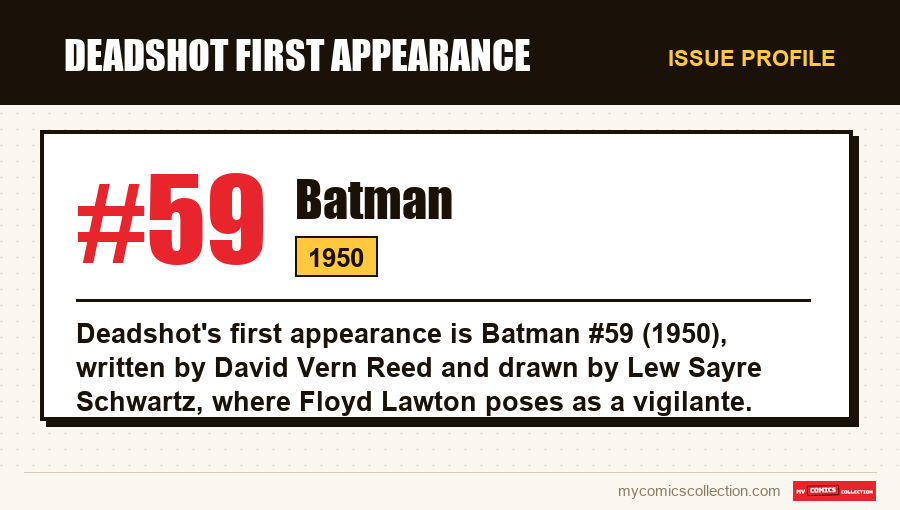
Look for Batman #59 from 1950, where the tuxedo-wearing Deadshot debuts in "The Man Who Replaced Batman." The script is by David Vern Reed, the art by Lew Sayre Schwartz, and the concept credit goes to Bob Kane. Floyd Lawton arrives as a wealthy newcomer to Gotham who poses as a masked marksman vigilante. The red-and-silver killer collectors know today comes from Detective Comics #474 in 1977.
Few Batman villains have two separate lives in print as distinct as Deadshot's. The man in a tuxedo and top hat who debuted in 1950 and the grim assassin with wrist guns who returned in 1977 share a name and a gift for marksmanship, and very little else. That split is the first thing to understand before you hunt for Batman #59, because the issue you are buying is a Golden Age curiosity with a modern reputation.
Everything stated about Reed, Schwartz and the plot of the Deadshot story was confirmed in published references; what follows on copies, condition and collecting order is our own analysis, and any Golden Age credit we could not confirm is simply absent.
The identity of Batman #59
Batman #59 is a 1950 issue of the original Batman series, the title that began in 1940 and ran for decades before DC restarted numbering. The story that matters to collectors is "The Man Who Replaced Batman." Golden Age Batman books bundled several short tales under one cover, so the Deadshot feature shares its issue with other stories.
The credit block for the debut story reads as follows. David Vern Reed is the writer. Lew Sayre Schwartz is the artist. The concept is credited to Bob Kane, whose name appeared on Batman stories of the era whether or not Kane drew them. That list is shorter than a modern credit box, and it is shorter on purpose: credits were not printed inside issues of that era the way later decades did, so the attributions for this book come from later research.
Because of that, the safe way to describe the book is by what is established. Reed is the writer of the Deadshot story. Schwartz drew it. No separate inker, letterer or colorist is established for this issue, and none is named here. If you see a seller listing extra names with certainty, treat the listing as unverified.
The cover date is the other detail that trips people up. Listings print the month differently, so the one safe statement is the year: 1950. Use the year in your own records and let the physical cover date printed on the copy in your hand settle the rest.
How Floyd Lawton is introduced
In "The Man Who Replaced Batman," Floyd Lawton is not a hired killer. He is an independently wealthy man who takes up residence in Gotham City with an ambition that sounds familiar from a dozen crime comics: he wants to become an influential crime lord. What makes the story distinctive is the cover he builds for himself. Lawton appears in public as a vigilante calling himself Deadshot, and he uses his skill as a marksman to disarm criminals without killing them.
The costume reflects the era. Deadshot wears a tuxedo, a top hat, a gun belt and a domino mask. The look has the polish of a gentleman sportsman rather than the armor of the later versions, and that detail is a good test for fake or confused listings: if the description mentions a targeting reticle or wrist guns, the seller is describing the 1977 redesign, not Batman #59.
Notice what the debut leaves out: there is no death wish, no estranged family, no team of convicts, and no suggestion of a killer who cannot miss because he stopped caring whether he lives. All of that belongs to later writers. The 1950 Lawton is a one-issue opponent with a gimmick, which is exactly how the debut was designed.
The people behind the debut
David Vern Reed wrote the Deadshot story. Lew Sayre Schwartz is the more unusual figure. Schwartz worked as a ghost artist for Bob Kane on Batman from the mid-1940s until 1953, likely producing about 240 pages a year over a seven-year period. Schwartz left in 1953, describing himself as unable and unwilling to draw Batman for Bob Kane again.
That context matters for collectors because it explains the credit line on the book. The Kane name appears as the originator of the concept, but the drawing in the Deadshot story is Schwartz's, and Reed supplied the script. Schwartz is also credited as co-creator of Vicki Vale, another Batman supporting character, and had a long career outside comics that included the credits for Dr. Strangelove and sequences for Sesame Street.
Why Batman #59 is a key issue
The demand for this book rests on one fact: it contains the debut of a character who later became one of the best-known assassins in DC's catalog. Floyd Lawton's popularity grew from the 1970s onward, and the more he appeared, the more collectors wanted the origin of the name. That is the pattern behind most Golden Age villain keys, and Batman #59 follows it.
The chain of events is worth laying out in order, because it tells you which later books also matter. In 1977, Steve Englehart and Marshall Rogers revived the character in Detective Comics #474 with a redesign: wrist-mounted guns, a reticle emblem on the chest, and a mask with a targeting sight over the right eye. In 1987, Deadshot joined the team assembled by John Ostrander in Suicide Squad. In 1988 and 1989, a Deadshot limited series by Ostrander and Kim Yale, illustrated by Luke McDonnell, established his death wish. In 2005, a Deadshot limited series written by Christos N. Gage and illustrated by Steven Cummings introduced his daughter, Zoe. Each step made the 1950 debut more of a destination for completists.
Do not confuse the 1950 debut with Detective Comics #474
The most common mistake in listings is mixing up two different issues. Batman #59 introduces Floyd Lawton as the tuxedo vigilante. Detective Comics #474, from 1977, brings the character back with the redesign that shaped everything after. Steve Englehart wrote the later issue, Marshall Rogers drew it, and the design work gave Deadshot his modern look.
The two books answer different questions. If you want the original appearance, you want Batman #59. If you want the first appearance of the costume, the mask with the sight and the wrist guns, you want Detective Comics #474. Many collectors end up wanting both, and a few go after the 1977 issue first because it matches the character they know from the Suicide Squad stories and the films.
A good way to protect yourself is to read the description for visual clues. A tuxedo, a top hat and a domino mask mean 1950. A full face mask with a red lens means the redesign. If a listing says "first Deadshot" without naming a series, ask for the cover and the title before you pay attention to anything else. The guide to the best Deadshot comics lays out how the modern reads fit around these two issues.
Do you collect this series?
Track what you own, what you are missing and what your collection is worth. 7-day trial.
Start my trial →
Reprints and facsimile confusion
Because the original is a Golden Age book, most readers meet the story through a later collection rather than through the 1950 issue. A collection that gathers Detective Comics #474 with other Deadshot appearances, Deadshot: Beginnings, is a handy way to read the 1977 redesign story and its neighbors, but it is not a substitute for the 1950 comic book and does not carry its value as a collectible.
The rule for any reprint is the same. A reprint, a digital edition or a collected volume is a way to read the story, not a copy of the original issue. When a listing uses language like "reprint of the debut" or "contains the debut," read it as a description of a reading copy. When a listing shows a tuxedo-and-top-hat Deadshot on a Golden Age style cover and promises an original, check the paper, the printing and the cover mark before you believe it.
Inspecting a Golden Age copy before you commit
A 1950 comic is a fragile object, and the checks are the same ones that apply to any Golden Age book. Start with the cover. Look for color touch, glossy patches where a restorer has filled losses, and edges that look too clean for the age. Check the spine for fresh glue and the staples for rust bleeding into the paper. Pulp-era paper darkens and becomes brittle with time, so a copy with white pages deserves a question about how it got there.
If the copy is graded and sealed, read the label. A numerical grade tells you about condition, and the label type tells you whether restoration was disclosed. Compare the label's title, issue number and date with the book you intended to buy, and note whether the page-quality line is present. A Golden Age book with a high number and a note about restoration is a different purchase from an unrestored copy with the same number.
For a raw copy, the method is to photograph the front and back under neutral light and compare them against sales of copies that have been through a grading service. You are looking for relative condition, not a price, so write down what each copy lacks and let the differences guide you. The free comic valuation page is a place to start a record of what you own.
The appearances that matter next
Once you hold the debut, the next books fill in the character's real history. These are the ones that count, in rough order of importance for a collector.
Detective Comics #474 (1977) is the redesign issue, with Steve Englehart and Marshall Rogers, and it fixes the costume that all later artists follow. It is the book that makes the 1950 debut matter to a wider audience.
Suicide Squad (1987) is where Deadshot becomes a lead character. Floyd Lawton joined John Ostrander's version of the team, which had its own beginnings in the Legends crossover. The series is covered in more detail in the Suicide Squad key issues guide and the best Suicide Squad runs.
The Deadshot limited series (1988 to 1989), by Ostrander and Yale with McDonnell on art, gives the character his death wish and a story of his own. For readers who want one standalone Deadshot story, this is the one the character is built on.
The Deadshot limited series from 2005, by Christos N. Gage with Steven Cummings, introduces Zoe, his daughter, and moves the character toward a more domestic story. After that, during Infinite Crisis, Lex Luthor recruits him into the Secret Six, which opened another run of appearances.
That sequence is a useful buying map. The 1950 issue is the origin, the 1977 issue is the look, and the 1987 and 1988 books are the character.
How to place the issue in a Batman collection
Collectors keep Batman #59 on a want list for two reasons. One is completeness within the original Batman numbering. The other is the Suicide Squad connection, which has kept the character in front of readers and film audiences for decades. Place it next to a Silver Age debut like the Mr. Freeze appearance and a Bronze Age book such as the Black Mask debut, and each has a different condition problem and a different supply of copies.
The Batman key issues guide gives a broader picture of where this book sits. For most collectors, Batman #59 is not the first purchase or the loudest one. It is the book you add once the core of the run is in place, and you want the oldest name on the page.
Frequently asked questions
In Batman #59 from 1950, a wealthy Floyd Lawton appears as Deadshot in "The Man Who Replaced Batman," scripted by David Vern Reed and drawn by Lew Sayre Schwartz from a Bob Kane concept. Lawton appears there as a wealthy man posing as a vigilante marksman in a tuxedo and top hat.
No. Detective Comics #474, from 1977, is the issue that revived the character with Steve Englehart writing and Marshall Rogers drawing. It introduced the redesign with wrist-mounted guns, a reticle emblem on the chest and a targeting sight over the right eye. The original debut is Batman #59.
In Batman #59, Floyd Lawton is an independently wealthy man who moves to Gotham City to become a crime lord. He hides behind a public identity as a vigilante named Deadshot, disarming criminals with his marksmanship. Batman learns his true motives and identity, and the publicly exposed Lawton is tried and imprisoned.
Yes. Lew Sayre Schwartz is credited as the artist of the Deadshot story, with David Vern Reed as writer. Schwartz worked as a ghost artist for Bob Kane on Batman from the mid-1940s until 1953, which is why Kane appears in the concept credit rather than on the drawing itself.
Check the cover for color touch and glossy fill, the spine and staples for restoration, and the interior for missing pieces or swapped covers. On a slabbed copy, start with the label type, then match the title, number and date against the issue you set out to buy. Confirm the story pages match a tuxedo-era Deadshot, not the 1977 redesign.
Holding a Golden Age Batman issue and unsure how its condition compares with other copies? Describe it and get an estimate.
Estimate my comic