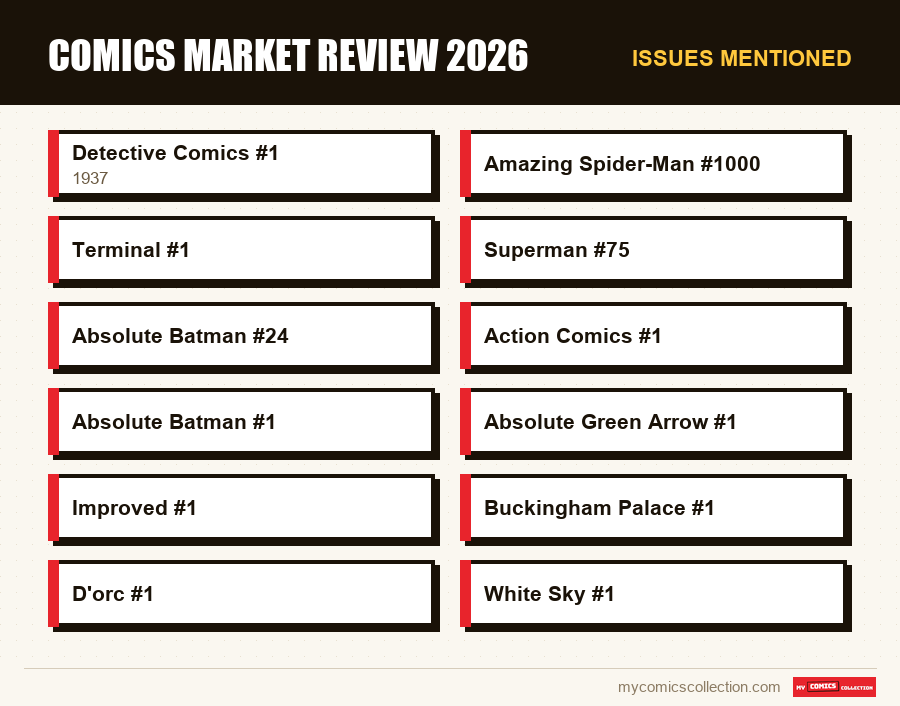
As of October 3, 2026, the market review comes down to five cross-checked facts. An old record: Detective Comics #1 (1937) in CGC 8.5 sold for $638,250 in a sale held March 15 to 18, 2026, against $228,000 for the previous record (CGC 6.5, April 2025). Print runs well out of the ordinary: Amazing Spider-Man #1000 at more than 400,000 copies ordered, Terminal #1 at 300,000, Absolute Batman around 500,000 a month according to its writer. A string of sellouts at every publisher, always closed by a reprint. Spectacular money going to original art (Superman #75) and to collectibles other than comics. And no public monthly or annual market share data: only weekly reports. The year confirms a two-speed market, without letting us predict what comes next.
A market review written in early October is necessarily partial. A quarter is missing, the holiday one, which weighs heavily in retail sales, and several major public sales are announced for the fall. This article does not anticipate them. It takes stock of what happened and of what is documented, separating cross-checked facts from figures that circulate without a solid source.
It puts forward no projection. The early-year forecasts have their own page, and the exercise here is the opposite: looking at what nine months of facts have confirmed or contradicted, without drawing a future price from them.
What we know, and what we do not
Let us start with the limit, because it conditions everything else. In 2026 there is no public monthly or annual market share data for North American comics. The monthly order reports that served as the reference stopped being published in spring 2022. What circulates today are weekly point-of-sale reports, built on a panel of equipped stores.
The latest report available at the time of writing, for the week of September 22 to 28, 2026, covers more than 600 stores. For that week, DC accounted for 41.29% of the panel's sales, Marvel 28.62%, Image 19.07%, then IDW, Titan, Boom and others under 3%. Six DC titles were in the top ten, with Absolute Batman #24 in the lead. It is a snapshot of one week, with a particular release schedule. Drawing a DC market share for the year from it would be wrong, and yet it is the most widespread error in 2026 commentary.
What we do know precisely, on the other hand, are one-off facts: print runs announced by publishers or authors, sellouts observed, public sale results released by identifiable sources. The review is built with them.
Fact no. 1: an old record, on an issue that had none
Detective Comics #1 (1937), CGC 8.5
The only comic book record of the year cross-checked by a direct source. The previous record for this issue was $228,000, for a CGC 6.5 copy sold in April 2025. The gap comes first from the grade: two points on the CGC scale, at this age, separate a common copy from one that has almost no equivalent.
Other "2026 records" circulated during the year, notably very high amounts for Action Comics #1. They were only picked up by aggregators, without a verifiable primary source, and do not appear in this review. It is a precaution that holds for any spectacular figure: if it does not trace back to the auction house or the grading service, it does not count.
Fact no. 2: modern print runs on a scale not seen in a long time
2026 is the year several recent issues reached volumes not seen since the early 1990s.
- Amazing Spider-Man #1000, out on September 30, 2026: more than 400,000 copies ordered, a sellout the same day despite everything, nine covers sent back to press, a second printing on October 28 and unfilled orders delivered on November 4.
- Absolute Batman: about 500,000 copies a month according to Scott Snyder, and an Absolute line that had moved more than 8.5 million copies by the end of 2025. Absolute Batman #1 was on its eleventh printing in March 2026.
- Terminal #1, a creation by Kirkman, Casey and Kubert at Skybound: 300,000 copies against an initial hope of 100,000, second printing on August 26.
- Ben 10, at Dynamite, written by Joe Casey: more than half a million copies in five months.
These figures are good news for publishers and for stores. For a collector, they say the opposite of what people often think: an issue printed at this level will not become rare. The precedent of 1991 and 1992, when several number 1s passed the million-copy mark, is known and documented. Those issues are still easy to find, and their value comes from condition and demand, never from scarcity. Our article on original creations printed in large runs develops this parallel.
Fact no. 3: sellouts everywhere, closed everywhere
The word of the year could have been "sold out." Absolute Green Arrow #1 was at the distributor a week before its May 20 release. Mind MGMT: New & Improved #1 and The Exorcism at Buckingham Palace #1, at IDW Dark, were before they even reached stores. At Image, D'orc #1 (February 4) and White Sky #1 (February 18) were on their release day. And Amazing Spider-Man #1000 ran short in shops despite its 400,000 orders.
The mechanism is always the same. Stores place firm orders two months or more before release, with no return rights. When demand exceeds orders, they cannot restock in time. The publisher reprints, and the tension eases within a few weeks. A sellout therefore measures the caution of orders, not the scarcity of an issue. The first printing remains a distinct object, which you need to know how to identify. Our guide to the difference between first printing and reprint gives the markers.
Fact no. 4: the spectacular money went elsewhere
The biggest public amounts for collectibles in 2026 do not concern comics. A Pokémon Illustrator card set a record on September 25 at $2.8 million for a copy certified by CGC. A summer card sale passed $18 million. A sports magazine carrying Michael Jordan's first NBA cover went for $378,200 on September 24. A sealed video game graded CGC 9.9 A++ broke its own record on October 1. The detail is in our article on the records of 2026.
On the comics side, the financial event was not an issue but original art. A set of pages and covers from Superman #75, the 1992 issue in which the character dies, was put back on sale for the first time in about thirty-three years, with a close on April 12, 2026. Bidding passed $3 million in the first 72 hours. Final prices were not published, and no result amount circulates from a verifiable source: our article on this sale sticks to what is established.
Another sale in October 2026, of a TMNT #1 signed by both co-creators and certified by CGC with authentication, is expected to reach six figures. That is an estimate, not a result, and it falls after the date of this review.
Fact no. 5: a two-speed market, confirmed
Taken together, these facts draw the same picture as the one we described in our analysis of the K-shaped market. At the top, unique or nearly unique pieces, original art, old copies in very high grade, signed and authenticated items, attract record amounts. At the bottom, the modern issue has become again what it was originally: an abundant reading object, printed and reprinted on demand, whose resale price settles at cover price once the sellout is absorbed.
Between the two, the middle zone, that of Bronze Age and 1980s key issues in mid-grade, is the one on which the public facts of 2026 say the least. No source consulted publishes a dated, numeric price movement for this recent period. It would be tempting to fill this void with impressions; this review refrains.
What 2026 confirmed against expectations
At the start of the year, our market trends for 2026 highlighted the role of adaptations, the strength of the Absolute line and the caution needed with modern number 1s. On these three points, the first nine months point the same way, with one nuance: the scale of the print runs exceeded what could be anticipated, and caution toward modern issues is all the more justified.
The other confirmation concerns the place of authors. The year's most massive independent launch, Terminal, rested on no known character. The market's top seller, Absolute Batman, sells markedly better than the other series of the same hero. These are teams that the public follows. For the comparison with the previous year, our 2025 market review remains the reference.
What this review cannot yet say
The weight of the fourth quarter
Year-end sales, the release of Avengers: Doomsday on December 18, 2026 and the Absolute Batman pause in December will change the autumn reports. None of this is measurable in early October.
The fate of the 2026 issues
It generally takes twelve to eighteen months to know whether a character born in the year takes hold. Ravage, the new Teen Titans or the independent creations do not yet have that perspective.
The fall announcements
New York Comic Con takes place October 8 to 11, 2026. Announcements are expected there, but nothing had yet been said at the time of this review.
What to do with this review, concretely
For a collector, the year 2026 gives three simple instructions. Do not confuse sellout and scarcity: an issue sold out on release day will be reprinted, and the price of the moment is not a price guide value. Do not compare two sales of different grades: the Detective Comics #1 record speaks of one copy, not of the issue. And keep a precise inventory, print run included, because it is the only way to know what you own when the market starts to distinguish first and second printings.
For a reader, the year is simply excellent. Rarely will so many comics have sold so well, with so many acclaimed series in the same movement. The issue has never been so accessible, and that is good news, even for those who expected something else from it.