As of October 1st, 2026, the comics market is neither rising nor falling: it is splitting in two. At the top, pieces whose scarcity is provable break record after record, with double-digit annual progress over the last fifteen years: a copy of Action Comics #1 in CGC 8.5 went from $1.5 million in March 2010 to $6 million in April 2024, both public sales, about +10% a year. A copy in CGC 9.0 changed hands for $15 million in January 2026, in a private transaction. At the bottom, the modern issue printed in abundance and kept in middling condition does not follow. Hence the image of the K-shaped curve: two branches that start from the same point and spread apart. The decisive fact is methodological: since 2022, no public print-run data exists any longer on the North American market.
There are two ways to be wrong about the state of the comics market in 2026. The first is to look at auction records and conclude that everything is rising. The second is to look at your own stack of 2010s issues, note that it is worth no more than at purchase, and conclude that the market is dead. Both observations are accurate. They simply concern two different objects, which no longer have much in common apart from the format.
Several market analyses published in 2026 describe this phenomenon under the name of K-shaped curve. The image comes from economics: after a shock, some segments head back up while others keep falling, and the single line splits into two diverging strokes. Applied to comics, it says something precise and verifiable, provided you accept a discipline: each figure must be tied to a year, a geographic scope and a type of indicator. An amount without these three pieces of information is worthless. This article holds itself to this, and ends with the list of facts that would invalidate its own reading.
What "K-shaped curve" means, and what it does not
The phrase deserves to be set down correctly, because it is often misused. A K-shaped curve does not describe a market that rises on average. It does not describe a market that falls either. It describes the disappearance of the average as useful information.
Take two portfolios of ten thousand euros built in 2015. The first contains a single piece, an old key issue in high certified grade. The second contains three hundred modern issues bought new, a majority of them variant covers. In 2026, the first has probably doubled or better. The second is worth at best its purchase price, often less once shipping and commission are deducted. If you add the two and divide by two, you get a modest progression figure that describes nobody's experience.
That is the whole value of the image. It forbids the sentence "the comics market did such and such a percentage" and forces you to ask: which segment, which grade, which sales channel. A clarification to avoid a frequent misreading: the low branch is not that of "bad comics." There are excellent recent series whose issues will never gain value, and forgettable titles of which a copy in very high grade reaches considerable sums. The K-shaped curve separates objects by their scarcity and condition, not works by their quality.
The high branch: what documented public sales show
The top of the market has a rare quality: its prices are public, dated, and concern copies identified by a certified grade. It is the only place in the market where you can reason on facts rather than impressions. Here is the series, as documented, for the most followed issue in the medium's history.
Action Comics #1, CGC 8.0 and 8.5 grades
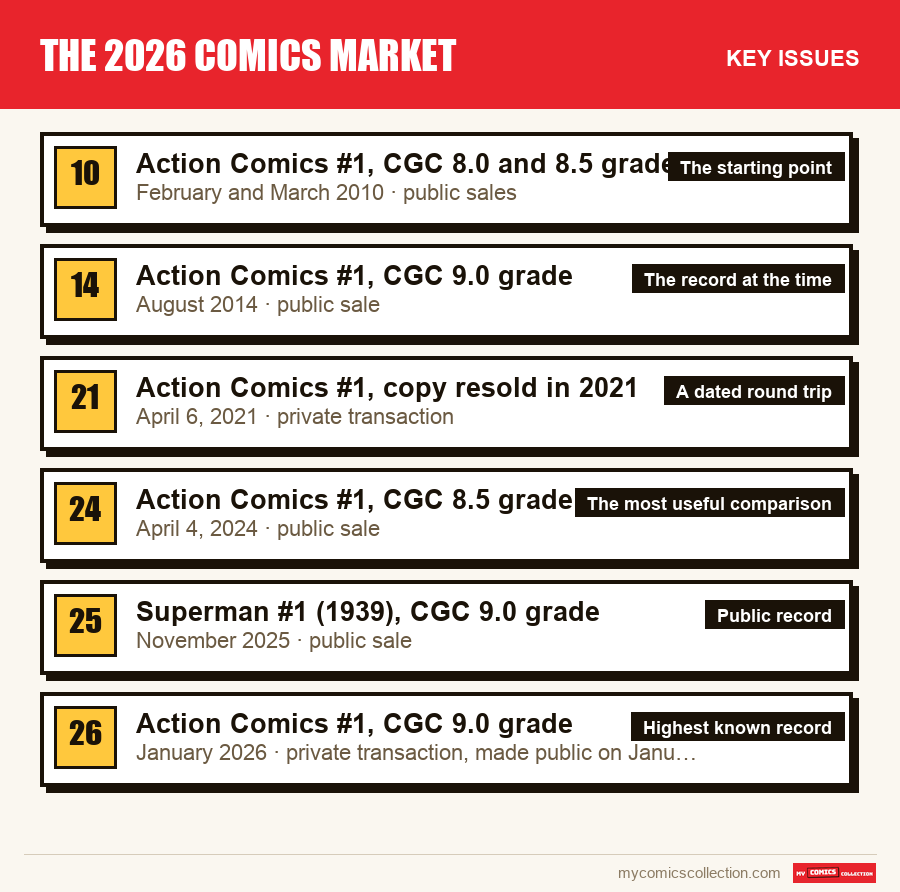
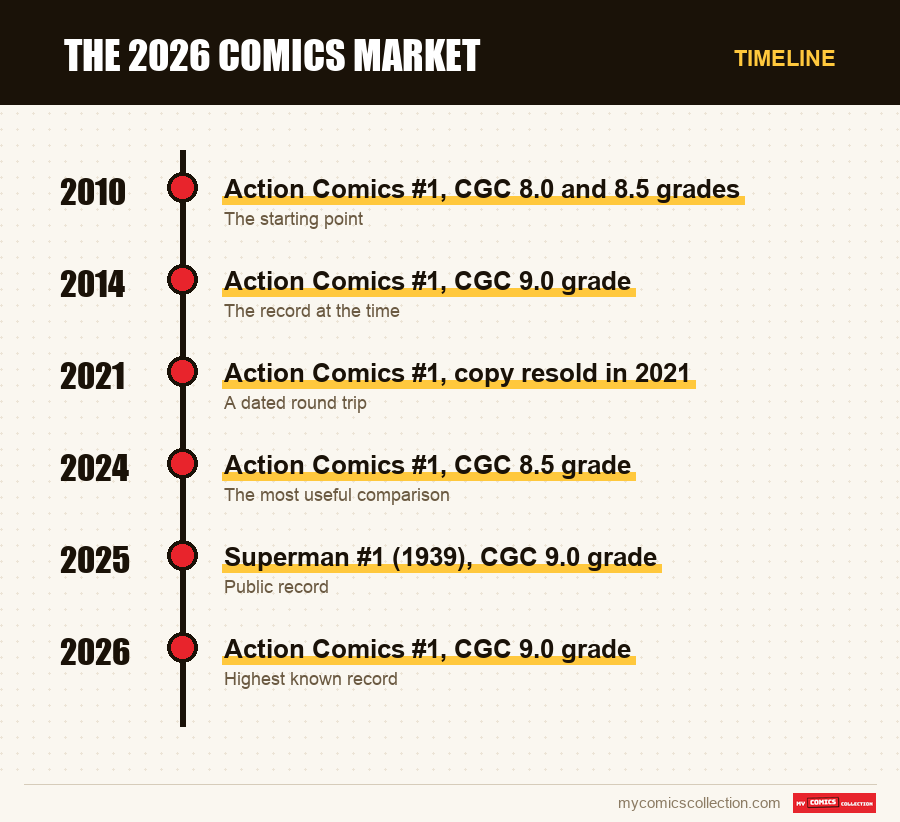
Two public sales close together set the level at the start of the decade: a copy in CGC 8.0 reaches $1 million on February 22, 2010, a copy in CGC 8.5 reaches $1.5 million on March 29 of the same year. These are the first seven-figure comic sales, and they have served since as the reference point for any comparison.
Action Comics #1, CGC 9.0 grade
On August 24, 2014, a copy in CGC 9.0 is knocked down at $3,207,852. This amount will remain the public record for a comic for eleven years. It is, according to published reports, the copy stolen from an American actor in 2000 then found in a storage unit in 2011, where it had then changed hands for $2.16 million on November 30.
Action Comics #1, copy resold in 2021
A copy acquired in 2018 for a little over $2 million is resold for $3.25 million on April 6, 2021. Three years' holding, about +17% a year. The interest of this case is its structure: known purchase price, known resale price, same copy, short duration.
Action Comics #1, CGC 8.5 grade
On April 4, 2024, a copy in CGC 8.5 reaches $6 million in public sale. It is exactly the same title, the same certified grade and the same type of channel as the March 2010 sale at $1.5 million. Fourteen years, a factor of four.
In November 2025, a copy of Superman #1 graded 9.0 by CGC is knocked down at $9.12 million, a new record for a public comic sale. The copy had been discovered in the attic of a California house in 2024.
Action Comics #1, CGC 9.0 grade
In January 2026, a copy in CGC 9.0 changes hands for $15 million. Buyer and seller remained anonymous, the operation was negotiated by intermediaries and announced on January 9. According to published reports, it is the copy already sold publicly in 2014.
How much is that per year, and why the question is badly framed
Three different calculations come out of this series, and they do not measure the same thing. That is precisely what you need to understand so as not to be told just anything.
First calculation, the most solid. Same title, same certified grade 8.5, two public sales: $1.5 million in March 2010, $6 million in April 2024. That is about +10% a year compounded over fourteen years. This calculation controls for grade and channel. It is the one to remember if you must remember only one.
Second calculation, on an identical copy. $2.16 million in November 2011, $3.21 million in August 2014: about +14% a year. Then $3.21 million in 2014 and $15 million in January 2026: about +14.5% a year over eleven and a half years. The convergence of the two figures is striking, but the second mixes a public sale and a private transaction.
Third calculation, the most flattering and the least useful. A little over $2 million in 2018, $3.25 million in April 2021: about +17% a year. Three years, two of which of exceptional surge. A period too short to inform a long-term decision.
Let us therefore retain an honest range: over the last fifteen years, the annual progress observed on top-tier keys in high grade lies between 10 and 15% a year depending on the calculation method, with a preference for the low end of this range, which rests on the cleanest comparison.
Three reservations, to state bluntly. First, these figures concern a handful of copies of a single title: it is not an index, it is a ladder of records, and a ladder of records rises by construction since a record is never published going down. Next, the scope is North American and denominated in dollars, which is not neutral for a eurozone buyer. Finally, none of these amounts includes acquisition fees, grading, insurance nor, for a European resident, taxation and import duties. A real buyer's net return is lower than the market's displayed return.
The low branch: why nobody can measure it since 2022
Here is the most important fact in this article, and the one least talked about. For decades, the North American direct market produced public monthly order data: you knew, issue by issue, how many copies had been ordered by stores. It is on this basis that generations of collectors estimated the scarcity of a modern issue.
This information has disappeared. The historic distributor stopped publishing its monthly and annual reports in 2022, and the distributors that replaced it chose not to release sales figures. Direct consequence: there is no longer public print-run data for comics released since 2022, and no more reliable annual totaling of the direct market.
The effects of this disappearance are considerable, and rarely taken to their conclusion.
A modern comic's scarcity is no longer demonstrable
Before 2022, asserting that an issue had been lightly distributed was a checkable claim. Since then, it is a seller's claim. An issue presented as rare can no longer be confronted with an order figure, and the buyer has no way to verify.
The market's annual growth figures can no longer be reconciled
Progression percentages circulate for fiscal 2025, sometimes very high. They cannot be cross-checked against a public total, since there is none left. We chose to cite none of these figures: we cannot place them, so we do not take them up.
Value shifts toward certified scarcity
When declared scarcity becomes unverifiable, counted scarcity takes a premium. A census of population in certified grade remains consultable: you know how many copies of a given issue have been graded 9.8, and that number can only grow slowly. It is one of the high branch's discreet drivers.
New sales and the secondhand market: two distinct stories
Two markets that have neither the same customers nor the same drivers are regularly confused. The first sells new releases at cover price. The second trades older copies at a price set by scarcity and condition. A good 2025 on the first implies nothing for the second, and vice versa.
Lacking a national totaling, a published sales report remains usable: that of a North American independent retailer who has published its figures every year for a long time. On its own scope, a single store, fiscal 2025 closed with a 1.5% decline from 2024, after an 8% rise in 2024. The detail is instructive: first and second quarters up, third and fourth down, with a fourth quarter at -6.5% and a November down more than 10%.
The makeup of its revenue is also worth reading: about 63% in albums and collections, new and used combined, about 36% in issues, old issues included, the rest in preservation supplies. And 246 different publishers listed over the year, the top four each weighing between 6 and 18% of sales.
One store does not make a market, and this report is valuable only for its methodological continuity over time. But it brings to light a more solid fact: the long form has overtaken the single issue in readers' spending. Yet the long form produces almost no collecting value, because it is reprinted as long as it sells. A segment that captures most of the spending while not feeding the secondhand market: that is, concretely, what the low branch of the K looks like.
The mechanism: provable scarcity against unverifiable abundance
Behind the divergence, there is a simple mechanism, resting on two oppositions.
First opposition: fixed supply against elastic supply. The number of copies of a 1939 comic surviving in high grade has long been fixed. It increases only by discovery, and every handling removes some. On the other side, an issue released last year exists in unknown but large quantity, and nothing prevents the publisher from reprinting its content in another form. Any additional demand on the first translates into price; on the second, it translates into new copies available.
Second opposition: collecting demand against speculative demand. Collecting demand looks for a precise object and accepts waiting years to get it in the desired condition. It is not very sensitive to price and very sensitive to quality. Speculative demand looks for a return and does not care about the object: it buys what rises and sells what stagnates. The first supports prices over time, the second amplifies them then abandons them.
Cross the two oppositions and you get the curve. At the top, fixed supply and collecting demand: prices rise slowly but do not come back down, because nobody sells under duress. At the bottom, elastic supply and speculative demand: prices rise only in short waves, and each wave leaves behind more copies on the market than the previous one. That is why overprinted modern in middling condition does not stagnate by accident: it stagnates by construction.
Condition plays the role of separator here. Between a middling copy and an exceptional copy of the same modern issue, the price gap has widened faster than the average price has moved. That is why the choice of whether or not to have it certified has become the most structuring decision of a recent collection, well before the choice of titles.
Where demand is heading: three niches that are filling up
The high branch is not reserved for seven-figure pieces. The same mechanism, real scarcity and collecting demand, operates at accessible levels. Three shifts are clear.
Newsstand copies. For decades, the same issue circulated through two channels: specialty shops, which ordered firm, and the general press network, which sold on consignment and destroyed unsold copies. Copies from the second channel are structurally scarcer and more damaged, since they were handled by readers and not by collectors. At identical issue and grade, the price gap between the two versions has settled in as a permanent datum. It is a scarcity verifiable by eye, which gives it a decisive advantage in a market where print runs are no longer published. Identification is covered in our guide on the distinction between newsstand and direct edition.
Neglected genres. Pre-code 1954 horror is the textbook case, and its scarcity is not an impression: after the April 1954 US Senate hearings, fifteen publishers ceased operations over the summer, and one of the genre's main players kept only one of its titles. A genre extinguished by collective decision leaves behind a very low world stock, with no possibility of reconstitution. The same reasoning, at lower intensity, holds for romance, western and courtroom stories of the same decades: long ignored because they fed no film, they are in demand again as collectors seek provable scarcity.
Low-distribution editions outside North America. Old European and Latin American editions, local translations printed in small quantities and almost never kept, combine real scarcity and absence of earlier speculation. A European collector has an access advantage a North American buyer does not: in the 2026 context, it is the most concrete asymmetry available.
What this changes for a European collector
Let's move to decisions. They fall into three stages: buy, keep, resell.
Choose the branch before choosing the title
Before any purchase meant to last, ask a single question: is the number of copies of this object in this condition known, limited and unable to increase? If yes, you are on the high branch, whatever the character. If not, buy to read, at a budget you accept not to see again. This question advantageously replaces any list of issues to watch.
When buying: prefer one superior copy to three middling copies
It is the direct consequence of the branches spreading apart. At equal budget, concentrating on a quality piece beats dispersion, and the gap widens with time. Dispersion keeps a meaning only for a reading goal.
In storage: the preservation effort follows the branch
Preserving costs time, space and money. On the high branch, each half-point of grade preserved represents a significant fraction of the value: the investment in preservation justifies itself. On the low branch, an archival-level preservation effort is economically without return. In other words, care for very few things a lot rather than many things a little.
In storage: documenting becomes the real added value
In a market where declared scarcity is no longer checkable, the documented copy sells better than the equivalent copy with no history. Date and place of acquisition, observed condition, certification number, photographs: this traceability is now a component of price, and it is the main use of issue-by-issue tracking.
When reselling: do not treat the two branches through the same channel
A high-branch piece sells piece by piece, with patience, after certification, to buyers looking for exactly this object. A low-branch set sells as a lot, quickly, accepting a discount: the individual handling cost exceeds the unit value. Applying the first method to the second set loses months for nothing.
When reselling: factor in currency and borders
Top-of-market price references are denominated in dollars and recorded in North America. For a eurozone seller, the final result also depends on the exchange rate at the time of the operation, insured shipping costs and customs formalities. A market gain can be wiped out by the journey. That is not decided after the sale.
Speculating on adaptation rumors has stopped paying
For some fifteen years, one strategy worked almost mechanically: buy a character's first appearance upon an adaptation's announcement, resell in the enthusiasm window. It assumed two conditions, both of which have disappeared.
The first is that an announcement turns into a release. The clearest case is that of a superhero film that had completed most of its shooting: its cancellation was made public on August 2, 2022, for budgetary and distribution strategy reasons, and it never came out, not even on a platform. A buyer committed on the strength of the announcement found himself with an object whose demand engine no longer existed, and whose scarcity had never justified the price paid.
The second is that few buyers think of it at the same time. Information now circulates in minutes: by the time an announcement becomes public, the asking prices have already moved, and only the top of the wave remains for the late buyer.
The lesson is not to ignore adaptations but to invert the reading order: an adaptation adds lasting value only where scarcity already exists. On an abundant issue, it produces a peak of a few months followed by a return to the starting point, with more copies in circulation than before. On a truly rare issue in high grade, it advances by a few years a progression that would have come anyway. In the first case you pay the noise, in the second a calendar. Our file on the real effect of adaptations on prices details this split.
What would invalidate this reading
A market analysis that does not say under what conditions it would be wrong is only an opinion. Here are the four facts that would call the K-shaped curve into question, in decreasing order of probability.
First fact: the top may not be a market. The January 2026 record is a private transaction, at $15 million, between two anonymous parties, through professionals. The amount is declared, not established by an open auction. If the highest levels ceased to be confirmed by public sales, we would have to conclude that the high branch rests on a handful of over-the-counter operations, and not on broad demand. It is the most serious weakness of this whole reading, and that is why the reference comparison retained above concerns two public sales and not the record.
Second fact: the return of public print-run data. If distributors resumed publishing order figures, or if an independent annual totaling took hold, the low branch would become measurable. It is not excluded that it would then prove less listless than assumed. A good part of the current diagnosis on modern rests on an absence of data, not on negative data.
Third fact: the elasticity of high-grade supply. The high-grade premium assumes that certified populations grow slowly. If certification capacity rose sharply, or if deposits of preserved copies appeared, high-grade populations would climb and the premium would compress. The copy that came out of a California attic in 2024 shows this scenario is not theoretical.
Fourth fact: the macroeconomic context. A collectible is a discretionary purchase. A lasting contraction of disposable income hits both branches, but not at the same moment: the low branch drops first, the high branch holds then freezes through a thinning of transactions. A freezing high market looks a lot, on a chart, like a rising high market. The distinction requires looking at volumes, not only prices.
On the facts available as of October 1st, 2026, the K reading holds. It holds because the high branch is documented by dated public sales comparable at constant grade, and because the low branch has lost even the instruments that would allow defending it. But it holds with a margin of error, and it is more useful to know this margin than to have one more figure. For an existing collection, the practical consequence is simple: stop reasoning on total value, which no longer describes anything, and look line by line at which side of the curve each copy sits.