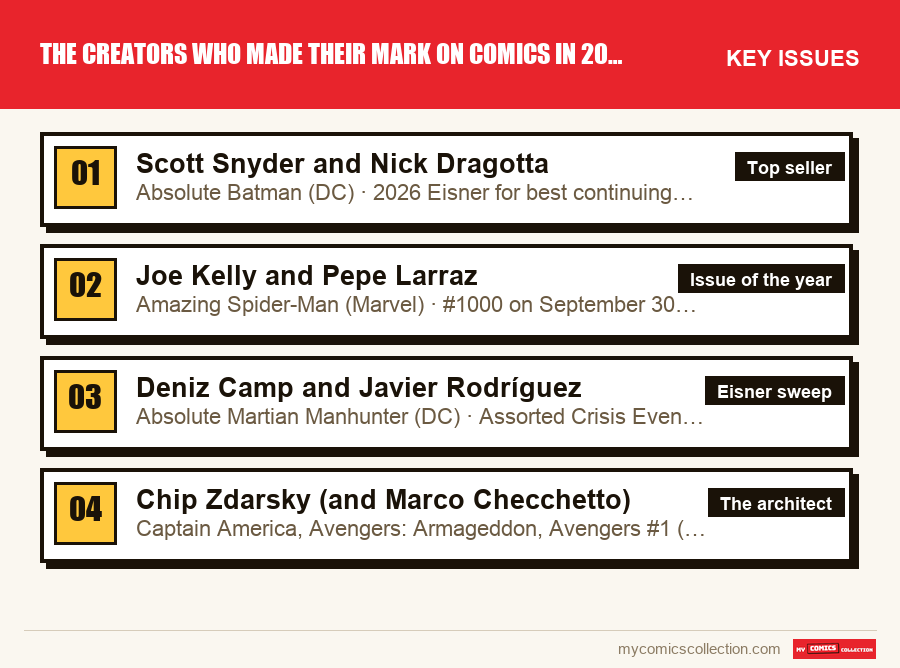
As of early October 2026, four teams dominate the year. Scott Snyder and Nick Dragotta, whose Absolute Batman won the Eisner for best continuing series and is approaching, according to its writer, 500,000 copies a month. Joe Kelly and Pepe Larraz, who write and draw the main story of Amazing Spider-Man #1000 (September 30, 2026, more than 400,000 copies ordered). Deniz Camp and Javier Rodríguez, honored for Absolute Martian Manhunter, with Camp also honored for Assorted Crisis Events. And Chip Zdarsky, whose Avengers: Armageddon event sets up the Avengers #1 of November 4. Behind them: Jason Aaron, Daniel Warren Johnson, Mariko Tamaki, Jamal Campbell, Jordie Bellaire and the trio of Kirkman, Casey and Kubert. For each one, this article gives the title of the year and what to reread from them.
"All-time" creator rankings have their value, but they answer a different question. This one is narrower: who, in 2026, moved readers, sales or juries? This review is closed as of October 3, 2026. It says nothing about the October to December releases, which nonetheless include several highly anticipated returns, and it prejudges no result.
Three sources of signal were cross-checked. Public order and print-run figures, when a publisher or a creator gave them. The Eisner Awards presented in summer 2026, which reward recent publications. And the publishing calendar, which shows whom publishers entrust with their most exposed launches. A creator who ticks two of these three boxes appears here; one who ticks only one is mentioned more briefly.
Why talk about creators rather than characters
2026 confirmed a shift that has been visible for a few years: readers increasingly follow a name on the cover rather than a costume. The clearest case is outside the big publishers. Terminal #1, a creation by Robert Kirkman and Joe Casey drawn by Andy Kubert at Skybound, was printed at 300,000 copies against an initial hope of 100,000, with a second printing on August 26, 2026. No well-known character carried this launch: only three names. Our analysis of original creations printed in large runs explains the phenomenon.
At DC and Marvel, the movement is the same but less visible, because it hides behind famous characters. Absolute Batman does not sell only because it is called Batman: the other Batman series of the same month do not sell like it. The difference is the team.
The four teams of the year
Scott Snyder and Nick Dragotta
Their series is the commercial engine of the year. Snyder puts it at around 500,000 copies a month, and it still held first place in the weekly chart at the end of September. The Eisner jury crowned it best continuing series, and Snyder was also nominated as best writer. A rare thing for a title of this weight, the series stops after #25 on October 28, 2026 and will not resume until #27 in February 2027, with the same team. Snyder also co-writes DC All In Saga: Darkseid vs. The World #1, announced for October 28.
Joe Kelly and Pepe Larraz
Joe Kelly has written Amazing Spider-Man since the new #1 of April 2025, and Pepe Larraz is the artist most associated with it, alongside John Romita Jr. and Ed McGuinness. Together, they do "Ravaged", the main story of #1000, 104 pages, more than 400,000 copies ordered, and the reveal of a new villain, Ravage. The issue sold out on its release day despite this volume, and a second printing is scheduled for October 28. Our reading guide to Joe Kelly's run details the arcs.
Deniz Camp and Javier Rodríguez
No name won as much in 2026. Absolute Martian Manhunter, a twelve-issue miniseries completed this year, received the Eisner for best limited series. Javier Rodríguez won those for best penciller and best cover artist. Deniz Camp, nominated as best writer for this series, for Assorted Crisis Events and for The Ultimates at Marvel, also won the prize for best new series with Assorted Crisis Events, drawn by Eric Zawadzki. Issue 4 of that series was also nominated as best single issue.
Chip Zdarsky (and Marco Checchetto)
Zdarsky spent the year building. His Captain America, launched on July 2, 2025, introduced David Colton; the five-issue miniseries Avengers: Armageddon turned Colton into Miracleman in its #4 of September 16, 2026; and the Avengers #1 he does with Marco Checchetto comes out on November 4, 2026, with a lineup public since August 20. Few creators are entrusted at once with a historic character and the relaunch of a publisher's flagship team. Our article on what to read before Zdarsky's Avengers sorts it out.
The other names of the year
Jason Aaron and Rafa Sandoval
Absolute Superman published its second collected edition in March 2026, its third is announced for November 3, and #25 of November 4 is presented as the end of a stage. Aaron remains one of the few writers able to hold a deeply established character by taking it up from scratch. Reread: his Thor, starting with Thor: God of Thunder in 2012. The detail of the Absolute Superman arcs is in our reading guide.
Daniel Warren Johnson
He won the 2026 Eisner for best single issue with Absolute Batman 2025 Annual #1, co-created with James Harren and Meredith McClaren, and his Chainkata, 40 pages with no ads, is announced at Image for November 2026. Johnson is the typical example of the complete creator, writing and drawing, whom the big publishers invite from time to time without locking him into one title. His career is told in our portrait of Daniel Warren Johnson.
Kelly Thompson, Hayden Sherman and Jordie Bellaire
Absolute Wonder Woman was nominated at the 2026 Eisners among continuing series, Kelly Thompson among writers, Hayden Sherman among pencillers. Colorist Jordie Bellaire, for her part, won the prize for best coloring, for a body of titles that includes Absolute Wonder Woman and Assorted Crisis Events. Sherman also draws the Legion of Super-Heroes #1 of September 2, 2026, written by Joshua Williamson.
Mariko Tamaki and Jamal Campbell
Mariko Tamaki received the Eisner for best writer for This Place Kills Me, drawn by Nicole Goux, who also won as best publication for teens. It is a rare signal: the writing prize went to a non-superhero graphic novel. Jamal Campbell won the one for best writer/artist with Zatanna, at DC. Two very different profiles, which remind us that the year cannot be reduced to sales figures.
Robert Kirkman, Joe Casey and Andy Kubert
The Terminal trio pulled off the biggest independent launch of the year. Joe Casey also writes Ben 10 at Dynamite, which passed half a million copies in five months. For a collector, these are figures to read with caution: a number 1 printed at this level will not be rare, whatever its fate.
Al Ewing and Jed MacKay
Two Marvel writers very present on the calendar. Ewing wrote the crossover Queen in Black, five issues from July to September 2026, and does Doom All-On-One #1, a 64-page one-shot planned for October. MacKay steers DNX, a five-issue crossover of the X-Men and the Fantastic Four begun on September 16, and follows in November with a Jean Grey miniseries.
The year-end returns, to watch without judging
Several major creators return between October and December 2026. It would be dishonest to rank them before reading their issues, but it would be incomplete to stay silent about them.
- Jonathan Hickman returns to the X-Men with Midnight X-Men #1, announced for October 7, 2026, in Marvel's horror line, Marvel Midnight. Our analysis of his return starts from his method, not from rumor.
- Dan Mora, an artist, writes his first script with Justice League: Dark Realm Special #1, on October 28. His portrait is on our page devoted to Dan Mora.
- Brian Michael Bendis and Michael Gaydos are reunited with Jessica Jones in December for the character's 25th anniversary; Paul Jenkins returns to Wolverine's origin, twenty-five years after Origin; Garth Ennis and John McCrea are reunited with Hitman on December 9.
A year-end review will say which of these returns kept their promises. In early October, these are dates, not results.
What this ranking says about 2026
Three lessons emerge. The first: DC's Absolute line alone concentrates a good share of the year's creators, to the point that three of the four main teams in this article worked or are working on it. It is proof that an imprint can become a workshop, provided you put creators in it rather than concepts.
The second: Marvel bet on long continuity. Kelly on Spider-Man since 2025, Zdarsky on Captain America then the Avengers, MacKay and Ewing on events linked to each other. Fewer spectacular launches, more patient constructions, with #1000 as the high point.
The third: juries and sales do not tell the same year. The 2026 Eisners honored Absolute Batman, which brings the two worlds closer, but also Mariko Tamaki, Jesse Lonergan for Drome or Jamal Campbell, who are not at the top of the sales charts. A curious reader is well advised to read both lists.
Sorting your collection by creator: how to
Choose a creator, not a series
Start from a name in this article and list their titles of the year, then their earlier runs. Joe Kelly's run on Spider-Man, for example, converses with his 1997 Deadpool more than you might think.
Note the exact role
Writing, art, cover only or colors: a variant cover signed by an artist is not an issue they drew. Note it on the record, otherwise your sorting by creator will be wrong.
Spot the gaps
A run is read in full. Compare your inventory to the list of the run's issues and note those that are missing, distinguishing what exists in collected form from what exists only as single issues.
Keep the reading date
A sort by creator becomes a reading journal if you note when you read each issue. That is what lets you make your own ranking at year's end.
To go beyond the single year of 2026, our all-era rankings of the best writers and the best artists place these names in a longer history.