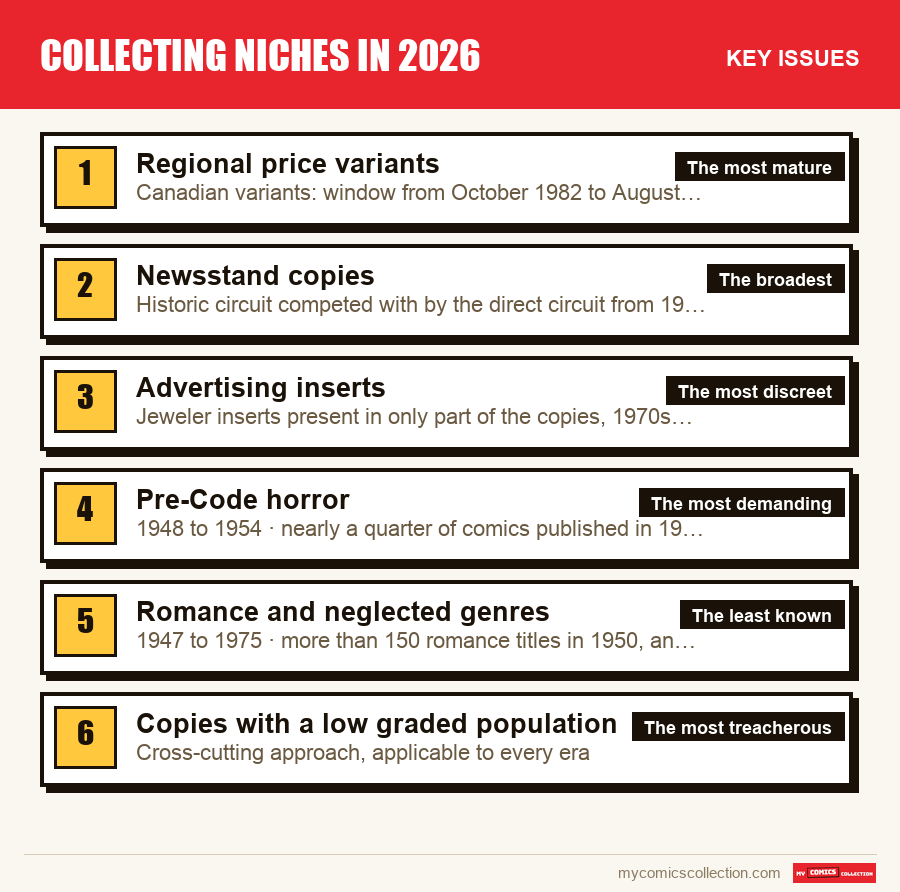
The segments attracting buyers in 2026 are no longer titles but categories of copies: regional price variants, newsstand print runs, copies carrying an advertising insert, genres that fell off the radar like pre-Code horror or romance, and issues with a low certified population. Three of these niches are recognized on a grading service's label, which gives them a name, an outline and comparable sales: the 1980s Canadian variants, the 1990s Australian variants and newsstand print runs. The others remain informal, hence riskier. The sorting rule that serves for everything: a niche exists as a market only if you can prove that a copy belongs to it, and if someone pays for that proof. Otherwise you are buying a curiosity, not a resalable object.
The prestige pieces of the comics market have left the field of vision of almost all collectors. This observation has become commonplace, and it is not the subject of this article. What is, is the practical consequence: when the top of the market closes, money and attention do not disappear, they move. They go looking for narrower, less documented objects, where precise knowledge replaces a big budget.
The problem is that this shift produces as many bad ideas as good ones. For each subset of copies that has become a real market, with a shared name, an identification method and measurable price gaps, there are about ten that remain oddities without buyers. The two look enormously alike from afar. In both cases people talk about scarcity, limited print runs, a detail invisible on the cover. What separates them can only be seen by asking the right questions, and those questions are the same for every niche.
This article serves as a front door. It goes through the segments people really talk about in 2026, gives for each a short definition, the profile of collector it suits and the main risk to know before buying. Then it offers the cross-cutting sorting grid, and ends with the point almost nobody addresses: resale.
Why niches have become the default playing field
There is a structural reason, and it has nothing to do with a fashion effect. For fifty years, the secondhand market was organized around a single identifier: the pair title plus number. You looked for an issue, you found it or not, and its condition set the price. In this system, two copies of the same issue in the same condition are the same object.
This system has stopped being sufficient. As grading services have written on their labels notations that distinguish copies previously lumped together, the market has gained a second dimension: with identical title and number, the category of copy becomes a price criterion in its own right. That is exactly what happens when a label carries the notation of a newsstand print run, a regional cover price or the presence of an insert. The name creates the category, the category creates the comparison, and the comparison creates the price gap.
Hence the situation of 2026: the interesting niches are almost never lists of issues. They are cross-cutting characteristics, applying to hundreds of issues at once. That is what makes them accessible, since you can find some in a low-priced box. It is also what makes them technical, since you have to know how to look.
The niches people talk about in 2026, one by one
For each: the definition, the profile it suits, the risk that characterizes it. Nothing more, because each segment deserves a separate file and those files exist.
Regional price variants
These are copies printed at the same time as the current edition, with strictly identical content, but whose cover box displays a price meant for another country. The two families recognized on label by CGC are the Canadian prices of the 1980s and the Australian prices of the 1990s, to which are added American price variants born from a price increase during distribution.
Who it suits: someone who likes physical verification and accepts digging. Identification is binary and requires no aesthetic judgment, which makes it the easiest niche to learn and the hardest to contest.
The main risk: the price gap is neither general nor guaranteed. The 2024 and 2025 sales reports compiled by the segment's reference guide give, on the most in-demand Canadian variants, a multiplier of about 2.5 times the current edition at grade 9.8, 1.6 times at 9.6 and 1.5 times at 9.4. In other words the premium concentrates in the high grades and evaporates below. Buying a regional variant in middling condition counting on its category is buying an ordinary comic for more.
Detailed files: recognizing a Canadian price variant, the 1976 and 1977 American price variants and the particular case of Incredible Hulk 181.
Newsstand copies
Two sales circuits coexisted for decades. The direct circuit, born when a bookseller offered publishers in 1972 to buy their comics directly rather than going through press distributors, became in the 1990s the main market of the two big publishers. The newsstand circuit, for its part, declined until it became residual, and its copies are generally recognized by the presence of a barcode where the direct edition carries another graphic.
Who it suits: someone who already collects a modern series or one from the 1990s and 2000s, and who can turn their existing collection into a rarer object without changing subject. It is the niche most compatible with an already built collection.
The main risk: the very breadth of the segment. Since the characteristic concerns tens of thousands of issues, it creates value only where the proportion of newsstand copies had become very low, that is, in the late periods, and on issues otherwise in demand. A newsstand copy of an issue nobody looks for remains an issue nobody looks for.
Detailed files: the difference between direct and newsstand edition and the authentication method.
Advertising inserts
Some copies received, at the time of distribution, an advertising insert stapled in their middle, aimed at a geographically or institutionally particular clientele. The best known is a jeweler's insert whose presence in only part of the print run was enough to make it a sought-after collecting subset; a second insert of the same kind, far less discussed, is listed on more than a hundred and fifty issues from one publisher of the 1970s.
Who it suits: someone who accepts flipping through. It is the only niche on this list whose identification requires opening the comic, hence the only one where the information advantage stays intact against a hurried seller.
The main risk: documentation is thin and the market narrow. The premium exists mostly on issues already coveted for another reason, and is almost nonexistent elsewhere. Another trap specific to this segment: a copy whose insert has been torn out may leave grading with an unfavorable label, which turns the asset into a handicap.
Detailed file: recognizing a copy carrying a jeweler's insert.
Pre-Code horror
A massive genre, brutally interrupted. The wave starts in fall 1948, when in the same period appear the first horror story from a publisher who will become the genre's reference and the first issue of a competing series devoted entirely to the fantastic. In 1953, nearly one comic in four is a horror title. The publication of a psychiatrist's book on April 19, 1954, the congressional hearings the following spring, then the creation in September 1954 of a publishers' association with a content code close the door: this code literally bans the use of the words horror and terror in a title, and fifteen publishers disappear over the summer.
Who it suits: a patient buyer who knows how to assess condition and detect restoration. The non-deacidified newsprint of the era makes condition more decisive than the title, which shifts all the required skill toward physical examination.
The main risk: undeclared restoration and the marriage of components. On seventy-year-old material, the price gap between two neighboring grades is such that the temptation to repair is permanent. It is the niche where buying without grading amounts to gambling.
Detailed file: collecting Golden Age horror.
Romance and neglected genres
Romance is born in 1947 with a title founded by two creators who already count in the medium's history, and becomes in three years one of the most printed genres of all time: more than a hundred and fifty titles in 1950, and more than one comic in four published in the first half of that year. The genre fades out in the mid-1970s with the last issues of its two flagship series. The same reasoning holds for the western, war, crime and humor.
Who it suits: someone who collects out of documentary curiosity rather than anticipating resale. Entry prices are low, the supply is real, and the intellectual satisfaction is immediate.
The main risk: the absence of organized demand. These titles combine a massive original print run and a very low survival rate, because a readership that did not consider itself collectors kept nothing. The scarcity is therefore authentic, but it is not sought after, which is the worst of both worlds for anyone who wants to resell in the short term.
Detailed file: romance and forgotten genres.
Copies with a low graded population
It is not a segment but a selection method: looking for the issues whose certified population is low, all categories combined, on the assumption that a low number will eventually be recognized as a scarcity. The practice has spread as population lists became freely consultable.
Who it suits: a collector who already has a field and uses it to refine purchases within that field. As a tiebreaking criterion between two equally desired copies, the population figure is useful.
The main risk: mistaking this figure for an inventory. The grading service says it itself in the notice accompanying its reports: this data only reflects quantities already graded and is not an indicator of value or scarcity, and the report must not serve as the basis for a purchase or an investment. A low population can mean impossible to find just as it can mean nobody thought it worth paying to have the object graded. The two figures look alike, the two markets have nothing to do with each other.
Detailed files: how to read a certified population and what the census says and does not say.
Two neighboring segments deserve a mention without deserving a file. Editions sold in pre-packaged bags outside the press circuit, in the department stores of the 1970s and 1980s, fall under exactly the same logic as newsstand print runs, with often greater scarcity and narrower demand: the subject is covered in our file on multipack editions. And issues withdrawn from sale by editorial decision make up a niche of their own, where scarcity is manufactured by an event rather than by distribution, with the hype that implies: see recalled comics.
What distinguishes a viable niche from a dead end
The six segments above are not equal, and the difference comes neither from their age nor from their scarcity. It comes from five conditions, which apply in this order. A niche that lacks even one is not necessarily without interest, but it is no longer a market.
The category has a shared name
As long as a subset of copies has no name that seller and buyer use the same way, it cannot be searched for, hence cannot be demanded. It is the first thing that happened to regional price variants, and it is what is still missing from many printing curiosities. A detail without a name remains a detail.
Membership is proven in ten seconds
The proof must be visible, objective and indisputable: a printed price, a barcode, an insert present or absent. As soon as membership depends on an appreciation, a shift in tint or a margin measurement, the segment attracts disputes and counterfeits, and remains confined to a circle of experts that does not constitute a demand.
An independent third party records the category
It is the clearest tipping point. When the notation appears on a grading label, it becomes a search criterion, a sorting filter and a sales comparison line. It stops depending on the seller's word. The niches on this list that have this recording behave very differently from those that do not.
The price gap is measured, not told
You must be able to observe, over several successive sales of the same issue in the same grade, that the category makes a difference. And you must look at which grade this difference appears at: on regional variants, the premium noted is strong at 9.8 and becomes marginal two grades lower. A niche whose premium exists only in very high grade is a high-budget niche, whatever the apparent entry price.
Demand comes from beyond the segment itself
A niche that sells only among its own specialists is a closed circuit. The segments that hold are those where the final buyer first looked for a specific issue and agrees to pay a surcharge for the category. That is why almost all real premiums concentrate on issues already in demand for another reason, and almost never on ordinary material.
This grid explains in passing why the niches most promising on paper are often the most disappointing. A subset nobody has talked about yet rarely meets conditions 1 and 3, by definition. Being the first to identify a category is intellectually satisfying and commercially uncomfortable: you then have to convince the market, which takes years and does not always succeed.
Liquidity, the risk nobody quantifies
All discussions about niches concern the purchase price and future value. Almost none concern the most concrete question: how long does it take to turn the object into money, and at what discount.
Yet the mechanics are brutal and perfectly predictable. The narrower a segment, the fewer buyers present simultaneously; the fewer the buyers, the longer the interval between two sales of the same object; the longer this interval, the more the observed price depends on the chance meeting of a seller and an enthusiast. It is visible in the price indexes published on the secondhand market. In the September 25, 2026 report, the Golden Age comics index advances in clean steps, separated by long flat periods, because each individual sale is enough to move the average; at the same time, the Bronze Age comics index rises in small regular steps, because transactions there are numerous. Both indexes are rising. They do not describe the same risk at all.
Three practical consequences follow, and they hold for the six niches above.
The holding horizon is not negotiable. On a narrow segment, reselling within the year forces you to sell to whoever is available, not to whoever pays the best. The gap between the two is the real cost of the niche, and it is far greater than what you save by buying outside the expensive zones.
An observed price is not a market price. On an object that changes hands once every two years, the last sale tells you about a meeting, not about a value. Basing a purchase on a single comparable is the most frequent mistake, and it is all the easier to make since niches produce few comparables.
The proof must travel with the object. It is the most often neglected point. If membership in the category is not attested by a third party, it is you who will have to demonstrate it at each resale, to a buyer who has no reason to believe you. On the segments where the label exists, the cost of grading is not a prestige expense but a liquidity expense.
Where to start, depending on what you already are
The choice of a niche should never start from supposed potential, but from what you own and already know. Three cases cover most situations.
You have a modern collection or one from the 1990s and 2000s. Look at your own boxes before buying anything. The question of newsstand print runs applies directly to what you have, and it is likely that you own some without knowing it. It is the only way into a niche that costs nothing and teaches you something from the first evening.
You hunt at flea markets and garage sales. Regional price variants and inserts are made for you, because the advantage there is an advantage of the eye, exercised on stock nobody has sorted. It is the only place in the market where two hours of knowledge still turns into a price gap at purchase.
You aim at a heritage object and accept devoting time to it. Pre-Code horror and neglected genres are the most intellectually rich segments, but they demand a skill in material appraisal that nothing replaces. Start by reading the stories in modern collections, then buy ordinary issues in modest condition to get your hand in on the paper of the era, and only aim at a known cover once you can spot a restoration.
In all three cases, a single discipline makes the difference over ten years: writing down what you buy, in which category, on what proof, and at what price. A niche is managed as an inventory of characteristics, not as a list of titles, and that is precisely what a hand-kept collection always ends up losing. Our collection tracking app is designed for this, and an estimate lets you check coldly where the whole stands.