A Mark Jewelers insert is a four-page advertising insert, stapled in the center of the comic, that promoted engagement rings and jewelry to American military personnel. Documented sources place these inserts between 1972 and the mid-1980s, some extending into the early 1990s, at Marvel, DC and Gold Key. The copies concerned went to military base outlets, in the United States and overseas, which makes them a subset of a subset: starting with issues dated October 1980, the insert appears only in newsstand copies, already a minority. CGC mentions the insert on the label, and a copy whose insert was torn out may come back with a green "qualified" label. The premium exists, but it is very uneven: strong on a coveted key issue, close to zero elsewhere.
In American comics there is a category of objects that almost nobody looked for when they were circulating, and that nobody really looks at even today in France. Mark Jewelers inserts are one of them. They are jeweler advertising pages, printed on paper thicker than the rest of the issue, inserted in the middle of some copies and only some. Nothing on the cover announces them. Nothing in the contents mentions them. You have to open the comic, or look at its edge, to know.
This discretion is exactly what makes the subject interesting, and what makes it tricky. Interesting because an object you do not notice is an object you do not keep: the mortality of these copies has been high, and their scarcity is real. Tricky because scarcity alone does not create value, and because the literature available on the subject is thin, scattered, sometimes contradictory. This article therefore makes two promises: to give you an identification method that works, and to tell you honestly where what is established stops.
A jeweler, soldiers, and a very targeted commercial idea
The starting point is an advertising operation classic in its mechanics and singular in its target. Mark Jewelers was a jewelry retailer that struck a deal with comics publishers to have an insert slipped into some copies promoting engagement rings, wedding bands, watches and necklaces. The target was not the average teenage reader: it was the American serviceman on post, far from home, likely to buy a piece of jewelry for someone back home.
The commercial reasoning reads effortlessly. Comics were a mass-market product present in base outlets, including overseas. The military readership was young, often single or recently engaged, had a regular paycheck, and was geographically cut off from the shops where they would otherwise have made this purchase. A stiff insert in the middle of a twenty-five or thirty-five cent issue reached this population for a trifling cost. The operation was, in its logic, perfectly rational.
On the advertiser itself, however, we must be frank: documentation is almost nonexistent. Research published by collectors who tried to trace the company stopped for lack of traces. An investigation published in 2021 tells precisely of this failure: the author found neither a birth record nor a death record for the company, and the namesakes contacted had no link to it. Several sources mention a company of the same name in California, but one of them notes that this company was created in 1981, several years after the first inserts, which makes the connection doubtful. There are also jewelers whose name is spelled slightly differently, with no established link.
In other words: the object is documented, the advertiser is not. It is an unusual asymmetry, and it explains part of the haziness surrounding this niche. When the issuer of a variant is a publisher, you can reconstruct print runs, contracts, internal memos. When it is a vanished advertiser, only the copies themselves remain.
The period and the publishers: what is established, what varies by source
The time boundaries differ from one source to another, and it is better to present this gap than to hide it.
The most often cited reference places the inserts between 1972 and 1986. Collector censuses identify copies as early as issues dated August 1972, citing notably Action Comics #415 and House of Secrets #99 as the earliest spotted at DC. A survey devoted to licensed series documents a range from November 1972 to July 1986. Other sources, notably specialty shops, extend the practice to the early 1990s. Part of this disagreement probably comes from method: identifying the last insert assumes having gone through entire series, copy by copy, which nobody has done exhaustively.
On publishers, the consensus is clearer. Marvel and DC are systematically cited. Gold Key appears in the earliest surveys, with a useful nuance: some early-1970s Gold Key issues contained a one-page Mark Jewelers ad, printed on the issue's ordinary paper, and not a separate insert. Those copies are not a variant, since the entire print run carried them. The distinction is fundamental and worth retaining: what makes the variant is not the presence of a jeweler ad, it is the presence of a physically separate insert that only part of the print run received.
Another structuring observation appears in the surveys: starting with issues dated October 1980, Mark Jewelers inserts appear only in newsstand edition copies. This does not come from an advertiser decision but from the reorganization of American distribution, in which the network of specialty bookstores gradually separates from the press network. For anyone who already knows the distinction between newsstand and direct edition, the consequence is immediate: on issues after that date, a copy with an insert is necessarily a newsstand copy, and the scarcity of the insert adds to that, already real, of the newsstand.
Why these copies are rare: three successive filters
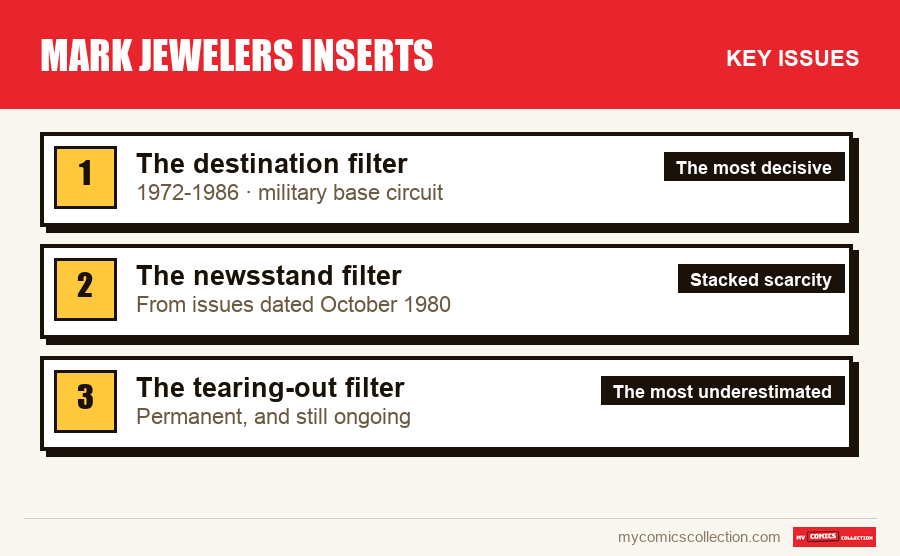
The scarcity of copies with an insert does not come from a limited print run decided by the publisher. It comes from the stacking of three independent filters, and that is what makes it hard to quantify.
The destination filter
Only a fraction of the print run received the insert, and that fraction went to the outlets of American military bases, on national territory as well as overseas. A reader who bought his comic at an ordinary drugstore had no chance of coming across a copy with an insert. The geography of distribution, not the print run, is the first factor of scarcity.
The newsstand filter
In the second half of the period, the insert exists only in the newsstand edition. Yet the newsstand itself becomes a minority over the 1980s, as the specialty bookstore absorbs the market. Looking for a copy with an insert on a 1984 issue therefore amounts to looking for a subpopulation of an already reduced population. It is what an observer described as a multi-tiered scarcity, hard to track.
The tearing-out filter
The insert is stiff. The first versions were printed on cardboard, the later ones on thick glossy paper. In both cases, the issue is hard to flip through and opens crookedly. Many readers therefore simply removed the insert to read comfortably. Each tearing-out destroys a variant without destroying the comic: the copy survives, the peculiarity disappears.
That leaves the question of the number. You sometimes read that about 2% of the print run received the insert. This estimate circulates in reference works, but it is presented as an opinion and not as a measurement. The most cautious collector censuses say something else: the ratio between ordinary copies and copies with an insert is unknown, and you can only observe that the latter are markedly fewer. That is the honest wording, and the one to adopt. If you want to reason seriously about these volumes, it is better to use the general methods of print run and scarcity estimation than to repeat a percentage whose source nobody knows.
Identification method: six steps, in this order
Identification is within anyone's reach, provided you proceed in the right order and do not skip the edge step, which is the quickest.
First check the date window
Look at the date in the indicia, at the bottom of the first page. If it is before 1972 or after the end of the 1980s, the insert hypothesis becomes very unlikely and you can stop there. This reflex will save you from inspecting hundreds of issues for nothing. On issues after October 1980, add a second condition: the copy must be a newsstand edition, identifiable by its barcode.
Examine the top edge, comic closed
It is the most effective and least risky step. Set the closed issue down and look at the top edge in raking light. An insert on thick paper creates a visible band in the middle of the thickness, often of a different shade from the surrounding newsprint. Collector descriptions speak of a band of heavy stock, sometimes bluish, spottable without opening the comic. This inspection handles nothing and therefore cannot damage the staples.
Open at the center, on a flat surface
The insert is stapled at the center of the issue, at the location of the centerfold. Open the comic flat, without forcing the spine, until you reach the middle. The insert stands out on its own: it is stiffer, glossier, and its format may be very slightly different from that of the comic's pages. Never fold the cover backward to go faster: that is the move that creates spine creases.
Count the pages and read what they announce
The typical insert is about four pages of advertising, devoted to rings, wedding bands, watches and necklaces. The content must be a jewelry ad in the name of Mark Jewelers, not just any jewelry ad. Other inserts of the same kind existed for other advertisers in the sector, on early-1970s issues: a jewelry ad on thick paper is therefore not, by itself, proof of a Mark Jewelers.
Tell the insert from a simple ad page
If the jeweler ad is printed on the issue's ordinary paper and is part of the normal pagination, you do not have a variant: the whole print run carried it. That is the documented case of a few early-1970s Gold Key issues. The criterion is physical and unambiguous: the insert is a separate signature, on another paper, added at the time of assembly.
Look for an insert code, then record the result
The most detailed surveys note the presence, on some inserts, of a small alphanumeric code that distinguishes successive versions of the ad. This level of detail interests only a handful of specialists, but it exists. In every case, finish by writing down what you found in your inventory, next to the issue concerned: insert present, absent, or partially torn out. Without this note, the information will be lost at the first reshelving.
When the insert has been removed: what that really changes
This is the point where the niche stops being a curiosity and becomes a question of serious appraisal, and also the one where you must be the most careful.
A copy whose insert has been torn out poses a problem of a particular nature. It is not an ordinary condition flaw, like a crease or a discoloration: it is a missing page. Yet a missing page is not treated by grading services as wear, but as incompleteness. Observations reported by collectors indicate that CGC assigns in this case a green label, called "qualified," which explicitly signals that the copy is incomplete relative to what it should be. The same principle applies more broadly: an insert stapled into the issue is part of the object, and its absence is noted.
Two practical consequences follow, and they go in opposite directions.
The first is unpleasant. If you hold a newsstand copy of an issue known to have received inserts, and the centerfold is missing, your copy is not simply an ordinary copy: it may be perceived as a copy with an amputated insert, with the label that goes with it. On a sought-after issue, this distinction matters.
The second is a warning against repair. The idea of gluing a found insert back in its place seems tempting: it is to be avoided absolutely. Interventions of this type fall under restoration, and restoration is flagged by a label distinct from that of incompleteness. Trying to fix an incompleteness flaw by adding material amounts to swapping one flag for another, generally less well received. The rule is simple: you add nothing to a collectible comic, and you remove nothing either. The detail of these label categories is covered in our guide on CGC grading.
One last precision, and it is important so as not to over-interpret: collector sources note that the insert is mentioned on the label, but also that this mention has sometimes been omitted, forcing owners to have their copy relabeled. The absence of a mention on an old label therefore does not prove the absence of an insert. It is counterintuitive, and a frequent source of error in this niche.
The effect on value, and why it is so uneven
Here is the part where honesty matters most, because it is the one that collector discussions distort most readily.
The premium exists, and it is documented on specific issues. The most often cited example concerns Werewolf by Night #32, first appearance of Moon Knight. A survey published by a price-tracking service indicates that a copy graded 6.5 with a Mark Jewelers insert sold on October 31, 2020 for $1,975, whereas the estimated market value of an ordinary copy of the same grade stood around $975. The gap, on that sale, is of the same order as the value of the comic itself. It is a real, dated, documented case.
But the counterpart must be set immediately, and it is massive: this case is not representative. On most issues, the insert produces nothing at all, or so little that the gap is lost in the normal dispersion of prices. The same surveys that document the premium on a key issue mention elsewhere copies with inserts of average series sold at levels barely distinguishable from those of ordinary copies, even down against earlier transactions. The most lucid commentators of this niche say it bluntly: scarcity is present everywhere, but the premium only materializes where a buyer makes it exist.
The mechanism is in fact simple to understand, and it holds well beyond Mark Jewelers. A copy peculiarity does not create demand, it segments it. On an issue where thousands of people compete for copies, a rare subcategory provides a tiebreaking criterion, and the price moves apart. On an issue where demand is weak, the same rare subcategory breaks no tie, because there is nobody to separate. The insert therefore does not manufacture value: it amplifies a value that already existed. It is the logic found throughout the field of edition peculiarities, and that we detail in the guide to cover variants.
Three factors concretely explain the observed inequality.
First the issue itself. A major first appearance attracts a population of buyers large enough that a fraction of them cares about peculiarities. A mid-series issue attracts nobody of that profile. That is why the lists of issues with inserts that circulate among collectors are almost all lists of issues already key for other reasons: issues of Uncanny X-Men, of New Mutants, or of Amazing Spider-Man. The insert there is a supplement, not the subject.
Then the grade. On a high-graded copy, the combined scarcity of the insert and the condition creates a population of a few dozen copies, sometimes fewer, and that is where price gaps become visible. On a mid-grade or damaged copy, the insert changes practically nothing, because the buyer of a reading copy is not buying a peculiarity.
Finally the notoriety of the peculiarity itself. A variant known to everyone trades with a stable gap, because everyone knows what it is worth. A variant known to a handful of people trades erratically: depending on whether the seller knows what they are selling, and whether the buyer knows what they are buying, the same object can go at the price of an ordinary copy or at double. Mark Jewelers inserts are still in this second situation, and that is precisely what makes them a niche.
Who this niche makes sense for, and who it does not
We must say clearly why this subject remains marginal, because the reasons are structural and will not disappear.
The first reason is invisibility. A cover variant is seen from a meter away; an insert is not seen at all. A peculiarity you cannot show without opening the object, and cannot show at all once the object is sealed, spreads poorly. It exists only through the mention on a label, that is, through an intermediary.
The second reason is the fragility of the corpus. Since nobody collected these copies at the time, nobody drew up the complete list. There is no exhaustive census of the issues concerned, only partial lists drawn up by collectors from their own finds. This lack of a reference prevents the niche from structuring itself: you cannot collect methodically a set whose outlines are unknown.
The third reason is cultural and holds particularly in France. The driver of this collection is partly memory-based: it touches on the lives of American servicemen on garrison, on bases whose names mean nothing to a French reader, and on a commercial practice specific to this context. This dimension, which feeds interest in the United States, does not transpose.
That said, this niche makes precise sense for three profiles.
The collector who already works on newsstand copies finds a natural extension in it. If you are inspecting barcodes and dates of your 1980s copies anyway, adding a glance at the edge costs nothing and may bring a peculiarity to light in a lot already bought. It is the best ratio between effort and result of the whole subject.
The bargain-bin hunter finds an information advantage in it. In a market where most sellers do not look at the edge, knowing how to look is a real advantage. The testimonies of collectors who describe finding a copy with an insert in a low-priced bin are not legends: they are the direct consequence of the fact that the information is not shared.
The long-haul collector on a single series finds an additional goal in it. If you are completing an entire series from the 1970s or 1980s, the insert version of a few issues is a coherent extension, in the manner of a second layer laid over an already assembled set. It is a long-term project, not an operation.
On the other hand, this niche makes no sense for anyone seeking a return. Inserts are neither documented enough, nor liquid enough, nor uniformly valued enough to make up a strategy. Someone who buys a copy with an insert hoping for the premium observed on a key issue is setting themselves up for disappointment on the other ninety-nine.
How to record the thing in a collection
One last practical point, often neglected, and which determines whether all this identification work is of any use.
An invisible peculiarity vanishes from a collection's memory within a few months. You spot an insert, you are pleased, you shelve the comic, and two years later you no longer know which of your three copies of that issue carried it. The problem is not identification, it is the trace.
The good practice is to treat the copy with an insert as a distinct entry in the inventory, and not as a note thrown into a comment. Concretely: one line per copy, with the mention of the insert, its condition, and if possible a photograph of the edge and of the centerfold. The photograph of the edge has a particular use: it is the proof you will be able to show without opening the issue again. It is exactly the kind of information that a collection tracking app is made to retain, and that the paper index card file systematically loses.
You must also record the negatives. Noting that a specific copy does not carry an insert is as valuable as the reverse, because it spares you from reinspecting it. On a series of a hundred and fifty issues in the right date window, the difference between a kept inspection list and one not kept represents several hours of redone work.
Finally, a preservation recommendation. If you hold a copy with an insert, the main risk is not wear but accidental removal, by you or by someone else. A comic with an insert opens badly, and it is by forcing it open that the centerfold gets torn out. Handle it flat, limit consultations, and if the copy has value, consider that a rigid sleeve here protects the peculiarity as much as the condition. A prior estimate will tell you whether this precaution is justified for the copy you hold in your hands.