A Canadian price variant is a copy printed in the United States, at the same time as the standard edition and with the same content, but whose cover box shows a higher amount in Canadian dollars. The documented window begins in October 1982 at both major publishers and closes in August 1986 at Marvel, in September 1988 at DC. The most common price pair is 60 American cents against 75 Canadian cents. These copies exist only in the newsstand channel, therefore with a barcode, and their indicia page is strictly identical to the American edition's. In the June 2026 census, they account for 2.8% of certified Marvel copies and 3.1% of DC for the 1980s decade. Since May 2019, the CGC label has carried the notation "Canadian Price Variant" followed by the cover price.
There is a category of copies in 1980s North American production that almost all collectors have handled without seeing it. They are perfectly ordinary comics: same paper, same ink, same pagination, same ad for the same candy, same issue. Only one thing separates them from the edition everyone knows, and it fits in a rectangle of two square centimeters at the top of the cover. The amount printed there is not the American one, it is in Canadian dollars, and it is higher.
This detail took some thirty years to become a subject. For a long time, a buyer who came across a 75-cent copy in the middle of a pile of 60-cent ones put it back, or bought it without thinking, because nothing in the secondary market's vocabulary gave him a name to put on it. Since the late 2010s, that name exists, grading services write it on their labels, and measurable price gaps have set in between the two printings. The niche has become serious, which does not mean it is easy.
This guide does not try to convince you to enter this segment. It answers two practical questions, in this order: how to recognize one of these copies with certainty when you have it in hand, and how to decide whether it deserves a place in your collection rather than someone else's.
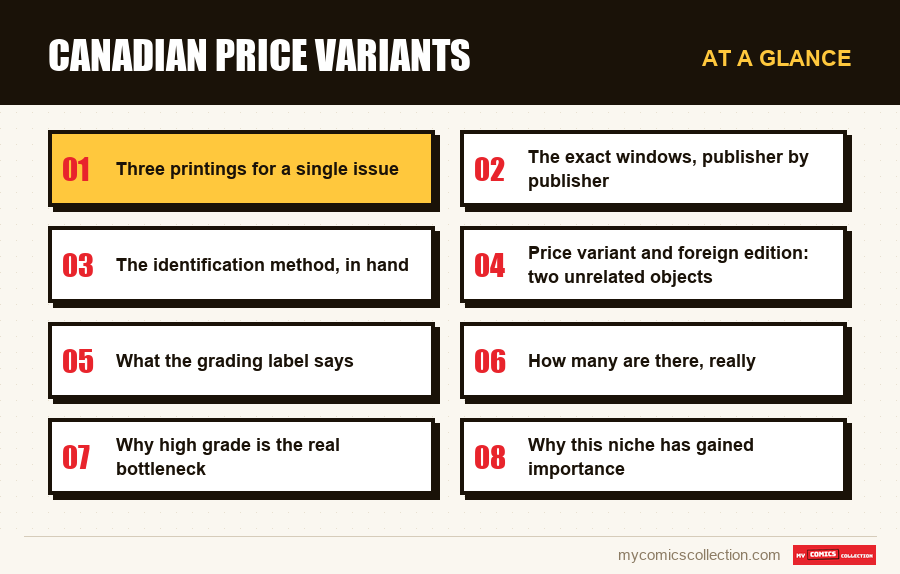
Three printings for a single issue
To understand where this category comes from, remember that in the early 1980s an American publisher manufactures the same issue for two very different sales networks. On one side the direct market, that is, specialty shops, which order firm and do not return unsold copies. On the other the newsstand, that is, mass distribution, grocery stores, drugstores, gas stations, where unsold copies go back and are destroyed.
These two networks already receive distinct covers: the direct market carries an insert with a logo in place of the barcode, the newsstand carries the full barcode at lower left. This distinction predates and goes well beyond our subject; it is treated in detail in the guide on the difference between direct edition and newsstand edition.
What happens from October 1982 is different. Parity between the two North American currencies has deteriorated to the point where a single price shown in dollars no longer holds on both sides of the border. The publisher then makes a very simple production decision: it prints two lots of newsstand covers instead of one. One lot with the American amount, meant for U.S. newsstands. One lot with a higher Canadian amount, meant for Canadian newsstands. Technically, only the black plate changes, the one carrying the text. All the rest of the printing is shared.
For an issue published in this window, there are therefore three legitimate objects, all first printings: the direct market copy, the American newsstand copy, the Canadian newsstand copy. The third is the one that concerns us. It is neither a reprint, nor a reissue, nor an object produced after the fact: it comes off the same press, the same week, with the other two.
The exact windows, publisher by publisher
This is the point on which approximations are most frequent, and it deserves to be laid out precisely because it conditions everything else.
At Marvel, the window runs from October 1982 to August 1986. Forty-seven months of publication, which represents a considerable number of issues, including several of the most sought-after pieces of the period.
At DC, the window runs from October 1982 to September 1988. Same starting point, but a much later exit: the publisher kept the practice two years longer than its competitor. A collector who mechanically applies the 1986 date to DC titles therefore misses two entire years of production, including a not-negligible part of the series that matter for the end of the decade.
Outside these windows, price variants exist at both publishers, but they follow other logics and are not recognized the same way. The 30 and 35 cent copies of the mid-1970s, for example, come from price tests run on American territory and are covered by the guide devoted to 30 and 35 cent variants. Further back still, the true Canadian editions of the 1940s and 1950s are another matter entirely, and we come to them.
The identification method, in hand
Five checks are enough, and they are done without equipment. Order matters: each eliminates a possible confusion.
Read the cover's price box
The printed amount is the only visible clue, and it must be higher than that of the American edition of the same issue. The most common pair of the period is 60 American cents against 75 Canadian cents, and this 75-cent amount is also the first that was identified as a category by collectors. But cover prices moved during these six years: the exact pair depends on the issue, never on a general rule. If you do not know what the American price of this specific issue was, conclude nothing at this stage.
Check for the barcode at lower left
This category exists only in the newsstand channel, with very rare exceptions. A copy carrying the direct-market logo insert in place of the barcode is therefore not one, whatever the price shown. This one check eliminates most good-faith errors, because it is binary and requires no knowledge of the issue.
Confirm the expected price with a direct-market copy
It is the most useful trick of the lot, and it is counterintuitive. On many direct-market copies, the Canadian price is printed in small characters next to the American price, because that copy could be sold in shops on both sides of the border. This small amount gives you exactly the price the Canadian newsstand variant of the same issue should carry. You thus have an internal reference, drawn from the object itself, without depending on any outside database.
Open to the indicia page
The indicia must designate the American publisher, with its New York address for Marvel, and carry the same date and the same volume number as the standard edition. The interior pages must be strictly identical, ads included. This is not a check of the variant: it is a check of the opposite, the one that proves you do not have a complete foreign edition in hand. If the indicia names another publisher, or mentions a local edition, change categories.
Look at the cover under raking light
Last step, the least pleasant. Since the printed amount is the only thing that distinguishes a common copy from a rarer one, it is also the only thing a forger needs to modify. A retouched, repainted or recomposed box betrays itself under oblique light: different grain, ink that does not sink into the fiber the same way, character edge too sharp or too blurry relative to the rest of the cover text. On a valuable copy, physical examination is not optional.
Price variant and foreign edition: two unrelated objects
The costliest confusion is not between two American printings, it is between a price variant and a true foreign edition. Both can present themselves as a "Canadian copy", and they are radically different objects.
In the 1940s and 1950s, restrictions prevented American publishers from selling their issues directly in Canada. The solution of the time was to send the printing plates north and let a Canadian publisher manufacture the issue on site. The result is a distinct edition: content sometimes reworked, local ads, its own printing quality, and above all a Canadian edition mention in the indicia. It is a foreign publication, in the full sense, and it is collected as such.
The 1980s price variant is the exact opposite of this logic. It is not manufactured in Canada, it is shipped there. It has no content of its own, it shares everything. Its indicia is that of the American publisher. It crosses the border as a finished product. It is precisely to avoid this confusion that the terminology on certification labels changed, which brings us to the next point.
There is a third source of confusion, which must be known without dwelling on it here: British copies whose price is expressed in pence. Same apparent principle, a foreign amount on an otherwise identical cover, but an entirely different distribution history, periods and market economy. The two categories are not valued at all the same way, and treating them together is the best way to be wrong about both. A separate guide in the same batch is devoted to them.
What the grading label says
The label vocabulary has considerable practical importance in this segment, because it is what makes a copy identifiable, therefore searchable, therefore comparable to others.
Before May 2019, CGC wrote the notation "Canadian Edition" on its labels. The wording was misleading: it suggested a foreign edition, exactly the category these copies do not belong to, and it glossed over the fact that this is an American first printing. From the week following May 5, 2019, the notation became "Canadian Price Variant", with the cover price shown on the right part of the label, for example 75 cents.
Two concrete consequences for a buyer. First, a copy certified before this date carries a label with the old wording without that changing anything about the object: do not read "Canadian Edition" as a sign of a problem. Second, the price on the label is information verifiable at a distance, and it is the only one of the lot. On a remote purchase, a slab whose label shows the expected amount gives you a certainty that the best cover photograph will never give.
How many are there, really
It is the question that interests everyone and the one where the most nonsense is told. No publisher published print-run figures per cover lot. What exists are two approaches, and you have to know which one you are citing.
The first approach is a population reasoning. The Canadian market represented about a tenth of the American market. Starting from the known print runs of a popular series of the period, assuming a roughly equal split between direct market and newsstand, then applying this one-tenth ratio to the newsstand share, you get a few thousand Canadian copies per issue. For a series like Batman in the mid-1980s, whose monthly print runs were between about 75,000 and 98,000 copies, the calculation gives an order of magnitude of 3,800 to 4,900 Canadian copies per issue.
This reasoning was refined in an interesting way. A significant part of the Canadian population was French-speaking and did not read English: in the 1986 census, about 17% of the country's inhabitants could not carry on a conversation in English, and Quebec also had French editions from the major publishers. These readers therefore did not buy, or very little, English-language issues. Correcting the Canadian market share for this effect brings it down to a bit under 9% of the potential English-speaking readership, and the authors of this analysis arrive at a distribution share of about 3.6%.
The second approach is a count. In the census of CGC-certified copies closed in June 2026, Canadian price variants represented 2.8% of Marvel copies of the 1980s decade and 3.1% of DC. The best-represented issues are very few: the most certified at Marvel has about 946 copies in Canadian variant, the next about 724. At DC, the top three hover around 177, 113 and 107 copies. Below this leading pack, we are talking about dozens of certified copies, sometimes fewer.
These two approaches do not measure the same thing and you have to remember it. The first estimates what was printed, the second counts what was submitted for certification. They nonetheless converge on the same order of magnitude, around 3% of production, and it is this convergence that gives the figure its credibility.
Why high grade is the real bottleneck
Print scarcity is only half the story. The other half comes from the distribution network, and it is more decisive.
These copies were sold in grocery stores, convenience stores, drugstores. They were stacked in metal spinner racks, thumbed through by customers who did not buy them, folded in shopping bags, read by children who did not protect them. During the same years, direct-market copies went off to specialty shops, to a clientele that already knew how to shelve them flat in bags.
The result is an asymmetry of survival, not only of print run. Applying to the previous estimates a survival rate in very fine condition of about one fifth, then taking returns destroyed into account, you arrive at orders of magnitude of a few dozen copies per issue in the high grades. This is where all the segment's interest comes from: not from a small printed quantity, but from an extremely small surviving quantity in fine condition.
This has a direct consequence on how you buy. In this segment, the price gap is not spread uniformly along the grading scale, it is concentrated at the very top. The certified sales surveys compiled for the year 2025 on issues having both Canadian variant sales and American edition sales give a ratio of about 2.5 times at grade 9.8, about 1.6 times at 9.6 and about 1.5 times at 9.4. In other words, the premium exists across the whole scale but becomes really significant at the summit, and only there.
Reading these multipliers correctly
These ratios are averages computed over issues that have enough documented sales in both versions to be compared. They do not constitute a grid applicable to a given issue. A little-demanded title may show no premium at all, because there is nobody to pay it. A highly sought-after issue may on the contrary far exceed the average, because two determined collectors are enough to set a price in a market this narrow.
Why this niche has gained importance
The movement is recent and it has identifiable causes, which have almost nothing to do with the comics themselves.
The normalization of vocabulary. As long as these copies had no standard name, they were invisible in listings and catalogs. You cannot search for what you cannot name, and you cannot compare two prices if the two objects carry the same description. The inscription of a distinct notation on certification labels, then its adoption in auction descriptions, turned a curiosity into a market category. It is a documentary evolution that produced an economic effect.
The rise in value of the newsstand channel in general. The realization that newsstand copies are markedly rarer than direct-market copies, especially in fine condition, spread over the same period. It set up a barcode-checking reflex in many buyers, and the Canadian variant is a subset of the newsstand channel: it benefited from the same movement, more markedly. This reasoning is developed in the guide on recognizing and authenticating newsstand copies.
Gaps that became visible. When public sales reveal substantial differences between two copies of the same issue at the same grade, the category stops being theoretical. An April 2022 public sale saw a Marvel annual of the period reach $15,000 in Canadian variant, which served as a landmark for the segment. This kind of result says nothing about the value of the issue you own, but it explains why buyers started looking at price boxes.
A shift of attention. The great pieces of the 1960s and 1970s have left many collectors' budgets. 1980s production remains accessible, and seeking the rare printing of an affordable issue is a way to keep collecting scarcity without devoting an investor's budget to it. It is probably the segment's most solid driver, because it is structural.
The limits, to know before buying
Nothing above makes this niche a good investment, and it would be dishonest to stop at the pleasant part of the file.
The market is narrow, in the literal sense. The number of people who know what a Canadian price variant is, who actively look for it and who are ready to pay a premium to get it is counted in thousands, not hundreds of thousands. A scarcity with no buyers is not an asset, it is a rare object. The value of a copy in this segment depends more on the existence of a specialized buyer than on its count in the census.
Resale is slow. It is the direct counterpart of the previous point. A common copy in an average grade finds a taker in a few days because its audience is broad. A niche copy finds a taker when its buyer passes by, which can take months. If you need to be able to exit a position quickly, this segment is the wrong place for you.
The premium does not generalize. On secondary titles, in average grades, the gap with the American edition is often nil or nonexistent. Paying a premium on an issue whose variant nobody looks for is buying information rather than value. The segment is concentrated on a small number of desirable issues, and the scarcity of a forgettable issue remains forgettable.
The 2021 and 2022 peaks will not mechanically return. The comics market went through a phase of frenzy then a severe correction, on the order of 20 to 40% down over large parts of the market. Canadian price variants held up better than average, pieces under about fifty dollars having barely moved, but a copy bought at the height of the frenzy will not necessarily regain its purchase price. This remains true today.
The forger has an easy job. When the whole value difference rests on an amount printed on a cover, the temptation to modify this amount is proportional to the price gap. The more the niche gains value, the more this risk grows. On a significant copy, certification is not a luxury of the meticulous collector, it is the only reasonable way to know what you are buying.
Deciding, issue by issue
A decision method fits in three questions, asked in this order.
Is the issue desirable independently of its print run? If the answer is no, stop there. The variant of an uninteresting issue remains an uninteresting issue: you would simply have paid more for the same lack of demand. A rare printing amplifies an existing desirability, it never creates it.
Does the condition justify the premium? We have seen that the gap concentrates at the top of the scale. In average grades, a Canadian copy often trades at the price of a comparable American copy, which is excellent news if you collect to read and to own, and a bad deal if you pay a scarcity premium on a copy that will not carry it.
Do you already own the issue? A banal question, and yet it is the one that does the most damage when forgotten. On a series followed in the 1982-1988 window, it is quite possible to buy the same issue twice in two different printings without noticing, then no longer know six months later which of the two slabs corresponds to what. This is exactly the kind of situation that the app settles upstream, provided you record the printing at the time of purchase and not from memory.
In an inventory, the useful reflex is to treat the printing as a characteristic of the copy and not as a variant of the issue. One issue, several possible copies, each with its cover price, its distribution channel, its condition and its purchase price. Copies of this category are the textbook case of this discipline, because nothing in the issue number shown on the cover will remind you of the distinction: only the price box does, and you will not see it again once the issue is shelved.
What to remember
Canadian price variants are a rare case of a niche that is at once documented, verifiable to the naked eye and inexpensive to explore. The windows are known, October 1982 to August 1986 at Marvel and October 1982 to September 1988 at DC. The identification method is short and requires no equipment. The relative scarcity is estimated in two independent ways that converge around 3% of production. The certification label has carried an explicit notation since May 2019.
What this niche does not offer is liquidity. It rewards the collector who likes to search, who knows his series and who does not need to resell fast. It punishes the one who buys an average multiplier hoping to resell it to an unknown in a hurry. Between these two postures lies the whole difference between a collection and a portfolio, and this segment is clearly made for the former.
The most profitable gesture costs nothing: the next time you have a 1980s comic in hand, look at the price box before shelving it. There is a small chance the amount is not the one you think, and you are now the person who knows what that means.