
My Comics Collection's Pro insurance report generates a complete PDF of your collection in thirty seconds, with declared value + eBay market value, a server-side SHA-256 cryptographic signature, a public verification QR code, an optional personal logo, and the owner's address. Available in seven languages (English, French, German, Spanish, Italian, Portuguese, Dutch) with formatting tailored to each locale. Every report gets a unique identifier that anyone can verify without logging in at mycomicscollection.com/verify-report.html?id=X, letting an insurer instantly confirm that the document a collector hands over is genuine. Report history is stored persistently in the database.
Insuring a comic collection worth more than five thousand dollars in estimated value raises a concrete problem: most standard homeowners policies cap collectibles at one or two thousand dollars, and beyond that threshold they require a document stating the total value, listing every piece, and issued by a verifiable source. Until now, the common workaround was to present a homemade Excel file or a PDF generated by an app with rough, inconsistent formatting-which regularly triggered rounds of back-and-forth with the insurer ("where's the per-item estimate?", "can you prove this list wasn't altered after the loss?", "do you have a version in our service language for the claims department?"). On June 4, 2026, My Comics Collection rolled out a complete overhaul of its insurance report feature to address each of these objections upfront. This guide explains what the report contains, how the cryptographic signature works, and how to use it in practice with an insurer.
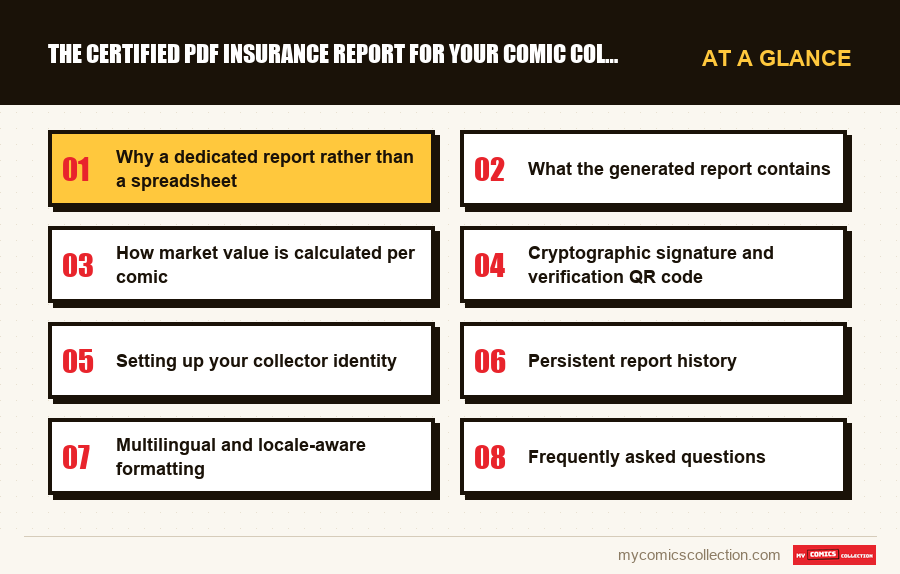
Why a dedicated report rather than a spreadsheet
Handing an insurer an Excel spreadsheet works in only three situations: the collection is worth less than two thousand dollars, the insurer is an independent broker who accepts homemade documentation, or the collector has a long contractual relationship with an agent who already knows their holdings. In every other case, the insurer-whether it's State Farm, Allstate, Allianz, AXA, Chubb, or a specialty collectibles carrier-requires three things that the Excel format struggles to provide natively. The first is a total value clearly broken out between declared value (the documented acquisition price) and market value (the current estimate). This distinction drives the annual premium: an insurer doesn't charge the same rate to cover a comic bought for five dollars that's now worth five hundred. The second is proof of prior existence: the inventory has to predate the loss, which requires a verifiable time stamp. The third is a per-item visual (cover, issue number, condition, value), which is used during a post-loss appraisal to confirm what the insurer has to pay out on.
A homemade Excel file generally fails on all three points. It doesn't systematically separate declared value from market value. It has no independent time stamp (the file date is editable, metadata included). And it doesn't attach the covers, forcing the insurer to make do with a text-only list that falls short in a dispute. My Comics Collection's Pro insurance report meets all three requirements at once in a single document. For general background on insurance coverage, see insuring your comic collection.
What the generated report contains
The report has five structured sections. The header shows the document title, the owner's name (configurable, defaulting to the account username), an optional mailing address, the issue date in the active locale's format (for example "June 4, 2026" in English, "4 juin 2026" in French), and an optional collector logo uploaded as a PNG or JPEG up to one hundred fifty kilobytes. This personalization makes the document instantly recognizable and gives it the standing of an official record rather than a generic screenshot.
The summary section displays five key figures as boxes: total number of comics owned, number CGC-graded, number signed, total declared value (in red), and estimated market value (in blue). Showing the two totals side by side is the deciding factor with an insurer: it proves the collector hasn't overstated the collection (the declared figure remains the contractual basis) while flagging the investment dimension (the market figure justifies a rider if needed).
The third section groups the comics by logical collection (Marvel, DC, Spider-Man, Batman, indie series), with a detailed table per group: a 48×72 pixel cover thumbnail (legible in print), issue number, full title with CGC and signed badges, condition, publication date, purchase price, and individual market value. Each table ends with two subtotals (declared and market) to make it easy to read piece by piece and category by category. This per-group granularity avoids the flat, thousand-row list that no insurer ever reads all the way through.
The fourth section is the regulatory disclaimer box (a yellow callout) that restates the distinction between purchase price and market value, and notes that any payout depends on the terms of the policy in force. This paragraph protects the collector legally by spelling out that the report is a declaration, not an independent appraisal. The fifth section is the cryptographic verification block with its QR code, covered later in this article.
How market value is calculated per comic
The individual market value shown for each comic is read from the cache of eBay estimates the app maintains internally. For every issue that has been manually priced at least once in the last twelve months, the server keeps a JSON file containing the median of closed (Sold) eBay sale prices over the past ninety days, along with the average, the minimum, the maximum, the number of observations, and the date of the last calculation. The report uses the median, because it holds up better against outliers (isolated sales of a CGC 10.0 copy that would drag the average up for raw copies of the same issue).
Comics that have never been priced show a dash in the "Market" column. This absence is deliberate: the app doesn't try to compute estimates in the background for twelve hundred comics at once, which would burn through the eBay quota and produce a lot of unreliable estimates on low-volume issues. To widen the report's coverage, the collector can look up the value manually from each comic's detail page: one click is enough, and the value will then be available for the next report. The full method is explained in looking up your comics' value online.
Cryptographic signature and verification QR code
Every generated report is signed server-side with a SHA-256 hash that combines eight elements: the user ID, the exact date and time of generation, the total number of comics, the number CGC-graded, the declared total, the market total, the currency code, the language code, and a server secret. This hash is stored in the database in a dedicated table (insurance_reports) with a uniqueness constraint, and a sequential numeric ID is assigned to the report. The first sixteen characters of the hash, plus the ID, together form the short signature printed at the bottom of the document.
That short signature is encoded into a square QR code one hundred forty pixels on each side, placed at the bottom of the report in a dedicated box. The QR code holds the public verification URL in the format https://mycomicscollection.com/verify-report.html?id=X&h=Y. An insurer-or any third party-who scans this QR code with a smartphone is immediately taken to a public, multilingual page (seven languages auto-detected from the browser setting) that queries the server and shows a clear status: "✅ Authentic report" if the hash matches, "❌ Invalid hash" if the document was altered after issuance, or "❌ Report not found" if the ID doesn't exist in the database.
This mechanism solves the proof-of-prior-existence problem. A collector can't generate a backdated report, because the generation date is set server-side at the moment of database insertion and feeds into the hash calculation. Changing the date on the printed PDF would invalidate the hash, which the verification page would detect right away. An insurer who receives a report dated June 4, 2026 can therefore confirm in under ten seconds that the report really did exist in the database on that date, without having to trust the document the collector handed over. This technical trust replaces human trust and speeds up the handling of insurance claims.
Collecting this series?
Track what you own, what you are missing and what your collection is worth. 7 day trial.
Start my trial →Setting up your collector identity
The identity shown in the report header is configurable from the "⚙️ Identity & logo" button in the top bar of the report screen. Three fields can be edited. The owner name replaces the account's technical username with the collector's legal or business name (for example "John Smith" or "Smith Comics Investments LLC"). The owner address is a free, multi-line field that appears just below the name in smaller type (ideally one or two lines: street number and name, ZIP code and city). The collector logo is a PNG, JPEG, or WebP image upload up to one hundred fifty kilobytes, automatically resized to fit the header without distorting the aspect ratio.
These three fields are stored in the database in the user table, so a single setup covers every future report. The logo, address, and name are loaded automatically on each generation. For collectors who lend part of their collection to exhibitions or museums, including an institutional logo makes the document easier to identify. For private individuals, an optional personal logo is a subtle touch that raises how serious the document looks to an insurer.
Persistent report history
Every report generated is kept in the database and accessible via the "📜 History" button in the top bar. This list shows the last fifty reports with issue date, number of comics covered, declared and market totals, language of issue, and currency code. Each row offers a direct shortcut to the public verification URL, so the collector can re-send an insurer the link to an older report without having to regenerate a new document.
The usefulness of this history shows up in two scenarios. First scenario: the loss. A burglary in September 2026 requires presenting the report that was in force at the time of the event. The history lets you pull up the June 4, 2026 report (the most recent one predating the loss) and give the adjuster its verification link. Second scenario: a tax audit for collectors who have declared their collection as part of their assets. Keeping time-stamped reports over several years constitutes admissible administrative evidence. This persistence fits into the broader traceability logic detailed in taking inventory of your comic collection.
Multilingual and locale-aware formatting
The report is generated in the app's active language at the moment of the click, among seven supported languages: English (US), French, German, Spanish, Italian, Portuguese, Dutch. Each has its full set of thirty translated labels (title, owner, date, totals, column headers, subtotals, legal notices). Price formatting uses each locale's conventions via the browser's Intl.NumberFormat API: "$1,234.56" in American English, "1.234,56 €" in German, "1 234,56 €" in French. Dates use toLocaleDateString with the appropriate locale code (en-US, fr-FR, de-DE, etc.), producing "June 4, 2026" in English, "4 juin 2026" in French, and "4. Juni 2026" in German.
This language adaptation directly targets collectors presenting their collection to a foreign insurer (job relocation, moving abroad, international sale), as well as German, Spanish, Italian, Portuguese, or Dutch collectors who until now had no report tailored to their native language anywhere in the comic-collection app ecosystem. As of June 4, 2026, no other app on the market offers a multilingual insurance report with this level of detail.
Frequently asked questions
The report contains the standard items insurers require for homeowners and specialty valuables coverage: a detailed item-by-item inventory, declared value, a separate market value, an issue date certified by a server signature, and a unique identifier anyone can verify publicly. Insurance companies (State Farm, Allstate, Allianz, AXA, Chubb, Travelers, and specialty collectibles carriers) accept this kind of format as a complement to the inventory form they may provide. For collectibles coverage above the standard homeowners cap, plan to discuss with your insurer the threshold beyond which a rider or a separate policy is required.
Yes, and that's the whole point of the system. The verification page verify-report.html is public and requires no authentication and no My Comics Collection account. Any member of the insurer's staff can scan the QR code with a standard smartphone, or copy and paste the URL into a browser, and immediately get cryptographic confirmation that the report presented is authentic. This verification takes less than ten seconds and doesn't depend on any cooperation from the collector. It's precisely this mechanism that elevates the report from a self-declared document to one that's admissible as evidence.
Visually editing the PDF (adding a comment, changing a value, deleting a row) doesn't affect the hash stored in the database. When the insurer scans the QR code, they access the original values issued by the server (totals, comics_count, generated_at) and can compare them with what the PDF shows. Any discrepancy is immediately detectable. It's the digital equivalent of a notary's seal: the document can be altered, but the alteration becomes visible at the first verification.
Yes, with no limit. Each generation creates a new report with its own identifier, its own hash, and its own issue date. The practical rule is to regenerate a report every six to twelve months to reflect the real evolution of market value, and always after a major acquisition (a lot of more than a hundred comics) or a significant sale. The history keeps the last fifty reports, which amounts to several years of use for a typical collector.
The declared value is the documented purchase price of each comic at the time of acquisition, as entered by the collector in each copy's record. It's the contractual basis of the insurance coverage and the figure used to calculate the annual premium. The market value is the current estimate based on the median of current eBay listings for each issue you've looked up, updated daily. It reflects what the comic would be worth if sold today. The gap between the two totals indicates the collection's unrealized gain, useful when weighing an insurance rider adjustment.