
In short
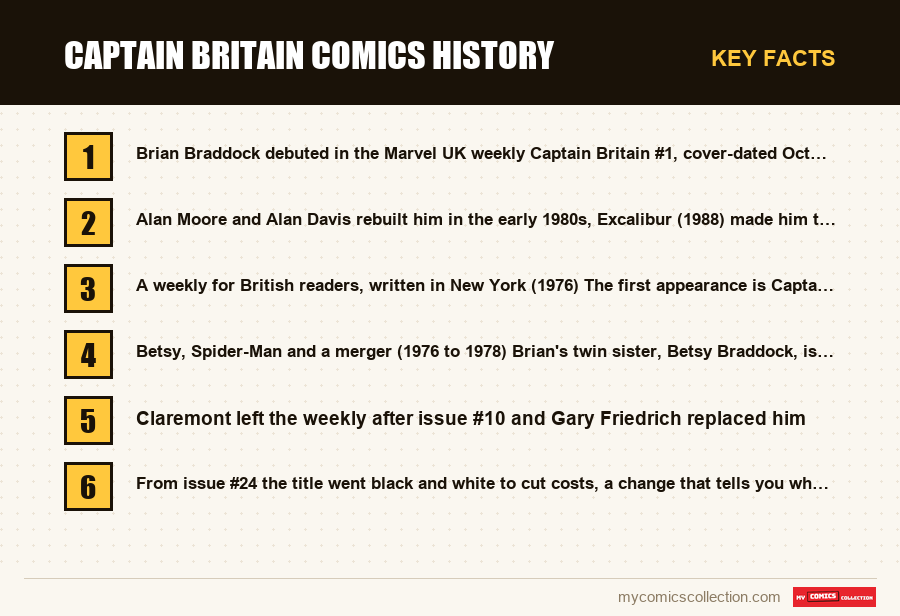
Brian Braddock debuted in the Marvel UK weekly Captain Britain #1, cover-dated October 1976, with Chris Claremont writing and Herb Trimpe drawing. Alan Moore and Alan Davis rebuilt him in the early 1980s, Excalibur (1988) made him the heart of a team, he was crowned king of Otherworld in 2001, and his sister Betsy took over the mantle in Excalibur vol. 4 (2019).
Captain Britain is the rare Marvel hero whose most important years were published outside the American direct market. The costume, the cast and the cosmology that matter to a collector were assembled across British weeklies, a monthly built for the home market, and a long run of a team book that carried his name in its heart without ever putting it on the cover.
Every cover date and writer or artist credit in this chronology was confirmed against published listings, and no inker is named because none was confirmed; the readings of what each shift did to Brian are ours.
A weekly for British readers, written in New York (1976)
The first appearance is Captain Britain #1, a weekly comic published by Marvel UK and cover-dated October 1976. Chris Claremont wrote it and Herb Trimpe drew it. In those years Marvel UK titles such as The Mighty World of Marvel were anthology magazines of reprinted American material, so a new hero made for British readers was a departure from the house routine.
The origin that Claremont set up has the shape of a fairy tale. Brian Braddock, son of Sir James Braddock, owes his powers to two figures from another reality, Merlyn and his daughter Roma. Later stories reveal that the pair arranged powers for each chosen member of the Captain Britain Corps, often using unscrupulous means, which casts a long shadow back over Brian's own gift.
That gift is the hinge of everything that follows, and later writers keep returning to the bargain behind it when they want to test him. Merlyn and Roma are the first pieces of a mythology that Moore and Davis would later expand into a multiverse police force, the Corps founded by Merlyn, Roma and Sir James Braddock to defend the multiverse.
Betsy, Spider-Man and a merger (1976 to 1978)
Brian's twin sister, Betsy Braddock, is introduced in Captain Britain #8.
Claremont left the weekly after issue #10 and Gary Friedrich replaced him. From issue #24 the title went black and white to cut costs, a change that tells you where the book stood in the publisher's priorities. After 39 issues it merged with Marvel UK's Spider-Man reprint title, at the time called Super Spider-Man. For a collector, those thirty-nine weekly issues are the foundation of the character, but they are British newsprint, which affects condition and availability.
Claremont and John Byrne then brought Brian to American readers through a two-issue storyline in Marvel Team-Up, which also saw the debut of Arcade and his Murderworld. In August 1978 Stan Lee hired Dez Skinn, who pushed for homegrown British material, including Hulk Comic, a weekly styled like the boys' comics of Marvel UK's rivals, with a Black Knight serial written by Steve Parkhouse and drawn by John Stokes.
Marvel Super-Heroes and the Thorpe and Davis relaunch (1981)
The next restart came in Marvel Super-Heroes #377, cover-dated September 1981, where Dave Thorpe and Alan Davis launched a new feature. This is the point at which Alan Davis, the artist who will shape the character for the next decade, joins the story.
Thorpe wrote a story set against the Troubles in Northern Ireland, and then left. The handover to Alan Moore is the moment collectors usually mark as the point where the character becomes a major property, and the fact that it happened in an anthology format, rather than a standalone series, is why the books are scattered across several British titles.
Alan Moore, Alan Davis and Jaspers' Warp (1982 to 1984)
Alan Moore replaced Thorpe, and the new team moved the strip in a darker tone, reconfiguring Mad Jim Jaspers as a powerful reality-warping mutant, the thread that grows into the arc known as Jaspers' Warp. The Captain Britain Corps, created by Moore and Davis, first appears in The Daredevils #6 (June 1983). The Daredevils launched in January 1983 and was cancelled after eleven issues in November 1983. Linda McQuillan, later Captain U.K., is the sole survivor of Earth-238, transported to Earth-616 to escape the Fury, which she eventually helps destroy.
The antagonist who gives the arc its name is Mad Jim Jaspers, and the story introduces the Fury, an unstoppable hero-killing cybiote. Moore left in June 1984, once the Jaspers' Warp storyline had concluded.
For collectors, this stretch is the heart of the character's reputation. It also demonstrates why the property is hard to collect issue by issue: the story runs across more than one title and several formats, so the sensible way to approach it is through the reprint collections, which put the Moore and Davis pages in one place. A reader who wants to see the writer's wider range can start with the Alan Moore hub.
Jamie Delano and the monthly Captain Britain (1985 to 1987)
In January 1985 the serial moved into a new monthly series, Captain Britain vol. 2 #1, with Jamie Delano writing and Alan Davis drawing. The monthly was the first time in years that the character had a title of his own, and it gave Delano room to take the multiverse that Moore built and use it for a darker tone. Davis stayed on art, which kept the visual language continuous across a change of writer.
During the same period Brian guest-starred in Captain America #305 and #306, with art by Paul Neary, a rare crossover into a mainstream American monthly. He also had a sizeable role in the limited series Contest of Champions, which was delayed until 1982.
Do you collect this series?
Track what you own, what you are missing and what your collection is worth. 7-day trial.
Start my trial →
Excalibur: a team built around a British hero (1987 to 1998)
Claremont and Alan Davis launched Excalibur in the Excalibur Special Edition, on sale in December 1987, and the regular series started with issue #1 in October 1988. The team forms under the mistaken impression that the rest of the X-Men are dead, and Brian and Meggan are among its founders. The book is the setting for Brian's relationship with Meggan, who becomes his partner, and it keeps him at the center of a team with American mutants and British sensibilities.
Claremont left the series after issue #34 in 1991, and Davis returned as writer and penciller from issue #42. The shift from one creator to a writer-artist is the reason the series is often read in two parts: the Claremont and Davis opening, and the Davis-driven run that follows. If you want a ranking of the runs rather than a chronology, the best Excalibur runs guide covers it.
Brian was lost in the time-stream, off-panel, before Excalibur #68, and when he did return he was rechristened Britannic, with a redesigned costume. Warren Ellis became the writer in 1994, and Brian reclaimed the Captain Britain identity in Excalibur #100. Ellis's successor, Ben Raab, swiftly ended the title: the series closed in 1998 with issue #125, which features the wedding of Meggan and a de-powered Brian.
Otherworld, New Excalibur and MI13 (2001 to 2013)
In 2001 Ben Raab wrote a four-issue Excalibur limited series that detailed Brian's rise to become King of Otherworld. The title is easy to confuse with the long-running series, so a seller's listing should be read for the volume number. In 2005 he led New Excalibur, which ran for twenty-four issues from 2005 to 2007, and the story culminated in the limited series X-Men: Die by the Sword, where the Corps' leadership changes and Saturnyne appoints Albion the new leader as the Corps is rebuilt once again.
In the same decade the mantle had a different holder, Kelsey Leigh Kirkland, who served as Captain Britain for a brief time before becoming Lionheart. It is a reminder that the identity belongs to a role as much as to a man, and a collector who wants the full list of people who have worn the costume has to look beyond Brian's own titles.
The 2008 series Captain Britain and MI: 13, written by Paul Cornell, followed the Secret Invasion crossover and recast the character as the head of a British security team. He then appeared as a regular in Secret Avengers from issue #22 (April 2012) through issue #37 (March 2013), and in the Avengers' Time Runs Out storyline. The multiversal structure took a hit as well, when the Ivory Kings sent their entire forces to overrun the Starlight Citadel, the base where Corps members had trained.
Betsy takes the name, Brian becomes Captain Avalon (2019 to now)
The most visible recent change comes with the Dawn of X relaunch. After Brian is corrupted by Morgan le Fey, Betsy takes the Captain Britain mantle in Excalibur vol. 4 #1, part of the October 2019 relaunch and written by Tini Howard.
During X of Swords Betsy is apparently killed in a duel with Isca the Unbeaten, then returns with the assistance of Kwannon. Betsy and the Corps return in the follow-up series Knights of X, also written by Howard, where Merlyn, the figure who stood behind Brian's very first powers, is still part of the picture. Brian, for his part, takes a new title, Captain Avalon, as defender of Avalon.
The key issues across his history
- Captain Britain #1 (1976): the first appearance of Brian Braddock, by Chris Claremont and Herb Trimpe.
- Captain Britain #8 (1976): the introduction of Brian's twin sister, Betsy Braddock.
- Captain America #305 and #306: a guest appearance in an American monthly, with art by Paul Neary.
- Marvel Super-Heroes #377 (1981): the relaunch by Dave Thorpe and Alan Davis.
- Excalibur #125 (1998): the last issue of the first volume, with the wedding of Brian and Meggan.
- The Daredevils #6 (1983): the Captain Britain Corps appears, created by Moore and Davis.
- Excalibur #1 (1988): the regular series begins with Claremont and Davis.
- Excalibur vol. 4 #1 (2019): Betsy Braddock takes the Captain Britain mantle, under Tini Howard.
How to follow Brian Braddock in a collection
Start by deciding which Captain Britain you want. The weekly of 1976 and 1977 is the origin, but it was British newsprint and the most fragile material in the run. The Moore and Davis stories are the critical center, and they are spread across Marvel Super-Heroes, The Daredevils and other British titles, so a reprint collection is the efficient way to read them in order. Excalibur vol. 1 is the long run, from issue #1 in 1988 to issue #125 in 1998, and it rewards a sequential pass.
Watch the numbering. There is a Captain Britain weekly, a monthly vol. 2 from January 1985, an Excalibur limited series in 2001, a third Excalibur volume in 2004 about Professor X and Magneto, and a fourth in 2019. The same word on a cover can mean five different books, so check the volume and the cover date before you buy. For the wider team context, the X-Men hub and the Psylocke comics history show where the Braddock family intersects with the mutant titles.
Frequently asked questions
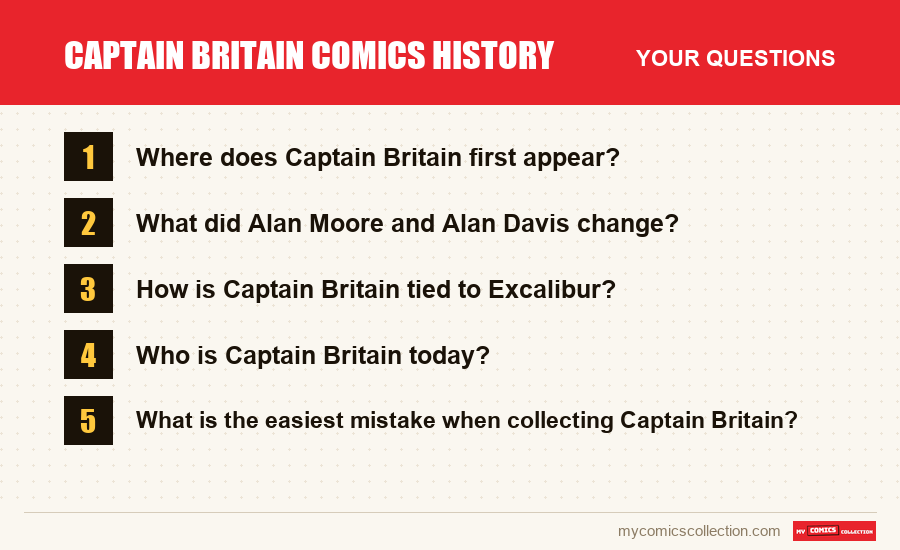
Brian Braddock bows in issue #1 of the Marvel UK weekly Captain Britain, cover-dated October 1976, a Chris Claremont script drawn by Herb Trimpe. His twin sister Betsy is introduced in issue #8. American readers met him later, in a two-issue Marvel Team-Up storyline by Claremont and John Byrne that also introduced Arcade.
Alan Moore replaced Dave Thorpe on the feature, and with Alan Davis he took the strip into a darker tone, recast Mad Jim Jaspers as a reality-warping mutant and introduced the Fury in Jaspers' Warp. The Captain Britain Corps first appears in The Daredevils #6 in June 1983. Moore left in June 1984.
Chris Claremont and Alan Davis launched Excalibur in a Special Edition in December 1987, and the regular series began in October 1988. Brian and Meggan are founding members of a team that formed believing the other X-Men were dead. The first volume ran to issue #125 in 1998, which features the wedding of Brian and Meggan.
Betsy Braddock took the Captain Britain mantle in Excalibur vol. 4 #1, launched in October 2019 under writer Tini Howard, after Brian was corrupted by Morgan le Fey. Brian now uses the title Captain Avalon, as defender of Avalon. Betsy's story continues through X of Swords and Knights of X.
Confusing volumes. The name covers the 1976 weekly, the 1985 monthly, and four separate Excalibur volumes in 1988, 2001, 2004 and 2019, and the 2001 miniseries and the 2004 series are not part of the first volume. Check the volume number and the cover date before buying, and keep a list by series and issue.
Found an old Captain Britain weekly or an early Excalibur issue in a box? Get an estimate of what your copy is worth.
Estimate my comic