In short
Betsy Braddock, the character who later becomes Psylocke, first appears in Captain Britain #8, a Marvel UK issue with a December 1976 cover date. Chris Claremont wrote the issue and Herb Trimpe drew it. She arrives in the book as Brian Braddock's twin, and the same issue reveals her psychic gift. The name Psylocke does not exist yet: it arrives ten years later, in The New Mutants Annual #2 (October 1986).
Few collectors set out to hunt a British periodical from the winter of 1976, yet Captain Britain #8 is exactly that kind of target. It sits at the start of a story that crosses two publishers, two countries and several decades, and every later stage of that story points back to this one issue.
The December 1976 date, the Claremont and Trimpe credits and every later issue number below were read against published histories of Captain Britain and of Psylocke. The advice on condition and buying is our own analysis, and nothing here reproduces artwork or dialogue.

The identity of the issue: cover date, publisher and credits
Captain Britain #8 carries a December 1976 cover date and was published by Marvel UK, the British branch of Marvel Comics. It belongs to the first series of the title, which began with issue #1 dated October 1976. The two credits that matter are firm: Chris Claremont is the writer and Herb Trimpe is the artist. Those are the names attached to the introduction of Betsy Braddock in every standard reference.
What this guide does not give you is an inker, a letterer or a colorist for #8. Credits at the level of the full production team are easy to get wrong for British material of this period, and a wrong credit on a listing is worse than a missing one. If you need them for a label or a database entry, take them from the copy in your hands, where the indicia and the credits box show what the publisher printed.
How Betsy Braddock enters the story
Issue #8 is where Brian Braddock, the physics student turned hero, gets a twin: Betsy Braddock steps in as a supporting figure. She is a supporting character, and the issue also reveals that she has psychic powers. That reveal matters for the way the character is catalogued: the powers belong to her from her first page, long before she has a code name or a place in a team.
The next issue, #9, brings in a different member of the family, the older brother Jamie Braddock. Reading #8 and #9 back to back gives you the whole Braddock household as Claremont and Trimpe set it up: a hero, his twin, and an elder brother who arrives one issue later. That makes #8 the entry for Betsy and #9 the entry for Jamie, and a collector who wants the family should plan on both numbers.
This section deliberately stays at the level of what the issue introduces. The plot beat by beat is not needed to identify the book, and the appeal of the issue to a collector does not depend on it. What you are buying is the debut of a person, drawn by Herb Trimpe in a year when nobody reading a British newsstand title could have predicted that she would end up on the roster of a mutant team.
Why a British hero was written by Claremont and drawn by Trimpe
The series was built for a British audience. Marvel UK launched Captain Britain as a new hero designed for readers in the United Kingdom, and Claremont, who is credited with the name, the origin and the supporting cast, was assigned the book as one of the few Anglophiles on the Marvel staff. Herb Trimpe supplied the pencils. Trimpe had drawn The Incredible Hulk for years before this and is on record as the first artist to draw Wolverine for publication, so a British superhero launch under his pencil was a natural assignment.
The editorial arc of the title is short and worth knowing. The first series ran from #1 to #39 and was then merged with Marvel UK's Super Spider-Man reprint title. The run went black and white from #24 to cut costs. Claremont left after the tenth issue and Gary Friedrich replaced him. Put those facts next to the date of #8, and you can see that Betsy debuts inside the stretch of issues written by Claremont himself, shortly before he left.
Four dates that are not the first appearance
The most common mistake in listings for this character is to treat one of the later landmarks as her debut. There are four dates worth separating, and each corresponds to a different issue.
- December 1976, Captain Britain #8: Betsy Braddock appears for the first time, as Brian's twin sister with psychic powers.
- January 1986, Captain Britain vol. 2 #13: her debut in the Captain Britain role, a temporary one, in the monthly series that began in January 1985.
- October 1986, The New Mutants Annual #2: the code name Psylocke is introduced and Claremont brings the character into the X-Men franchise. After the New Mutants rescue her, she is invited to join the X-Men.
- December 1989, Uncanny X-Men #256: a kidnapped, amnesiac Betsy is taken by the Hand, brainwashed and physically altered to take on an East Asian appearance. The art for the redesigned costume is by Jim Lee.
A buyer who wants "Psylocke's first appearance" has to know which of these is meant. The honest answer for the person is #8, because that is where Betsy Braddock first appears. The honest answer for the code name is the 1986 annual. A seller who lists #8 as the debut of Psylocke under that name is conflating the two, and one who lists the annual as the debut of the character is doing the same in the other direction.
There is a further complication that comes much later. Kwannon first appears in X-Men #17 (February 1993), created by Fabian Nicieza and Andy Kubert, and Nicieza's 1993 story retroactively established the body swap behind the 1989 change. Kwannon's own debut as Psylocke is Fallen Angels #1 (November 2019). None of that alters the identity of #8, but it explains why a search for "Psylocke first appearance" returns several different books depending on which Psylocke the searcher has in mind.
Do you collect this series?
Track what you own, what you are missing and what your collection is worth. 7-day trial.
Start my trial →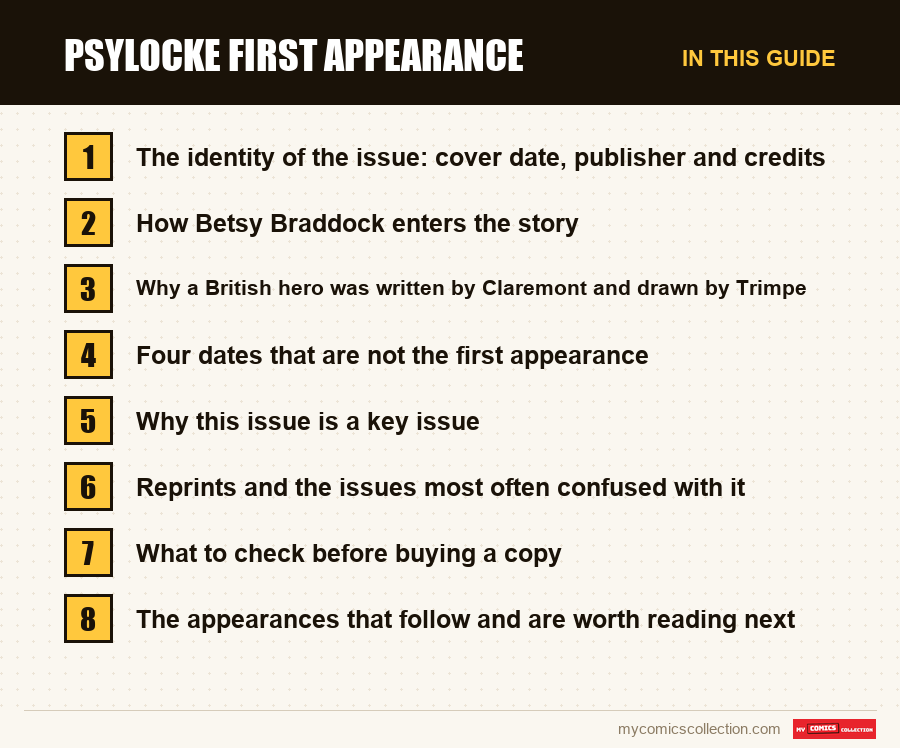
Why this issue is a key issue
The case for #8 as a key issue is a case about what followed. The character introduced as a supporting sister became, in 1986, a member of the X-Men, and later she took up the Captain Britain role in her own right. In 2019, during the Dawn of X period, Betsy claimed the Captain Britain mantle in a new Excalibur volume written by Tini Howard. A single British issue from 1976 therefore sits behind more than forty years of publishing.
Two things make that argument durable. The first is that the Claremont connection is continuous: the writer who created Betsy in a British weekly is the writer who brought her into the X-Men ten years later, and the writer on the 1987 launch of Excalibur with Alan Davis. The second is that the issue is hard to confuse with anything else. It has a clear date, a clear publisher and a clear debut, which are the three things a collector looks for when deciding whether an issue is a safe key.
Reprints and the issues most often confused with it
Three confusions come up repeatedly. The first is the annual: The New Mutants Annual #2 (October 1986) is a separate book, an American annual, and it carries the name, not the debut. The second is the series itself. Captain Britain #8 belongs to the 1976 series, and Captain Britain vol. 2 #13 belongs to the monthly series from the mid-1980s. The same title and a similar issue number do not make them the same publication.
The third is the Psylocke redesign issue. Uncanny X-Men #256 (December 1989) is the most recognized single image of the character, drawn by Jim Lee, and many listings use it as shorthand for the whole story. Its importance is of another kind: it records the 1989 change of look for Betsy, which is a separate event from her creation in #8.
If you are comparing a trade paperback or a hardcover with the original issue, the practical point is simple. The collected editions let you read the story, while the single issue is the artifact. Whether a reprint exists for the story you want is easy to check in the catalog or in a publisher's listing, and it should not be assumed from the character's later popularity. This guide does not list collected editions for #8, because the reprint history of Marvel UK material is more tangled than the American one, and a guess is worse than an omission.
What to check before buying a copy
Treat a December 1976 Marvel UK copy on its own terms, since it was printed and distributed differently from American books of that year. Format, paper and distribution all differ, so start from the physical object. Look at the cover for creasing, color flaking and edge wear; look at the spine and the staples for rust or lifting; look at the interior pages for the toning and brittleness that can affect inexpensive newsprint of this era. Photographs from a few angles tell you more than a grade stated in a title.
Next, confirm the identity. The cover should read Captain Britain, the issue number should be 8, and the date should be December 1976. If the listing has no readable cover date, ask for a photograph of the indicia or the cover banner. Mixed lots of British weeklies often include issues from the second series, from the monthly title, and from reprint titles with similar covers, and the number alone does not settle which one you have.
Then look at restoration. Color touch-ups, tape repairs, rebuilt spines and glued pieces all change what a copy is, and they are easier to see in good light than in a thumbnail. If your Captain Britain #8 comes in a slab, read the whole label, including the page-quality line and the restoration notes, before the numeric grade.
Finally, compare condition against condition. Because the supply of a 1976 British periodical is irregular, you may wait before a copy at the grade you want appears, and the useful comparison is between copies of the same issue, described the same way. Paying attention to the grade, the notes and the photographs is more reliable than chasing the cheapest listing. This guide gives no prices, because any figure would date quickly, and because the decision rests on the copy, not on a number.
The appearances that follow and are worth reading next
If #8 is your debut issue, the next purchases follow from the four dates above. Each is a separate book and a separate decision.
- Captain Britain #9 (1976): the next issue brings in the older brother Jamie Braddock, completing the family introduced in #8.
- The New Mutants Annual #2 (October 1986): the debut of the Psylocke name, written by Chris Claremont. The same annual carries Darla of the Fat Boys, a character with powers similar to those of Jubilee, though no story link between the two has been established.
- Uncanny X-Men #213 (January 1987): a Claremont and Alan Davis issue that belongs to the period when Betsy becomes part of the X-Men's world. See the key issues of Uncanny X-Men for the surrounding run.
- Uncanny X-Men #256 (December 1989): the Hand, the new appearance and the Jim Lee costume. Jim Lee's career before and after this issue is covered on the Jim Lee page.
- X-Men #17 (February 1993): Kwannon appears, by Fabian Nicieza and Andy Kubert, which begins the retroactive explanation of the 1989 change.
A sensible order for a collector is to settle the debut first, then decide which of the later landmarks you want: the name, the redesign or the explanation. A shelf with #8, the 1986 annual and #256 tells the story of the character in three books, and it is easier to extend from there than to begin with the most visible image and work backwards.
Frequently asked questions
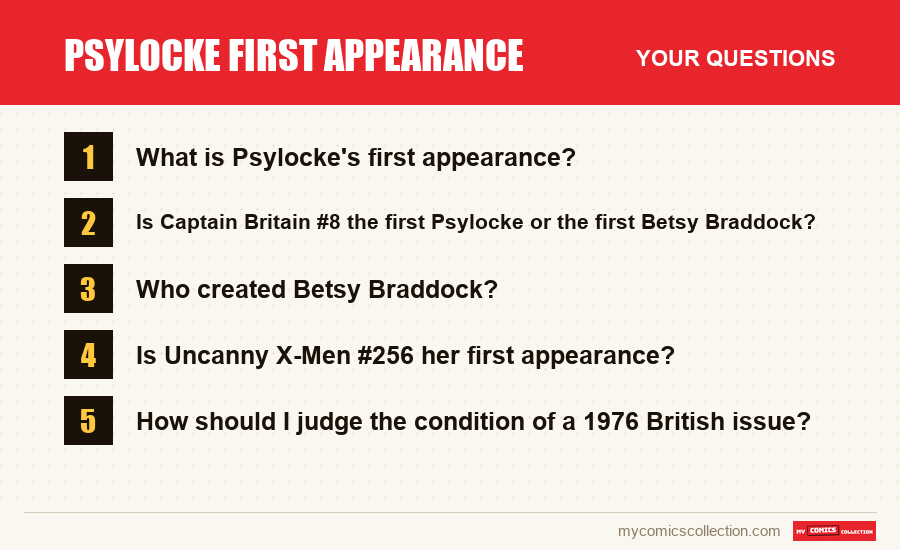
Betsy Braddock, the future Psylocke, first appears in Captain Britain #8, published by Marvel UK with a December 1976 cover date. Chris Claremont wrote it and Herb Trimpe drew it. She is introduced as Brian Braddock's twin sister. The code name Psylocke is introduced separately, in The New Mutants Annual #2 from October 1986.
It is the first appearance of Betsy Braddock, the person. The Psylocke name does not exist in 1976. A listing that calls #8 the first Psylocke is shorthand for the character who later takes that name, and a precise listing says Betsy Braddock for #8 and Psylocke for the 1986 annual.
Chris Claremont is credited with creating the character, and Herb Trimpe drew her debut in Captain Britain #8. Claremont was assigned the British title as one of the few Marvel staff members with a strong connection to Britain, and he later wrote her into the X-Men, first through the 1986 New Mutants annual.
No. Uncanny X-Men #256 (December 1989) is the issue where Betsy is taken by the Hand and altered, with Jim Lee drawing the new costume. She had already appeared in 1976, carried the name Psylocke from 1986, and was a member of the X-Men before this issue. It is a key issue for the redesign.
Examine the cover for creases and color loss, the spine and staples for lifting or rust, and the interior paper for toning. Confirm the cover reads Captain Britain #8 with a December 1976 date, and check for tape or color touch-ups. For a slabbed copy of #8, the notes on the label count as much as the number.
Holding a copy of Captain Britain #8 or another early Psylocke issue and unsure where it stands? Describe its condition and get an estimate.
Estimate my comic