The Brightest Day reading order covers a biweekly series of twenty-four issues, #1 to #24, preceded by a #0, published in 2010-2011 and written by Geoff Johns and Peter J. Tomasi, with several artists including Ivan Reis, Patrick Gleason, Scott Clark, Joe Prado, and Ardian Syaf. Read Blackest Night first, then the series in issue order. The Green Lantern, Green Arrow, and The Flash tie-ins are the closest ones; the rest is optional.
Brightest Day picks up from Blackest Night right after its conclusion. Its premise is simple to state and trickier to read in order: twelve characters brought back to life, a main series that alternates with another biweekly series, and a large number of regular series that connect to it more or less directly. This article gives you a clean path, with the issue ranges for each title involved.
As always on this guide, we only state verified information (creators, issue numbers, dates); the analysis is our own, with no reproduction of protected art or dialogue.
What to read before Brightest Day
The essential prelude is Blackest Night (2009-2010), the Geoff Johns event that resurrects and showcases the dead of the DC universe. The series starts the day after it ends, with Boston Brand, a.k.a. Deadman, breaking his own tombstone. To track it down issue by issue, our page on the key issues of Blackest Night is a good starting point.
One other read helps without being mandatory. Geoff Johns's Green Lantern series, whose arc Brightest Day extends across issues #53 to #62, is easier to approach with the Green Lantern reading guide.
One last thing to know: the main series is not written by a single author. Geoff Johns and Peter J. Tomasi write it together, and the art passes from one artist to another over the issues, with David Finch on covers for the entire series, which gives the single issues on the shelf a visual unity.
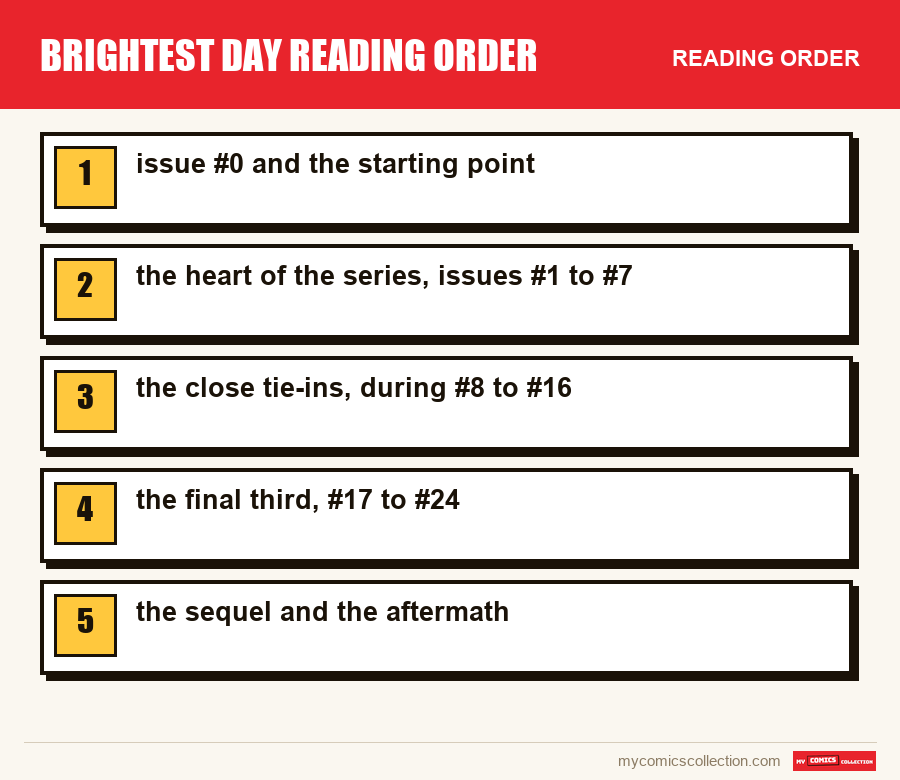
Phase 1: issue #0 and the starting point
Brightest Day issue #0 is drawn by Fernando Pasarin. It serves as a threshold: it sets up the frame and tone of the series, in the wake of Blackest Night. Read it before #1 and before any tie-in, without treating it as a separate read.
The twelve resurrected characters are, in the order we noted them: Reverse-Flash, Jade, Osiris, Maxwell Lord, Hawkgirl, Hawkman, Aquaman, Martian Manhunter, Firestorm, Captain Boomerang, Hank Hall, a.k.a. Hawk, half of the Hawk and Dove duo, and Boston Brand, a.k.a. Deadman. This list gives you a reference point: each follows his or her own thread, and the main series interweaves them.
Geoff Johns summed up the premise with the idea of "second chances," specifying that some succeed and others do not, which gives the key to reading the series.
A word on the release cadence: the main series and Justice League: Generation Lost were published in alternation, so a reader in 2010 received an issue of one or the other almost every week. If you want to recreate that rhythm, read one issue of Brightest Day, then one issue of Generation Lost, counting twenty-four issues for the latter. If you only care about the twelve resurrected characters, leave Generation Lost aside: it is not part of the main series, even though it accompanies it on the calendar.
In practice, a successful first read comes in two steps. First, move through the main series to the end of a collected-edition block, that is #7, #16, and then #24. Then, if you feel like it, go back to the tie-ins of the family you follow, stopping at the end of each block to take stock of what you have read.
Phase 2: the heart of the series, issues #1 to #7
The series is published twice a month and alternates with Justice League: Generation Lost, the biweekly series by Keith Giffen and Judd Winick. The hardcover collection of the first volume (December 2010) gathers issues #0 to #7, which makes a good cut for a first read: this is the part where the series sets up its characters.
During this block, read the main series issues in order, without interruption, and only then the closest tie-ins. That way you keep the thread of the resurrected characters' mission without being pulled away by the regular series. Ivan Reis, Patrick Gleason, Scott Clark, Joe Prado, and Ardian Syaf share the art across the whole series.
Phase 3: the close tie-ins, during #8 to #16
This is where you need to work in the regular series that run at the same time. The ones most tied to the event are the titles of the Lantern family: Green Lantern (volume 4) #53 to #62, Green Lantern Corps (volume 2) #47 to #57, and Green Lantern: Emerald Warriors #1 to #6. Alongside them, Green Arrow (volume 4) #1 to #12 and The Flash (volume 3) #1 to #7 are also among the series linked to the event.
For the team books, keep Justice League of America (volume 3) #44 to #48 and Justice Society of America (volume 3) #40 to #43. Titans (volume 2) #24 to #30 along with Titans: Villains For Hire Special #1 form another line. Birds of Prey (volume 2) #1 to #6 rounds out the picture.
The reading rule: do not try to read everything in parallel. Pick one family, for example the Lanterns if you follow the Green Lantern universe, and read it between issues of the main series, at the pace of one tie-in issue for each issue of Brightest Day. Our guide to Green Lantern crossovers helps you connect these titles.
Phase 4: the final third, #17 to #24
The third hardcover collection (September 2011) gathers issues #17 to #24: this is the last third of the series, which you can read straight through. The second collection (May 2011) covers #8 to #16, which confirms that the series divides naturally into three blocks of eight to nine issues.
If you read in single issues, keep the tie-ins from this period in reserve: Green Lantern runs to #62, Green Lantern Corps to #57, Green Arrow to #12, and The Flash to #7 of that series. The Atom issues are separate: Brightest Day: The Atom Special is a one-shot that leads into Adventure Comics #516 to #521 and Giant-Size Atom #1.
Do you collect this series?
Track what you own, what you are missing and what your collection is worth. 7-day trial.
Start my trial →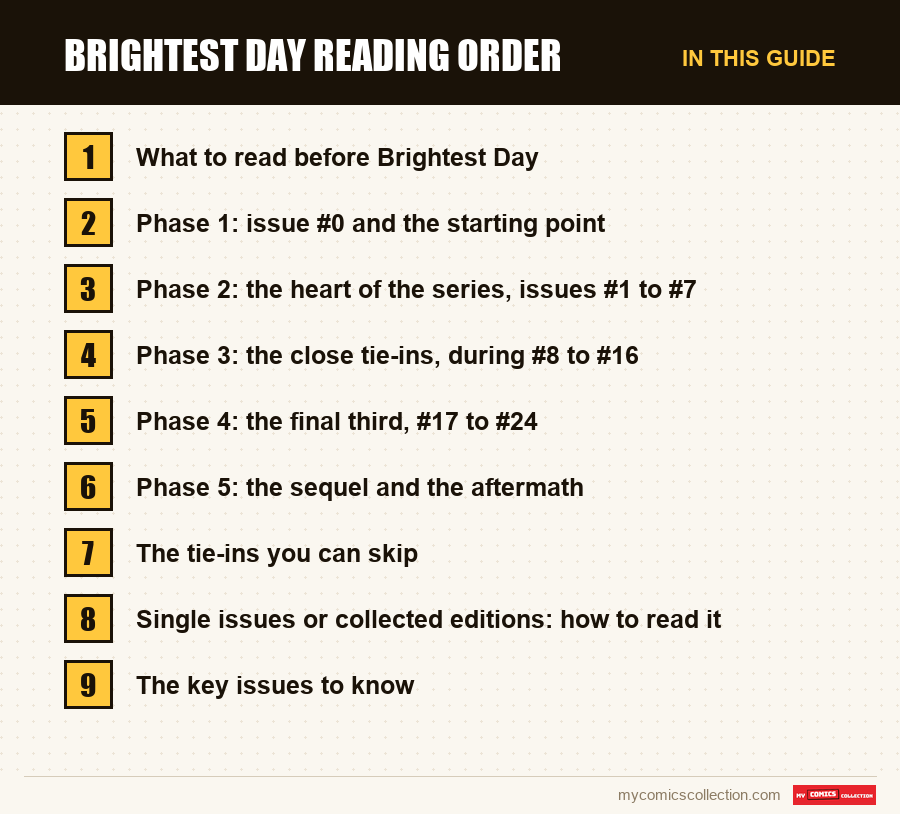
Phase 5: the sequel and the aftermath
The direct sequel is Brightest Day Aftermath: The Search for Swamp Thing, in three issues: #1 comes out on June 22, 2011, #2 on July 27, 2011, and #3 on August 24, 2011. Heads up, spoiler about the end of the series: the miniseries follows John Constantine, who tries to convince Superman and Batman of a decision concerning Alec Holland.
Other titles, less directly connected, run during the same months: Action Comics #890 to #900, Booster Gold (volume 2) #33 to #43, Power Girl #13 to #23, Teen Titans (volume 3) #83, Shazam! #1, and Untold Tales from Blackest Night #1.
The tie-ins you can skip
The titles in the last list above, the ones with the most indirect connection, can be skipped at no loss: Action Comics, Booster Gold, Power Girl, Teen Titans, Shazam!, and Untold Tales from Blackest Night tell stories that stand on their own. Reading them is no mistake, but the Brightest Day order does not depend on them.
Among the closer titles, Birds of Prey, Titans, and the two team books, Justice League of America and Justice Society of America, are add-ons for readers of those teams. You can leave them aside if you are focusing on the twelve resurrected characters.
Single issues or collected editions: how to read it
In single issues, the main series runs twenty-five issues with the #0: a compact collection, easy to complete if you are only going for the series. The tie-ins multiply that number: add them all and you get past a hundred single issues, which is why we advise picking one family of titles.
In collected editions, three hardcover volumes cover the main series: the first (#0 to #7, 256 pages, December 2010 in hardcover, December 2011 in paperback), the second (#8 to #16, 240 pages, May 2011), and the third (#17 to #24, 280 pages, September 2011). That is a comfortable route for reading the main series in one go. For the tie-ins, check the contents of each collection before buying.
On the single-issue side, keep a list of missing issues, block by block, and complete it before moving on to the next.
The key issues to know
Here, the keys can be spotted by three clues: the series opener, the issues where a resurrected character's situation changes, and the cover variants. David Finch's covers, which illustrate the whole series, make copies easy to recognize on the shelf; you then check condition and authenticity.
Brightest Day #0 and #1 are the obvious entry point of the series. Issue #24, which closes the main series, is the natural complement for anyone who wants the complete run. Brightest Day Aftermath: The Search for Swamp Thing #1 (June 2011) marks the start of the direct sequel.
For each issue, always compare the copy to the series' official cover, and cross-check against several listings before settling. If you want us to look at a specific copy, you can go through the free estimate.
Recap: the complete order
- Blackest Night (2009-2010), as a prelude.
- Brightest Day #0 (Fernando Pasarin on art).
- Brightest Day #1 to #7 (first hardcover collection with the #0).
- Brightest Day #8 to #16, with the Green Lantern family tie-ins: Green Lantern #53 to #62, Green Lantern Corps #47 to #57, Emerald Warriors #1 to #6.
- Depending on your interests: Green Arrow #1 to #12, The Flash #1 to #7, Justice League of America #44 to #48, Justice Society of America #40 to #43, Titans #24 to #30, Birds of Prey #1 to #6.
- Brightest Day: The Atom Special, then Adventure Comics #516 to #521 and Giant-Size Atom #1.
- Brightest Day #17 to #24 (third hardcover collection).
- Brightest Day Aftermath: The Search for Swamp Thing #1 to #3 (June to August 2011).
For the author, our path on how to read Geoff Johns places Brightest Day within his body of work.
Frequently asked questions
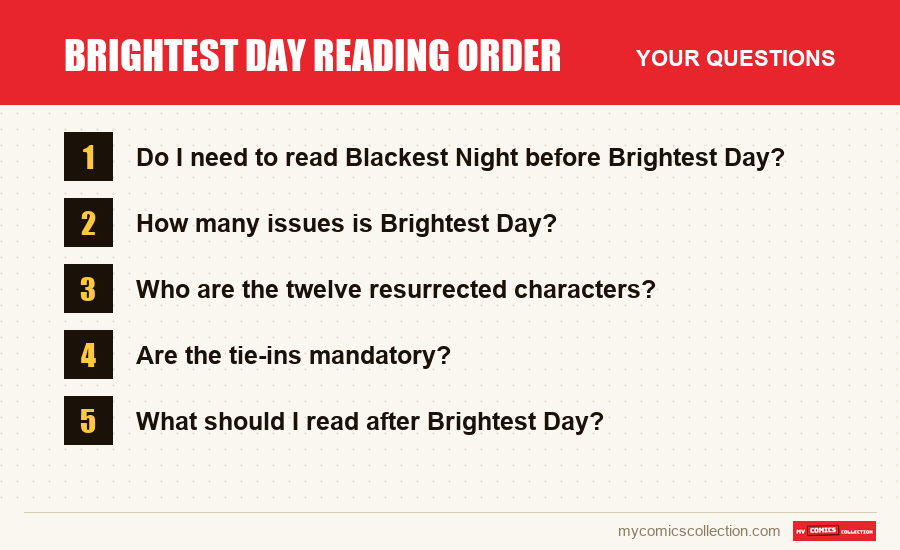
Yes, it is the direct prelude. The series picks up the day after the end of Blackest Night, with Boston Brand breaking his tombstone, and follows twelve characters brought back to life. Without that event, you will miss the reason for their return.
Twenty-four issues, #1 to #24, preceded by a #0: twenty-five single issues in total, published twice a month in 2010-2011. Geoff Johns and Peter J. Tomasi write, and several artists take turns, with David Finch on covers.
Reverse-Flash, Jade, Osiris, Maxwell Lord, Hawkgirl, Hawkman, Aquaman, Martian Manhunter, Firestorm, Captain Boomerang, Hank Hall (Hawk), and Boston Brand, a.k.a. Deadman. The main series interweaves their stories.
No. The main series reads on its own. The closest ones are the Green Lantern family titles, Green Arrow, and The Flash; Action Comics, Booster Gold, or Power Girl have a looser connection and can be skipped without harm.
The direct sequel is Brightest Day Aftermath: The Search for Swamp Thing, three issues published from June to August 2011. The tie-ins you kept in reserve, such as Green Lantern #53 to #62, can then be read in turn.
Do you own a Brightest Day issue or a variant you want appraised? Describe it to get an estimate.
Estimate my comic