
In short
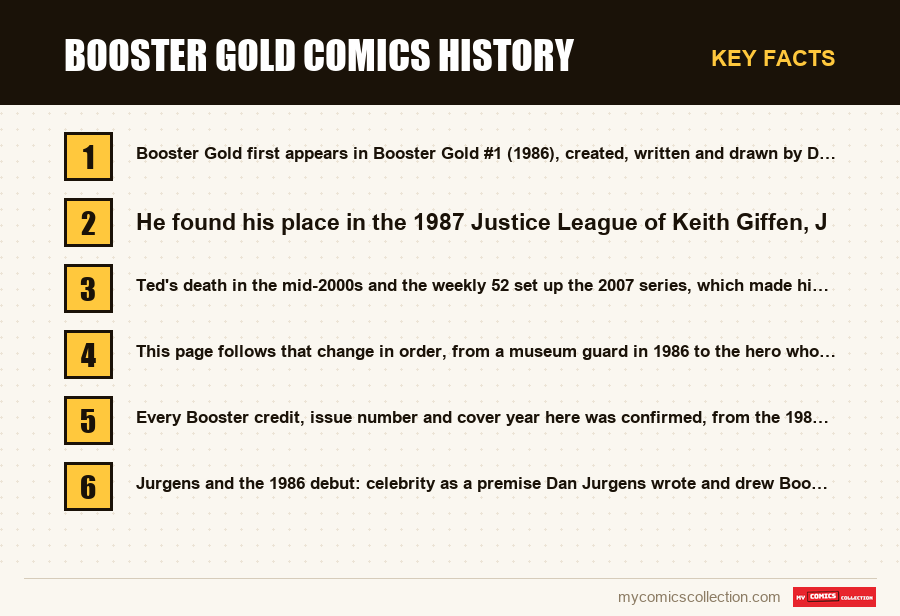
Booster Gold first appears in Booster Gold #1 (1986), created, written and drawn by Dan Jurgens as a fame-seeking hero from the 25th century. He found his place in the 1987 Justice League of Keith Giffen, J. M. DeMatteis and Kevin Maguire, alongside Ted Kord. Ted's death in the mid-2000s and the weekly 52 set up the 2007 series, which made him a secret guardian of the timeline.
Booster Gold is a character defined by a gap between what he wants and what he becomes. He arrives in the 1980s hoping for endorsement deals and a statue, and over four decades the stories turn that vanity into the cover for DC's quietest time-travel job. This page follows that change in order, from a museum guard in 1986 to the hero who keeps history intact.
Every Booster credit, issue number and cover year here was confirmed, from the 1986 launch to the Flashpoint tie-in, and a bare year stands wherever the month was not. The thread running through his eras, vanity put to work, is our own reading.
Jurgens and the 1986 debut: celebrity as a premise
Dan Jurgens wrote and drew Booster Gold #1, the February 1986 issue that introduces him. DC treated him as the first significant new character introduced into its continuity after Crisis on Infinite Earths, which makes the issue a marker of the rebuilt universe. Jurgens's 1984 series proposal compared the hero to U.S. Olympic gold medal athletes, and that satire of fame is the engine of the whole concept.
Michael Jon Carter was born poor in 25th-century Gotham City. He and his slightly younger twin sister, Michelle, never knew their father, and Michelle, the more responsible of the two, took on multiple jobs to support their ailing mother. Michael was a gifted athlete who attended Gotham University on a football scholarship, until he was exposed, disgraced and expelled, and he ended up as a night watchman at the Metropolis Space Museum. He lifted exhibits, among them a Legion flight ring and Brainiac 5's force-field belt, and with Skeets as his robot companion he borrowed Rip Hunter's Time Sphere for a trip to the twentieth century. He wanted celebrity, not justice.
The origin changed when DC hired John Byrne to reboot Superman in The Man of Steel, and the museum background was adjusted with it. The solo series ran 25 issues, through February 1988, and in that last issue Harbinger reveals Booster's ancestry to the Martian Manhunter. Our guide to Booster Gold #1 covers the condition and edition questions around the debut.
Celebrity hero and bankrupt businessman
In the first run Booster becomes a celebrity superhero in Metropolis and founds Goldstar, Inc., later Booster Gold International, as a holding company. His agent, Dirk Davis, turns out during Millennium to be a disguised Manhunter who has been siphoning Booster's money to force him to serve the Manhunters; they are defeated, but Booster is left bankrupt. The plot is one of the most honest in the series, because it lets the premise punish the character without making him unlikeable.
The tone of this period is comic and a little cynical. Carter holds an unfair advantage and intends to cash it in, with no calling to serve anyone, and the early issues play that straight. It is the reason the character later fit so naturally into a team book that treated heroism as an office job.
The 1987 Justice League: Booster finds his people
The turning point came a year after the debut. Justice League #1, cover-dated May 1987, launched the revamped team under Keith Giffen, J. M. DeMatteis and Kevin Maguire, and Booster became a regular there within the year: Maxwell Lord put his name forward, and a fight with the Royal Flush Gang earned him his place. He remained a member until the group disbanded in 1996. The series took the title Justice League International with issue #7, dated November 1987, and our history of the Justice League places the revamp in the longer story of the team.
In that book Booster was frequently partnered with Ted Kord, the second Blue Beetle, and the two became close friends. The comedy of the book depends on the pair: a man chasing endorsements beside a man whose gadgets keep failing. It is the best illustration of what the character does to a story, which is to make people around him look slightly more human. Our companion piece on Ted Kord and Booster Gold follows that friendship.
The League years also produced the Conglomerate: after a run of embarrassments Booster quit the League to found a team funded by corporate sponsors, who often compromised it, and he rejoined the League afterward. Once the group fell apart, he joined Extreme Justice, a team led by Captain Atom. These years keep him in print, though the story that matters comes later.
2003: the affectionate reunion
In 2003 Giffen, DeMatteis and Maguire reunited for Formerly Known as the Justice League, a six-issue comedy in which Maxwell Lord tries to reunite former members, Booster among them, as the Super Buddies, a hero-for-hire group working out of a strip mall. The Super Buddies got a second outing in 2005, a sequel story that filled issues #4 to 9 of JLA: Classified.
The project is a useful test of the character. Sixteen years after the League revamp, the same creators could still write Booster as a self-promoting optimist, and the book works as a loving parody of its own history. For the reader, it is the lightest entry point to the group, but it also sets up the shock that follows.
2005 to 2006: Ted Kord, Infinite Crisis and 52
The comedy ends in the middle of the decade. Countdown to Infinite Crisis #1 (May 2005) finds Booster assisting Ted Kord with an inquiry into KORD Industries; across The OMAC Project #1 to 6 in 2005, the truth about Maxwell Lord and Ted comes out. Booster leaves, saying he has decided to go home, and the character who joked through the League years has a reason to be serious.
Booster then appears in Infinite Crisis #2, #5 and #6 (2006): he resurfaces in the ruins of the Justice League Watchtower on the moon, finds Jaime Reyes and takes him to the Batcave, and plays a pivotal role in destroying the Brother Eye satellite. The weekly series 52, which ran from 2006 into 2007, gives him one of its threads. When Superman, Batman and Wonder Woman fail to arrive at Superboy's memorial, Booster suspects Skeets is malfunctioning, and after Skeets reports more incorrect historical data he searches Rip Hunter's desert bunker, where he finds photos of himself and Skeets surrounded by the words "his fault." Our Infinite Crisis reading order shows where these issues sit.
This period is the hinge of the history. Booster stops being a comedy character and becomes a hero with a mission, and the weekly format lets that change happen without a new origin story.
The 2007 series: Johns, Katz and the timeline guardian
Dan DiDio announced All-New Booster Gold at Wizard World Los Angeles in March 2007, and the book was published as Booster Gold. It followed 52, with Geoff Johns and Jeff Katz as the initial writers and Dan Jurgens and Norm Rapmund on art. Johns and Katz left after twelve issues (#1 to 10, #0 and a One Million issue), and Jurgens stayed with Rapmund. The tagline, "The greatest hero you've never heard of," says what the book does: Booster protects the timeline in secret, saving history without receiving credit.
That premise gives his vanity a purpose, since a man who craves recognition is now assigned work that no one can know about. The series ties him to Rip Hunter, whose Time Sphere started his career and who is revealed as Booster's son, and to the idea of an older Booster who anonymously watches over his earlier self and prunes divergent timelines. See our reading guide for the order of the arcs.
Do you collect this series?
Track what you own, what you are missing and what your collection is worth. 7-day trial.
Start my trial →
2010 and 2011: Time Masters and Flashpoint
In 2010 Booster was caught in Justice League: Generation Lost, which pits him against Maxwell Lord, and in May of that year Keith Giffen took over the Booster Gold title. Time Masters: Vanishing Point, a six-issue miniseries from July 2010 to February 2011, placed him inside a larger time-travel story. Jurgens returned to the main title with issue #44.
That return coincides with Flashpoint. In Booster Gold volume two #44 to 47 (2011), Booster confronts Project Six, which is revealed to be Doomsday, saves a woman named Alexandra Gianopoulos from its attack, and discovers that Doomsday is controlled by General Nathaniel Adam.
The New 52 and the Waverider years
The September 2011 reboot placed Booster at the head of a new team. In Justice League International volume three, written by Dan Jurgens with art by Aaron Lopresti, he is chosen by the United Nations to lead the group because of his PR sense and naivety, and issues #7 to 12 and the Annual #1 carried the book through 2012. In Booster Gold: Futures End #1, an older Booster explains that he is not an older version of the New 52 Booster.
In Convergence, the pre-Flashpoint Booster is reborn as Waverider, a cosmic time traveler. The change moves the character from guardian of one timeline to a figure outside time. For a collector, it means that books from these years can show different versions of Booster, and the cover alone does not tell which.
Rebirth to the present
Booster and Skeets returned in Action Comics #992, dated November 2017, as part of DC Rebirth, which had restored pre-New 52 continuity in 2016. In 2022, Blue and Gold issues #6 to 8 introduced an alternate-universe Michael Carter as Black Beetle, which shows how far the name has traveled from the 1986 premise. More recently, Superman volume six #30 to 32 (2025 to 2026) shows Booster, after absorbing Omega Energy, captured and tortured by Darkseid's forces for two years in a post-apocalyptic future until Superman and Superboy-Prime free him; the story later implies that Darkseid had taken his form and infiltrated the heroes' ranks.
The pattern across four decades is consistent: each revival uses the same trait, a man who needs to be seen, and puts it against a job that cannot be seen.
The key issues across his history
- Booster Gold #1 (1986): Dan Jurgens's debut of Michael Jon Carter and Skeets.
- Justice League #1 (1987): Giffen, DeMatteis and Maguire launch the team that Booster joins that year.
- Formerly Known as the Justice League #1 (2003): the six-issue reunion of the League's creative team.
- Countdown to Infinite Crisis #1 (2005): Booster and Ted Kord investigate Kord's company.
- The OMAC Project #1 (2005): the six-issue series in which Booster learns Maxwell Lord killed Ted Kord.
- 52 (2006 to 2007): Skeets's faulty historical data sends Booster to Rip Hunter's bunker.
- Booster Gold volume two #1 (2007): Johns, Katz, Jurgens and Rapmund begin the timeline-guardian series.
- Booster Gold volume two #44 (2011): the Flashpoint arc, with Jurgens back on the title.
How to follow Booster Gold in a collection
Begin with the 2007 series, because it states what the character is for, then go back to the 1986 run to see where the idea started. The 1986 series is only 25 issues and can be completed as a set. Add the 1987 Justice League run for the character's best-known period, and treat Formerly Known as the Justice League as a short companion.
Numbering needs care. Two Booster Gold series both begin at #1, so a seller's listing that gives only "#1" can mean 1986 or 2007. The 2007 book also contains a #0 and a One Million issue inside its first twelve, so check the cover year before comparing copies. Booster's roles in 52 and the Ted Kord storyline are scattered across event titles, and collected editions are the practical way to gather them. If you organize by character, the Green Lantern hub and the Superman hub cover the wider DC universe he moves through.
Frequently asked questions
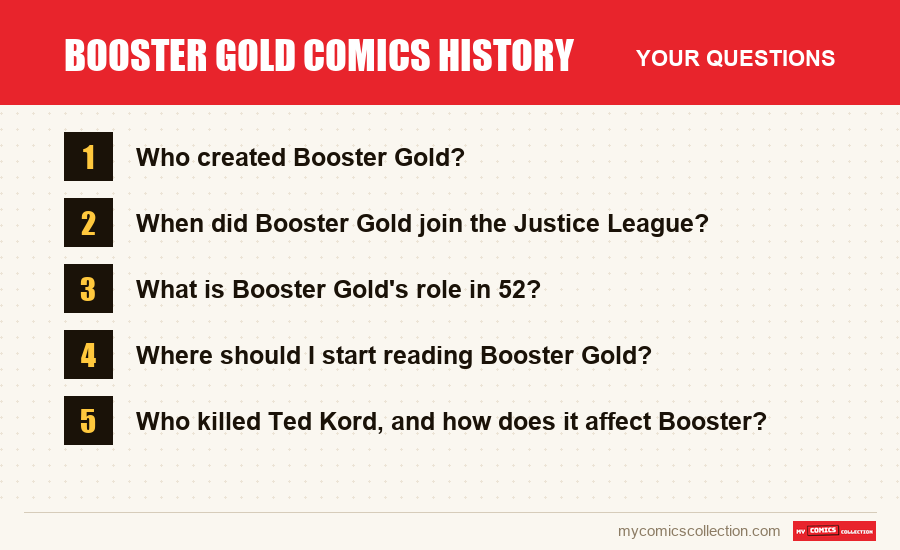
Dan Jurgens is the creator. Michael Carter first appeared in Booster Gold #1 with a February 1986 cover date, and Jurgens both wrote and drew that series. His 1984 proposal compared the hero to U.S. Olympic gold medal athletes, which is the idea behind the character.
Booster began appearing regularly in the Justice League book in 1987, the year it was relaunched by Keith Giffen, J. M. DeMatteis and Kevin Maguire with Justice League #1. He stayed a member until the team disbanded in 1996, and in those years he was frequently partnered with Ted Kord.
In the weekly 52 (2006 to 2007), Booster's robot Skeets malfunctions and gives faulty data, and Booster searches Rip Hunter's bunker, where he finds photos of himself and Skeets marked "his fault." This thread sets up the 2007 Booster Gold series about protecting history.
Start with the 2007 Booster Gold series by Geoff Johns, Jeff Katz, Dan Jurgens and Norm Rapmund, because it explains his secret job guarding the timeline. Then read Booster Gold #1 (1986) for the origin, and the 1987 Justice League for the team comedy that made him popular.
In The OMAC Project #1 to 6 (2005), Booster learns that Maxwell Lord killed Ted Kord, the Blue Beetle who had been his closest friend since the Justice League years. The loss ends the comedy of the earlier era and pushes Booster toward the more serious role of the 2007 series.
If a Booster Gold #1 or a 1987 Justice League issue sits in your boxes, a quick estimate shows where it stands.
Estimate my comic