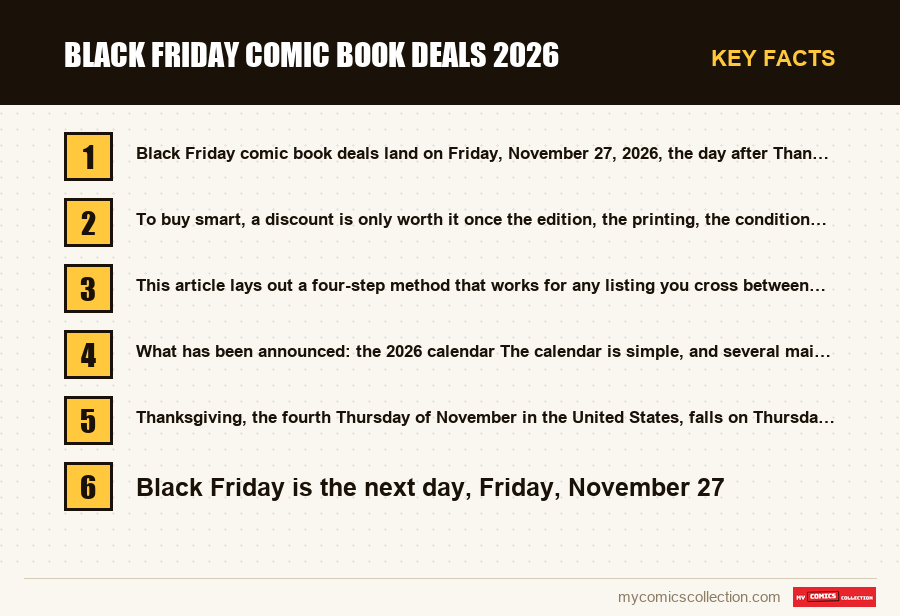
Black Friday comic book deals land on Friday, November 27, 2026, the day after Thanksgiving (Thursday the 26th), with Cyber Monday following on November 30. That is the US calendar, and some retailers stretch their offers over several days. To buy smart, a discount is only worth it once the edition, the printing, the condition and the shipping costs are checked before you pay: a key issue and its 2023 reprint are not the same object.
A weekend of sales pushes you to decide fast, and speed is expensive in comics: a single title exists as an original printing, a reprint, a facsimile and a variant, with values that bear no relation to one another. This article lays out a four-step method that works for any listing you cross between November 27 and 30, and illustrates it with three issues whose recent reprints are well documented.
The dates, credits and issue numbers cited below were checked before publication; the buying advice comes from our own method, and no protected artwork or dialogue is reproduced.
What has been announced: the 2026 calendar
The calendar is simple, and several mainstream press sources agree on it. Thanksgiving, the fourth Thursday of November in the United States, falls on Thursday, November 26, 2026. Black Friday is the next day, Friday, November 27. Online shopping gets its own day three days later, on Monday, November 30.
What those dates do not tell you is what the offers will contain. No specific discount on comics is announced here, and we are not inventing any: shops and individual sellers set their own terms, often at the last minute. The press does note, however, that some retailers stretch their promotional period well past Friday, into early December. For a buyer, that changes one useful thing: nothing forces you to buy on Friday the moment doors open, and "only a few hours left" is a sales pitch, not a market constraint.
From Thursday the 26th to Monday the 30th, the volume of listings goes up: lots, reprints, omnibus editions, graded slabs, modern-era issues. Their quality does not change. A blurry photo on Tuesday is still blurry on Friday, and a seller who does not state the printing will not do so any more readily because a sale is running. The method below is there to hold you to the same standard you apply the rest of the year.
Point 1: Identify the edition before you look at the price
Take Giant-Size X-Men #1, published in 1975: Len Wein wrote it and Dave Cockrum penciled it. X-Men fans have chased it for decades, and it is also the textbook example of confusion between an original and a reprint. Marvel published a facsimile edition of this issue in 2019, on sale July 17, then a new facsimile printing on August 30, 2023. Marvel presents these editions as a reproduction of the 1975 issue in its original form, ads included.
The ads are what fools people: a faithful facsimile looks like the original right down to its period advertisements. What sets it apart is the paper, the indicia (the legal notice at the bottom of an interior page, which carries the date and the publisher), the barcode, the facsimile notice on the cover depending on the printing, and the absence of aging. A careful seller writes it in the listing title. A hurried seller simply writes "Giant-Size X-Men 1" and lets the buyer draw their own conclusion.
Before comparing any price, then, ask three questions: what is the indicia year, does the cover carry a facsimile notice, and can you see the interior title page? Three minutes is enough to rule out the most expensive mix-up. The facsimile versus original comparison for Amazing Fantasy #15 walks through the same logic on a different issue.
The issue number is only part of the address: you also need the series year. For Giant-Size X-Men, 2025 saw a new anniversary story with the same title, which revisits the 1975 era without being a reprint; a title search brings up both. Check the series year before you add anything to your cart.
Point 2: Read the printing and the variant
Within a single original edition, you then have to tell printings and cover variants apart. At DC, The Batman Adventures #12 (September 1993) raises a different trap: printings and covers. Kelley Puckett wrote it, Mike Parobeck and Rick Burchett drew it, and Harley Quinn, born in the animated series, makes her comic book debut in it. DC published a facsimile edition, on sale March 12, 2025, with several covers: a standard cover by Parobeck and Burchett, a foil version, a blank cover meant for sketches, and a "Super Powers" variant starring Batgirl.
The lesson is twofold. First, a listing that shows "the Harley Quinn cover" says nothing about the printing: the 1993 printing, later reprints and the 2025 facsimile can share the same image. Second, the foil variant of the facsimile is a modern object in its own right, with no value link to the 1993 printing. The guide to the printings of Batman Adventures #12 details the markers for separating the printings: indicia, barcode, paper tone.
The distinction between the newsstand edition (with a barcode) and the edition made for comic shops (the direct edition, with the publisher's logo in a box in place of the barcode) applies to 1980s and 1990s production. It matters: on certain issues collectors hunt for the two separately, as the case of the newsstand copy of Amazing Spider-Man #300 shows. Ask for a photo of the barcode area.
For any issue from the 1990s onward, the list of questions is short:
- Which printing (1st, 2nd, 3rd) and which indicia year?
- Newsstand or direct edition, backed by a photo of the barcode?
- Standard cover or variant, and exactly which one?
- Is it a facsimile, a relaunch printing or an original?
Point 3: Judge condition from the photos, not the adjective
The words in listings ("like new," "very good condition") are not grades: they commit the seller to nothing, whereas a numerical grade assigned by a grading company corresponds to a published scale. The CGC scale guide describes that scale; what to remember is that a serious listing gives a numerical grade or, failing that, a defect-by-defect description.
Another example: The Incredible Hulk #181 (1974), by Len Wein and Herb Trimpe, known as the first full appearance of Wolverine. The publisher put out a facsimile edition in 2019, then a new printing of that facsimile in July 2023. A copy sold without a photo of the back or the corners is the situation to avoid: you know neither whether it is the original nor what condition it is in. On a comic from that era, the points to look at are:
- The cover spine: white stress lines, creases, cracking of the paper, signs of repeated reading.
- The corners: rounded, creased or crushed.
- The staples: rust, enlarged holes, traces of a replaced staple.
- The paper: yellowing, water stains, a musty smell mentioned by the seller.
- The page edges: dust, cuts, scratches or, on the contrary, clean, white edges.
Insist on, at a minimum, the full-frame front, the full-frame back, the length of the spine, a close-up of one top corner and, for an older comic, the inside of the cover. A listing that shows only one of these, from a distance, against a dark background, is hiding a defect or has not been looked at. A discount does not make up for a visible defect that you discover on delivery.
A copy that is already graded (a slab) calls for one more step: the certification number on the label is checked on the grading company's website. The guide to CGC certification lookup explains the process, and the guide to fake CGC slabs describes the warning signs. A discount on a slab whose certification does not match is not a deal.
Do you collect this series?
Track what you own, what you are missing and what your collection is worth. 7-day trial.
Start my trial →
Point 4: Count the full cost and prepare for arrival
Between the advertised price and the amount charged sits everything that surrounds the package. A comic bought from a distance involves shipping fees, sometimes insurance, sometimes duties or taxes for a shipment from outside the European Union, and packaging whose quality matters as much as that of the comic. A rare issue shipped in a soft mailer arrives bent, and the discount vanishes into the real condition of the parcel. Before you confirm, ask:
- Is the shipment tracked and insured, and for what declared value?
- Is the comic slipped into a bag, with a rigid cardboard piece on each side?
- What is the delivery time, and how much margin is left before the holidays?
- Who pays for the return if there is a disagreement about condition?
Return terms vary from one seller to another and depending on the seller's status, business or individual. Read the seller's policy before paying, not after. If there is none, treat the purchase as final and ask for extra photos accordingly. The guide to buying comics online in France goes over the practical side of shipping.
Prepare for arrival too. When the package comes, a suitable bag and a backing board are needed before any storage: the preservation guide details the steps. Ordering supplies after delivery means leaving the issue bare at exactly the moment you flip through it and set it down on a table.
Finally, set your budget before Thursday, November 26. Write down the list of issues you are after, with the target edition, the printing and the minimum acceptable grade, and a ceiling for each issue. Drawn up in cold blood, this list protects you from impulse buying: whatever is not on it waits until the following week.
What this changes for a collector
For a collector, these four days are less a chance for discounts than a test of method. The market does not get more generous; it gets noisier. Three principles hold all year round, and this weekend simply brings them into focus.
Edition comes before price. Whether it is the facsimile of Giant-Size X-Men #1, the reprint of The Incredible Hulk #181 or one of the covers of the reprint of The Batman Adventures #12, identification gives you the reference value. A recent reprint does not have the value of a period printing, and that is not a flaw: it is another category of object, to be compared with other reprints.
Condition has to be proven. A numerical grade with a verifiable certification, or a series of photos that let you redo the judgment yourself, replaces any adjective. If you cannot redo that judgment from the listing, you are buying trust, and trust costs more than a discount.
The full cost decides. It is made up of the price, transport, insurance, any customs fees, preservation supplies and, for a slab or an older comic, the time spent verifying. A discount of a few points off the listed price does not always survive those line items.
Also record, at the time of purchase, the edition, the printing, the grade, the price paid, the date and the photos from the listing. Bulk purchases from a promotional weekend produce messy entries: issues with no printing noted, duplicates discovered later, approximate conditions. A few lines written that day are worth much more a year from now, when you need to insure, appraise or resell.
What is still to be confirmed
As of November 21, 2026, here is what nobody can yet guarantee, and what we therefore do not claim:
- The content of the offers: no specific discount on comics is announced here, and each seller sets their own.
- The real length of the promotions: some retailers extend their period beyond Cyber Monday, with end dates that vary from one player to another.
- The availability of reprints or new printings of key issues during the period: stock depends on the sellers.
- The delivery schedule between now and Christmas, which varies by carrier and by destination country.
The dates of Thursday the 26th, Friday the 27th and Monday the 30th of November 2026 are stable: they follow from the Thanksgiving calendar. The commercial terms remain in the sellers' hands.
Frequently asked questions
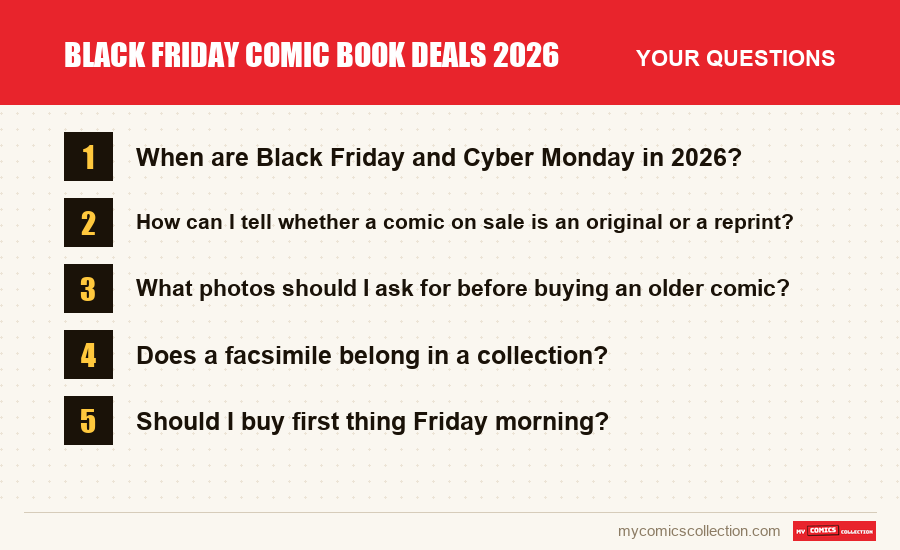
Black Friday is Friday, November 27, 2026, the day after Thanksgiving, which falls on Thursday, November 26. Online shopping gets its own day on Monday, November 30. Several retailers keep their promotions running into December, each in its own way: no single end date applies to everyone.
Find the indicia, the legal strip on an interior page that gives the year and the publisher, then compare the barcode, the paper and any facsimile notice on the cover. For Giant-Size X-Men #1, Marvel reprinted the 1975 issue in 2019 and again in 2023: the image is identical, the dates are not.
At a minimum the front and back in full frame, the length of the spine, a close-up of one corner and, for an older comic, the inside of the cover. These images let you judge the creases, corners, staples and paper yourself, without depending on an adjective like "very good condition."
Yes, as long as it is bought for what it is. The facsimile of The Batman Adventures #12, on sale March 12, 2025 with a foil variant and a blank cover, reproduces a 1993 issue; it is a modern object distinct from the period printing, to be compared with other reprints and not with originals.
Nothing requires it. This weekend's offers often run over several days, and the urgency on display is a sales pitch. It is better to prepare, before Thursday, November 26, a list of issues with edition, printing, minimum grade and a price ceiling, then not stray from that list for any listing, whatever the discount.
Already have a key issue in hand and want to pin down its edition and condition before buying anything else?
Estimate my comic