
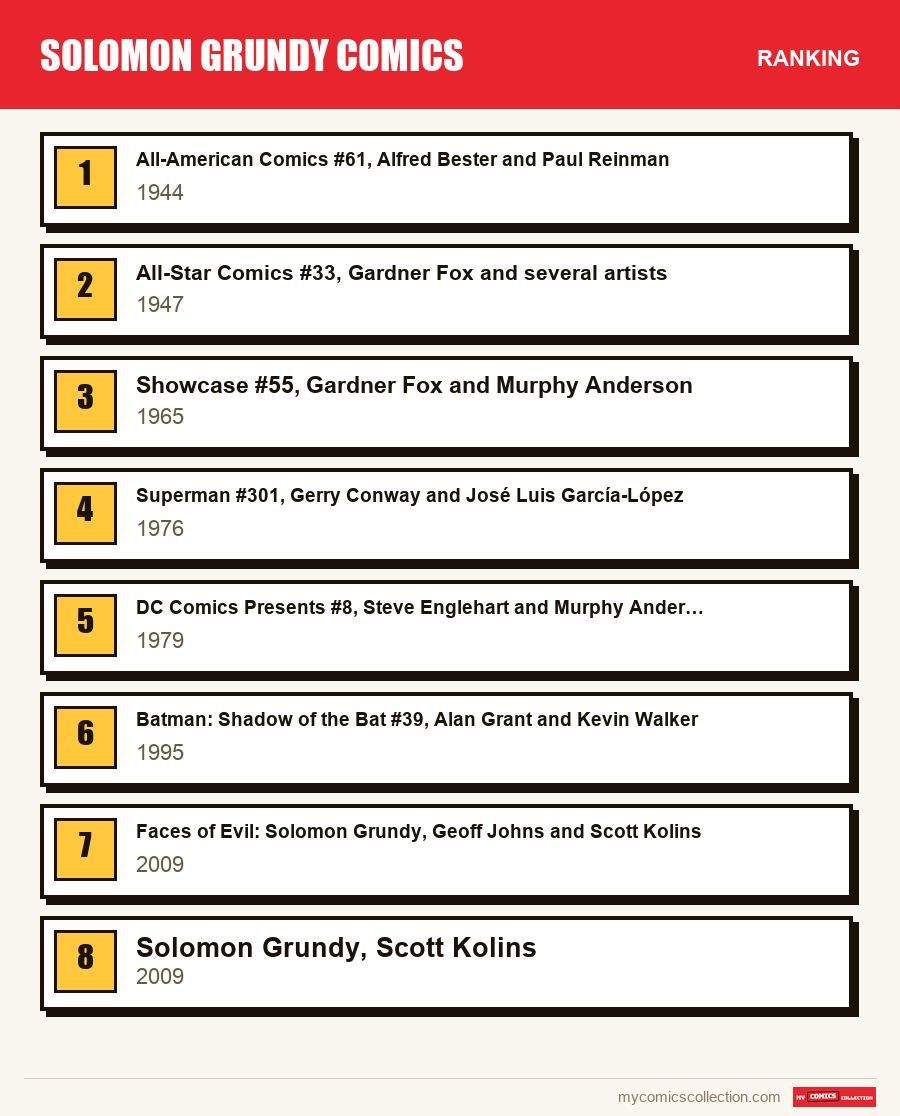
To read the best Solomon Grundy comics, start with Scott Kolins's Solomon Grundy (2009) miniseries, seven issues that finally give Cyrus Gold a voice. Then go back to All-American Comics #61 (October 1944), where Alfred Bester and Paul Reinman unleash him against Green Lantern, then Showcase #55 (1965), and finish with Batman: Shadow of the Bat #39 (1995) for his most savage version.
Solomon Grundy is a special case among DC's villains: a murdered merchant, dumped in a swamp near Gotham, who rises decades later with no memory of his life. Successive writers have treated him sometimes as a brute, sometimes as a tormented soul, and choosing the right entry point changes the experience a lot. This guide ranks eight reads where he sits at the center of the story and says, for each one, what it brings and which reader it suits.
As always on this guide, only verified facts (creators, issue numbers, dates) are stated as fact; the analysis is our own, with no reproduction of protected panels or dialogue.
His first appearance
Solomon Grundy was born in All-American Comics #61, cover-dated October 1944. The story is titled "Fighters Never Quit!"; Alfred Bester wrote it, and Paul Reinman drew it and also did the cover. The hero of the tale is Alan Scott, flanked by Doiby Dickles, his sidekick. The same issue brings together other heroes from the house, among them Atom, Doctor Mid-Nite and Hop Harrigan, a reminder that Green Lantern then shared his book with several short features.
The character stems from a well-known English nursery rhyme, the one that runs through a man's life from Monday to Sunday. Bester turns it into a tragic creature: Cyrus Gold, a wealthy Gotham merchant, is murdered at the end of the nineteenth century, then his body, abandoned in Slaughter Swamp, rises about fifty years later, mingled with swamp matter and stripped of memory. That nursery rhyme ancestry explains why so many later stories play with the days of the week.
One design detail matters for what follows: Green Lantern's ring handles wood poorly, a material Grundy borrows his nature from, and that flaw fed their rivalry for decades. For the publisher and period context, see our page on Golden Age comics.
1: All-American Comics #61, Alfred Bester and Paul Reinman (1944)
This is the foundational read. "Fighters Never Quit!" establishes the monster, his relentlessness, and the predicament of a hero whose usual weapon is not enough. Reinman, who designed the character with Bester, also did the cover, which gives this entry a rare visual coherence.
What this story brings to the character comes down to the essentials: a dead man who no longer knows who he is, and whose strength knows no brake. No deep psychology, but a silhouette that later creators picked up without betraying it.
It is for the collector who loves origins and accepts the pace of a 1944 story, short and direct. Read it in one sitting, then move on without looking for the complexity of the modern Grundy.
2: All-Star Comics #33, Gardner Fox and several artists (1947)
The issue dated February-March 1947 carries a title that tells you what to expect, "The Revenge of Solomon Grundy!", on a thirty-eight-page story. Gardner Fox writes the issue, which brings together several artists; Irwin Hasen did the cover. A Grundy imitator and his gang are also in the contents.
This entry shows the monster facing the entire Justice Society, and no longer a single hero. The title promises revenge, and the issue makes Grundy a recurring adversary rather than a one-off appearance, three years after his birth.
It suits anyone interested in the history of the Justice Society, of which Grundy remains an emblematic enemy. To place that team better, our guide to Doctor Fate will give you bearings on one of its members.
3: Showcase #55, Gardner Fox and Murphy Anderson (1965)
More than twenty years after his birth, Grundy returns in Showcase #55, cover-dated March-April 1965. The twenty-three-page story is titled "Solomon Grundy Goes on a Rampage!"; Gardner Fox writes it, Murphy Anderson draws it and does the cover, under the direction of Julius Schwartz. Doctor Fate (Kent Nelson) and Hourman (Rex Tyler) are the featured heroes: Grundy plays the title adversary.
What this story contributes is putting the character back into circulation just as DC brings its 1940s heroes back out. Anderson, with his elegant line, handles the cover and the interior alike.
It will please Silver Age readers who like to see the Justice Society heroes come back. Gardner Fox is also the writer of other stories described on his page: browsing that bibliography helps you spot the neighboring issues of this period.
4: Superman #301, Gerry Conway and José Luis García-López (1976)
Dated July 1976, Superman #301 is titled "Solomon Grundy Wins on a Monday!!", a direct nod to the nursery rhyme. Gerry Conway provides the script and José Luis García-López the art; the inking is split between Bob Oksner for the characters, and Terry Austin and Bob Wiacek for the backgrounds, which explains the crispness of the line. The story runs seventeen pages.
It shows Grundy as an adversary for the Man of Steel, which widens his playground beyond Gotham and the Justice Society. The Earth-Two Grundy crosses the barrier that separates him from Earth-One, a world that Crisis on Infinite Earths would later erase.
This read is for the collector of Bronze Age Superman looking for a visually strong adversary, drawn by one of the era's benchmark artists. Complement it with our ranking of the best Superman runs to place this issue within the series.
5: DC Comics Presents #8, Steve Englehart and Murphy Anderson (1979)
In DC Comics Presents #8, from April 1979, Superman crosses paths with Swamp Thing in "The Sixty Deaths of Solomon Grundy!" Steve Englehart writes these seventeen pages, Murphy Anderson draws them, José Luis García-López did the cover and Julius Schwartz oversees the whole. The action takes place in Metropolis and at S.T.A.R. Labs, with Lois Lane and Jenet Klyburn in support; Grundy is replicated there in sixty copies.
What the story brings is mostly an idea: a monster you cannot destroy, who comes back in multiple forms. It sets up the idea of repeated returns, which later stories would take up, and it crosses two swamp creatures in one tale.
The natural audience for this issue is the team-up crowd, starting with fans of the swamp creature, whose major periods are traced on our top Swamp Thing runs page.
Do you collect this series?
Track what you own, what you are missing and what your collection is worth. 7-day trial.
Start my trial →
6: Batman: Shadow of the Bat #39, Alan Grant and Kevin Walker (1995)
Dated June 1995, issue #39 of Batman: Shadow of the Bat carries the title "Solomon Grundy: One Night in Slaughter Swamp." Alan Grant writes, Kevin Walker draws, with inks by Curt Shoultz and Frank McLaughlin; the cover is by Brian Stelfreeze. The issue sits between Batman #519 and #520.
Grundy wakes in his swamp and slaughters those who cross his path, among them forest ranger Karin Rykel, a descendant of the woman who betrayed him in life. Batman holds him off for a time, but the human toll stays heavy. This version is the most brutal in our selection: the character is conceived as a natural scourge, not as an adversary to be punished.
It is made for the Batman reader who wants a self-contained horror story, readable without knowing the rest. For a broader overview, browse our Batman hub.
7: Faces of Evil: Solomon Grundy, Geoff Johns and Scott Kolins (2009)
This one-shot, dated March 2009, is titled "The Curse!" Geoff Johns and Scott Kolins wrote it, Kolins drew the interior, and the cover is by Shane Davis inked by Sandra Hope. Killer Croc is the villain; Alan Scott and the Phantom Stranger make appearances.
The story serves as a launchpad for the miniseries that follows, framing Cyrus Gold's misfortune as a curse to be understood rather than a simple outburst of strength. The reader is invited to look at the monster as a man.
It is for the reader hesitating before committing to seven issues: it is a tone test. The writer's other work is cataloged on our Geoff Johns page.
8: Solomon Grundy, Scott Kolins (2009)
The Solomon Grundy miniseries runs seven issues, from May to November 2009. Scott Kolins is the full creator: he writes and draws the series. The titles follow the nursery rhyme, from "Born on a Monday" for issue #1 to "Buried on a Sunday!" for issue #7, by way of "Took Ill on a Thursday" (#4) and "Died on a Saturday!" (#6).
The Phantom Stranger gives Grundy one week to undo the curse, with Alan Scott as his guide; flashbacks revisit nineteenth-century Gotham and Cyrus Gold's family. Etrigan plays the villain in the first and last issues. It is the read that gives the most room to the character's inner life.
It is the best modern entry point: it needs no prerequisites and reads in one evening. Green Lantern readers will find a nice extension of Alan Scott here. Fans of Gotham monsters should also check the page on Killer Croc, the adversary of the previous entry.
Where to start based on your profile
If you want to understand Cyrus Gold first, read the 2009 miniseries, preceded by the Faces of Evil one-shot. It offers a complete, bounded story with no prior knowledge. It is the simplest route for a reader discovering the character.
If you collect the Golden Age, start with All-American Comics #61 then All-Star Comics #33: you follow the creation and the first revenge. Collectors who like chains of issues will enjoy seeing how Bester, Fox and Reinman each set one piece of the puzzle.
If you mostly read Batman, Shadow of the Bat #39 is self-contained and brutal. Two supplements are possible. The first is The Long Halloween (1996-1997), by Jeph Loeb and Tim Sale, where Grundy takes on Batman without playing the central role. Then Starman, by James Robinson and Tony Harris, where he returns several times over the course of Jack Knight's adventures.
If you prefer crossovers, DC Comics Presents #8 offers a short meeting with Swamp Thing. Superman readers will find in Superman #301 an adversary drawn by García-López.
The key issues to know
The obvious key remains All-American Comics #61, the character's first appearance; its value depends on condition and on whether or not it has been restored, and the safest approach is to compare it against several completed sales rather than asking-price listings. Showcase #55 is the key to the Silver Age return, with Doctor Fate and Hourman as the stars.
The issues set on Earth-One, Superman #301 and DC Comics Presents #8, form a coherent pair to hunt for together. Later, Batman: Shadow of the Bat #39 and the 2009 Solomon Grundy #1 are reading turning points, not investments: their value lies in the story, and you can find them without effort.
As for method, note what makes a copy desirable: a legible cover, white pages, intact staples, and above all an exact identification of the issue, because Grundy appears on the cover or in the contents of many issues where he is not the focus. Record each purchase with its date, condition and price paid, and go back to it before selling.
Frequently asked questions
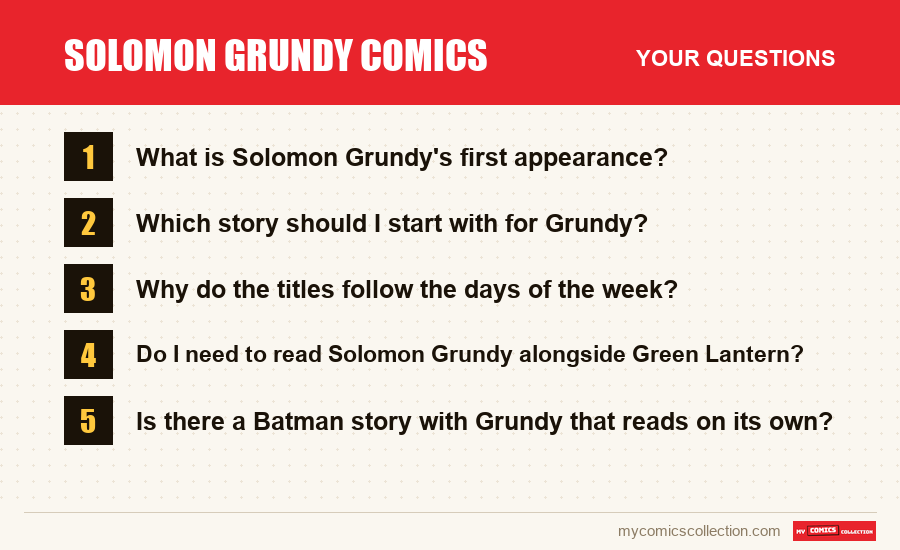
Solomon Grundy first appears in All-American Comics #61, cover-dated October 1944, in the story "Fighters Never Quit!" written by Alfred Bester and drawn by Paul Reinman. The hero who faces him there is Alan Scott, accompanied by Doiby Dickles.
Scott Kolins's Solomon Grundy miniseries, published from May to November 2009 in seven issues, is the simplest entry point. It tells a complete story, with no prerequisites, featuring Alan Scott and the Phantom Stranger. The Faces of Evil: Solomon Grundy one-shot serves as a preamble.
The character takes his name from an English nursery rhyme that tells a man's life from Monday to Sunday. Scott Kolins reuses its structure for his 2009 miniseries: "Born on a Monday" opens issue #1 and "Buried on a Sunday!" closes issue #7.
Not necessarily, but it helps. Grundy is born facing Alan Scott, and the 2009 miniseries makes Alan Scott his guide again. A basic knowledge of Alan Scott enriches the reading, without being required to understand the Batman or Superman stories where he appears.
Yes: Batman: Shadow of the Bat #39, cover-dated June 1995, is titled "Solomon Grundy: One Night in Slaughter Swamp." Alan Grant writes it and Kevin Walker draws it. It reads as a self-contained horror story, with no knowledge of the rest of the series.
Found All-American Comics #61 or Showcase #55 in your boxes? Get the copy appraised before you sell it or have it graded.
Estimate my comic