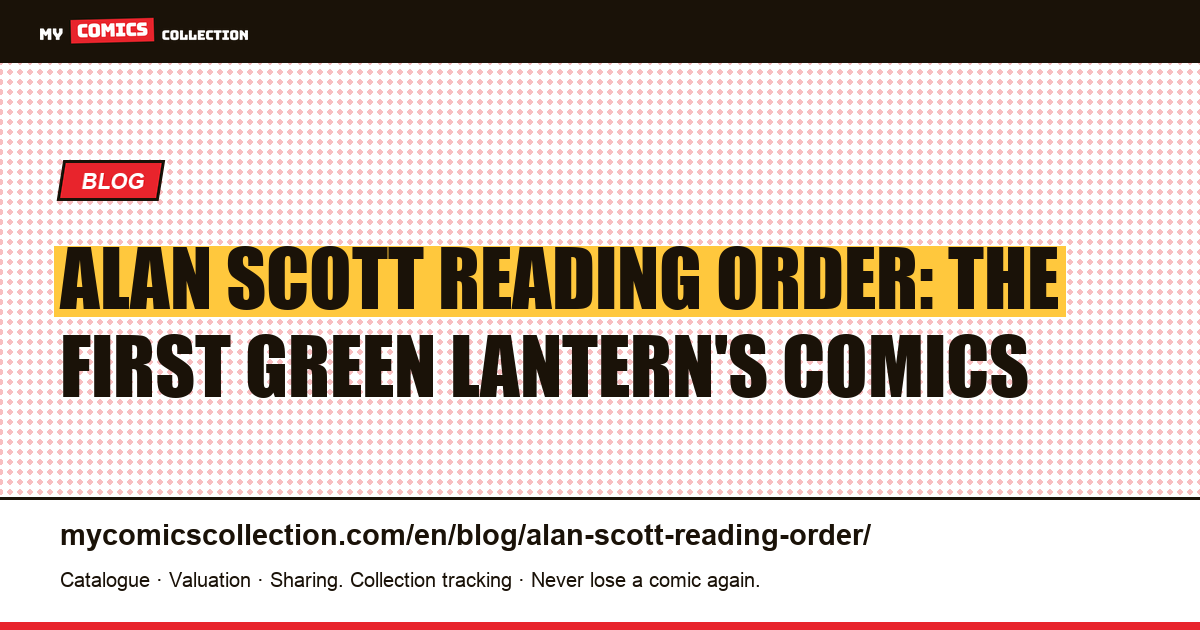
For the Alan Scott reading order, start with All-American Comics #16 (July 1940), then the Green Lantern series launched in 1941, which runs alongside All-Star Comics and the Justice Society. Continue with Justice League of America #21 and #22 (1963), the 1976 revival of All-Star Comics, All-Star Squadron and Infinity, Inc., then JSA (1999), Earth 2 (2012) and Alan Scott: The Green Lantern (2023).
Alan Scott is the first Green Lantern, and his bibliography looks nothing like Hal Jordan's: no big continuous series, but a character who disappears, resurfaces on another Earth, and changes his reference point and status with each reshaping of the DC universe. Looking for "the" right reading order therefore means choosing a logic: publication order, story order or the shortest path. This guide follows publication order, the only one that stays stable from one reprint to the next.
As always in this guide, we only state verified facts (creators, issue numbers, dates); the analysis is our own, with no reproduction of protected art or dialogue.
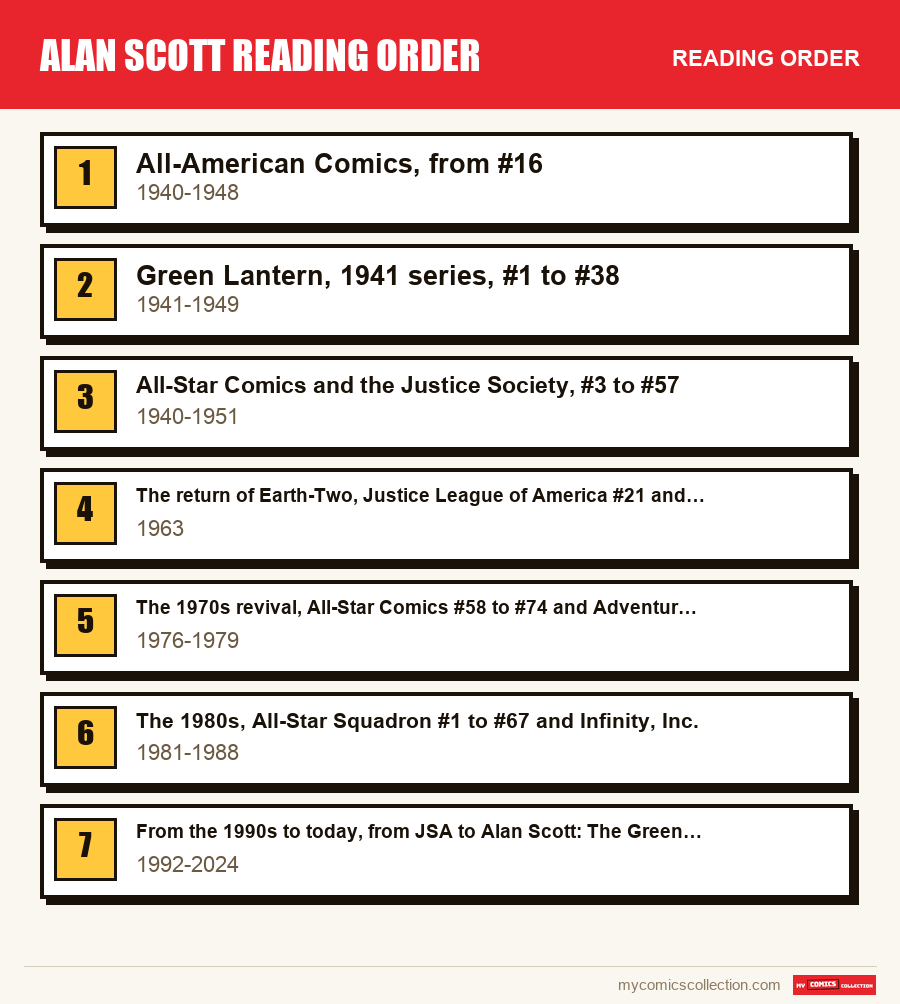
Before you start: who is Alan Scott?
July 1940, All-American Comics #16: Bill Finger writes, Martin Nodell draws, and the newsstand discovers an engineer with a green lantern. He is an engineer who finds a green lantern of mysterious origin and makes a ring from it, whose power was magical at the time rather than technological. Hal Jordan, for his part, only arrives in Showcase #22 in October 1959, with a science-fiction origin: the two men share neither the same narrative universe at the start, nor the same family of characters. For those two founding issues, see the dedicated article on Green Lantern's first appearance; here we cover everything published afterward.
A point of method before getting into the detail. Many readers search for "Green Lantern Alan Scott" thinking of a single series that could be read in one go. It does not exist: the bibliography is scattered across 1940s anthologies, team series, retrospective miniseries and a few relaunches. The seven steps below are therefore not volumes to chain together by force, but stations; you can skip several without losing the thread.
Step 1: All-American Comics, from #16 (1940-1948)
The first station is the obvious one: All-American Comics #16, July 1940. Alan Scott receives his ring and costume there, and the anthology series from All-American Publications then welcomes him as one of its regular heroes. His adventures in that title run through the end of the 1940s: his last appearance there comes in #102, in 1948, the final issue before the title became All-American Western, which makes for nearly eight years of the same monthly appointment.
What should you take away from this period? First, Martin Nodell's art, which fixes the costume and the silhouette of the lantern as visual reference points. Next, a rules detail that explains many plots: the Golden Age ring has no effect on wood, a weakness the character's adversaries exploit repeatedly. Finally, the tone: short stories where the hero investigates as much as he fights. It is a historian's read, not a comfort read, and most readers today discover it in an archive collection rather than in period single issues.
Step 2: Green Lantern, 1941 series, #1 to #38 (1941-1949)
The character's success earns him his own series as early as 1941. This Green Lantern series runs thirty-eight issues and stops in 1949, which makes it his only solo series before 2023. It is not read after All-American Comics but at the same time: the two publications run side by side, and the stories do not form a continuous chronology.
For a modern reader, it is the least urgent station. The thirty-eight issues repeat a pattern of standalone stories, with no long arcs, and the interest lies mostly in what the series says about its era: a superhero adapting to the end of the war, then to a market where the genre is running out of steam. If you only want to read a sample, choose an archive collection and stop after a few stories; you will have grasped the register. For single-issue collectors, on the other hand, this is the rarest part of the bibliography, with fragile issues whose condition determines their interest.
Step 3: All-Star Comics and the Justice Society, #3 to #57 (1940-1951)
Alan Scott joins the Justice Society of America in All-Star Comics #3, in the winter of 1940. It is in this title that he spends most of his publishing life: he remains one of the team's pillars there. His last Golden Age episode appears in All-Star Comics #57, in 1951, just as the superhero genre fades from the newsstands.
This station is the richest for understanding the character: the Justice Society's Green Lantern is a teammate, not an isolated hero, and his relationships with the other members are the framework for everything that follows. Reading All-Star Comics straight through would nonetheless be overkill. A reasonable approach is to choose a few team stories, notably around Alan Scott's arrival, then move on: the modern retellings of the Justice Society, especially in steps 5 to 7, pick up these foundations with more momentum.
Step 4: The return of Earth-Two, Justice League of America #21 and #22 (1963)
After 1951, the Justice Society disappears for more than a decade. It returns in Justice League of America #21, dated August 1963: Gardner Fox writes, Mike Sekowsky draws, Bernard Sachs inks, and Julius Schwartz edits. The story is titled "Crisis on Earth-One!", and its second part, in #22, "Crisis on Earth-Two!". The two teams, the Earth-One team and the Justice Society, meet for the first time and trade worlds. In #21, Alan Scott is among the Justice Society guests, alongside Doctor Fate, Hourman, Hawkman, the Atom and Black Canary, among others.
This is where the idea of a parallel Earth, where the heroes of the 1940s have aged, is born, which would become the great convention of the years that followed: Hal Jordan on Earth-One, Alan Scott on Earth-Two. This meeting reads in two issues, which you can find in collections devoted to the first encounters between the two teams (the volume Crisis on Multiple Earths gathers these stories). To understand the team concept, our guide to reading the Justice League gives the context of the parent series.
Do you collect this series?
Track what you own, what you are missing and what your collection is worth. 7-day trial.
Start my trial →
Step 5: The 1970s revival, All-Star Comics #58 to #74 and Adventure Comics #461 to #466 (1976-1979)
In 1976, DC relaunches All-Star Comics with issue 58: the old numbering resumes, and the Justice Society finds its readers again. Gerry Conway opens the cycle, Paul Levitz then writes issues #63 to #74, and Joe Staton and Bob Layton handle the art on #66 to #72. The series ends with #74, a casualty of the 1978 "DC Implosion," and the Justice Society is picked up in Adventure Comics from #461 to #466.
For someone who has never opened a single issue from before 1960, this step is the gentlest way in. The seventeen issues of All-Star Comics read like a TV season: a team, recurring threats, a dramatic thread from issue to issue. They exist in a collection titled All Star Comics: Only Legends Live Forever, which gathers issues #58 to #74, an issue of DC Comics Special and the six Adventure Comics installments. To place this decade within the life of the Green Lantern series, the page on Green Lantern #76 describes the Hal Jordan period contemporary with it.
Step 6: The 1980s, All-Star Squadron #1 to #67 and Infinity, Inc. (1981-1988)
The early 1980s put the Justice Society heroes back in their decade of origin. All-Star Squadron, launched in September 1981 by Roy Thomas, runs sixty-seven issues until March 1987, with Rich Buckler and Jerry Ordway among the artists. It shows the heroes of the World War II era, Alan Scott included, in a large team fresco. In #25, dated September 1983, Jade and Obsidian appear, the twins of Alan Scott and Rose Canton, created by Roy Thomas and Jerry Ordway.
These two characters carry the next series, Infinity, Inc., published from March 1984 to June 1988 in fifty-three issues, written by Roy Thomas with Dann Thomas. Alan Scott holds the place of a parent watching his children take over. The one-shot Last Days of the Justice Society of America (1986) then closes the story of the classic Earth-Two, at the moment DC merges its parallel universes. If you should read only one thing from this period, choose Infinity, Inc.: that is where the character changes roles, from front-line hero to patriarch.
Step 7: From the 1990s to today, from JSA to Alan Scott: The Green Lantern (1992-2024)
The Justice Society is relaunched after the great reshaping of the DC universe. A Justice Society of America series appears in 1992-1993 and stops at the tenth issue. The real return dates from August 1999 with JSA, which runs eighty-seven issues until September 2006: David S. Goyer and James Robinson open it with Stephen Sadowski on art, and Geoff Johns takes over the writing. Alan Scott is among the founding members; the page on Geoff Johns's universe and the guide on where to start with Geoff Johns help place this series within his body of work.
In 2012, Earth 2 #1 (May 2012), written by James Robinson with Nicola Scott on art, reinvents the character on a parallel world. Alan Scott is presented there as a media magnate, and the series makes him a gay hero, which marks a clear break from earlier versions. Finally, Alan Scott: The Green Lantern, a six-issue miniseries written by Tim Sheridan and drawn by Cian Tormey (2023-2024), is his first solo series since the one from 1941 to 1949. It is part of the The New Golden Age initiative led by Geoff Johns: it is the most readable recent entry point, but it is better enjoyed once you know the earlier steps.
Single issues or collected editions: how to read it
The question arises differently depending on the step. For the 1940s, original single issues call for precautions: the paper browns, spines give way, and many covers have been restored. For reading, an archive volume is more than enough, and spares you from exposing a rare copy to repeated handling. For the 1963 Justice Society, Crisis on Multiple Earths saves you from hunting down two separate single issues.
From 1976 on, the choice reverses: the Only Legends Live Forever volume covers most of the revival, and single issues of All-Star Comics #58 to #74 turn up in varied conditions. For JSA (1999) and its follow-ups, collections by cycle are the natural route, while Earth 2 and the 2023 miniseries read just as well in six or twelve single issues as in volumes. For a general guide to this distinction, the page on Golden Age collections gives the method. Our collector's advice remains simple: read in collected editions, buy single issues only for what matters to you, and never pay for an issue before you have identified what it brings to the character.
Recap: the complete order
- All-American Comics #16 (July 1940), then the character's adventures in that title through 1948.
- Green Lantern (1941), thirty-eight issues through 1949.
- All-Star Comics, from the arrival in the Justice Society (#3) to #57 (1951).
- Justice League of America #21 and #22 (1963), the return of Earth-Two.
- All-Star Comics #58 to #74 (1976-1978) and Adventure Comics #461 to #466.
- All-Star Squadron (1981-1987) and Infinity, Inc. (1984-1988).
- JSA (1999-2006), Earth 2 #1 (2012), then Alan Scott: The Green Lantern (2023-2024).
This path does not aim to be exhaustive: it leaves out annuals, special miniseries and the character's one-off appearances in crossovers. If you want to cross them with Hal Jordan's series, the guide to the best Green Lantern runs offers a complementary read.
Frequently asked questions
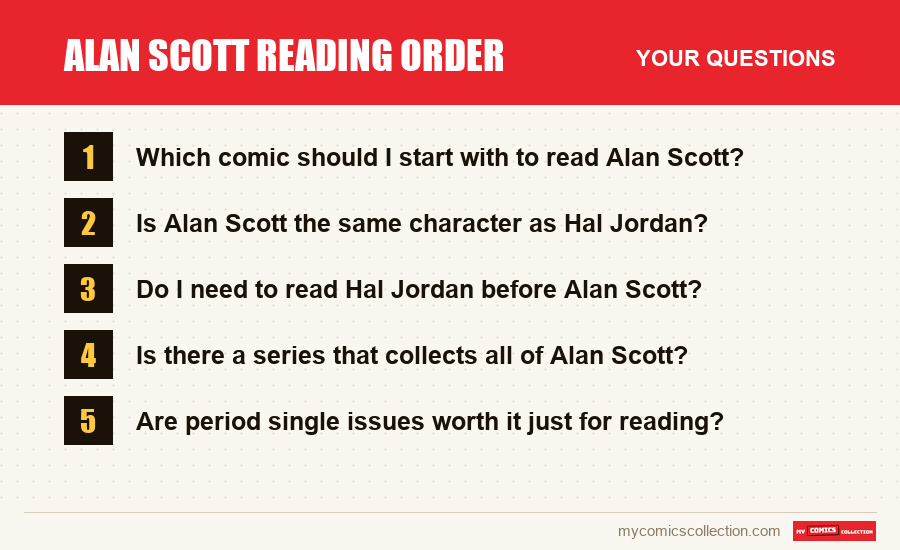
If you are after the character's history, open All-American Comics #16 (July 1940), by Bill Finger and Martin Nodell. For a pleasant read today, try the Justice Society revival in All-Star Comics #58 to #74 (1976-1978), or the miniseries Alan Scott: The Green Lantern (2023-2024), designed for a general audience.
No. Alan Scott carries a lantern of magical origin from 1940, while Hal Jordan, introduced in Showcase #22 in 1959, belongs to science fiction. The two lineages have coexisted since Justice League of America #21 and #22 (1963), which place them on two distinct Earths.
No, the order is free. Alan Scott's stories can be read without knowing Hal Jordan, apart from the team meetings starting in 1963. Conversely, Hal Jordan's series requires no prior reading of Alan Scott. Choose by the era that draws you rather than by a hierarchy of characters.
No series gathers everything. He had his own Green Lantern series from 1941 to 1949, then a six-issue miniseries in 2023-2024, but most of his bibliography lies in team titles such as All-Star Comics, All-Star Squadron and JSA.
Not for reading alone. Archive collections and retrospective volumes cover most of it, and protect the fragile copies from 1940 to 1951. The original single issue answers a collecting project: owning the issue itself, knowing its condition and print run.
Do you own an All-American Comics, an All-Star Comics or an older issue of Green Lantern? Get a first read on its condition and its interest.
Value my comic