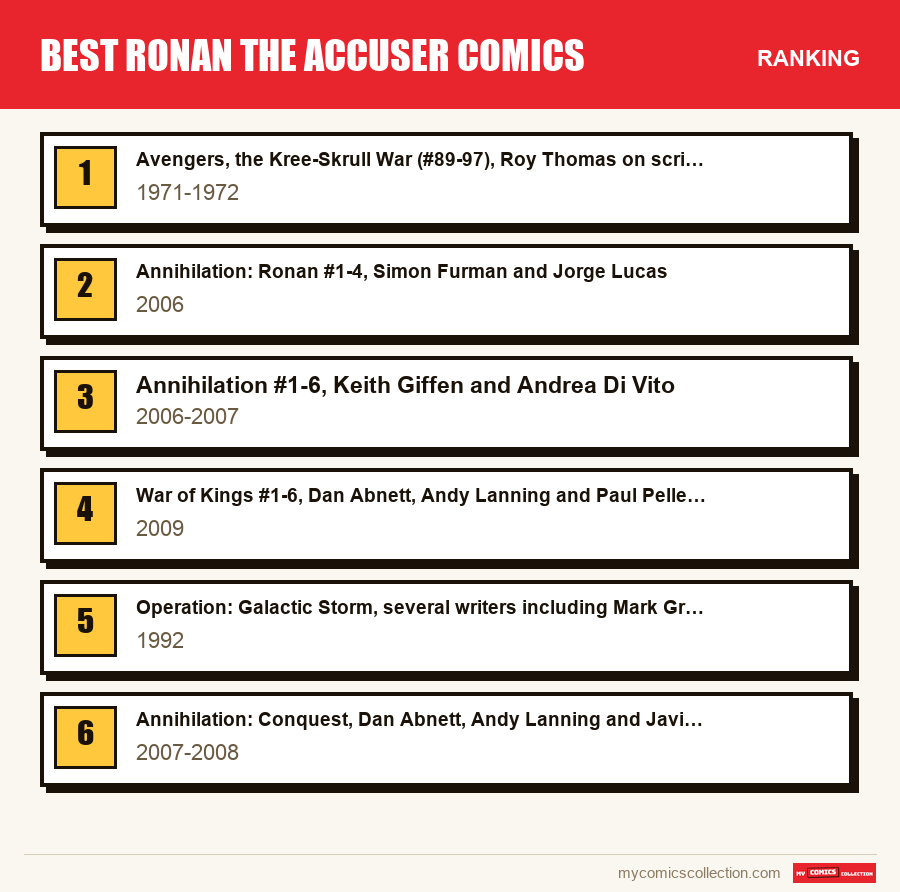
The best Ronan the Accuser comics start with Avengers #89-97 (1971-1972), Roy Thomas's Kree-Skrull War, followed by the miniseries Annihilation: Ronan (2006), by Simon Furman and Jorge Lucas. Then read Annihilation (2006-2007), by Keith Giffen, and War of Kings (2009), by Dan Abnett and Andy Lanning. His first appearance is in Fantastic Four #65 (1967), the key issue to know.
Ronan is the Supreme Accuser of the Kree empire: a judge-soldier whose law is indistinguishable from his people's pride, at times an ally of his own, at times an outlaw, at times a claimant to the throne. No regular series bears his name: he is discovered in episodes, through Marvel's cosmic wars, and six reads truly matter for him, presented below with what they give him, who they are for and how to approach them.
As always in this guide, only verified facts (creators, issue numbers, dates) are stated as fact; the analysis is our own, with no reproduction of protected artwork or dialogue.
His first appearance
Ronan appears in Fantastic Four #65, cover-dated August 1967. Stan Lee writes the issue and Jack Kirby draws it, which makes them the character's creators. The same issue also marks the debut of the Supreme Intelligence, the organic computer that governs the Kree empire: the two major figures of Kree power therefore enter the stage together, which gives this single issue a weight that few issues of the period have.
For a collector, this is the benchmark issue. It belongs to the series that founded the modern Marvel universe, and it carries the double debut of Ronan and the Supreme Intelligence. It is a story from the great Lee and Kirby era, where the quartet faces alien civilizations rather than city criminals; the Kree are presented through their government, with the Supreme Intelligence at the top.
Don't look in this first role for the Ronan of the 2000s: the 1967 one is only the starting point. His importance comes from what follows, because later writers made this judge's function into material for drama. If you read the single issue today, read it as an archival piece, expecting a story of its time.
1: Avengers, the Kree-Skrull War (#89-97), Roy Thomas on script, three artists (1971-1972)
This is the great Avengers arc of the early 1970s, and the best way into the classic Ronan. Roy Thomas writes the series; the artists are Sal Buscema for the first issues, Neal Adams for the central stretch, and John Buscema on two issues. Ronan is among the main characters: he is the instigator of the Kree Sentries' attacks on Earth, and of the "Atavus" plan, which aims to devolve our planet to turn it into a base against the Skrulls. He ends the confrontation with the heroes when he learns that a Skrull attack is striking Hala, the Kree capital.
The contribution is twofold. First, he becomes an empire-scale adversary, no longer a mere officer. Second, the Kree-Skrull War sets the backdrop that Marvel's cosmic stories will return to for decades. Ronan is not the hero here, but it is a structuring role, one you see better by reading the arc as a whole.
Who is this read for? Fans of classic Avengers and collectors who want to understand the origin of the Kree conflicts. To read it, take the nine issues in order: the arc is designed as a whole, and the artists who take turns give each third a different identity. Our Captain Mar-Vell guide, cited in the box, shows the other side of this story, that of the Kree hero caught between two loyalties.
2: Annihilation: Ronan #1-4, Simon Furman and Jorge Lucas (2006)
The 2006 miniseries is the most character-focused read in the whole list. Simon Furman writes it, Jorge Lucas draws it. At the start, Ronan, arrested for treason in the one-shot that serves as the event's prologue, sets off to find Tana Nile, the witness who falsely accused him. He fights Gamora and others on Godthab Omega, while the attack of the Annihilation Wave upends every plan: Tana Nile dies there, and Ronan decides to return to the Kree despite his exile.
The contribution is essential: the judge ends up in the dock, and it is this inversion that makes him a character in his own right. The series gives him a personal quest, a rivalry with Gamora and a goal, restoring his honor, which then explains his choices in the rest of the event.
It speaks to fans of war-driven science fiction, and to those who collect the standout miniseries of the 2000s. To read it, open the event's prologue first, then the four issues, before moving on to the main series. Our Annihilation reading guide gives the order of the event's threads.
3: Annihilation #1-6, Keith Giffen and Andrea Di Vito (2006-2007)
The event's main series is written by Keith Giffen and drawn by Andrea Di Vito, with covers by Gabriele Dell'Otto. Ronan there rejoins the Kree and takes power among them, after eliminating the members of House Fiyero. His role is that of a warlord who comes back to face his own people before governing them.
The contribution to the character is a mutation: from outlaw, he becomes ruler of the empire. This is the turn that moves him from the status of enforcer to that of legitimate power, and it sets up his later roles. The event does not set him apart from the other players: Nova, Drax, Gamora and the Surfer share the stage, which makes it an ensemble saga.
It is for anyone who wants the full context of the 2000s cosmic line, or who is preparing to read Guardians of the Galaxy. Read it after Furman's miniseries so that Ronan's trajectory is clear. If you have already read the best Drax comics, you will recognize part of the cast.
4: War of Kings #1-6, Dan Abnett, Andy Lanning and Paul Pelletier (2009)
Dan Abnett and Andy Lanning write the main series, Paul Pelletier draws it. The starting point is a wedding: Black Bolt arranged the union of Ronan and Crystal to bring the Kree and the Inhumans together and secure them a common defense. In the first issue, the Shi'ar Imperial Guard, led by Gladiator, attacks the ceremony, and Ronan falls while trying to help Crystal. The Inhumans and the Kree then strike back at the Shi'ar.
Ronan does not carry the war all by himself: Black Bolt, Vulcan and the Shi'ar hold an equivalent place, and the story is above all a clash between empires. He is nonetheless its trigger, and his status as the future husband makes him the visible reason for the conflict. That is what justifies his spot in the ranking, at a rank where his importance depends on the reader: stronger for anyone interested in the Inhumans, weaker for anyone looking for a portrait of Ronan.
The read is for Inhumans fans, who will also find our page on the best Black Bolt comics useful. To read it, go in publication order, and don't forget that the miniseries in its wake, including Realm of Kings: Inhumans, extend the event.
Do you collect this series?
Track what you own, what you are missing and what your collection is worth. 7-day trial.
Start my trial →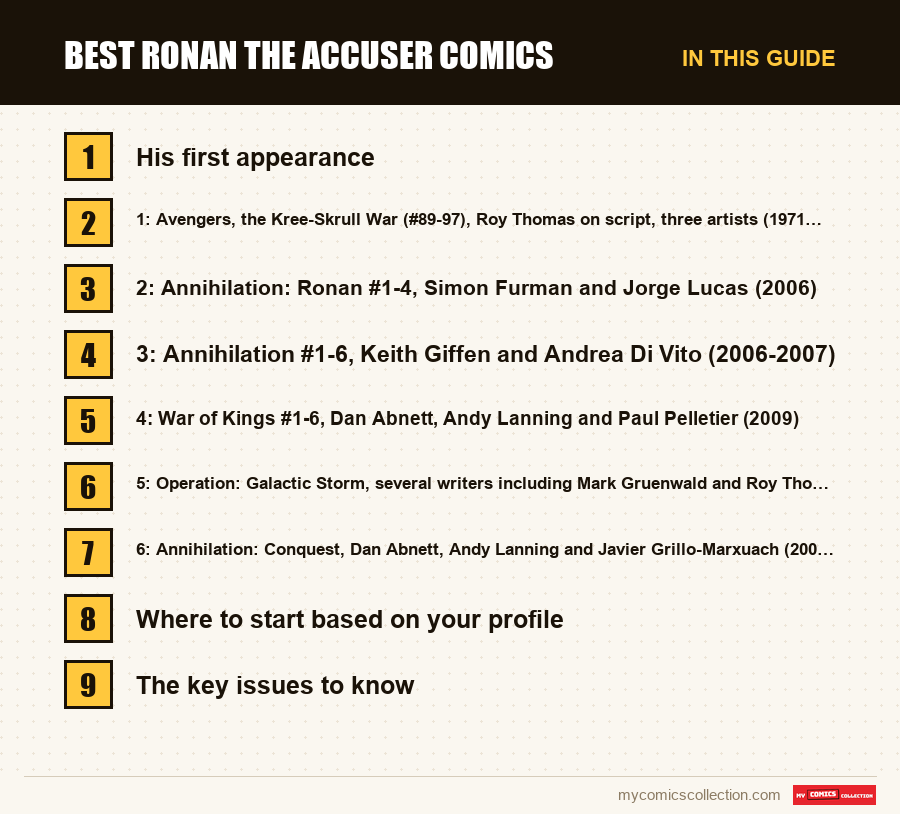
5: Operation: Galactic Storm, several writers including Mark Gruenwald and Roy Thomas (1992)
This nineteen-chapter crossover, running March to May 1992, spans the Avengers-related series: Avengers, Avengers West Coast, Captain America, Iron Man, Thor, Wonder Man and Quasar. Mark Gruenwald is one of the writers, Roy Thomas writes the Avengers West Coast chapters. It pits the Kree and Shi'ar empires against each other, with the Avengers caught in the middle, and it is in this story that the Starforce, the Kree team led by Ronan, makes its debut.
The contribution is this: Ronan is a team leader and a war player there, which extends the officer function he had in the 1970s. The crossover reads as an openly acknowledged sequel to the Kree-Skrull War, with the same stakes transposed to the 1990s. Its scattered format is a drawback: the chapters are spread across seven titles.
It is for the patient collector, who loves crossovers of the era and accepts gathering the chapters in order. A tip on method: draw up the list of single issues before buying and note the publication order of each series' chapters.
6: Annihilation: Conquest, Dan Abnett, Andy Lanning and Javier Grillo-Marxuach (2007-2008)
The sequel to Annihilation pits the Phalanx, a techno-organic civilization, against the Kree, with Dan Abnett and Andy Lanning at the helm of the main miniseries. In the Annihilation: Conquest - Wraith thread, written by Javier Grillo-Marxuach, Ronan is converted to the Phalanx's cause and sent to interrogate Wraith, who reveals his origin during the interrogation.
Ronan's role there is secondary: he appears as an instrument of the Phalanx, not as the engine of the story. We rank it last for that reason, and cite it as a continuity stop rather than a portrait. It does show, however, how far the saga transformed the character, from warlord to pawn of a collective intelligence.
This read is for anyone who has already worked through the earlier events and wants to follow the full chain of the cosmic line. It is read after Annihilation, not before, or you lose the logic of the alliances.
Where to start based on your profile
The reader in a hurry will start with Annihilation: Ronan: four issues, a central role, a story that stands on its own. The classic Avengers reader will open Avengers #89 and follow the arc through #97, before coming back down toward the early 2000s. The reader of the modern cosmic line will take Annihilation, then War of Kings, to see how the character goes from reclaiming power to the politics of imperial marriages.
If you come from the 2019 Captain Marvel movie, our movie vs. comics page, cited in the box, helps tell what comes from the page. The collector who wants to work it all backward can start from Fantastic Four #65, then read the Kree-Skrull War, then the whole twenty-first century in order.
A minimal path takes three steps: Avengers #89-97, Annihilation: Ronan #1-4, then War of Kings #1. These three blocks give the function (soldier of the empire), the fall (outlaw) and the power (claimant to the throne), the three faces of the character.
The key issues to know
The method is the same for every character: tell apart the first appearance, the character turning points and the events, then compare each issue to sold listings of an identical grade rather than to asking prices. Here are the character's benchmarks.
- Fantastic Four #65 (August 1967): first appearance of Ronan and the Supreme Intelligence, by Stan Lee and Jack Kirby. This is the benchmark issue.
- Avengers #89 to #97 (1971-1972): the Kree-Skrull War, where Ronan is a protagonist of the arc.
- Operation: Galactic Storm (1992): crossover that sees the debut of the Starforce, led by Ronan.
- Annihilation: Ronan #1 (2006): first issue of Simon Furman's miniseries, benchmark of the modern Ronan.
- Annihilation #1 (2006): start of Keith Giffen's main series.
- War of Kings #1 (2009): the attacked wedding, by Dan Abnett and Andy Lanning.
- Annihilators (2011): series in which Ronan appears, the last milestone of our path.
Keep the usual hierarchy in mind: a first appearance is verified by publisher, issue number and authenticity; a narrative turning point or a modern miniseries is judged by real reader demand. A 2006 single issue does not play in the same category as a 1967 issue, and it would be misleading to compare them without considering the gap in print runs.
Frequently asked questions
Ronan appears in Fantastic Four #65, cover-dated August 1967. The issue is by Stan Lee and Jack Kirby, and it also marks the debut of the Kree Supreme Intelligence. Collectors treat it as the character's benchmark piece.
Read Avengers #89 to #97 (1971-1972), scripted by Roy Thomas: this Kree-Skrull War is the reference. Ronan is a protagonist there. The story sets up the clash between the two empires, which Marvel's cosmic sagas will return to several times afterward.
Yes: Annihilation: Ronan, in four issues, published in 2006. Simon Furman writes it and Jorge Lucas draws it. It follows Ronan as he looks for the witness who accused him of treason, before the attack of the Annihilation Wave.
In War of Kings (2009), written by Dan Abnett and Andy Lanning, Black Bolt arranges the marriage of Ronan and Crystal to unite the Kree and the Inhumans. The ceremony is attacked by the Shi'ar Imperial Guard, which triggers the war between empires.
It is recommended. Annihilation (2006-2007) sets up the Kree situation and Ronan's role at their head, and War of Kings (2009) picks up the consequences. The second story can be read alone, but it loses clarity without the first.
Do you own a Fantastic Four #65 or an issue from the Kree-Skrull War? Get a free estimate before deciding whether to keep it or sell it.
Estimate my comic