
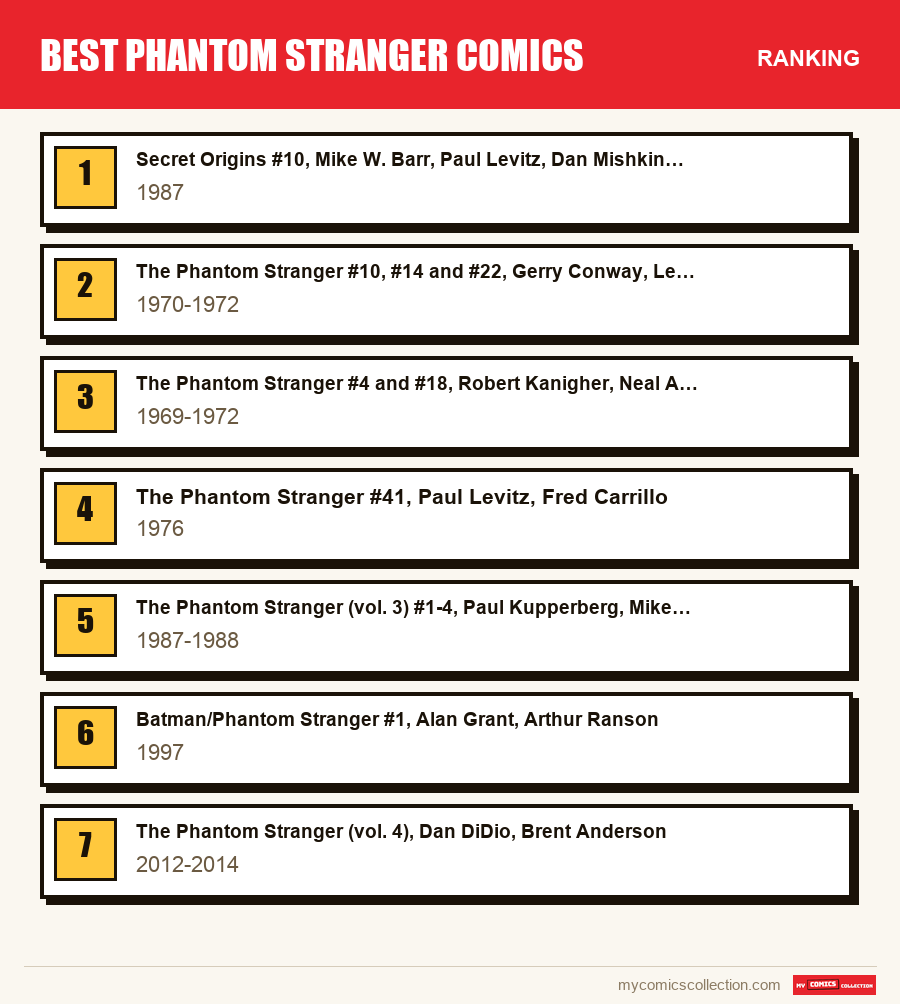
The best Phantom Stranger comics start with Secret Origins vol. 2 #10 (1987), which offers four contradictory origins, then the Len Wein and Jim Aparo issues of the 1969-1976 series (#14 and #22). Continue with the 1987-1988 miniseries by Paul Kupperberg and Mike Mignola, then the 1997 one-shot Batman/Phantom Stranger. His first appearance is Phantom Stranger #1, dated August-September 1952.
The Phantom Stranger is a character who never explains himself: he shows up at the right moment, warns, steps forward and leaves without giving his name. That discretion makes sorting hard, because he crosses dozens of series where he is only a guest. Seven reads genuinely put him at the center or try to say where he comes from; here they are, from the most useful to the most anecdotal.
As always in this guide, only verified facts (creators, issue numbers, dates) are stated; the analysis is our own, with no reproduction of protected art or dialogue.
His first appearance
The Phantom Stranger appears in Phantom Stranger #1, dated August-September 1952, at DC. The character is the work of writer John Broome and artist Carmine Infantino. The opening story is titled "The Haunters from Beyond!": in it, Bryce Parris tries to convince Anne Parris, a descendant of a Salem witch hunter, that the ghosts of witches are haunting her, in order to steal her inheritance.
That first series runs six issues, published between 1952 and 1953. The character returns in Showcase #80 (February 1969), with a framing story by Mike Friedrich, Jerry Grandenetti and Bill Draut under a Neal Adams cover, before his own series restarts in May-June 1969.
A nameless hero, series without a sequel
The Stranger is a passing character: he appears in Justice League Dark, in the New 52 crossovers and in dozens of series where he carries little weight. We only kept stories where he is the hero or the stakes, and we set aside team books where he is merely a guest.
The ranking starts with the best entry point, the one that poses the character's questions, and ends with the recent series most tied to the events of their day.
1: Secret Origins #10, Mike W. Barr, Paul Levitz, Dan Mishkin, Alan Moore (1987)
Issue #10 of the second Secret Origins series, dated January 1987, with a cover by Jim Aparo, collects four ten-page stories that each offer a different origin for the Stranger. None became canon, and that is the very principle of the issue: "Tarry Till I Come Again," by Mike W. Barr and Jim Aparo, shows him as Isaac, whose wife and son die in a flashback beginning in the year 33; "...and men shall call him Stranger," by Paul Levitz and José Luis García-López, places him in a doomed city saved by an angel; "Revelations," by Dan Mishkin, Ernie Colón and Pablo Marcos, imagines a future where he passes his powers to a scientist who will become the Stranger and travel back to the Big Bang; "Footsteps," by Alan Moore and Joe Orlando, makes him a fallen angel among the rebels, alongside Lucifer, Asmodeus, Leviathan and Etrigan.
What the read adds to the character is his very definition: a being whose mystery is the subject. The issue offers four doors into the Stranger and leaves readers to choose the one they prefer. For anyone discovering the character, it is the most economical introduction.
Who is it for? Any reader curious about who the Stranger is. How should you read it? In one sitting, in the order of the issue. If you like Alan Moore's register, move on to our Swamp Thing key issues.
2: The Phantom Stranger #10, #14 and #22, Gerry Conway, Len Wein, Jim Aparo (1970-1972)
In the 1969-1976 series, Jim Aparo draws the issues that set the Stranger's look. Issue #10 (November-December 1970), "Death... Call Not My Name," is written by Gerry Conway: it introduces Tannarak, a mage obsessed with eternal life, with Doctor Thirteen in support. Issue #14 (July-August 1971), "The Man with No Heart!", is by Len Wein: the villain Broderick Rune captures the Stranger and takes his heart in a transplant. Issue #22 (November-December 1972), "Circle of Evil!", again by Len Wein, reveals that the Dark Circle is behind several plots the Stranger has foiled.
The read delivers the tone of the series: short stories in which an adversary obsessed with power, immortality or revenge collides with the Stranger. Aparo also did the lettering on several of these issues. Issues #14 and #22 contain a Doctor Thirteen backup story, in which the Stranger does not appear.
Who is it for? Readers who like the gothic horror of the Bronze Age. How should you read it? Issue by issue, in the volume Showcase Presents: The Phantom Stranger, which collects Showcase #80 and issues #1-21 of the series.
3: The Phantom Stranger #4 and #18, Robert Kanigher, Neal Adams, Len Wein, Tony DeZuniga (1969-1972)
Issue #4, dated November-December 1969, marks the shift to entirely new stories. "The Dead Don't Sleep Forever!" runs twenty-three pages in three chapters, with Robert Kanigher on script, Neal Adams on art and Bill Draut inking the first seventeen pages. The action takes place in Haiti and New York, with Doctor Thirteen and Marie Thirteen, four teenagers and the adversary Tala.
Issue #18 (March-April 1972) offers another path: "Home is the Sailor," eighteen pages by Len Wein drawn by Tony DeZuniga, in which the Stranger meets the Flying Dutchman. Both issues show the series in its early days on the side of longer stories: the first showcases the art of Neal Adams, one of the most recognizable of the era.
Who is it for? Collectors interested in the artists of the era, especially Neal Adams. How should you read it? On their own, after read 2, since these issues are more often detours than landmarks.
4: The Phantom Stranger #41, Paul Levitz, Fred Carrillo (1976)
Issue #41, dated February-March 1976, closes the series launched in 1969. "A Time for Endings," twelve pages written by Paul Levitz and drawn by Fred Carrillo, brings the Stranger and Deadman together around Cassandra Craft, whom Nathan Seine wants to sacrifice; Seine dies there. In the backup, a Black Orchid story written by Michael L. Fleisher does not feature the Stranger.
The read is useful as a marker: it shows where the classic series ends. The character will later return in team books and supplements, and an issue #42 will only appear in January 2010, as a standalone issue tied to Blackest Night.
Who is it for? Readers who want to finish the 1969 series and collectors completing the run. How should you read it? Last, after the rest of the issues in read 2, since the story assumes familiarity with the character.
Do you collect this series?
Track what you own, what you are missing and what your collection is worth. 7-day trial.
Start my trial →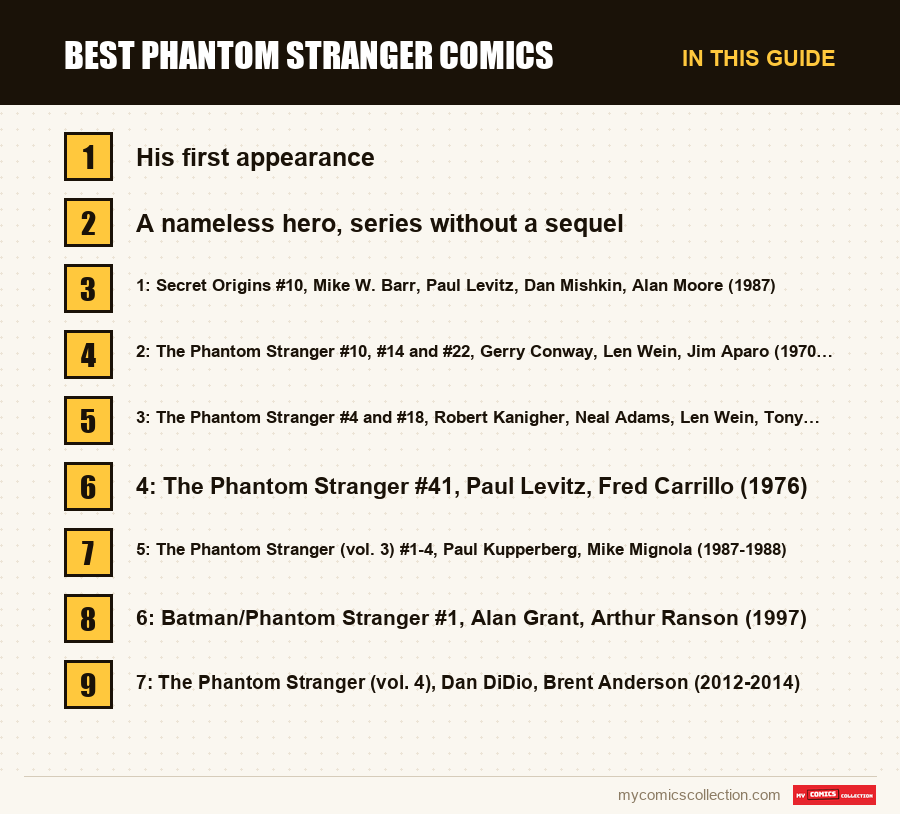
5: The Phantom Stranger (vol. 3) #1-4, Paul Kupperberg, Mike Mignola (1987-1988)
The four-issue miniseries was published from October 1987 to January 1988. Paul Kupperberg writes, Mike Mignola draws, and P. Craig Russell inks issues #1, 2 and 4. The titles are "The Heart of a Stranger," "The Soul of the Man!" and, for the last issue, "A World Full of Voices!" The adversaries are Eclipso, Lycaon and the Temple of Divine Light, while Bruce Gordon, Jenet Klyburn and Valentina Vostok accompany the character, and the Lords of Order step in. To understand Eclipso, see our Eclipso guide.
The read delivers a Stranger as agent of the Lords of Order, and above all Mike Mignola's linework a few years before Hellboy. It is the best visual surprise in the ranking.
Who is it for? Readers who like Mignola's art and magic in dark tones. How should you read it? All four issues in one go, with no prior reading.
6: Batman/Phantom Stranger #1, Alan Grant, Arthur Ranson (1997)
This 1997 one-shot is written by Alan Grant and drawn by Arthur Ranson, who also colors it; Bill Oakley letters and Scott Peterson edits. Batman crosses paths with the Stranger there, and their meeting sets a young man's life straight. The two hear the song of a Lemurian prophet whose moral urges treating others as you would want to be treated.
The read is no event, but it shows the Stranger's spirit when facing Batman. To find Batman in this register, see the Batman hub.
Who is it for? Batman collectors who like unusual team-ups. How should you read it? On its own: it is a one-shot with no sequel.
7: The Phantom Stranger (vol. 4), Dan DiDio, Brent Anderson (2012-2014)
The fourth series launches in September 2012, written by Dan DiDio and drawn by Brent Anderson. It becomes Trinity of Sin: The Phantom Stranger with issue #9 (August 2013) and ends with issue #22 (October 2014). In this series the Stranger is revealed to be Judas Iscariot: the Circle of Eternity condemned him to walk the Earth as an agent of God, and he wears a necklace of the thirty pieces of silver.
This answer contrasts with the four leads of 1987, and the read shows what a settled origin costs: it closes the mystery that the 1970s kept alive.
Who is it for? New 52 readers and anyone who wants the origin adopted in 2012. How should you read it? After Secret Origins #10, to measure the gap.
Where to start based on your profile
To approach the Stranger, pair read 1, which poses the enigma, with read 2, which sets the atmosphere. If you love the art, move on to read 5, with Mike Mignola, and read 3, with Neal Adams. If you follow the New 52, read 7 gives the context of Trinity of Sin.
If you collect the Bronze Age, look for the issues of the 1969-1976 series, starting with Aparo's issues. To place the Stranger in DC's mystical universe, look at the best Spectre comics and those of Doctor Fate.
The key issues to know
On the collecting side, we distinguish the 1950s, the 1969 series and the relaunches. No price here: Stranger single issues are compared by grade and printing, on completed sales rather than on listings.
- Phantom Stranger #1 (August-September 1952): first appearance of the Stranger, with Carmine Infantino on art. This is the baseline reference.
- Showcase #80 (February 1969): the character's return, with a framing story by Mike Friedrich, Jerry Grandenetti and Bill Draut.
- The Phantom Stranger #4 (November-December 1969): the shift to new stories, by Robert Kanigher and Neal Adams.
- The Phantom Stranger #10 (November-December 1970): first appearance of Tannarak, by Gerry Conway and Jim Aparo.
- The Phantom Stranger #22 (November-December 1972): the Dark Circle unveiled, by Len Wein and Jim Aparo.
- The Phantom Stranger #41 (February-March 1976): the end of the classic series, by Paul Levitz and Fred Carrillo.
- Secret Origins #10 (January 1987): the four origins. The Stranger is the subject of every story there.
- The Phantom Stranger (vol. 4) #1 (September 2012): the New 52 relaunch, by Dan DiDio and Brent Anderson.
Check the cover date before buying. The 1952 issue #1, the 1969 one (May-June), the 1987 one and the 2012 one all carry the same series title.
Frequently asked questions
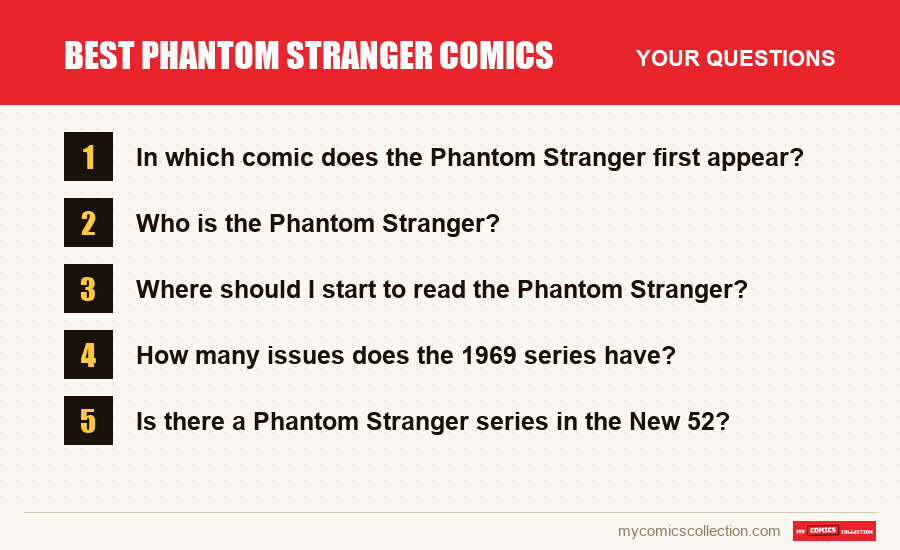
The Stranger appears in Phantom Stranger #1, dated August-September 1952, in the story "The Haunters from Beyond!", with Carmine Infantino on art; John Broome and he created the character. That first series runs six issues; the character returns in 1969, in Showcase #80 and then in a 41-issue series.
It depends on the series. Secret Origins #10 (1987) offers four contradictory origins, including that of a fallen angel written by Alan Moore. Dan DiDio's 2012 series settles on the identity of Judas Iscariot, condemned to walk the Earth as an agent of God.
Start with Secret Origins #10, which poses the character's questions in four stories, then the Len Wein and Jim Aparo issues of the 1969 series, such as issues #14 and #22. The 1987 miniseries by Paul Kupperberg and Mike Mignola extends the read with remarkable art.
Forty-one issues, from May-June 1969 to February-March 1976. The first three reprint stories from the 1950s with new sequences, then the all-new stories begin at issue #4 with Robert Kanigher, Len Wein, Jim Aparo and Neal Adams. An issue #42 appears in 2010.
Yes: The Phantom Stranger (vol. 4) launches in September 2012, written by Dan DiDio and drawn by Brent Anderson. It becomes Trinity of Sin: The Phantom Stranger at issue #9 and ends with issue #22, in October 2014.
Do you own a copy of Phantom Stranger #1 or an issue of the 1969 series? Get a free valuation.
Value my comic