
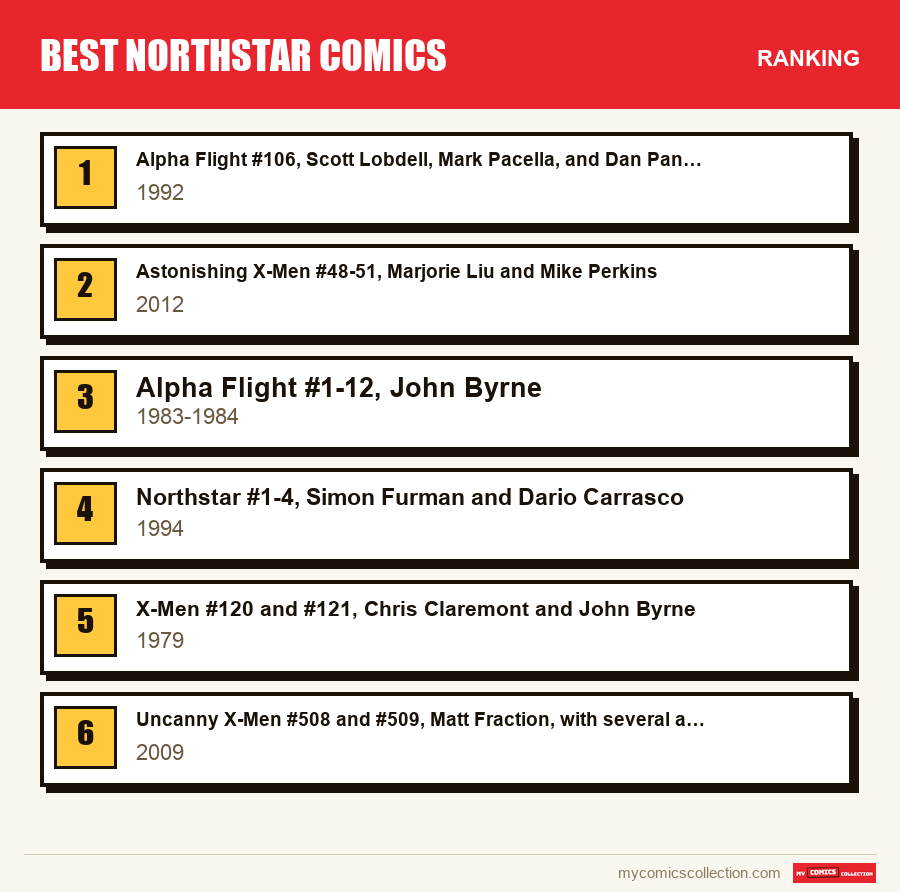
The best Northstar comics to start with are Alpha Flight #106 (March 1992), by Scott Lobdell and Mark Pacella, where Jean-Paul Beaubier comes out as gay, followed by Astonishing X-Men #48-51 (2012), by Marjorie Liu and Mike Perkins, which lead to his wedding to Kyle Jinadu. Then go back to Alpha Flight #1 (August 1983), by John Byrne. His first appearance is in X-Men #120 (April 1979), by Chris Claremont and John Byrne.
Jean-Paul Beaubier is a mutant from Montreal with super speed and the power to generate light, and his bibliography is split between a Canadian team book, a few miniseries, and stints with the X-Men. The ranking below only includes the reads where he carries the story, and it tells you plainly which ones feature him as just one member among many.
As always in this guide, we only state verified facts (creators, issue numbers, dates); the analysis is our own, with no reproduction of protected art or dialogue.
His first appearance
Northstar was created by writer Chris Claremont and artist John Byrne. He debuts in X-Men #120, cover-dated April 1979, as part of the Canadian team that his country's government sends after Wolverine. The next issue, X-Men #121, shows him in action and continues the arc in which Wolverine is captured.
At this point Jean-Paul is not yet a hero: he is one of a group of antagonists, a brief and minor role in a story that belongs to Wolverine. That is why these two issues are landmarks for readers and collectors, but not Northstar stories. Mostly, they set up what Byrne would develop later in his own series: a national team, a government department that oversees it, and two twins, Jean-Paul and his sister Aurora, whose powers complement each other.
One detail about the timeline helps you avoid grabbing the wrong title: at this point the series is still called X-Men, and that is the name under which catalogs and collectors list #120 and #121. To place these issues within the Chris Claremont era, our page on the history of the X-Men in comics gives the overall timeline.
1: Alpha Flight #106, Scott Lobdell, Mark Pacella, and Dan Panosian (1992)
Cover-dated March 1992, Alpha Flight #106, titled "The Walking Wounded," is written by Scott Lobdell, penciled by Mark Pacella, and inked by Dan Panosian. Northstar rescues a baby abandoned during a fight, then adopts the child. Doctors discover the baby's illness, and a meeting with Major Mapleleaf, a former hero whose son died of AIDS, opens a debate that leads Jean-Paul to publicly declare that he is gay.
This story gives the character a public voice and the commitment that comes with it: Jean-Paul stops being a hero whose private life stays off the page. It is also very much a product of its time, carrying the mark of the early 1990s public debates about the disease. It remains the most direct way into the character, because it can be read with no prerequisites: the issue itself tells you what you need to know about Northstar and his team.
It suits the curious reader who wants to know why Jean-Paul has a place in Marvel's publishing history, and the collector hunting 1992 single issues. The issue went to a second printing, so you need to check which printing your copy comes from. To read it comfortably, pick up the trade paperback Astonishing X-Men: Northstar, published in 2013, which places it alongside the more recent material.
2: Astonishing X-Men #48-51, Marjorie Liu and Mike Perkins (2012)
Marjorie Liu writes Astonishing X-Men from #48 to #68, and Mike Perkins opens his run with issue #48, in March 2012. The first arc, #48-51, centers on Northstar and Karma. Jean-Paul proposes to Kyle Jinadu, Kyle first says no, then accepts at the end of the arc. Issue #51, with its main cover by Dustin Weaver, depicts the ceremony.
The payoff is significant: Northstar is seen in his private life, with a partner who is not a mutant and a simple question, whether an X-Man can balance his mission with his relationship. Liu hands that question to a short four-issue arc, which keeps the story tight. The social dimension of the event, widely discussed when it came out, does not change the fact that the arc is first and foremost a story about commitment and compromise.
This read suits anyone who has read #106 and wants to see what happened twenty years later. You can follow it with no prior knowledge of the X-Men: all you need to know is that Jean-Paul is an X-Man and that Kyle Jinadu is his partner. The next arc, Weaponized, covers issues #52-56 and changes the subject, with Gabriel Hernandez Walta and then other artists following Perkins; if you are looking for Northstar, stop at #51.
3: Alpha Flight #1-12, John Byrne (1983-1984)
John Byrne writes and draws the first twenty-eight issues of Alpha Flight on his own. Issue #1, "Tundra!," is cover-dated August 1983 and launches the series. In the early issues, Byrne scatters his team before bringing it together, and companion stories revisit the origins of its members, including Northstar and his sister Aurora.
In this series, Northstar is one of the protagonists of a group, without everything resting on him. What you read here is his natural setting: the speed, the light, and the bond with Aurora, in a Canadian universe that Byrne builds step by step. It is the foundation for everything that follows, including the 1992 issue, which makes more sense once you know where the character comes from.
It is aimed at readers of 1980s comics, at anyone who likes team books where each member has their own rhythm, and at collectors completing the run. For the launch, our page on Alpha Flight #1 covers the issue in detail. Read the first twelve issues in one sitting, because their strength comes from how they build on one another.
4: Northstar #1-4, Simon Furman and Dario Carrasco (1994)
The Northstar miniseries runs four issues, published in 1994, with Simon Furman writing and Dario Carrasco on art. Simon Furman knows the character well, as he wrote the final issues of Alpha Flight, up to the series' cancellation in 1994. The miniseries therefore extends the team's last period by giving Jean-Paul his own title.
Take this miniseries for what it offers: four issues, all centered on Jean-Paul. It replaces neither #106 nor the 2012 arc; it shows the character as the headliner, and it is above all a piece of bibliography.
It appeals to completists and to those who want to follow Jean-Paul from the end of Alpha Flight to his return to the X-Men. The Furman and Carrasco story fits into a single evening, and nothing obliges you to complete the series issue by issue if reading comes first.
Do you collect this series?
Track what you own, what you are missing and what your collection is worth. 7-day trial.
Start my trial →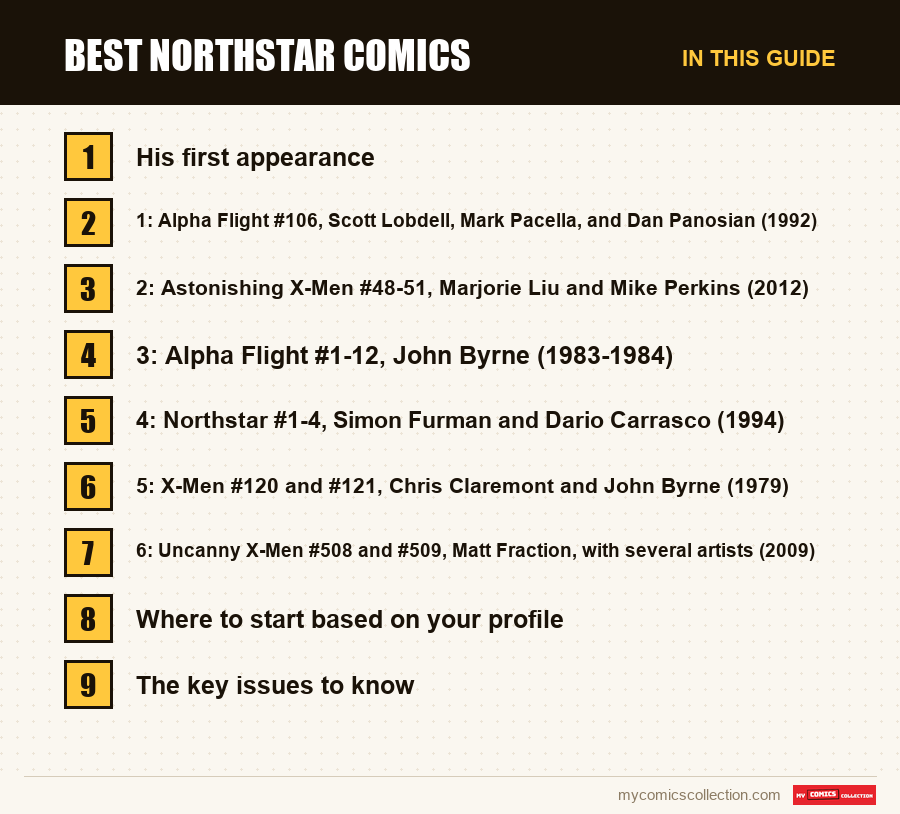
5: X-Men #120 and #121, Chris Claremont and John Byrne (1979)
These two issues are not Northstar stories, and we rank them here with that caveat clearly stated: he is one of the members of the Canadian team facing Wolverine, and his role stays limited. Chris Claremont writes, John Byrne draws, and the whole thing sets up the Alpha Flight series, which Byrne would launch four years later.
What you gain is a starting point: seeing Jean-Paul before any development, in sketch form, surrounded by characters Byrne would pick up again. Mostly you are reading the birth of a team, more than the birth of an individual. These single issues interest those who like to go back to the sources of characters.
Issue #121 gives the character his full appearance, while #120 shows him only at the very end of the story. If you collect the Claremont and Byrne period, you probably already own them. The series they come from is covered in our guide to collecting Uncanny X-Men.
6: Uncanny X-Men #508 and #509, Matt Fraction, with several artists (2009)
Here again, Northstar is not the center: he is one of the X-Men on the team. In issue #508, Wolverine asks him to join the team as a fast runner after the Skrull invasion; issue #509 reveals his relationship with Kyle. Matt Fraction writes, and several artists follow one another across the period.
These two issues bridge #106 and the 2012 wedding: without them, Liu's arc seems to come out of nowhere. They also clear up a timeline question, namely what Northstar is doing between his Canadian series and his return to the spotlight. The tone is understated and serves the team, and the space given to the character stays modest.
Read them as a transition, after the 1992 arc and before the 2012 one, if you want continuity with no gaps. If you would rather keep only the stories where he is at the center, jump straight from the 1994 miniseries to Liu's issues.
Where to start based on your profile
A reader new to the X-Men should first open Alpha Flight #106, then Astonishing X-Men #48-51: two reads of under ten issues that tell you the essentials of the character. A reader who enjoys team books should instead begin with Alpha Flight #1-12, following Byrne's build before moving on to the Lobdell period.
A fan of Claremont and Byrne will start from X-Men #120 and #121, then follow the Canadian team into its own series. Finally, someone looking for the complete bibliography will read in publication order: #120, #1, #106, the 1994 miniseries, then #508 and #509, and finally Liu's four issues. If Bobby Drake interests you too, the guide devoted to Iceman shows a similar trajectory for another X-Man.
The key issues to know
The first landmark is X-Men #120 (April 1979), where the character appears at the end of the issue, followed by X-Men #121. Next comes Alpha Flight #1 (August 1983), the launch issue of Byrne's series. The third is Alpha Flight #106 (March 1992), and the fourth is Northstar #1 (1994), the start of his miniseries.
Later on, Uncanny X-Men #414 (December 2002), written by Chuck Austen, marks his arrival among the X-Men; in 2009, issue #508 has him recruited by Wolverine. Astonishing X-Men #51 (2012) is the landmark for his wedding. Outside of these issues, the X-Men and Alpha Flight miniseries (1985), written by Chris Claremont, penciled by Paul Smith, and inked by Bob Wiacek, brings the two teams together.
For each key issue, compare copies from the same printing and in the same condition: #106 exists in two printings, and a collected edition does not replace a single issue if you are after the object itself. Also note whether the issue carries an alternate cover, because the variant of #51 does not hold the same place in a collection as the main cover. To size up a copy from your own boxes, the free estimate gives you a first frame of reference.
Reading single issues or trade paperbacks
The 1992 and 2012 stories are available in a collected edition, the volume Astonishing X-Men: Northstar published in 2013. The first twelve issues of Alpha Flight read well in a reprint of Byrne's series, because the strength comes from the sequence. The 1994 miniseries, rarer in collected form, is more often hunted down as single issues.
On the collecting side, separate two approaches: the reader who wants the character's story is better off going through trade paperbacks, and the collector who wants key pieces will hunt for #120, #1, and #106 as single issues, checking printing and condition.
Frequently asked questions
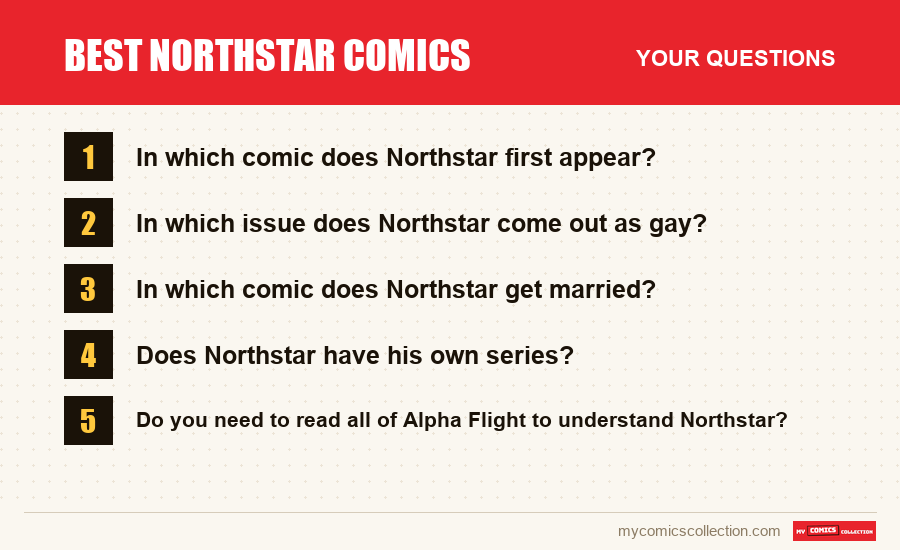
Northstar first appears in X-Men #120, cover-dated April 1979, created by Chris Claremont and John Byrne. He is part of the Canadian team sent after Wolverine, and the arc continues in X-Men #121. His own series comes later, with Alpha Flight #1 in August 1983.
In Alpha Flight #106, cover-dated March 1992, written by Scott Lobdell and penciled by Mark Pacella, with Dan Panosian on inks. Jean-Paul publicly declares that he is gay at the end of a story tied to the AIDS epidemic. The single issue went to a second printing.
In Astonishing X-Men #51 (2012), written by Marjorie Liu and drawn by Mike Perkins. Northstar marries Kyle Jinadu there, after a marriage proposal that Kyle first turns down. The arc runs four issues, #48-51, and is also available as a trade paperback.
He has a four-issue miniseries, Northstar, published in 1994 with Simon Furman writing and Dario Carrasco on art. Above all he was one of the members of Alpha Flight, John Byrne's series launched in August 1983, which ended with issue #130 in 1994.
No. Alpha Flight #106 can be read with no prerequisites, and so can the Astonishing X-Men arc in #48-51. The first twelve issues of Byrne's series, from 1983 and 1984, are enough to know the character in his original context; the complete series runs 130 issues.
Is an Alpha Flight or X-Men single issue sitting in your boxes? Get a first reference point before deciding what to keep.
Estimate my comic