
The best Iceman comics to read start with the founding issue of the franchise, The X-Men #1 (September 1963), by Stan Lee and Jack Kirby, his first appearance and the key issue of his debut. Move on to X-Factor #1 (February 1986), by Bob Layton and Jackson Guice, then All-New X-Men #40 (April 2015), by Brian Michael Bendis, and the Iceman (2017) series by Sina Grace, which puts Bobby Drake front and center.
Bobby Drake has been part of the original X-Men lineup since 1963, yet his bibliography looks nothing like that of any other founding member. He passes through the Champions, through the Defenders, through two miniseries of his own, through X-Factor, and then, in 2015, through a revelation that changes the way he is read. This guide ranks eight reads, from 1975 to 2017, to show how one of the five original students became a character in his own right.
As always in this guide, only verified information (creators, issue numbers, dates) is stated as fact; the analysis is our own, with no reproduction of protected artwork or dialogue.
His first appearance
Bobby Drake debuts in The X-Men #1, cover-dated September 1963. Stan Lee writes, and Jack Kirby draws and co-plots the issue, which introduces the first five students of Professor Xavier's school all at once: Cyclops, Angel, Beast, Marvel Girl (Jean Grey), and Iceman. The young man shows up with his ice powers, still far from the more polished image he will have decades later.
This issue matters to a collection because of its founding status: it launches the series, introduces the team, and sets up the school. Yet it says almost nothing about what Bobby will become, and that is what makes the rest of the journey interesting: a teenager presented in the background, whose depth arrives through successive additions, decades later. For the value and identification of this issue, see our page on X-Men #1 (1963).
The milestones that follow willingly drift away from the parent series: Iceman finds himself with the Champions, with the Defenders, and then in his own miniseries. That scattering explains why a ranking by character is useful: without one, you hunt for Bobby across three series and never find him.
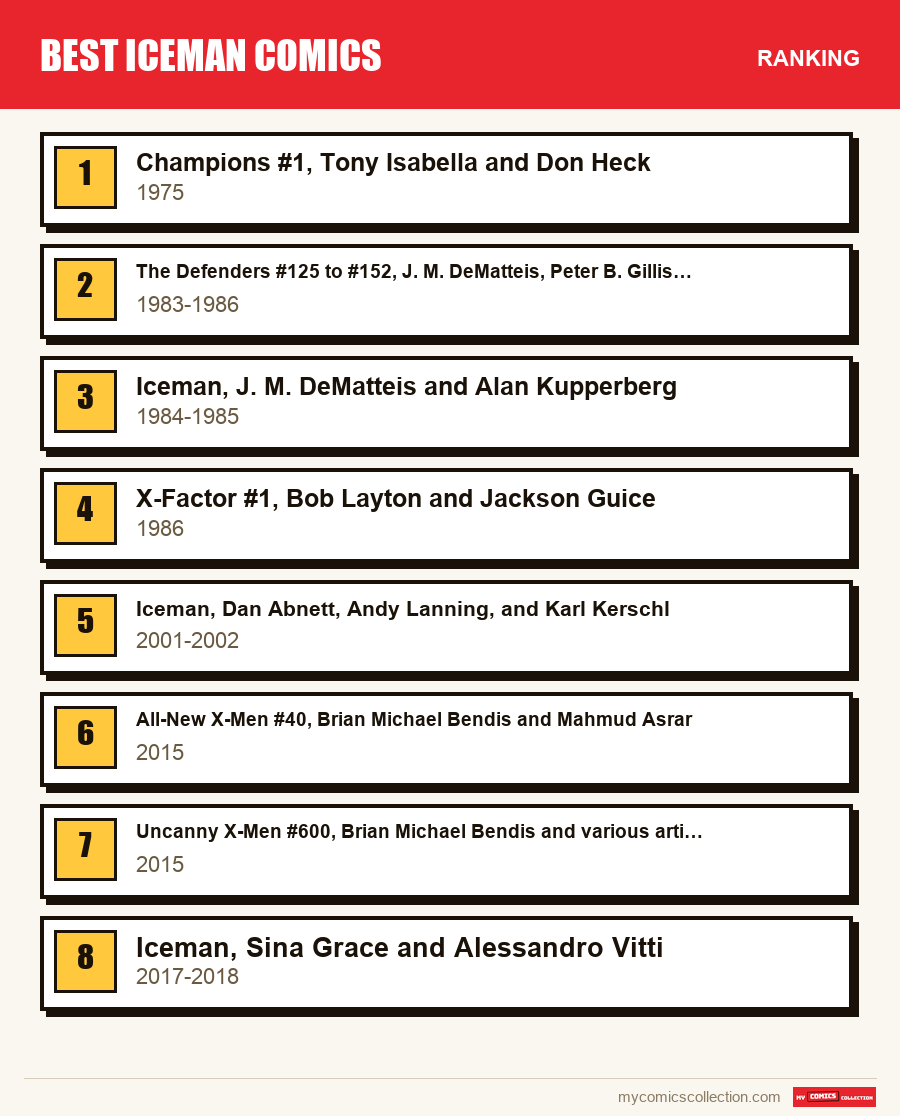
1: Champions #1, Tony Isabella and Don Heck (1975)
Cover-dated October 1975, the first issue of Champions is written by Tony Isabella and drawn by Don Heck. The series brings together heroes from several backgrounds, including Iceman and Angel, two former X-Men. It extends their story beyond Xavier's school, at a time when the parent series itself is undergoing a complete overhaul.
For Bobby, it is a change of scenery: he is no longer a student on a team, he is one of the faces of a group built on different foundations. The series runs from 1975 to 1978, and it is a completist read more than an entry point into the character.
It suits the collector who enjoys Marvel's secondary titles of the 1970s and the one who wants to see Iceman outside the mutant framework. If you read just one issue, take the first, which sets up the team; the rest asks for some patience with the pacing of the era.
2: The Defenders #125 to #152, J. M. DeMatteis, Peter B. Gillis, and Don Perlin (1983-1986)
The Defenders #125, cover-dated November 1983, transforms the series: the classic Defenders leave, the title becomes The New Defenders, and Iceman joins the team alongside Angel. J. M. DeMatteis writes this issue and the next ones for six issues, then Peter B. Gillis takes over, with Don Perlin on art. The series ends with issue #152, in 1986.
This period shows a more grown-up Bobby, far from the school gags, and plunged into a team that pulls him away from the classroom. It also quietly prepares the period when Xavier's former students are reunited in a series of their own, a few years later.
The read appeals to fans of rotating-roster series who can tolerate a continuity that is sometimes muddled. To place the series, our page on the best Defenders runs gives the context, and Defenders #1 tells the story of the 1972 launch.
3: Iceman, J. M. DeMatteis and Alan Kupperberg (1984-1985)
The Iceman miniseries runs four issues, from December 1984 to June 1985. J. M. DeMatteis writes it, Alan Kupperberg draws it, with Mike Gustovich on inks. It brings Bobby back to his childhood suburb for a family reunion, where he runs into a cosmic-level menace called Oblivion.
Its interest lies in the choice of setting: instead of a battlefield, a backyard, a family, and neighbors, with a hero who has to find his place there again. It is the most domestic read on the list, and the one that lets you see Bobby out of costume. It stays short, so it is easy to complete.
It suits readers who prefer character-driven stories to fights, and anyone who wants to know Bobby's 1980s without reading the parent series. Several issues have covers by Mike Zeck, one more reason for fans of that artist to take a look.
4: X-Factor #1, Bob Layton and Jackson Guice (1986)
Cover-dated February 1986, X-Factor #1 is written by Bob Layton and drawn by Jackson Guice. Layton's idea is to reunite the original X-Men team, and Iceman is part of the cast of this series, which opens a new cycle for everyone. Louise Simonson and Walt Simonson take over the reins afterward.
The series puts Bobby back next to Cyclops and his old classmates, in a lineup that recalls the early days while owning up to twenty-three years of baggage. For the reader, it is one of the moments where you can see that the character has grown, but also that he remains tied to the others by a shared history.
This read is for those who want to follow the former students as a team rather than Bobby solo. To go further, the page on X-Factor #1 (1986) details this issue, and the best X-Factor runs offer a path through the series.
5: Iceman, Dan Abnett, Andy Lanning, and Karl Kerschl (2001-2002)
This four-issue miniseries belongs to the X-Men Icons collection. Dan Abnett and Andy Lanning write it, Karl Kerschl draws it. Bobby travels to Hong Kong, far from the team, in a story that separates him from his teammates.
Kerschl's art, round and readable, gives the character a lighter feel than in the series of the 1980s. The story requires no prior knowledge of continuity, which makes it a reasonable entry point for a reader curious about a short format.
It speaks to those who like self-contained miniseries, the kind you read in one evening. It pleases less those who look for team stakes or crossovers. Like the other miniseries on the list, it is quickly completed, and its main flaw is that it is rarely mentioned in classic reading guides.
Do you collect this series?
Track what you own, what you are missing and what your collection is worth. 7-day trial.
Start my trial →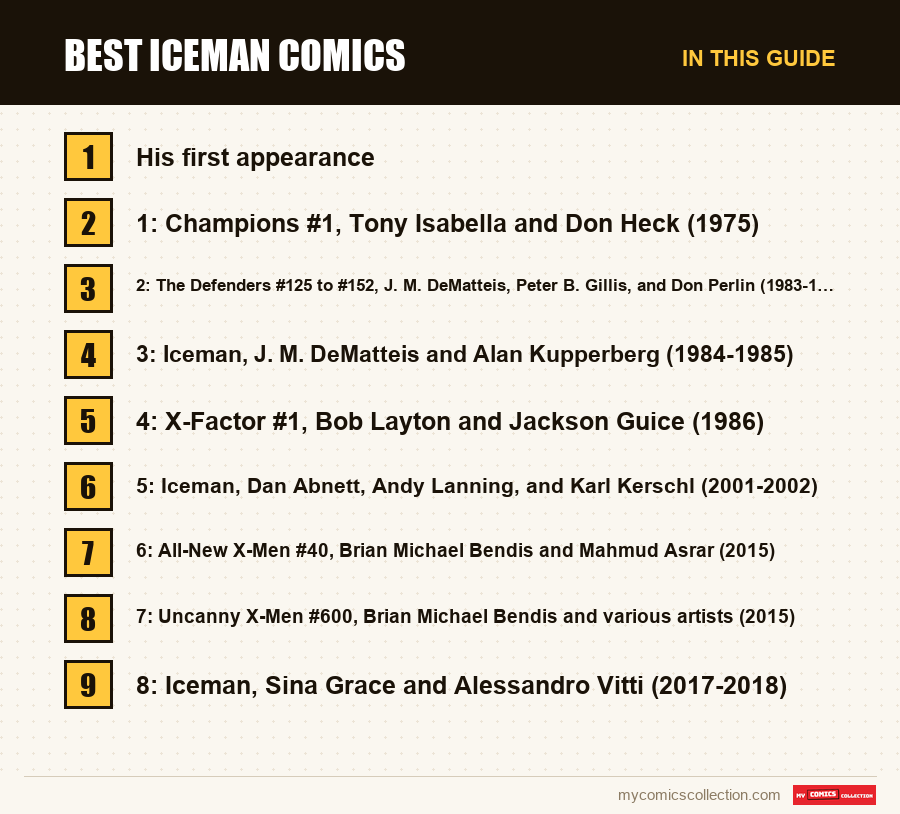
6: All-New X-Men #40, Brian Michael Bendis and Mahmud Asrar (2015)
In April 2015, in All-New X-Men, the young Bobby, brought from the past, hears from Jean Grey that he is gay. Brian Michael Bendis writes, Mahmud Asrar draws. The young Iceman is confronted with a truth he had been avoiding, under the gaze of a telepath who reads his thoughts.
The effect on the character is lasting. It is not a mere plot twist: the scene reboots the way Bobby is written, and sets up what follows. It also makes this issue a collecting landmark, for reasons of history more than speculation. A reader who opens it without knowing the rest of the series understands what is at stake within a few pages.
This issue is for any reader interested in the character's evolution, including those who have not yet read a single X-Men comic. To place the writer, the page Brian Michael Bendis: where to start gives his other entry points.
7: Uncanny X-Men #600, Brian Michael Bendis and various artists (2015)
Cover-dated November 2015, Uncanny X-Men #600 is a giant anniversary issue signed by Bendis, with a troupe of artists including Sara Pichelli, Mahmud Asrar, Stuart Immonen, Kris Anka, Chris Bachalo, David Marquez, and Frazer Irving. The young Bobby meets his adult self and talks to him about what he has understood about himself.
The issue closes a chapter: that of Bendis's mutant series, with a story that puts the question of identity at the center and gives the floor to both versions of the character. It reads as the direct sequel to the previous issue on the list, and is best read right after it.
It is for the reader who followed All-New X-Men and wants to see the other Bobby's answer, but also for anyone looking for an example of an anniversary issue with many artists. It is better understood with the context of the time-displaced characters from the previous series.
8: Iceman, Sina Grace and Alessandro Vitti (2017-2018)
The Iceman series begins in June 2017 under the pen of Sina Grace, with Alessandro Vitti on art for the first issues, followed by other artists. Bobby headlines a character-driven series rather than an event.
It is the most direct read for anyone who wants Bobby at the center, and who accepts that the series takes its time with its scenes. It reads without major prerequisites, although knowing the two 2015 issues helps in grasping what has changed.
It speaks to readers who like character series over crossovers, and to collectors who follow the solo series relaunches of the period. For the overall context of the X-Men at that time, see the X-Men reading guide.
Where to start depending on your profile
To discover the character in a single read, pick up the 2017 Iceman series, which requires no background. To understand where the 2015 revelation comes from, read All-New X-Men #40 and then Uncanny X-Men #600, in that order. The classics reader will start with The X-Men #1, then move to X-Factor #1 to see the students reunited.
Anyone who likes short formats will choose the 1984 and 2001 miniseries. The collector, finally, will keep one milestone per stage: the founding issue of 1963, the launch of X-Factor in 1986, and the two 2015 issues, which count for historical reasons as much as for scarcity.
The key issues to know
The first landmark is The X-Men #1 (September 1963), Bobby Drake's first appearance. The second is Champions #1 (October 1975), which places him outside the original team. The third is The Defenders #125 (November 1983), where he joins the New Defenders with Angel.
Next come Iceman #1 (December 1984), the start of his first miniseries, and X-Factor #1 (February 1986). On the recent side, All-New X-Men #40 (April 2015) and Uncanny X-Men #600 (November 2015) are the two landmarks of the revelation, and Iceman #1 (June 2017) opens Sina Grace's series.
To decide which one to hunt for, ask yourself whether you are buying a piece of history or a reading tool. An early founding issue is judged on its condition and authenticity, while a 2015 issue is judged on its readability and how well it holds up. Identify the printing of your copy before any comparison, and only compare equivalent grades. If one of these issues is sitting in your boxes, the free estimate gives you a first frame of reference.
Reading in single issues or in collected editions
The 1984 and 2001 miniseries are short and read in four issues each. For the 2015 arcs, a trade paperback of All-New X-Men or of the end of Uncanny X-Men saves you from chasing single issues filed in different series. The 2017 series lends itself to reading in volumes, one arc at a time.
The team series, like The New Defenders and X-Factor, are trickier: Bobby is one character among others, and it is better to read an entire cycle than isolated issues. In every case, stop when Bobby is no longer at the center: the appeal of this bibliography lies in the moments where he carries the story.
Frequently asked questions
Bobby Drake, a.k.a. Iceman, is present from The X-Men #1 (September 1963), created by Stan Lee with Jack Kirby. The issue introduces the first five students of Xavier's school. The character is a teenager there, far from the image we know today.
For a story centered on him with no prerequisites, open the Iceman (2017) series by Sina Grace. For the classic, start with The X-Men #1 (1963). To understand his recent evolution, follow up with All-New X-Men #40 and then Uncanny X-Men #600, both from 2015.
In All-New X-Men #40 (April 2015), by Brian Michael Bendis, Jean Grey reveals to the young Bobby, brought from the past, that he is gay. In Uncanny X-Men #600 (November 2015), this young Bobby meets his adult version. These two issues are the landmarks of the revelation.
Yes, several. Two four-issue miniseries bear his name, one from 1984-1985 by J. M. DeMatteis and Alan Kupperberg, the other from 2001-2002 by Dan Abnett, Andy Lanning, and Karl Kerschl. Sina Grace's Iceman series starts in June 2017.
Yes. He joins the Champions in the series launched in October 1975 by Tony Isabella and Don Heck. He also enters the New Defenders starting with The Defenders #125 (November 1983), and then X-Factor from issue #1 (February 1986).
An X-Men, X-Factor, or Defenders issue sleeping in your boxes? Get a first reference point before deciding what to keep.
Estimate my comic