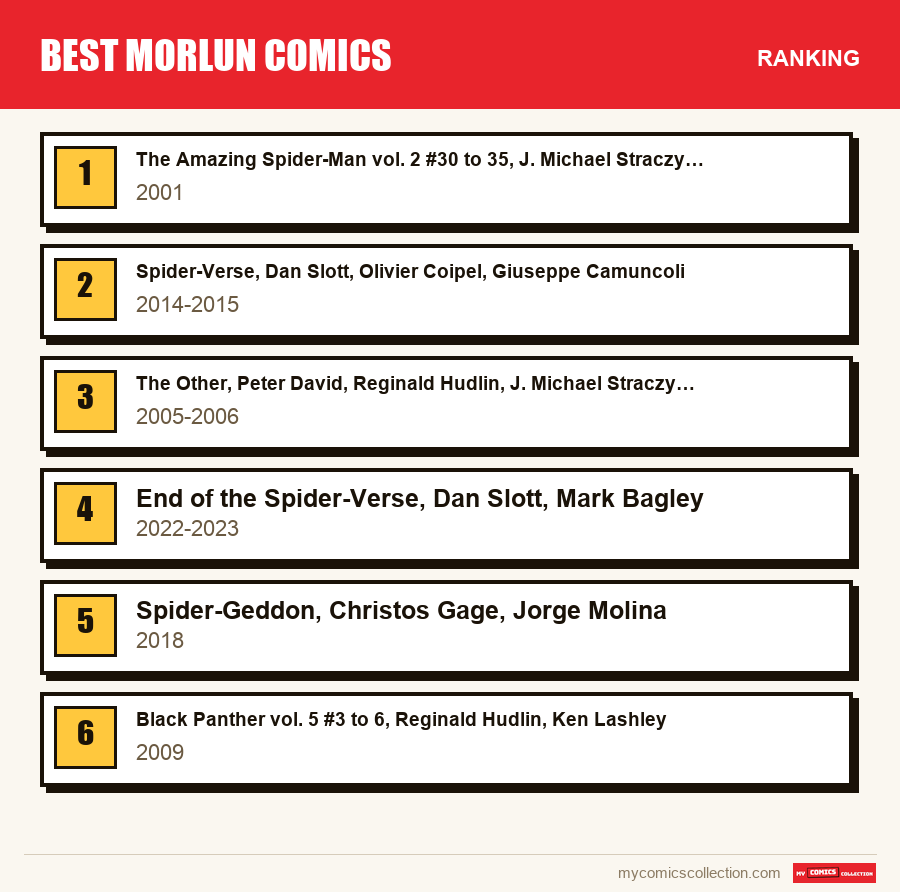
To read the best Morlun comics, start with The Amazing Spider-Man vol. 2 #30 to 35 (2001), where J. Michael Straczynski and John Romita Jr. introduce him as a hunter of totems. Continue with Spider-Verse (2014-2015) by Dan Slott, where he leads the Inheritors' hunt, then The Other (2005-2006), End of the Spider-Verse (2022-2023), and Spider-Geddon (2018). The key issue to know is #30 of June 2001, his first appearance and debut.
With Morlun, nothing is about loot or grudges: this Spider-Man enemy hunts in order to feed, and every fight is a kill. That predator nature explains why his appearances cluster in a few high points, separated by long absences. Six stories follow, chosen because Morlun drives the action in them, each with what it offers, its ideal reader, and a tip on reading order.
As always in this guide, only verified information (creators, issue numbers, dates) is stated as fact; the analysis is ours, with no reproduction of protected pages or dialogue.
His first appearance
Morlun debuts in The Amazing Spider-Man vol. 2 #30, cover-dated June 2001, written by J. Michael Straczynski and drawn by John Romita Jr. The issue also carries the number 471 in the series' legacy numbering, which is why you will run into both references in catalogs and at comic shops. Ezekiel Sims, the mentor who warns Peter Parker about what is coming, appears in that same issue.
For collectors, this issue matters because it sets the character's rule: Morlun pursues beings whose power is tied to an animal totem, and Spider-Man is one of them. Every later story, up to the multiverse-scale crossovers, picks up this logic of the hunt. The immediate follow-up runs through #35, which closes the arc.
To place this period in the series, read the Spider-Man reading guide, then the page on John Romita Jr., where to start to get a sense of the artist on this issue.
How we ranked the six reads
Morlun shows up in plenty of issues, but very few put him at the center of the story. We set aside cameos, sequences where he is only a backdrop of menace, and stories where another enemy carries the stakes. That leaves six reads where Morlun, alone or at the head of the Inheritors, structures the plot. The order blends historical importance, ease of access, and quality of the writing: an entry point should read without prerequisites, while a sequel can afford to demand some.
1: The Amazing Spider-Man vol. 2 #30 to 35, J. Michael Straczynski, John Romita Jr. (2001)
The arc runs from June to November 2001 and is collected under the title Coming Home. Straczynski writes all six issues, Romita Jr. draws them. Morlun is an opponent Spider-Man cannot beat in a fair fight: he is stronger, faster, and he follows Peter's trail. The arc ends in #35, where Morlun collapses into dust.
What the story gives the character is considerable. It hands Spider-Man an adversary against whom his usual reflexes are useless, and it moves the series toward a mystical dimension, with a power that stops being a lab accident and becomes a matter of origins. It also sets the tone for the rest of the Straczynski period.
Who is it for? Every reader, first of all the one looking for the foundational version of the character, with no prior knowledge of Spider-Man's history. How should you read it? In one sitting, in the trade paperback or as single issues, from #30 to #35, with no detours. For the context of the previous decades, see the history of Spider-Man comics.
2: Spider-Verse, Dan Slott, Olivier Coipel, Giuseppe Camuncoli (2014-2015)
The core of the event is in The Amazing Spider-Man vol. 3 #9 to 15, written by Dan Slott and drawn by Olivier Coipel and Giuseppe Camuncoli, from November 2014 to February 2015. Issues #7 and #8 serve as a prelude, and the whole thing spreads across many tie-in series, including Spider-Verse vol. 2 #1 and 2, Superior Spider-Man #32 and 33, and the five-issue Edge of Spider-Verse series.
Morlun becomes again what he was in 2001, but on the scale of the entire universe: he leads the Inheritors' hunt, a family that feeds by killing the incarnations of the Spider across every reality. Slott turns an individual threat into a mass threat, and that is what makes the story approachable for readers who know the alternate Spider-Men from animated film.
Who is it for? The reader who loved the animated takes on the multiverse and wants their source. How should you read it? Open Edge of Spider-Verse #2, covered on the page Edge of Spider-Verse #2 and Spider-Gwen, before following #9 to 15 of the main thread. The rest is optional.
3: The Other, Peter David, Reginald Hudlin, J. Michael Straczynski, Mike Wieringo, Pat Lee, Mike Deodato Jr. (2005-2006)
This crossover spans three series at once: Friendly Neighborhood Spider-Man #1 to 4, Marvel Knights Spider-Man #19 to 22, and The Amazing Spider-Man #525 to 528. Peter David writes the first act, Reginald Hudlin the second, and Straczynski the third, with each finale going back to the regular writer of its series. Mike Wieringo draws Friendly Neighborhood Spider-Man, Pat Lee Marvel Knights Spider-Man, and Mike Deodato Jr. The Amazing Spider-Man.
Morlun returns as a personal menace. In the first act, he haunts Peter's dreams; in the second, he tracks him down and strikes him at the university; in the third, he comes to drain his life force at the hospital. The story ends with Peter's death, after which he emerges from a cocoon under the Brooklyn Bridge, transformed by the fight.
Who is it for? The reader who has already read the 2001 arc and wants to see what Morlun does to an older Peter. How should you read it? Follow the order of the acts, one series after another, because the three titles complement each other. It is the most demanding read on this list, but it shows how the totem myth was extended.
Do you collect this series?
Track what you own, what you are missing and what your collection is worth. 7-day trial.
Start my trial →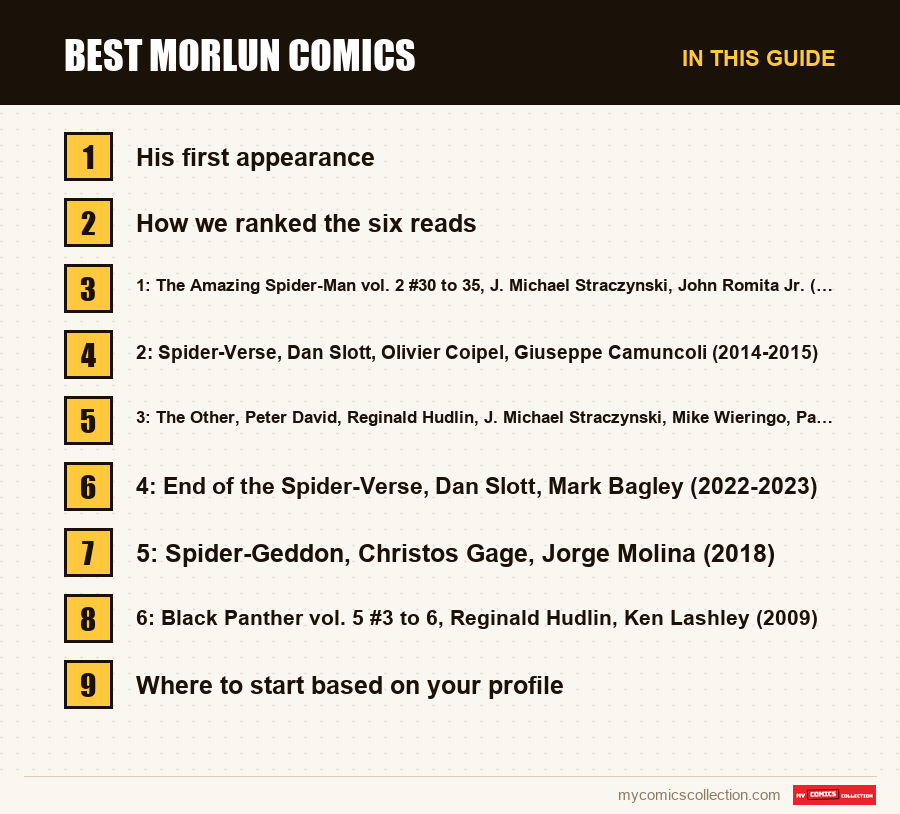
4: End of the Spider-Verse, Dan Slott, Mark Bagley (2022-2023)
This story runs through the series Spider-Man vol. 4 #1 to 7, from October 2022 to April 2023, with Dan Slott on script, Mark Bagley on art, and John Dell on inks. It follows Edge of Spider-Verse, a five-issue anthology published starting in August 2022.
Morlun's role has changed: he is no longer the hunter stalking his prey, but a survivor who teams up with Spider-Man variants against Shathra, the spider-wasp goddess. His family was devoured by a mutant version of Spider-Ma'am, and he went to the Loomworld to face Shathra, who outmatches him. In the end, Silk strikes him with the dagger that releases the life energy he had absorbed, which resurrects the spiders he had killed. He escapes, weakened.
Who is it for? The reader who wants an unexpected Morlun, tragic rather than merely menacing. How should you read it? After Spider-Verse, because the story assumes its stakes. For Silk, who lands the decisive blow, see the key issues of Silk.
5: Spider-Geddon, Christos Gage, Jorge Molina (2018)
This six-issue miniseries, #0 to 5, is written by Christos Gage and drawn by Jorge Molina. It extends Spider-Verse: the Inheritors escape from the prison where they were held and come back to take revenge on the army of spiders. Morlun surges in early, kills Spider-Man Noir and Spider-UK, then goes off to find Peter Parker. The conflict with Peter Parker continues in Peter Parker: The Spectacular Spider-Man #311 to 313.
The story is not centered on Morlun alone, since Solus, resurrected, takes an important place in the rest of the narrative. We rank it anyway because Morlun ends the confrontation defeated, tranquilized, the last of the Inheritors still alive, and because his return to Earth-616 sets the stakes of the ending.
Who is it for? The reader who has finished Spider-Verse and wants to know how the family comes back. How should you read it? In the order of the miniseries, adding the three issues of Peter Parker: The Spectacular Spider-Man if you want to follow Morlun to the end.
6: Black Panther vol. 5 #3 to 6, Reginald Hudlin, Ken Lashley (2009)
In this series launched in April 2009, Reginald Hudlin writes and Ken Lashley draws, with Paul Neary on inks. The first six issues are collected under the title The Deadliest of the Species. From June to September 2009, in #3 to 6, Shuri, now the Black Panther, faces Morlun.
The appeal lies elsewhere than in Spider-Man: Morlun serves here as a trial for a heroine who must prove her legitimacy, and the end of the arc presents her as the true Black Panther. It is proof that the character can leave his home series and stay dangerous. Our history of Shuri places this period within her journey.
Who is it for? The Black Panther reader, or anyone who wants to see Morlun outside New York. How should you read it? As four consecutive single issues, after the first two of the series.
Where to start based on your profile
The reader discovering Spider-Man who wants to understand what Morlun is should start with The Amazing Spider-Man vol. 2 #30 to 35. The arc stands on its own and sets up everything that matters.
Anyone coming in through the animated multiverse films is better off opening Spider-Verse: the Inheritors are front and center there, and the event served as the template for those adaptations. The page on the film Across the Spider-Verse versus the comics helps make the connection.
The reader who has already read everything Spider-Man has done since 2001 will find their interest in The Other and in End of the Spider-Verse, which show two very different faces of the same character. Finally, the Black Panther reader can start with entry 6 and work back toward the main thread.
The key issues to know
For a collector, the hierarchy follows the scarcity of the first appearance and each issue's place in the mythology.
- The Amazing Spider-Man vol. 2 #30 (June 2001): first appearance of Morlun, and of Ezekiel Sims. It is the character's reference issue.
- The Amazing Spider-Man vol. 2 #35 (2001): conclusion of the foundational arc, where Morlun collapses into dust.
- The Amazing Spider-Man vol. 3 #9 (November 2014): start of the core of Spider-Verse.
- Superior Spider-Man #33 (2014): setup issue for Spider-Verse.
- Edge of Spider-Verse #2 (September 2014): the September 2014 issue that introduces Spider-Gwen and sets up the event, without being a Morlun issue.
- Spider-Geddon #0 (2018): the return of the Inheritors.
The method is the same for all of them: look up completed sales of the exact issue, compare copies of the same grade, and do not pay for a "first appearance" label that concerns a different character. For #30, check the series title and the legacy number, 471, printed on the cover.
Frequently asked questions
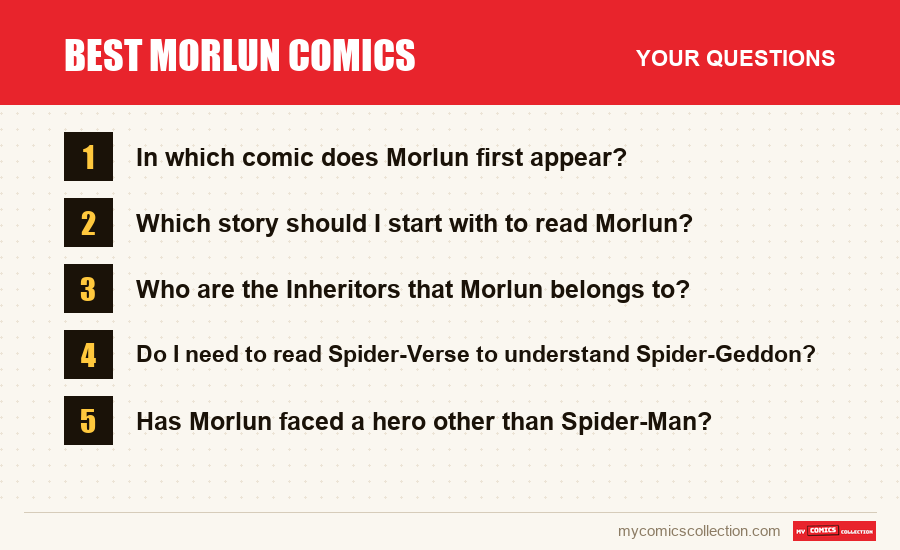
Morlun appears in The Amazing Spider-Man vol. 2 #30, dated June 2001, written by J. Michael Straczynski and drawn by John Romita Jr. The issue also carries the number 471 in the series' legacy numbering. Ezekiel Sims, who warns Peter Parker of the threat, appears in the same issue.
Start with the 2001 arc, The Amazing Spider-Man vol. 2 #30 to 35, collected under the title Coming Home. It reads on its own, sets up the character's rule, and ends with #35. Then move on to Spider-Verse, where Dan Slott takes Morlun to the multiverse scale, between 2014 and 2015.
The Inheritors are a family of predators who feed on the life force of beings tied to a totem, chief among them the incarnations of the Spider. They are at the center of Spider-Verse (2014-2015), where Morlun leads the hunt, and then of Spider-Geddon (2018), which brings them back.
It is recommended. Spider-Geddon, written by Christos Gage and drawn by Jorge Molina in 2018, starts from the escape of the Inheritors, who were imprisoned at the end of Spider-Verse. Without that foundation, Morlun's return and the revenge on the army of spiders lose part of their meaning.
Yes. In 2009, in Black Panther vol. 5 #3 to 6, written by Reginald Hudlin and drawn by Ken Lashley, Shuri faces him. In End of the Spider-Verse (2022-2023), he teams up with several Spider-Man variants against Shathra, which changes his usual role.
Do you own The Amazing Spider-Man vol. 2 #30 or another issue from Morlun's hunt? Get its condition and value estimated.
Estimate my comic