
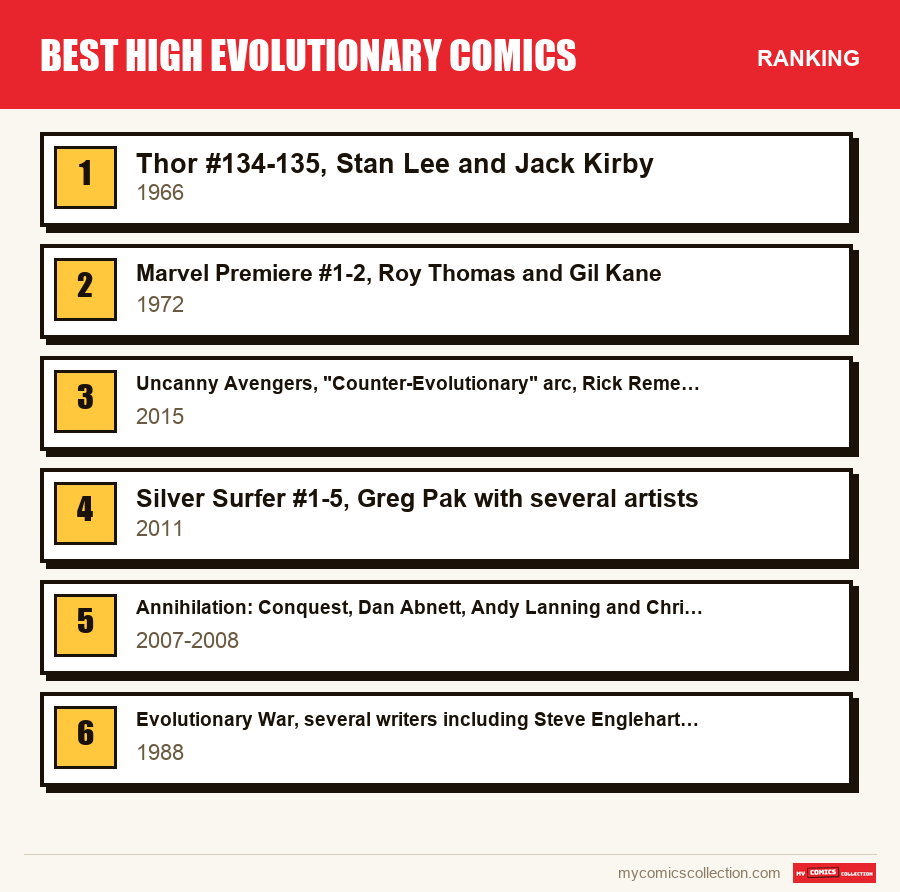
The best High Evolutionary comics start with Thor #134 and #135 (1966), where Stan Lee and Jack Kirby created him. Then open Marvel Premiere #1 and #2 (1972), by Roy Thomas and Gil Kane, where he meets Adam Warlock. Continue with Rick Remender's Uncanny Avengers (2015), Greg Pak's Silver Surfer (2011) and Annihilation: Conquest, and finish with the Evolutionary War annuals (1988). Those are the key issues to know.
Herbert Edgar Wyndham, a.k.a. the High Evolutionary, is a British geneticist turned architect of entire peoples: he fabricates New Men, builds a Counter-Earth and treats humanity as an unfinished construction site. Wyndham has no series of his own: you follow him from issue to issue, from Wundagore to the cosmic wars, and this guide picks six stops where he truly matters, with what each one changes, who it speaks to and how to approach it.
As always in this guide, only verified facts (creators, issue numbers, dates) are stated as fact; the analysis is our own, with no reproduction of protected artwork or dialogue.
His first appearance
The High Evolutionary is mentioned in The Mighty Thor #133, cover-dated October 1966, then appears for real in The Mighty Thor #134, cover-dated November 1966. Stan Lee handles the script and Jack Kirby the art of this birth. The detail matters to a collector: #133 holds only a mention, the full-page presence belongs to #134, and so that is the issue the market and readers treat as the first appearance.
In that issue, Thor climbs Mount Wundagore, in Transia, in search of Jane Foster. The Knights of Wundagore, animal creatures raised to a humanoid form, bring him before their master. That is where the elements that will make the character are set down: the high-mountain laboratory, the New Men, and the idea of a scientist who conquers not by force but by selection.
Issue #135, cover-dated December 1966, is the natural companion. The Man-Beast, a creature born of the scientist's experiment, turns on him, and Thor steps in to bring it down. That Man-Beast will return, much later, on Counter-Earth: the antagonist met here is therefore also a narrative seed. Read both issues together, as a two-parter, because neither is enough to understand the other.
One useful note before hunting for a copy: #133, #134 and #135 span three consecutive months of publication, October to December 1966. A collector building a run around the character can therefore gather them as a small sequence, keeping #134 as the centerpiece and treating the other two as supplements.
1: Thor #134-135, Stan Lee and Jack Kirby (1966)
This is the mandatory entry, and the shortest in the ranking: two single issues. It gives the character his setting (Wundagore), his vocabulary (New Men, Knights, Man-Beast) and his psychology, that of a man of science sure he can correct nature. The High Evolutionary is not yet the figure of the later cosmic stories: he appears as the master of an isolated domain, and it is Thor, the god of thunder, who plays the visitor.
It is for the reader who wants to understand where the character comes from before following him through events that warp him. It will also please fans of the Lee and Kirby era on Thor, where Norse mythology rubs shoulders with science fiction. To read it, look for a collection of the period or the original single issues, and keep the direct follow-up within reach: the series then moves on to other adversaries and will not return to the High Evolutionary right away.
A point of method: do not confuse this two-parter with the adventures of "Him" in Fantastic Four #66 and #67 (1967), by Stan Lee, Jack Kirby and Joe Sinnott. Those two issues tell of the lab-created being who will become Adam Warlock; the link with the High Evolutionary is tied later, in the 1970s.
2: Marvel Premiere #1-2, Roy Thomas and Gil Kane (1972)
In April and May 1972, Marvel Premiere #1 and #2 relaunch "Him" under the name Adam Warlock. Roy Thomas writes, Gil Kane draws, Dan Adkins inks. In #1, Warlock meets the High Evolutionary: this is the moment the scientist stops being a backdrop in Thor and becomes a player in Marvel's cosmic corner, tied to Counter-Earth, the twin of our planet that he built.
The contribution is twofold. First, the character receives his second great function: world-builder and ambiguous mentor. Second, the ambition of a geneticist who worked on animals now applies to an entire planet. The Warlock series launched in August 1972 extends these themes, but the first two issues of Marvel Premiere remain the sharpest entry point.
Who is this entry for? Readers of Guardians of the Galaxy and Adam Warlock who want to know why the High Evolutionary is tied to that character. To read it, get the period in a collection; Kane's very dynamic art is reason enough to read it in sequence. Our history of Adam Warlock places these issues within his full journey.
3: Uncanny Avengers, "Counter-Evolutionary" arc, Rick Remender and Daniel Acuña (2015)
In early 2015, Rick Remender relaunches Uncanny Avengers with Daniel Acuña on art, and traces the Maximoff twins' quest back to Counter-Earth. The High Evolutionary is at the center of the arc: Scarlet Witch and Quicksilver learn that Magneto is not their father, and the investigation leads them to the geneticist. A sister, Luminous, is introduced there, with a combination of both twins' powers.
Issue #4 of this series is the one that announces the truth about their parents. For the character, the contribution is considerable: he goes from the distant figure of the 1960s to an intimate manipulator whose experiments touched heroes the reader has followed for decades. He also becomes, under Remender's pen, a frontal adversary of an Avengers team that then brings together Captain America, Rogue, Brother Voodoo and others.
This arc is for the reader who already knows the twins and wants to understand what changed in their biography. It can be read without knowing the whole 1960s run, but benefits from being preceded by Thor #134.
4: Silver Surfer #1-5, Greg Pak with several artists (2011)
In 2011, Greg Pak writes a five-issue series about the Silver Surfer, with Stephen Segovia, Harvey Tolibao and Iban Coello on art depending on the issue. The High Evolutionary tries to seize Galactus's role there: he covets the cosmic power of the world-devourer in order to replace its function with his own. Among the six reads in this ranking, this is the one that puts him in the role of a rival to Galactus.
The contribution is easy to state: this story gives him a scale comparable to that of the great cosmic players. It also makes the Surfer the moral counterpoint, a herald who must defend the balance of a universe he does not rule. Five issues are enough: it is an accessible way in for anyone who does not want to commit to a long reading path.
It is for readers of Silver Surfer and Galactus more than readers of Thor. If you follow the Surfer, pair it with our history of Silver Surfer and our pointers on his key issues.
Do you collect this series?
Track what you own, what you are missing and what your collection is worth. 7-day trial.
Start my trial →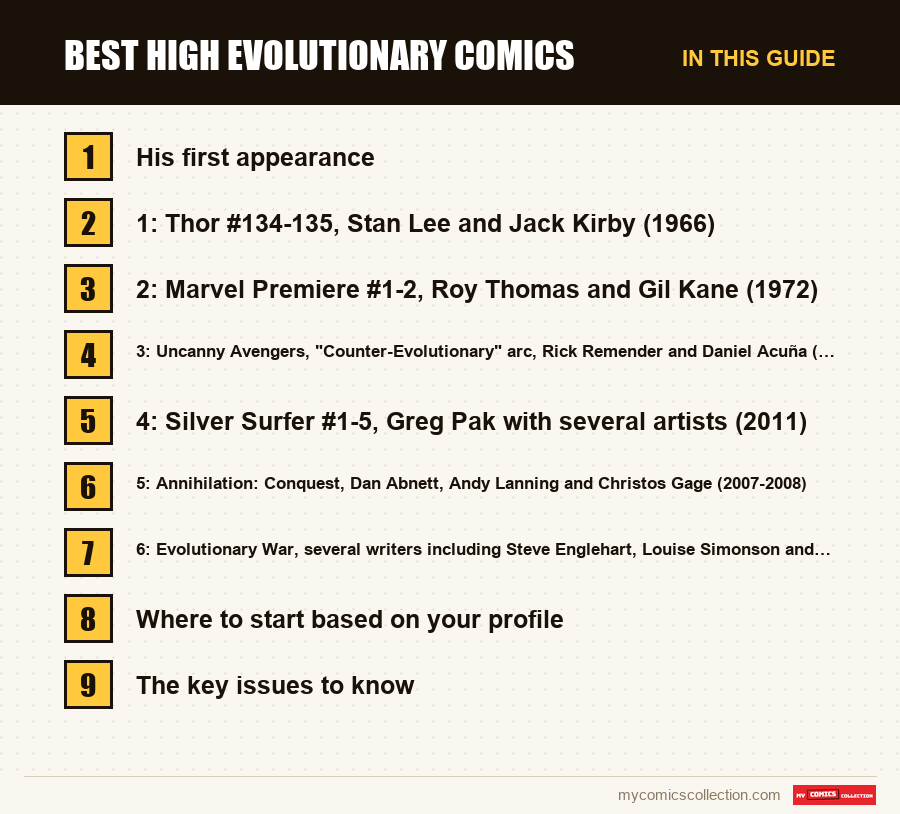
5: Annihilation: Conquest, Dan Abnett, Andy Lanning and Christos Gage (2007-2008)
The cosmic sequel to Annihilation sends the Phalanx, a techno-organic civilization, against the Kree empire. On the writing side, the Abnett and Lanning duo handles the central miniseries, while Christos Gage holds the pen on the Quasar tie-in. In this event, the High Evolutionary crosses paths with Quasar and Moondragon, who try to rally him, then falls into the hands of the Phalanx, which forces him to transfer Ultron's essence into Adam Warlock's body.
Here the character is not the center of the story: he is a cog, and he should be read as one. That is why the entry sits at this spot in the ranking. It brings one precise thing: proof that his knowledge, put to another's service, can become a weapon against the order he claims to defend. It also supplies a link in the continuity between the High Evolutionary and Adam Warlock.
Who is it for? Readers of the 2000s cosmic line who have already read Annihilation. To read it, start from the event in publication order rather than isolating the High Evolutionary's scenes: the pleasure lies in the progress of the invasion.
6: Evolutionary War, several writers including Steve Englehart, Louise Simonson and Chris Claremont (1988)
In 1988, Marvel organized a crossover between its annuals: Evolutionary War. The writers include Steve Englehart, Louise Simonson, Chris Claremont, Steve Gerber and Gerry Conway, with titles as varied as Fantastic Four Annual #21, Silver Surfer Annual #1, X-Factor Annual #3 or The Avengers Annual #17, the latter written by Walt Simonson. A companion story titled "The High Evolutionary", written by Mark Gruenwald, accompanies each of the chapters.
The contribution is of a different nature: here the character steps out of the cosmic shadow to touch the whole Marvel Earth of the day. The entry ranks last because it is scattered, uneven and awkward to assemble, but it remains the big moment where you see the High Evolutionary in contact with very different heroes.
It is for the completist collector, who loves annual crossovers and accepts the hunt for single issues. A tip on method: list the chapters before buying, and note the ones you are missing; this is a set you complete over months rather than in a single purchase.
Where to start based on your profile
The curious reader who knows the character from the movies will start with Silver Surfer #1-5: the story is short, readable on its own, and shows the High Evolutionary at the scale of cosmic stakes. The page on Guardians of the Galaxy Vol. 3 versus the comics, linked in the box above, helps sort out what comes from the page.
The reader of older history will take Thor #134-135, then Marvel Premiere #1-2: two short stages that give the character as his creators conceived him, then as Roy Thomas picked him up. The reader of modern Avengers will go straight to Uncanny Avengers and the Counter-Earth arc, before working backward if they want roots.
The collector seeking completeness will read in chronological order: 1966, 1972, 1988, 2007, 2011, 2015. This progression shows how one character changes function (scientist, world-builder, usurper, manipulator) while keeping the conviction that he is indispensable. The Guardians of the Galaxy reading guide, in the box, gives the context of the cosmic line.
Here is a three-step path for anyone with only a few evenings to spare. Step one, the foundations: Thor #134-135, two single issues. Step two, the link with Warlock: Marvel Premiere #1-2, two more single issues. Step three, a modern story of your choice, Silver Surfer or Uncanny Avengers, depending on whether you prefer cosmic scale or family drama. Six to ten single issues are thus enough to hold an accurate picture of the character.
One last reading tip: if you discover the High Evolutionary through a recent story, don't try to fill in everything backward. Each stop in this ranking has its own logic, and the character has been rewritten several times; better to read a period for its own sake than to chase perfect consistency between 1966 and 2015.
The key issues to know
For a collector, the hierarchy is built around a few milestones, which you assess by method and not by a price tag: you compare sold listings of the same grade, and you distinguish what is a first appearance from what is a turning point.
- The Mighty Thor #133 (October 1966): first mention of the character, of interest to completists.
- The Mighty Thor #134 (November 1966): full first appearance, by Stan Lee and Jack Kirby. This is the benchmark issue.
- The Mighty Thor #135 (December 1966): direct follow-up, with the Man-Beast.
- Marvel Premiere #1 (April 1972): Adam Warlock meets the High Evolutionary, by Roy Thomas and Gil Kane.
- The Avengers #185 to #187 (1979): arc that anchors the Maximoff twins' origin to Wundagore and the High Evolutionary.
- Evolutionary War (1988 annuals): crossover to assemble piece by piece.
- Silver Surfer #1 (2011): start of Greg Pak's arc, a modern benchmark.
- Uncanny Avengers #4 (2015): revelation about the twins' parents, by Rick Remender.
The market's rule of thumb is constant: a narrative turning point is not worth a first appearance, and a modern single issue is first compared to its print run. For a character's debut, condition and authenticity come first; for a recent issue, the variant and the period of publication count for more.
Frequently asked questions
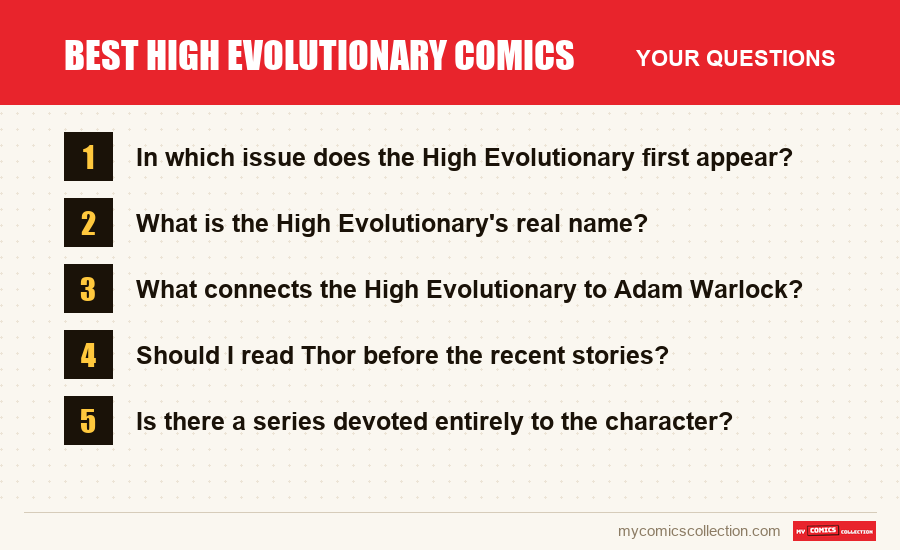
He is mentioned in The Mighty Thor #133, cover-dated October 1966, then appears fully in The Mighty Thor #134, cover-dated November 1966. The Lee and Kirby duo created this issue. Issue #134 is the benchmark issue for collectors, since #133 is only a first allusion.
His name is Herbert Edgar Wyndham. Born in England, he begins his genetic experiments at Oxford before settling on Mount Wundagore, in Transia.
Adam Warlock is born as "Him" in Fantastic Four #66-67 (1967). It is in Marvel Premiere #1 (April 1972), by Roy Thomas and Gil Kane, that this hero crosses paths with the scientist of Wundagore, who is tied to his destiny from then on, especially around Counter-Earth.
Not necessarily, but it is recommended. Silver Surfer (2011) and Uncanny Avengers (2015) can be read on their own. The two issues of Thor #134-135 nonetheless supply the setting of Wundagore and the New Men, which these modern stories pick up without always explaining it.
The major stories that involve him are spread across several titles: Thor, Marvel Premiere, Silver Surfer, Uncanny Avengers and cosmic events. A reading path therefore means assembling stages rather than following a regular collection.
Do you own a Thor #134 or another issue from the Lee and Kirby period? Get a free estimate before deciding whether to keep it or sell it.
Estimate my comic