
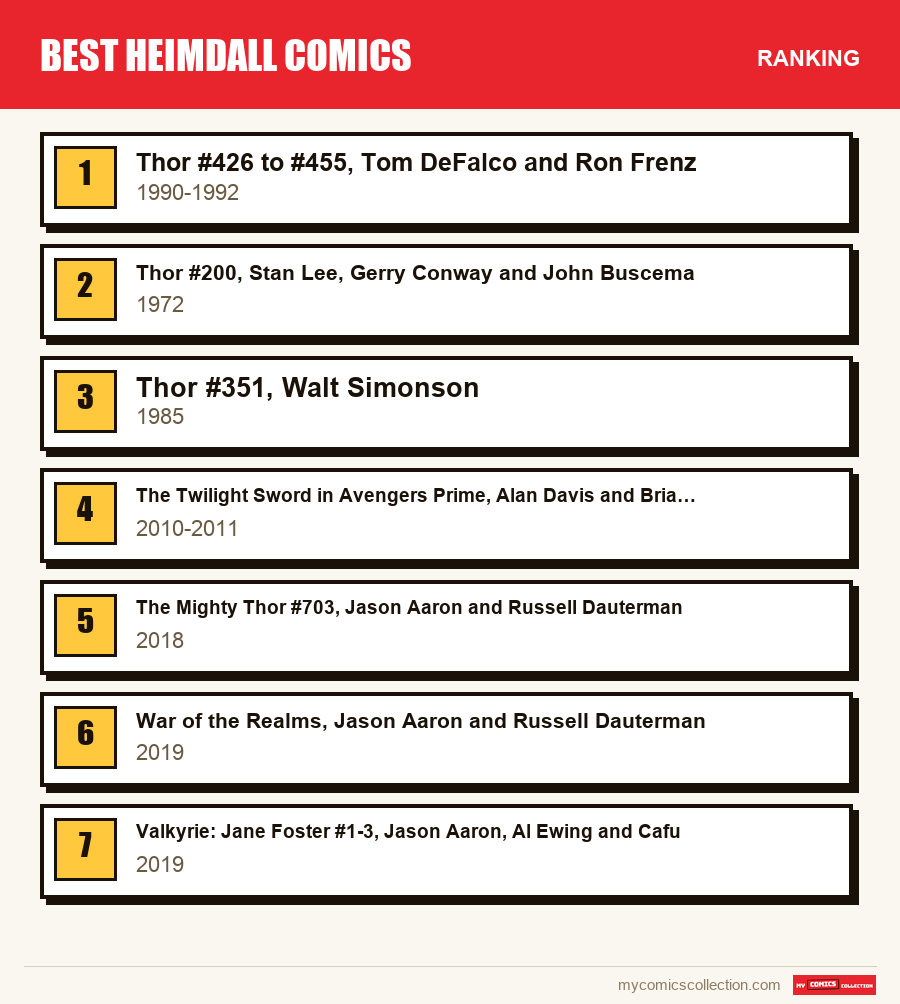
To read the best Heimdall comics, start with his first appearance in Journey into Mystery #85 (October 1962), then move on to the run where Odin lends him his power in Thor #426 to #455 (1990-1992), by Tom DeFalco. Round it out with the Ragnarok of Thor #200 (1972), the fall of the Bifrost in Thor #351 (1985) and, for the modern side, The Mighty Thor #703 (2018) and Valkyrie: Jane Foster (2019).
Heimdall guards the gate of Asgard: he sees everything, he hears everything, and he is the one who opens or closes the Bifrost. That role explains a collecting fact worth stating up front: the character has no series of his own that follows him from start to finish, and he rarely plays the hero. This guide therefore ranks stories where his decisions, his wounds or his fate weigh on the plot, and it spells out each time exactly what place he holds in them.
As always in this guide, only verified information (creators, issue numbers, dates) is stated as fact; the analysis is our own, with no reproduction of protected art or dialogue.
His first appearance
Heimdall is born in Journey into Mystery #85, cover-dated October 1962. Stan Lee and Larry Lieber wrote it, with Jack Kirby on pencils. The creators borrow the watcher of the rainbow bridge from Norse mythology and give him the task the old texts assigned him: watching the border between Asgard and the rest of the worlds. This issue belongs to the series that was then presenting Thor every month, shortly after the debut of the Thunder God himself, whose arrival is told in our guide to issue #83.
1: Thor #426 to #455, Tom DeFalco and Ron Frenz (1990-1992)
This is the run where Heimdall moves from the background to the center of Asgard. In Thor #426, Odin passes him a share of his power so that he can rebuild the Bifrost, and the following issues establish a Heimdall who wields power while Odin sleeps, with all the responsibility that comes with it. Tom DeFalco writes this long era of the series, with Ron Frenz on art for most of it, and the length is precisely what gives the character his scope: we watch him rule, make mistakes, and be deceived.
What follows is the heart of the appeal. Heimdall finds himself accused of treason after a plot in which Loki and Karnilla play parts, and he is banished to Nightmare's dream dimension, from which the Enchantress pulls him out in issues 451 and 452. In issue 448, he is the one who asks Karnilla to unite their realms against the invaders on the way, not knowing she is not playing fair, and Loki's scheme is foiled in issue 455. This is the arc where Heimdall acts, makes a bad choice and pays for it.
Who is this read for? The collector who likes multi-year sagas and is willing to step into the Eric Masterson era, since Thor shares the spotlight there with another bearer of the name. How to read it: in blocks, starting with issue 426 for the Bifrost, then jumping to issue 448 for Karnilla's trap, and finishing with the rescue in 451-452. The issues in between fit well but are not all centered on him.
2: Thor #200, Stan Lee, Gerry Conway and John Buscema (1972)
Thor #200, cover-dated June 1972, carries the title "Beware! If This Be... Ragnarok!" It is the series' Ragnarok, and Heimdall holds the role mythology gives him: according to the prophecy, he shatters the Bifrost and sounds the Gjallarhorn. Heimdall is not the hero of the issue, which belongs to Thor, Odin and the final duel against the Midgard Serpent, but he is its signal: without his act, the end of the world has no beginning.
What makes this issue interesting for the collector is its place in the series. It brings together Odin, Loki and the prophetess Volla around Thor, and it presents an end of cycle that later writers still cite. Stan Lee wrote the Ragnarok tale, Gerry Conway the framing story that encloses it, and John Buscema drew it, which makes it a transitional issue between two generations of the series' creators.
We recommend it to readers who want to understand why Heimdall is associated with the end of the world and the horn rather than with his feats of arms. You can read it on its own or preceded by a few issues for the setup, and you should not expect a Heimdall story in the strict sense: what you are looking for is his emblematic moment. In the 1972 follow-up, issues 201 and 203 of Thor see him go to Earth with the dwarf Kamorr to find humans worthy of elevation, which leads to the Young Gods.
3: Thor #351, Walt Simonson (1985)
In the Walt Simonson era, the Bifrost is not just scenery: it is the border Surtur comes to cross. Thor #351 (1985), which Walt Simonson writes and draws, shows Heimdall trying to defend the gates of Asgard against the invasion, being overwhelmed, and ending in the bridge shattering. It is the counterpoint to his usual role: the man who sees everything cannot stop what he sees coming.
This issue matters because it fixes an image the character's later history will return to: that of a guardian whose loyalty is not enough. It also matters because it sets up, a few issues later in Thor #357, the episode where Loki entrusts him with guarding Odin's great scepter, arguably one of the most ironic in the series, given what Loki is preparing elsewhere. Heimdall is more witness than driver there, and this guide says so plainly.
4: The Twilight Sword in Avengers Prime, Alan Davis and Brian Michael Bendis (2010-2011)
Brian Michael Bendis writes and Alan Davis draws, with Mark Farmer inking, these five issues that follow Siege: Thor, Iron Man and Steve Rogers are scattered across the nine worlds. Heimdall appears in issues 1 to 3, and at the conclusion of the adventure, he is the one entrusted with the Twilight Sword, the weapon capable of destroying the known worlds. He is not the star: he is the reason the object matters.
The read is worth it mainly for its art and its pacing, and for the way it reminds us that guarding Asgard is more than minding a door. A Heimdall who holds a weapon of that scale is a Heimdall the reader takes seriously, and that is what this miniseries gives him. Our page on Brian Michael Bendis places this project among his other work at Marvel.
It is for those who want a short, self-contained story with a beginning and an end rather than a multi-year era. You read it in one sitting, and you can shelve it next to the stories where Hela, covered in our selection on Hela, also shows up: the two guides overlap on this miniseries without repeating each other.
Do you collect this series?
Track what you own, what you are missing and what your collection is worth. 7-day trial.
Start my trial →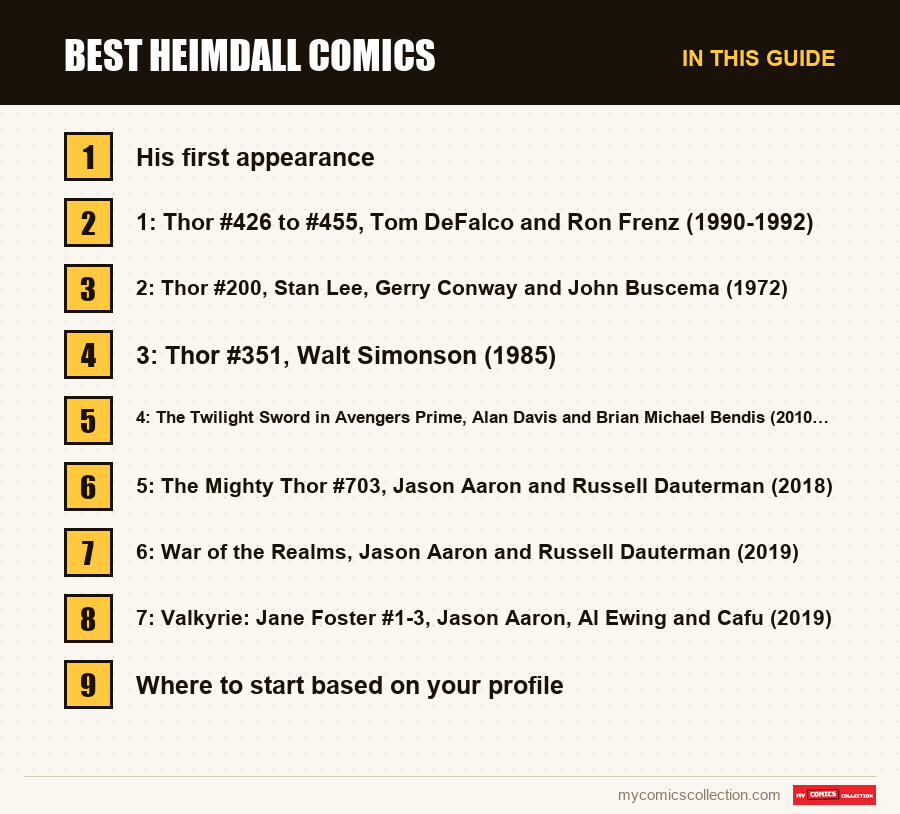
5: The Mighty Thor #703, Jason Aaron and Russell Dauterman (2018)
The Mighty Thor #703, released in January 2018, is part four of "The Death of the Mighty Thor," written by Jason Aaron and drawn by Russell Dauterman. Mangog arrives in Asgardia and, while the gods rally, Heimdall is defeated; the rainbow bridge is destroyed, and the guardian loses his sight. It is one of the rare issues where Heimdall's fate is the subject: he is the line of defense, and it is the line that gives way.
You need to read this issue in context. The arc tells of the illness of Thor, who is really Jane Foster, and the Mangog threat acts as a catalyst: the supporting characters earn their dramatic weight as the heroine weakens. Heimdall is therefore not at the center of the whole, but this issue is his. The Jason Aaron page details the long stretch in which the writer signed the series.
We recommend it to newer readers, and to those who know the movie Heimdall and want a moment on paper where the character matters just as much. How to read it: take issues 700 to 705 in one go rather than the single issue, because the tension of this chapter depends on what comes before and after it.
6: War of the Realms, Jason Aaron and Russell Dauterman (2019)
In the main War of the Realms series, six issues from 2019 plus the Omega epilogue, Heimdall enters the conflict still blind. In issue 2, Daredevil takes over the watcher's duties for a time, and it is in the Omega epilogue that the guardian regains his sight. His presence is discreet, but it directly extends issue 703: the wounded guardian keeps guarding.
The series is by Jason Aaron on script and Russell Dauterman on art, with Matthew Wilson on colors. It is not read for Heimdall but for the whole conflict; it is a war story in which each character around Thor takes a place. Heimdall links the former guardian to the one the reader finds diminished.
7: Valkyrie: Jane Foster #1-3, Jason Aaron, Al Ewing and Cafu (2019)
This spinoff of War of the Realms, scripted by Jason Aaron and Al Ewing and drawn by Cafu, stars Jane Foster, but issues 1 to 3 (September to November 2019) revolve around Heimdall's fate. Bullseye kills him with Brunnhilde's sword, Dragonfang, which gives him the power to slay a god; Jane then accompanies him toward the afterlife. Heimdall refuses to go to Valhalla, and Jane has to search with him for the place in the multiversal afterlife that his gaze cannot reach.
Here, the gaze that embraces all the worlds runs up against its own end: Heimdall dies, refuses Valhalla and has to admit he cannot see everything. It is the most intimate story on the list, and the one that does him the most justice, even if the point of view remains Jane's. The Al Ewing page presents the writer's other series.
We recommend it to everyone, including readers who did not follow the war of the realms: three issues are enough, and the story recalls what you need. It is a good endpoint after the earlier entries, or an entry point if you are mainly looking for a finished story.
Where to start based on your profile
If you want a short, moving story, read Valkyrie: Jane Foster #1-3: three issues are enough for this profile. If you like sagas full of twists, take the DeFalco and Frenz era, Thor #426 to #455: it gives you a Heimdall who rules, who is betrayed and who comes back.
If you collect archives and older issues, start with Journey into Mystery #85 and Thor #200, the two milestones that every bibliographer of the character cites. If you come from the movies, go through The Mighty Thor #703: it is the moment when the guardian takes the blow that a movie viewer expects from a print version. And if you want to understand the overall context, the Thor reading guide, cited above, places each era.
The key issues to know
The method is simple: an issue becomes a key issue when it fixes a turning point for the character, not when it merely showed him. Heimdall has several, in this chronological order.
- Journey into Mystery #85 (October 1962): the birth of the guardian, with Lee, Lieber and Kirby.
- Thor #200 (June 1972): the Ragnarok, with the Bifrost broken and the Gjallarhorn.
- Thor #201 and #203 (1972): his trip to Earth and the birth of the Young Gods.
- Thor #351 (1985): the fall of the gates of Asgard and the shattering of the Bifrost.
- Thor #426 (November 1990): Odin gives him the means to restore the Bifrost.
- The Mighty Thor #703 (released January 2018): Mangog strikes him down.
- Valkyrie: Jane Foster #1 (September 2019): his death.
The starting criterion, for deciding whether you need the period copy or a reprint, is use: reading or keeping. The 1962 and 1972 issues are justified as archival pieces, those from 1985 to 1992 as series reading or collecting, and those from 2018 and 2019 as reading first and foremost. To price a copy, whatever the era, compare closed sales of the same issue in the same condition and set aside one-off listings.
Frequently asked questions
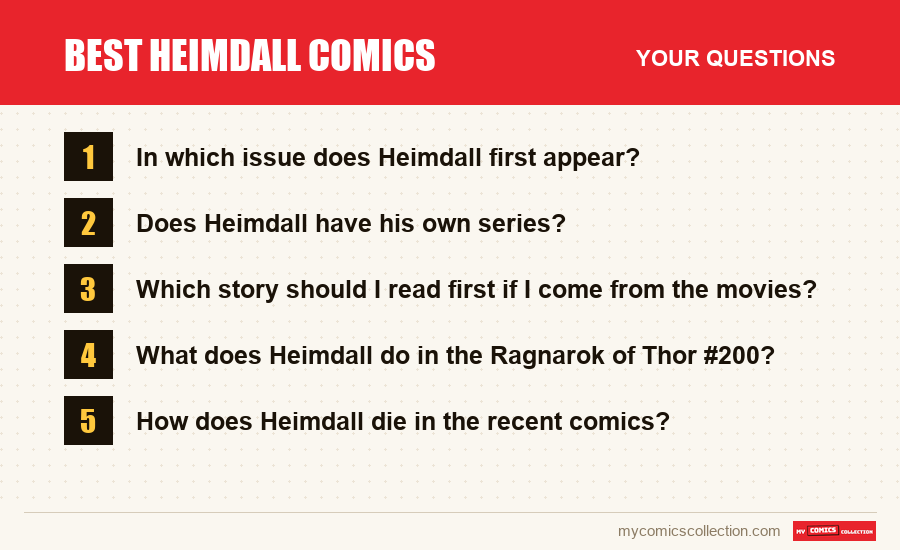
Heimdall appears in Journey into Mystery #85, whose cover carries the date of October 1962. The issue is by Stan Lee and Larry Lieber on script and Jack Kirby on art. It is an archival milestone rather than a story centered on him: the character is introduced there as guardian of the Bifrost.
This guide lists none: the stories where Heimdall weighs on the plot are scattered across the Thor series, as well as in a few miniseries and events. That is why the selection is organized by arc or by issue, and why it states the character's place in each, from central role to landmark.
Start with The Mighty Thor #703 (2018), where Jason Aaron and Russell Dauterman show Heimdall facing Mangog, then follow with Valkyrie: Jane Foster #1-3 (2019). These recent issues can be read without knowing the 1960s, and they give the guardian a more dramatic presence than the rest of the list.
According to the prophecy the issue stages, he shatters the Bifrost and sounds the Gjallarhorn, the horn that announces the end of the worlds. The issue, cover-dated June 1972, is by Stan Lee, Gerry Conway and John Buscema, and the spotlight goes to Thor, Odin and the Midgard Serpent.
In Valkyrie: Jane Foster #1 (September 2019), Bullseye kills him with Dragonfang, Brunnhilde's sword that gives him the power to slay a god. Jane Foster then accompanies him into the afterlife, because Heimdall does not want to go to Valhalla. The series is by Jason Aaron and Al Ewing, drawn by Cafu.
Found a Thor issue featuring Heimdall, vintage or modern? Have its condition and value appraised before you put it away.
Appraise my comic