
The best Chameleon comics start with his debut. The Chameleon (Dmitri Smerdyakov) is born in The Amazing Spider-Man #1 (March 1963), by Stan Lee and Steve Ditko. To read him at his best, open the Identity Crisis arc in The Spectacular Spider-Man #242-245 (1997), then The Amazing Spider-Man #340-343 (1990-1991) and Web of Spider-Man #50-52 (1989). For a recent take, Red-Headed Stranger (#602-604, 2009) does the job.
The Chameleon has no spectacular power and no armor: he has a mask, a voice, the patience to plan an impersonation, and a half-brother's grudge. That is what makes his best stories so distinctive, because the danger comes not from a punch but from doubt: who in the room is the right person? This guide ranks six stories where he sits at the center of the plot, not just somewhere in a crowd of villains.
As always in this guide, only verified facts (creators, issue numbers, dates) are stated as fact. The analysis is ours, with no reproduction of protected pages or dialogue.
His first appearance
In March 1963, Stan Lee and Steve Ditko bring the Chameleon into the very first issue of The Amazing Spider-Man. He is one of Spider-Man's earliest adversaries, arriving in the series' opening issue. His opening feat has remained his signature: he disguises himself as Spider-Man to frame the hero for stealing defense plans. The villain is thus defined by what he steals from his enemy, his appearance and his reputation, long before the character gets a full biography.
His identity comes later. Dmitri Smerdyakov, born in Russia, is the half-brother of Kraven the Hunter, Sergei Kravinoff. That family tie gives his hatred a personal dimension the rest of the rogues gallery lacks. For a collector, the 1963 #1 is a Silver Age issue with several things going for it, and its detailed profile is in our file on Amazing Spider-Man #1. If you are examining a copy of #1, inspect the spine, the staples and the margins, and make sure the printed date really is 1963.
A reading tip: do not start from #1 if you are after the character's best story. The 1963 issue is worth having for its historical status. The stories that truly exploit the mechanics of impersonation date from 1989 to 2009, and that is where the ranking below concentrates.
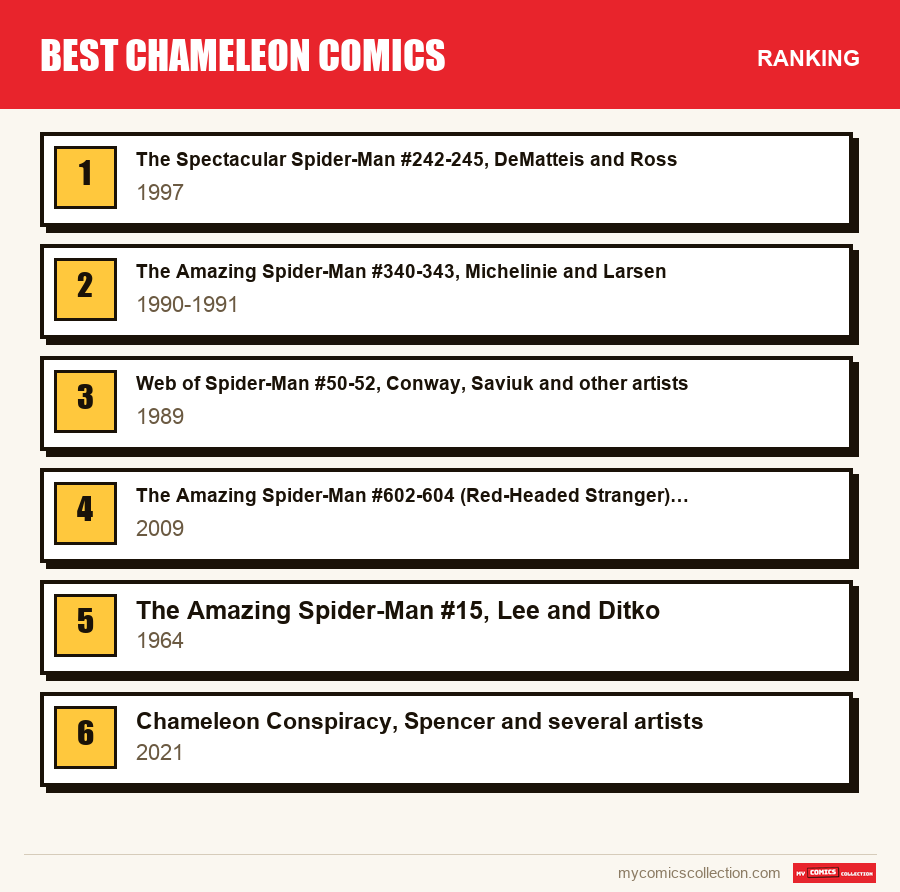
1: The Spectacular Spider-Man #242-245, DeMatteis and Ross (1997)
The Identity Crisis arc, subtitled Death of Chameleon, runs from #242 (January 1997) to #245 (April 1997). J.M. DeMatteis writes and Luke Ross draws. It is preceded by #241 (December 1996), in which Dr. Ashley Kafka frees the Chameleon from the Ravencroft institute, fearing that budget cuts and the intrusion of federal agents will ruin the work done on his fragile mind.
In #242, the Chameleon gets rid of his therapist by throwing her against a wall, takes on her appearance, shoots John Jameson, then drugs Spider-Man with a substance planted on his costume. The hero wakes up in a straitjacket at Ravencroft, where he is told he is just a patient convinced he is Spider-Man and that the face he sees under his mask is not his own. It is the most dizzying idea in the character's whole career: the villain is not trying to kill, he is trying to make Peter Parker doubt his own identity.
#245 closes the cycle on Kraven. A hallucination of the hunter leads the Chameleon to the house where Sergei Kravinoff died. There he finally embraces the half-brother bond he had long envied, imprisons Dr. Kafka and John Jameson in an electrified cage, then impersonates Mary Jane and Peter. It is Mary Jane who sees through the disguise and knocks him out with a bat. The arc ends on a gunshot, which explains its subtitle, but the character returns later: a comic book death is not a full stop.
It is the best entry point if you want to understand why the Chameleon is frightening. It is for the adult reader who responds to psychological tension, and it reads in one go: four issues, plus #241 as a prelude. To place the parent series, our file on the key issues of Spectacular Spider-Man helps pin down the era.
2: The Amazing Spider-Man #340-343, Michelinie and Larsen (1990-1991)
David Michelinie writes and Erik Larsen draws. #340 (October 1990) introduces the Femme Fatales, four women mercenaries, and shows Peter Parker visiting Dr. Turner's lab to ask him to remove his powers. #343 (January 1991), the third part of Powerless, reveals that this businessman is the Chameleon.
The plan is cruelly ingenious: a device obtained from the Tinkerer was meant to immobilize Spider-Man so hired killers could finish him off, and its side effect strips the hero of his powers. Spider-Man and Black Cat interrupt the scheme, Peter gets his abilities back, beats the mercenaries and destroys the machine, while the Chameleon escapes. The villain thus wins the game by letting Peter believe he is acting for his own good.
This entry suits the reader who likes the Michelinie era and Larsen's energetic art. It shows a manipulative Chameleon, not just an imitator: he builds a relationship of trust before striking. If you are buying, hunt for the issues together, since the plot runs across several single issues. The Erik Larsen page gathers the articles on this period of the artist's career.
3: Web of Spider-Man #50-52, Conway, Saviuk and other artists (1989)
Gerry Conway writes these three issues, published from May to July 1989. Alex Saviuk draws #50, then other artists take over. #50 fits into the gang war then shaking the Spider-Man books. The Chameleon steals the show by slipping into the skin of J. Jonah Jameson, while the real Jameson is tied up at home.
#51 (June 1989) spells out the character's ambition: in front of the Maggia's directors, he announces he will replace the Kingpin as New York's crime boss, and he plans to use the Daily Bugle as a private intelligence network. He then meets Hammerhead and offers him an alliance against Fisk. #52 (July 1989), "Chains," locks Jameson in an apartment. The prisoner breaks a mirror to flash light outside, a helicopter passes without understanding, and then the Chameleon comes back.
This three-parter is an office thriller more than a fight story. It appeals to the reader who likes seeing a supporting cast member, Jameson, carry the story. It also suits the collector curious about the 1980s, a period covered in our guide to the key issues of Web of Spider-Man. The Chameleon is not alone on screen, but he is the engine of these three issues.
4: The Amazing Spider-Man #602-604 (Red-Headed Stranger), Van Lente and Kitson (2009)
Fred Van Lente writes, Barry Kitson draws. The arc covers #602-604 from 2009: #602 is dated October and #604 November. In #602, the Chameleon takes the face of a guard in the mayor's office, learns of the city's emergency command center there, kills the guard, then disguises himself as the Statue of Liberty to jab Spider-Man with a poisoned dart and carry him off in an ambulance.
He then ties Peter to a chair, copies his voice from recordings taken at City Hall and prepares to take his face. When Mary Jane calls Peter about Harry Osborn, it is the Chameleon who answers in Peter's voice. #604, "The Ancient Gallery," shows him as Peter Parker, determined to blow up his hideout. Spider-Man tracks him with a tracer, unmasks him as Agent Trillo, finds a dirty bomb in an armored vehicle, then lets him go. A limousine then arrives: the Chameleon, who calls himself Dmitri, is invited to help Kraven's widow take her revenge.
This is the read to recommend to anyone who prefers Kitson's classic art and a monthly-series rhythm. It picks up the Kraven thread and sets up what follows in the series. It reads fine without having gone through the earlier issues, but better if you know the Kravinoff family.
Do you collect this series?
Track what you own, what you are missing and what your collection is worth. 7-day trial.
Start my trial →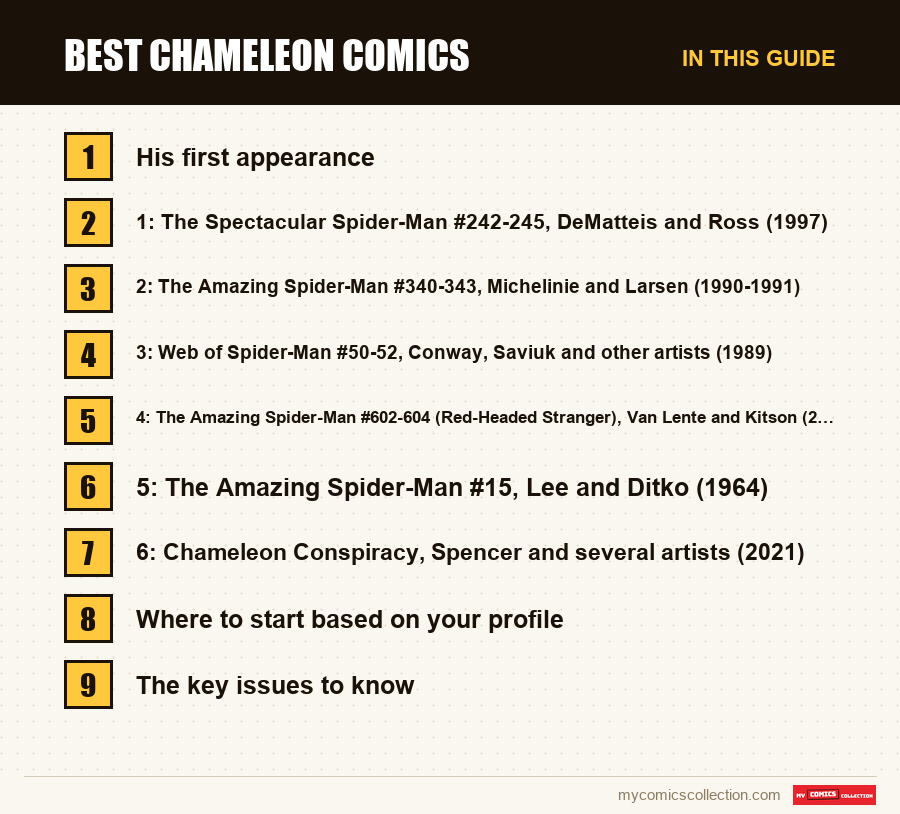
5: The Amazing Spider-Man #15, Lee and Ditko (1964)
Dated August 1964, this issue marks the arrival of Kraven the Hunter, created by Stan Lee and Steve Ditko. The Chameleon recruits the hunter there to kill Spider-Man, and their plan fails against the hero. This partnership lays the first stone of a story that will take decades to tell in full: that of two men bound by a blood tie they do not claim.
You read it for its historical value and the elegance of Ditko's layouts, not for psychological subtlety, which comes much later. It is for the Silver Age collector and for the reader who wants to understand where the ties between the two characters come from before opening Identity Crisis. If Kraven's world draws you in, the guide to Kraven's Last Hunt extends that trail. For other profiles from the Lee and Ditko era, visit the Stan Lee page.
6: Chameleon Conspiracy, Spencer and several artists (2021)
The story is part of Nick Spencer's run on the The Amazing Spider-Man series launched in 2018: it occupies #66-69 and concludes with the oversized Giant-Size Amazing Spider-Man: Chameleon Conspiracy #1, released in 2021. Several artists follow one another, and Mark Bagley draws the cover of the giant-size issue. The matching collected volume is the fourteenth of Nick Spencer's series.
The Chameleon runs a large-scale operation there, both Betty Brant and Ned Leeds return to the plot, and the Foreigner gets involved. The appeal is that of a return to recent publishing news, with a very contemporary take on impersonation and false identities.
This entry suits the reader who follows the modern series and wants to see the character at the center of a long story, more ambitious than his duels of old. It is also for the collector of recent output, who finds a giant-size issue and a trade paperback here. Save it for last: it gains from being read after the 1989 to 2009 arcs, which give the character his weight.
Where to start based on your profile
If you want the best of the character right away, read Identity Crisis in The Spectacular Spider-Man #242-245, then go back to #241 for its prelude. If you prefer a more classic thriller, open The Amazing Spider-Man #340-343: the plot is sharper there and the ending leaves no gray area.
If you read by era, start at the 1963 #1, move to the 1964 #15, then jump to 1989 through 1991 and 1997. If you like office, press and manipulation stories, choose Web of Spider-Man #50-52, whose real hero is Jameson. If you want modern series, Red-Headed Stranger in 2009 and Chameleon Conspiracy in 2021 are your two options. For wider profiles, the ranking of Spider-Man runs places the character within the whole.
A reading tip for everyone: read an arc in one block. The Chameleon's stories work on the duration of doubt, and a stand-alone issue loses the effect. If you collect alongside, pick one era and stick to it rather than scattering your purchases.
The key issues to know
The first marker is The Amazing Spider-Man #1 (March 1963), the first appearance, created by Stan Lee and Steve Ditko. The second is #15 (August 1964), which pairs the Chameleon with Kraven. In the 1980s, remember #294 (November 1987), which stages Kraven's death and triggers the character's vendetta against Spider-Man, and #307 (October 1988), where he returns with a kidnapping attempt the hero foils.
On the impersonation side, remember Web of Spider-Man #50 (May 1989), where we learn that the Bugle's Jameson is the Chameleon, then The Amazing Spider-Man #343 (January 1991), which unmasks Dr. Turner. The Spectacular Spider-Man #242 (January 1997) is the issue where the Identity Crisis arc tips into the Ravencroft straitjacket. A key issue is judged by its effect on the character's history, never by the rumor around it. Our overview of the key issues of Amazing Spider-Man helps you place these comics within the whole series.
For any copy on this list, compare the cover against the expected issue number and read the restoration notice, if there is one. The Chameleon is only one thread of Spider-Man's rogues gallery: for other villains ranked the same way, see the Vulture guide and the one on the Sinister Six.
Frequently asked questions
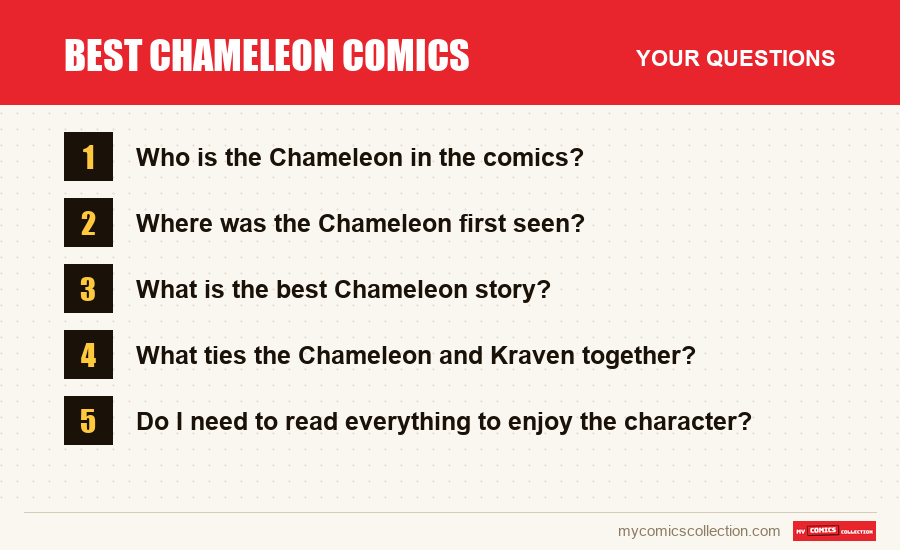
The Chameleon is Dmitri Smerdyakov, a spy and master of disguise born in Russia, half-brother of Kraven the Hunter. He appears right away in The Amazing Spider-Man #1 in 1963. With no superhuman power, he uses masks, makeup and imitated voices to take over the identity of his targets.
In the series' opening issue, dated March 1963, written by Lee and illustrated by Ditko. He takes on Spider-Man's appearance there to frame the hero for stealing defense plans. It is a Silver Age issue, to be examined carefully before any purchase.
The Identity Crisis arc, in The Spectacular Spider-Man #242-245 (1997), by J.M. DeMatteis and Luke Ross, is our pick. The Chameleon passes Spider-Man off as a Ravencroft patient and challenges his identity, which makes full use of the impersonation premise.
They are half-brothers: Dmitri Smerdyakov and Sergei Kravinoff. The Chameleon recruits Kraven in The Amazing Spider-Man #15 (1964), then Kraven's death in #294 (1987) feeds his grudge. The 1997 arc revisits this bond and concludes it dramatically.
No. Each arc in this ranking stands alone, and three issues are enough to get a feel for the character: the 1963 #1 for the birth, the 1991 #343 for the manipulation, and #245 of The Spectacular Spider-Man for the grand finale. Pick the rest to suit your taste.
Did you find a 1960s, 1980s or 1990s Spider-Man comic in your boxes? Have it estimated before you sell it or send it in for grading.
Estimate my comic