The best Carnage run is the founding trilogy by David Michelinie and Mark Bagley in Amazing Spider-Man #361-363 (1992), followed by the Maximum Carnage event (1993) and Zeb Wells and Clayton Crain's two miniseries, Carnage and Carnage, U.S.A. (2010-2012). This ranking covers five sets, from newsstand-era issues to recent miniseries, with the format we recommend for each.
Cletus Kasady has spent his publishing life barging into other people's series: Amazing Spider-Man, Web of Spider-Man, Venom, whole events. No monthly title has carried him across several years without a break. Building a list of his "best runs" means picking short blocks, sometimes four issues, sometimes fourteen, and deciding which deserve a continuous read. Here are our five picks, from the most essential to the most optional.
As always in this guide, we state only verified facts (creators, issue numbers, dates); the analysis is our own, with no reproduction of protected artwork or dialogue.
What a "run" means for a killer without a series
The idea of a run assumes a writer and a title settled in together. For Carnage, it becomes a convention: we call a run any sequence where Kasady is the center of gravity of the story, even if it sprawls across several titles or shrinks to four issues. One more clash between Spider-Man and the red symbiote is not enough to make the list. The killer has to structure the story, the sequence has to read without ten other issues behind it, and it has to have changed how later writers handle the character.
A warning is in order: the character lives in a zone of extreme tone. The violence is explicit, and some of these reads suit a young audience poorly. That did not weigh on the ranking, but it may weigh on your choice.
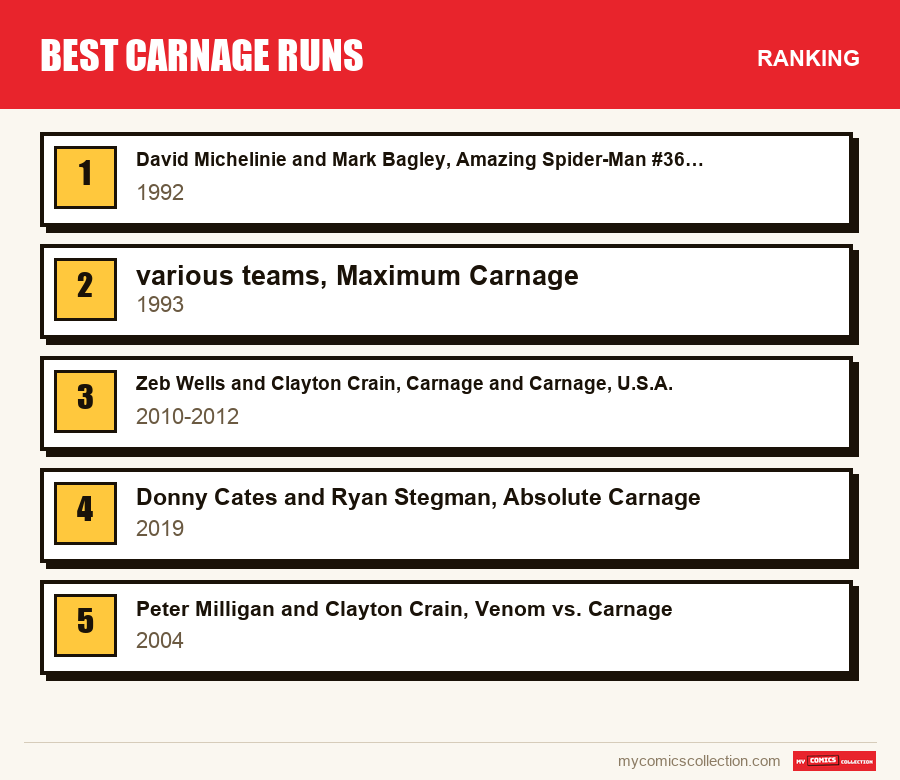
Number 1: David Michelinie and Mark Bagley, Amazing Spider-Man #361-363 (1992)
It all starts in Spider-Man's flagship title. Cletus Kasady was first introduced in 1991, in Amazing Spider-Man #344, as Eddie Brock's cellmate; preparatory appearances then dot issues 359 and 360. The arc proper begins with #361: the killer bonds with an offspring of Venom's symbiote and takes on Spider-Man, with a follow-up and a conclusion in #362 and #363. David Michelinie writes, Mark Bagley draws the trilogy.
This run matters because it lays down the logic of the character: Kasady's madness predates the symbiote, which merely amplifies what was already there. The contrast with Venom, who keeps a twisted code of honor, feeds most of the later stories. It suits any reader willing to read 1990s Spider-Man, and it stands on its own: the three issues tell a complete story.
For collectors, it is the heart of the list. Issue #361 is the first full appearance, and we give it an entry on the value of Amazing Spider-Man #361. The trilogy is available in a collected edition, which makes it easy to read, while the original issues form a coherent set to assemble. Watch the printing notice and the sales edition: direct or newsstand.
Number 2: various teams, Maximum Carnage (1993)
Maximum Carnage is the character's first big event: fourteen issues spread across several Spider-Man titles, published in 1993. Carnage escapes, gathers a band of outcasts around him and plunges New York into chaos; Spider-Man has to team up with Venom and others to stop him. Several creative teams share the chapters, hence the differences in style from one issue to the next.
The event matters because it turns Kasady into a collective danger instead of one hero's adversary, and because it established the idea of crossing over between titles as the engine of the saga. It is for readers who enjoy 1990s crossovers, not for those seeking uniform writing. Reading it depends on chapter order; our page on Carnage's multi-title crossovers explains the mechanics.
For collecting, there are two routes. The collected edition gathers the chapters in the right order and spares you the hunt for fourteen issues scattered across four or five series. The original issues keep the appeal of a complete set, built up gradually and stored in a box of its own. With a set like this, a gap shows quickly: one missing issue breaks the read.
Number 3: Zeb Wells and Clayton Crain, Carnage and Carnage, U.S.A. (2010-2012)
Two miniseries of five issues each, written by Zeb Wells and painted by Clayton Crain. The first, Carnage, published in 2010-2011, resurrects Kasady, long thought gone, and pits him against Spider-Man and Iron Man. The second, Carnage, U.S.A. (2011-2012), shows him taking over a small American town, facing an Avengers team sent to stop him.
This run counts for two reasons. It puts the character back at the center of a standalone story, without requiring you to have read the 1990s continuity; and its digital look, with saturated colors and organic textures, durably set the symbiote's appearance. It is for the reader who wants to enter the mythology through the modern, short door. It is the read we recommend before going back to the origins.
On format, both miniseries exist in collected form, sometimes combined in one volume. The single issues are affordable and easy to assemble, being two closed series of five issues each; the collecting appeal lies mostly in the covers and Crain's art, more than in scarcity.
Number 4: Donny Cates and Ryan Stegman, Absolute Carnage (2019)
The 2019 event carries the signature of Donny Cates on script and Ryan Stegman on art; the main miniseries runs five issues, surrounded by many tie-in issues. Carnage hunts down symbiote bearers, and Eddie Brock ends up at the heart of the fight. It extends the overhaul of the symbiote mythology that Cates began in the Venom series launched in 2018.
It matters for putting Carnage back at the front of Marvel's events, more than twenty-five years after Maximum Carnage. It is for the reader who follows the Venom series, since many of the emotional levers rest on what came before. If you have not read that series, the main miniseries is still readable, but it loses force.
These issues are recent and their market value is yet to be established. It will shift with the appeal Carnage retains, a possible adaptation, reprints and variant covers, for which we offer no ratio, for lack of reliable data. For reading, the collected edition of the main series is enough, the tie-ins being optional.
Do you collect this series?
Track what you own, what you're missing and what your collection is worth. 7-day trial.
Start my trial →
Number 5: Peter Milligan and Clayton Crain, Venom vs. Carnage (2004)
Peter Milligan on script, Clayton Crain on art: four issues published in 2004. It stages a fresh face-off between Carnage and Venom. It is one of the first chances to see Crain's painted style applied to the character, ahead of the 2010 miniseries.
It counts mostly as a visual landmark and as an example of a darker, more psychological approach than the 1990s one. It is for those who have already sampled the other reads on the list and want to round out their knowledge of the character. It is not essential, hence its last place. For collecting, four issues are enough to make up the set; the collected edition, when available, reads better in one go.
And outside the ranking
Four reference points deserve a word without making the list. The first is Amazing Spider-Man #344 (1991), where Cletus Kasady appears without a symbiote: an introductory issue, useful for understanding where the character comes from, but too short to count as a run. The second is the video game Maximum Carnage, released in 1994 on the home consoles of the day, which carried the 1993 event beyond paper and introduced the red symbiote to players who never opened a comic.
The third is the 2010 Carnage miniseries, where Scorn, a symbiote offshoot, appears; it belongs to the run ranked third, but that offshoot later lived elsewhere, and following its trail means leaving this guide to consult the Carnage universe. The fourth is the film Venom: Let There Be Carnage (2021), which put Kasady on screen. To untangle what comes from the pages and what the cinema added, see our analysis of the film versus the comics. None of these replaces the five reads above, but each lights up a different angle: the birth, the game, the offspring, the screen.
Which one to start with, depending on your profile
You're discovering Carnage. Begin with the two Zeb Wells and Clayton Crain miniseries: they are brief, independent and representative. Then go back to the 1992 trilogy to see where the red symbiote came from.
You like the 1990s. The Amazing Spider-Man #361-363 trilogy followed by Maximum Carnage makes a coherent pair, as long as you accept the pacing of the era's crossovers.
You follow Venom. Absolute Carnage is a direct extension of Donny Cates's series; our selection of the best Venom runs helps you place it.
You collect. Aim first for #361, then the other issues of the trilogy; the recent miniseries round out the set at a lower cost of entry. Our list of key issues ranks the priorities.
What these runs are worth as a collection
The value of these five sets is best understood through ratios. The first sets the 1990s single issue against the collected edition: for the 1992 trilogy, the gap between the original issue and the reprint is considerable, while it is small for Wells and Crain. The second ratio sets editions against each other: the same issue exists in a direct version and a newsstand version, and the latter, less widely distributed, may trade differently. Check the barcode before buying.
The third ratio separates listings from completed sales. An asking price is only a seller's intention. To place a copy of Amazing Spider-Man #361, first pull up completed sales at the same grade, then compare them with current offers: the narrower the gap, the more readable the market. The issue is very liquid, which makes the comparison easy.
The fourth concerns the calendar. Film releases or announcements around the symbiote shift attention toward first appearances, then bring it back to the reads. The runs on this list sit downstream of the keys, so they are less sensitive to these cycles than #361 itself. Finally, for crossovers like Maximum Carnage, keep an item-by-item inventory: each chapter is a line, with its home series, so you know exactly what is missing.
Frequently asked questions
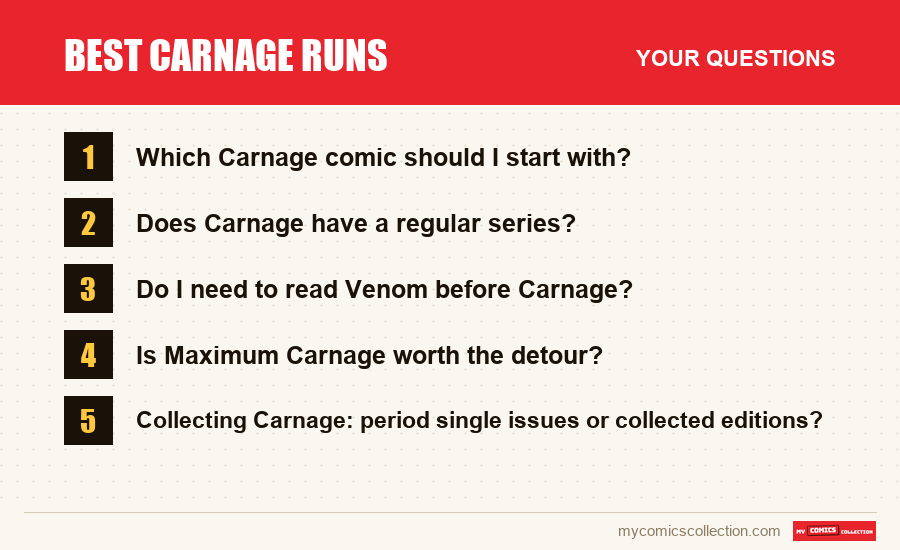
With the two Zeb Wells and Clayton Crain miniseries, Carnage (2010-2011) and Carnage, U.S.A. (2011-2012). They are short, independent and give a good picture of the character. The Amazing Spider-Man #361-363 trilogy comes next, for the origins.
He has had miniseries and limited series, but his best material remains scattered across the Spider-Man titles and events. That is why we rank short sequences and not a long monthly series.
It is not required for the Wells and Crain miniseries, which read on their own. Absolute Carnage (2019), however, gains a lot from being read after Donny Cates's Venom series, whose stakes it extends.
Yes, as long as you accept a story in fourteen chapters by several teams, with shifts in tone. It is a representative testament to 1993 crossovers. The collected edition spares you the hunt for issues scattered across several series.
For the 1990s, the original copy is the collector's piece, with #361 at the head. For the 2010 to 2019 miniseries, the single issues remain affordable, but a collected edition makes reading easier. Mixing the two calls for a separate inventory for each.
Do you own an Amazing Spider-Man #361 or another Carnage issue? Get its condition and market value estimated.
Estimate my comic