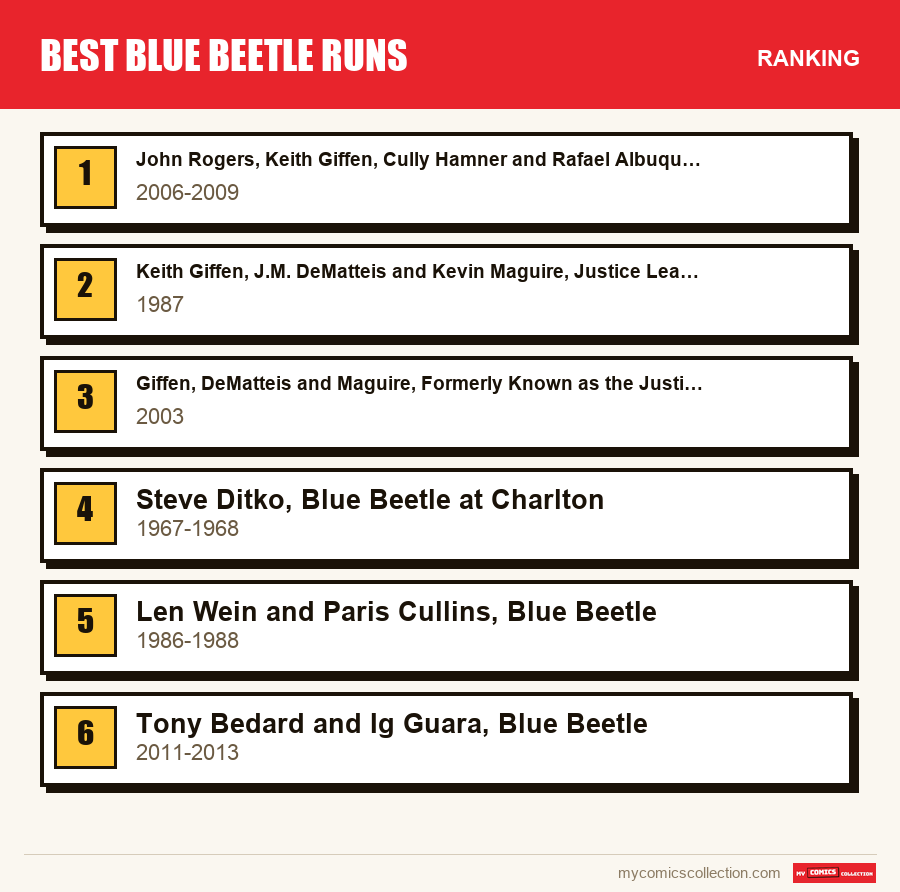
The best Blue Beetle run is the 2006 series by John Rogers, Keith Giffen, Cully Hamner and Rafael Albuquerque, devoted to Jaime Reyes. Next come Giffen, DeMatteis and Maguire's Justice League (1987), their 2003 reunion, Ditko's Charlton series (1967), Len Wein's series (1986) and the 2011 relaunch. Each run targets a different wearer, and therefore a different reader.
Ranking Blue Beetle runs poses a problem few characters share: the name covers three successive wearers, two publishers and at least five series that each restart at issue one. Putting a Texan teenager's story, an office comedy about failed heroes and an issue from a publisher gone for decades on the same scale means saying first what we are measuring. Our criterion is reading: which of these blocks is worth settling into for its own sake, and which is merely a piece of history.
As always in this guide, only verified facts (creators, issues, dates) are stated as fact; the analysis is our own, with no reproduction of protected art or dialogue.
How to read this ranking
To separate series that don't resemble each other, we asked each one a single question: if a reader opened only this block, would they understand why Blue Beetle still exists? The answer comes down to three things verifiable in the issues themselves. First, clarity about the wearer: does the story know who is under the helmet and what difference that makes? Second, independence: can you start at issue one without knowing the publisher's string of crises? Finally, staying power: is the register chosen by the creative team still picked up by other writers today?
Top 1: John Rogers, Keith Giffen, Cully Hamner and Rafael Albuquerque, Blue Beetle (2006-2009)
Thirty-six issues, from 2006 to 2009, to establish Jaime Reyes. The character makes a notable appearance in Infinite Crisis #3, early in 2006, then gets his own series a few months later. John Rogers writes, Keith Giffen helps shape the first episodes, Cully Hamner draws the opening and Rafael Albuquerque then takes over the art for most of the series.
The story starts with an El Paso high schooler who finds a blue scarab, which grafts itself onto his spine and gives him armor. What the series does with this is precise: the object comes from an expansionist species, the Reach, it has its own voice and its own intentions, it is called Khaji Da, and it proposes solutions that its wearer refuses. Jaime negotiates with his weapon the way you negotiate with an intrusive roommate. His friends Paco and Brenda, his sister and his parents know almost everything from the first issues, which strips the genre of its most worn-out device, the permanent lie to those around him.
Why it matters for the character: this is the run that gives Blue Beetle an identity that no longer depends on another hero. The intended audience is broad: even without ever having opened a comic book from this publisher, you can follow along, since the first chapters set out everything you need to know. It also offers a real city, a border, a working family: a setting that explains why the 2023 film adaptation chose to keep most of it.
How to collect it: in single issues, numbers 1 to 36 are easy to gather, and the series is among the most affordable of the character; it has also been reprinted in collected editions across several volumes. If you simply want to read, favor the collected editions; if you are after the object, check issue 1 against the indicia and look for the successive printings. Our guide to the Jaime Reyes series covers the reading from start to finish.
Top 2: Keith Giffen, J.M. DeMatteis and Kevin Maguire, Justice League (1987)
Second place is not a Blue Beetle series, and that is precisely why it carries weight: the Justice League launched in May 1987 is where Ted Kord becomes the character readers defend. Keith Giffen builds the plots, J.M. DeMatteis writes the dialogue, Kevin Maguire draws, with a knack for making faces act that few artists of the era had. The title first carries the plain name Justice League, then becomes Justice League International along the way.
The premise is a team of heroes some of whom are top-tier and the rest, including Ted Kord and Booster Gold, are not. The dramatic and comic engine comes from that gap. Meetings drag on, the headquarters has budget problems, egos collide. Ted is no longer just one more crimefighter: he is the one who asks the question the superhumans don't. Our article on Ted Kord in the 1987 team develops what this register changed for the character.
Who it's for: the reader who likes ensemble comedy, fans of dialogue, and those who want to understand why a powerless inventor inspires so much loyalty. It does require accepting a period context, with nods to late-1980s editorial events that you sometimes have to guess at.
To collect it: the original creative team signed the first years, but the issues are not all of the same level and the series changed teams afterward; limit your purchases to the issues by the Giffen, DeMatteis and Maguire team, relying on the credits in the indicia rather than on the cover. Collected editions have gathered these episodes in English; check the catalog for the issues contained before buying, since the volumes don't all cover the same range. For the duo itself, also read the friendship of Ted Kord and Booster Gold.
Top 3: Giffen, DeMatteis and Maguire, Formerly Known as the Justice League (2003)
The same team reunites sixteen years later for a six-issue miniseries, Formerly Known as the Justice League, published in 2003, then for a second installment in JLA Classified, titled I Can't Believe It's Not the Justice League (2005). The alumni of the lineup come back together, this time as an agency of private superheroes called the Super Buddies, run by Maxwell Lord. The tone is outright self-parody, paying tribute to the 1987 series while mocking everything it had established.
Why it matters: this reunion fixes Ted Kord's place in readers' memory shortly before his disappearance. Maxwell Lord, who runs the agency, is the one who kills Ted Kord in Countdown to Infinite Crisis in 2005; reading the 2003 miniseries therefore changes color once you know what follows. It is a set that gains depth in retrospect, and we devote a separate article to the death of Ted Kord.
Intended audience: the reader who has already tasted the 1987 register and wants to check that it holds up. It is not an entry point; without the original series, some of the jokes are lost. How to collect it: the miniseries' six issues fit in one collected edition, and the six JLA Classified episodes are found both in single issues and in a volume; the recommended reading order is publication order.
Top 4: Steve Ditko, Blue Beetle at Charlton (1967-1968)
Ted Kord is born in Captain Atom #83, in 1966, under Steve Ditko's pencil, before getting his series at Charlton. That series runs five issues, from 1967 to 1968, and is numbered independently of the character's earlier versions, which explains the confusion we describe in our article on Blue Beetle numbering.
The story sets up the billionaire inventor, his machines, his flying craft nicknamed the Bug, and a light adventure register that differs from Dan Garrett's mystical archaeology. Ditko draws it, and the writing credits vary by issue; check the indicia rather than assuming. The interest is twofold. On one hand, it is the original material for the powerless character, the one every later writer drew on. On the other, Ditko shows in a few pages how he treated a hero who has only his ideas to work with.
Do you collect this series?
Track what you own, what you're missing and what your collection is worth. 7-day trial.
Start my trial →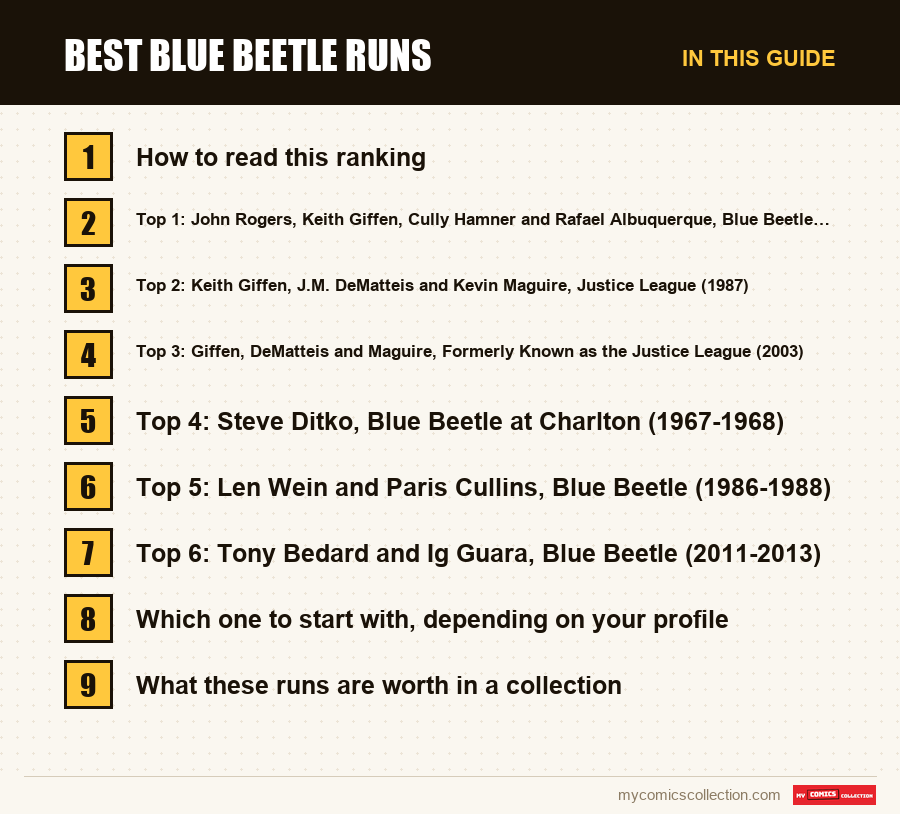
Top 5: Len Wein and Paris Cullins, Blue Beetle (1986-1988)
This is Ted Kord's first solo series at his current publisher: twenty-four issues, from 1986 to 1988. Len Wein launches the series and Paris Cullins draws it; the character, bought along with others from a defunct publisher, has to find his place in an already crowded universe. The series treats him as a technician rather than a superhuman, with a company, gadgets and a strained relationship with his legacy.
Why it matters: it is the only time Ted Kord carries his own series at this publisher, and the run links the Charlton years to the Justice League comedy that appears almost at the same time. Its rank rests on a simple fact: the title did not find its readers, and Ted Kord's fame comes from the 1987 Justice League rather than from these twenty-four issues. Our article on the 1986 series describes what it attempted.
Who it's for: the Ted Kord completist and the reader curious about a transitional character. How to collect it: a short, closed set of twenty-four single issues, with no reference collected edition to our knowledge, so original issues only. That finiteness makes it a good collecting project for anyone who likes series with clear boundaries.
Top 6: Tony Bedard and Ig Guara, Blue Beetle (2011-2013)
The last entry in the ranking, the series launched at the 2011 relaunch: sixteen issues, from 2011 to 2013, with Tony Bedard writing and Ig Guara drawing. It takes Jaime Reyes into a rewritten universe: he is once again a high schooler from El Paso, but the scarab and the story of the armor are reorganized, and the family loses part of the central place it held in 2006.
Why it matters: it is proof that the character holds up without his original team, and that Jaime can change hands without losing his outline. Why it stays sixth: readers who loved the 2006 series find less of what made it charming, and the relaunch has since been largely overtaken by more recent continuities.
Who it's for: anyone who wants a more dynamic, more compact version, with more action up front. How to collect it: only sixteen issues, a short series and so easy to assemble, published in an era of comfortable print runs; the issues are not rare, and it is condition that makes the difference. Variant covers exist for some issues of this period, but without a reliable source we cite none.
Which one to start with, depending on your profile
You don't know the character: take Top 1. Thirty-six issues, a clear wearer, a story that explains itself. The 2023 film draws on this series; our article film and comics compares the two.
You like team comedy: go straight to Top 2, then Top 3. The two read in that order, and the pleasure of the second assumes the first.
You are a Silver Age reader: Top 4 is for you, with the precaution of spotting the issues you're missing in advance, since supply is narrower than for modern series.
You want to read without buying old single issues: favor the collected editions of Top 1 and Top 3. These are the two sets easiest to find in bound volumes.
What these runs are worth in a collection
The value of a Blue Beetle run is read not from the wearer's fame but from the age of the issue. One observation stands out to anyone comparing listings: the wearer best known to the general public is often the one that costs the least, because his issues were printed in quantity and reprinted, while the oldest, little read, remains the most sought after. Scarcity follows the years, not celebrity.
The method is therefore to compare series with one another in the same way. Take the median of completed sales for a given issue, over the same period, in the same condition, then set the Top 4 figure against the Top 1 figure: the ratio tells you better than any isolated number where each run stands. Do the same between raw and certified copies, keeping in mind that the certified segment is narrow on modern series and does not allow firm conclusions.
Frequently asked questions
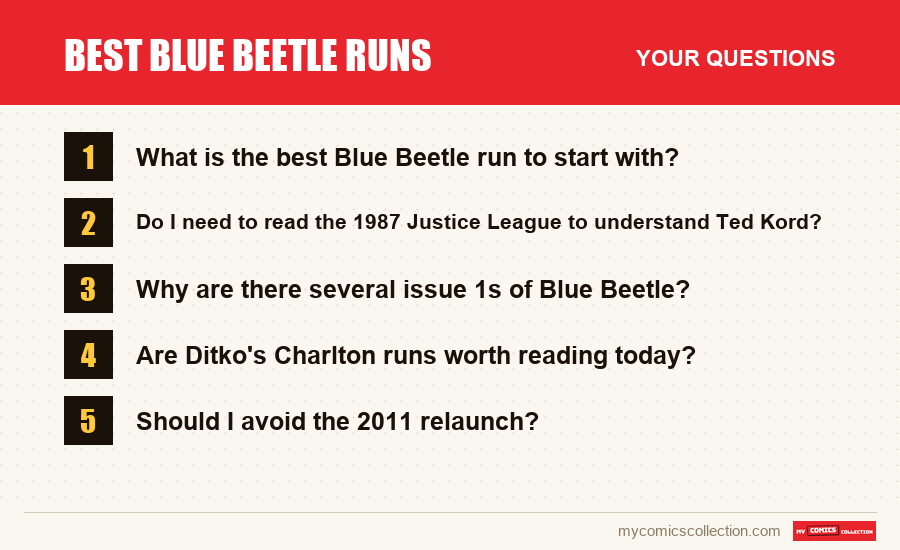
The 2006 series by John Rogers and Keith Giffen, drawn by Cully Hamner then Rafael Albuquerque. It runs thirty-six issues, reads without prior knowledge and establishes Jaime Reyes with his family, his talking scarab and his city of El Paso. It is also the most direct source of the 2023 film.
Yes, if you want to grasp why readers love him. The series by Giffen, DeMatteis and Maguire makes him, with Booster Gold, the comic counterpoint to a team of top-tier heroes. The 1986 solo issues set the stage, but it was the team that fixed his character.
Because the title was relaunched with each change of publisher, wearer or continuity: Charlton in 1967, DC in 1986, then 2006 and 2011. Each series restarts at issue one, with similar covers. Check the year and the publisher credit in the indicia before any purchase.
For a Silver Age reader, yes: it is the birth of Ted Kord and Steve Ditko's art applied to a powerless hero. For a modern reader, the format and the dialogue feel dated. The issues are scarcer, and so costlier than recent series.
No, but it comes after. The sixteen issues by Tony Bedard and Ig Guara offer a more high-strung version of Jaime Reyes, useful if you liked 2006 and want a follow-up at a different pace. It is not a first purchase, and the family is less central there.
Did you find a 1967 Blue Beetle or a 2006 issue one in a box? Get it estimated before selling it or sending it for grading.
Estimate my comic