The series that installed the current carrier can be found at a dollar an issue, including its first. As of August 29, 2026, it displays $14.99 gross median out of 142 ads, with copies from number one to $1.00. However, it is the direct source of what the general public knows about the character. Neither recent notoriety nor adaptation have changed these prices: supply remains higher than demand, and there is no indication that this is changing.
For a reader, this is the best gateway to the character and by far the cheapest.
We will see what this series does differently, where it is located on the market, which explains why recent notoriety has not displaced it, and how to take it.
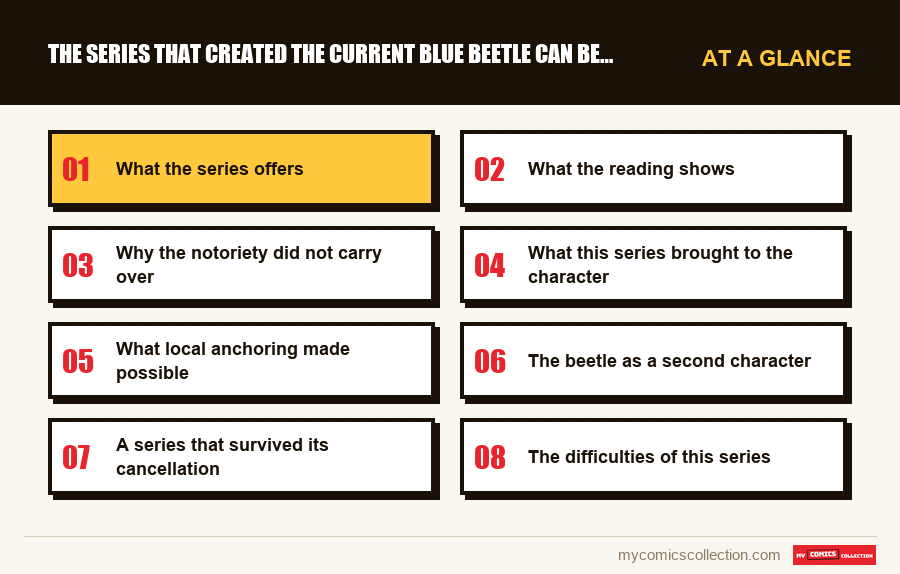
What the series offers
It differs clearly from the two previous periods, and on four points.
A teenage porter. The suit falls to someone who didn't ask for anything, doesn't know how to use it, and must continue to go to high school. The gap between power and situation provides most of the material.
A family present. Contrary to the usage of the genre, those close to him know and intervene. The story spends as much time at home as in costume.
A precise geographical anchor. The series takes place in a named town, with an identified community, which sets it apart from the genre's interchangeable settings.
An autonomous beetle. The object has its own intentions and negotiates with its wearer, producing a relationship rather than equipment.
These four traits make it a domestic-level superhero series, which was little practiced when it was published and explains the loyalty of its readership.
What the reading shows
The series
Raw : 142 ads, of $1.00 to $125.00 requested, median $14.99. Certified: 23 ads, median $83.95.
The first number is among the $1.00 entries.
Lowest entries
Numbers to $1.94, 2.54 and $2.95 requested, described in good condition. These are current copies, not rejects.
The first carrier, for comparison
Its 1960s issues display $40.00 raw median and $249.99 in certified.
The least known carrier therefore costs the most.
A modest certified slope
Twenty-three announcements, which remains low and indicates a poorly organized collectible market over this period.
Sounding of August 29, 2026: fixed price announcements, copies under shell counted separately. Amounts are displayed by sellers, not collected.
Why the notoriety did not carry over
Three causes, two of which are general and one specific to this series.
The draw was comfortable. Published by a major house in the mid-2000s, the series has enjoyed wide distribution and reprints. The supply remains abundant.
The recent public does not read issues. Spectators who come via the screen turn to bound volumes in general bookstores, not to second-hand booklets. The request does not refer to this format.
The character has no first appearance in this series. It appears elsewhere before, which deprives this first issue of the status which could have enhanced it.
This third reason is decisive and often missed. A series can establish a character without containing their first appearance, and it is the previous reference which captures the value: a mechanism observed on several authors of this campaign.
I can't say anything about the effect of adaptation. This data constitutes a snapshot taken on a given day: it does not include any previous point of comparison and relates to requests, not to sales.
Establishing that a film has moved prices would require two measurements spaced over time, on the same references, preferably with concluded transactions. I notice a level on a date: nothing more, and especially not an evolution.
What this series brought to the character
She is probably the reason it still exists, and in three ways.
It gave it its own identity. The previous two wearers were defined by the object; this one is because of its situation, which makes it transposable elsewhere without the scarab being explained.
She anchored the character in an environment. It is no longer a costume worn by someone but a situated person, with connections that the story cannot ignore.
She made it interesting. A beetle that argues and resists is better than a beetle that obeys, and this relationship provides ongoing conflict without an external adversary.
These three contributions explain why this version became established. It solved the problem of the previous two: a replaceable character: giving the wearer what the object could not provide.
What local anchoring made possible
A choice deserves to be developed, because it is rare in the genre and it carries part of what distinguishes this series.
Setting a superhero story in a real city rather than in an invented setting is more engaging than it seems. We must assume a geography, an economy, a population, and accept that readers who know the place will judge the accuracy of the portrait.
The benefit is a rooting that invented settings never obtain. A character who protects an imaginary city protects an idea; a situated character protects people who know where they live.
This also produces issues of another nature. The problems that the wearer faces relate as much to his social and family situation as to his adversaries: which is only possible if these elements are credible.
The price of this choice is less scope. A very situated story is poorly transposed, and this is one of the reasons why adaptations always modify entire sections.
The beetle as a second character
One design decision distinguishes this period from the previous two and is worth isolating.
In previous wielders, the item was equipment: it gave abilities and had no opinions. Here, it has its own intentions, often contrary to those of its wearer, and it argues.
This transforms a usage relationship into a negotiation relationship, which provides ongoing conflict without the need for any external adversaries. This is a considerable narrative economy.
The device has a second, less obvious effect: it makes power worrying. A wielder who has to convince his own equipment not to kill someone is never completely in control of what he does.
This is what prevents this series from tipping into the adolescent comedy that its premise led us to fear. The threat comes from inside the suit, and it does not settle.
Collecting this series?
Track what you own, what you are missing and what your collection is worth. 7 day trial.
Start my trial →A series that survived its cancellation
One last element is worth noting, because it explains the character's current position.
This series ended without having found a sufficient readership, which is the usual fate of titles devoted to secondary figures. She should have disappeared with him.
This is not what happened: the character continued to exist, was taken up elsewhere, then brought to the screen: an unusual trajectory for a canceled series.
The explanation is probably that this series has created something transposable: a situation and a character, rather than a set of stories. This capital survives the cancellation of a title.
This is a useful observation beyond this case. A series can fail commercially and still succeed sustainably, provided you have produced a figure that others can copy: which is a different objective from that of selling numbers.
The difficulties of this series
Several homonymous series
The title has been revived at different times with separate numberings and other bearers.
A first appearance elsewhere
The character is born in another title, which makes it difficult to put together a complete collection.
Changing teams
The series changes hands along the way, with the variations in tone that this implies.
Collections with variable scope
Volume covers do not always cover the same issues depending on the edition.
How to approach it
Three recommendations, which arise directly from the prices recorded.
Buy a batch from the beginning. At $1.00 and $2.95 an issue, twenty consecutive copies cost less than a single issue of the first carrier, and give the series as it worked.
Read in order. The series is based on the wearer's learning and on evolving relationships; taking it in the middle removes the essential.
Don't look for the first appearance here. It's in another title. Wanting to include it in this collection produces costly confusion.
This approach gives access for a few dozen dollars to all of the best that the character has. This is the best report in the entire file devoted to this figure, and it is solely due to drawing conditions.
A comparison between the three carriers
The survey allows for an overall observation that is worth asking.
The three periods are asked at very different levels, and the order is exactly the opposite of notoriety. The Porter from the 1960s, which almost no one has read, is the most expensive; that of the 2000s, which the general public knows, is the cheapest.
The explanation is entirely material: small publisher and fragile paper on one side, large house and comfortable prints on the other. Demand does not compensate for this supply gap.
This is a reader-friendly setup, and a rare one. Of most characters, the known version is also the most expensive, which forces a choice between reading and spending.
Here, the most interesting version to read is the most accessible: a situation that is worth noting, because it is not often encountered.
What to record
On a character with multiple bearers and homonymous titles, the file must anchor the generation concerned.
The bearer, the year of publication and the exact series, before the number. Several series share this title, with their own numbering and different bearers: a number identified by its single digit can designate three objects belonging to three generations, whose prices range from one to four hundred dollars.
This is the only way to know what you are completing, a question that arises as soon as you have around twenty issues purchased in batches.
Special issues that contain appearances: this character is born elsewhere and appears in other titles, and a collection organized around the main series alone misses elements that no summary indicates.
These two mentions address the problem specific to transmissible identities (a name, several people, several series) which single-bearer characters never pose.
Frequently asked questions
Three causes: a comfortable print run at a major house in the mid-2000s, a recent public who buys volumes in bookstores rather than second-hand booklets, and above all the absence of a first appearance: the character is born in another title, which captures the value.
Nothing here allows us to decide. Measuring a movement requires two measurements and I have only one, moreover relating to what sellers are asking for rather than what buyers have paid. I observe a level, on a date, and leave it at that.
It gave the wearer its own identity where the previous two were defined by the object, anchored it in an environment with ties that the story cannot ignore, and made the scarab interesting by giving it its own intentions. She solved the problem of a previously replaceable character.
By a lot from the beginning of the series: at $1.00 and $2.95 per issue, around twenty consecutive copies cost less than a single issue from the first carrier. And read in order: the series is all about the wearer learning and evolving relationships.
For entirely material reasons: small publisher and fragile paper in the 1960s, large house and comfortable print runs in the 2000s. Demand does not compensate for this gap in supply, and the result is a rare situation where the most interesting version to read is also the most accessible.
Which carrier, which year, which series?
The same number can designate three objects from three generations, from one to four hundred dollars.