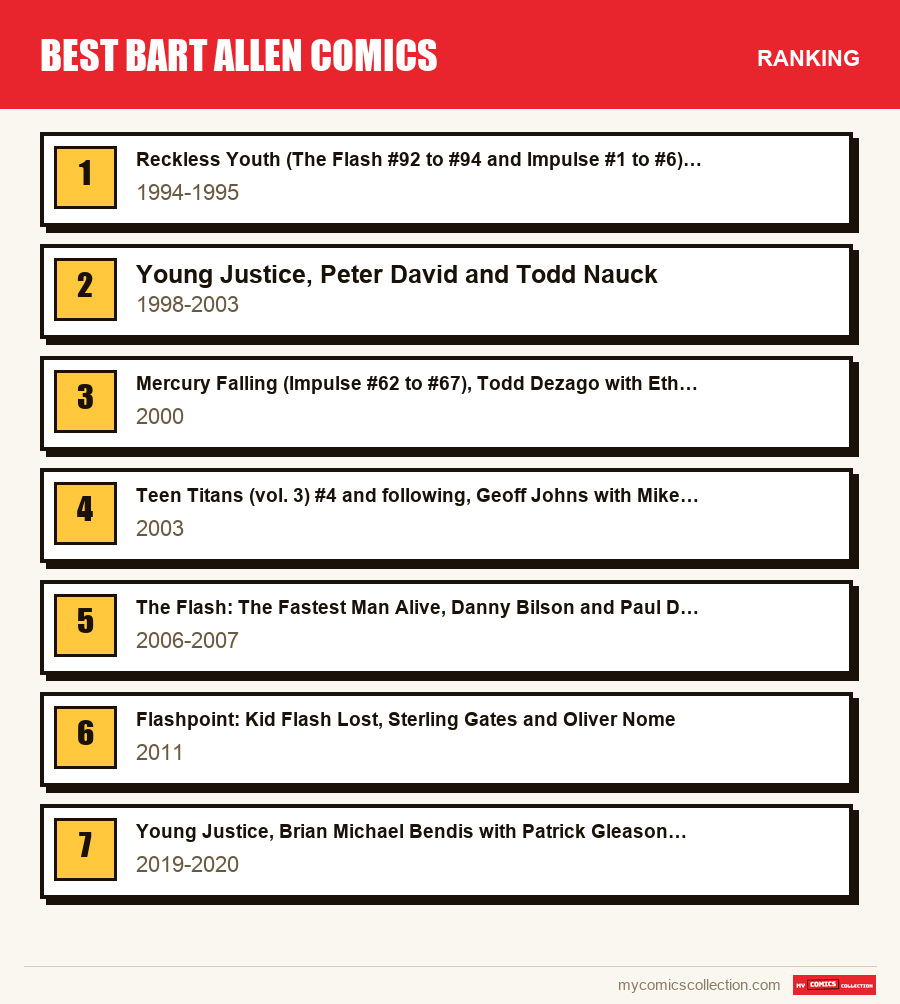
For the best Bart Allen comics, start with Mark Waid's Impulse: The Flash #92 to #94 then Impulse #1 to #6 (1994-1995). Continue in Young Justice, by Peter David and Todd Nauck (1998-2003), before Teen Titans #4 (December 2003) and his Kid Flash costume. Finish with The Flash: The Fastest Man Alive (2006-2007), the series where he carries the name Flash, and with Flashpoint: Kid Flash Lost (2011).
Three names, three eras, one character: Bart Allen has been Impulse, then Kid Flash, then Flash, and each identity matches a specific series. Mixing the three leads you to buy or read out of order, and to pay for an issue with an appearance that is not the one you are after. A descendant of Barry Allen who arrived from the future, Bart debuts as a teenager unable to slow down, then the writers make him grow up, sometimes without mercy. This guide ranks the seven reads that tell this journey and says, issue by issue, which name goes with which period.
As always in this guide, only verified information (creators, issues, dates) is stated as fact; the analysis is our own, with no reproduction of protected art or dialogue.
His first appearance
Bart Allen first appears in 1994 in The Flash (vol. 2), with a brief appearance in issue #91, then his full entrance in issue #92, under the name Impulse. He is created by Mark Waid on script and Mike Wieringo on art. Keep two landmarks in mind: #91 for the silhouette, #92 for the character as you follow him afterward. Cover years are enough to sort the single issues: 1994 for the entry in The Flash, 1995 for the Impulse series.
The series devoted to him, Impulse, begins with an issue #1 dated April 1995, written by Mark Waid and drawn by Humberto Ramos. Bart is entrusted to Max Mercury, then adopted by Jay and Joan Garrick. These chosen-family ties structure all of the character's youth stories.
Impulse, Kid Flash, Flash: who is who
Down to the issue number, the rule is simple. Impulse designates Bart from The Flash #92 (1994) and in the Impulse series (1995-2002). Kid Flash is the name he adopts in Teen Titans (vol. 3) #4, cover-dated December 2003. Flash is the name he carries in The Flash: The Fastest Man Alive, launched in 2006. Another frequent mix-up: the amnesiac Kid Flash from the 2011 launch of Teen Titans is not Bart; it is Bar Torr. The Kid Flash who precedes Bart, finally, is Wally West, covered in the Wally West guide.
1: Reckless Youth (The Flash #92 to #94 and Impulse #1 to #6), Mark Waid with Mike Wieringo and Humberto Ramos (1994-1995)
This is the collection that gathers Bart's entry into the DC universe. Waid writes a hero whose speed outpaces his maturity: Bart acts before thinking, and the series plays on that gap for comedy. Mike Wieringo draws issue #92; Humberto Ramos draws issues #1 to #6 of Impulse.
What this read brings to the character: his voice, his humor, his need for bearings. It suits whoever is discovering Bart, because it reads with no prerequisites. How to read it: in issue order, starting with The Flash #92. The trade paperback Impulse: Reckless Youth collects exactly this journey, from The Flash #92 to #94 through Impulse #6. To continue, Flash/Impulse: Runs in the Family collects Impulse #1 to #12 with The Flash #108 to #111, which lets you follow Bart across both series. To place this period within Waid's work on Flash, see the reading order of Mark Waid's stories.
2: Young Justice, Peter David and Todd Nauck (1998-2003)
The 56-issue series brings Robin, Superboy and Impulse together in a team of teenagers. Peter David writes it, Todd Nauck draws it, after the June 1998 one-shot Young Justice: The Secret, which introduces the group under the pen of Todd Dezago and Nauck. Issue #1 is dated September 1998.
What the series brings to Bart: friends his own age, and a place where his speed becomes a collective asset. It is for readers who like teen teams and Peter David's humor. How to read it: in order, keeping in mind that Bart remains Impulse there. For the TV version and the differences, the guide Young Justice, series and comics makes the comparison. The writer's other works are on his page.
3: Mercury Falling (Impulse #62 to #67), Todd Dezago with Ethan Van Sciver and Eric Battle (2000)
Todd Dezago writes the Impulse series through to its end, with Ethan Van Sciver on art from issue #50, in July 1999. The Mercury Falling arc features Bart's mentor, Max Mercury, and occupies several issues of this period. Van Sciver draws most of the issues; Eric Battle signs issue #64.
What this arc brings to the character: a story where his mentor moves to the foreground. It is for readers who have already read the series' early issues and want to see the Dezago period. How to read it: after Young Justice if you follow the chronology, or directly if you are after the Impulse series in its final period. The trade paperback The Flash Presents: Mercury Falling collects these issues.
4: Teen Titans (vol. 3) #4 and following, Geoff Johns with Mike McKone (2003)
The third Teen Titans series begins in September 2003 under the pen of Geoff Johns. In issue #4, cover-dated December 2003 and drawn by Mike McKone, Bart is hit in the knee by Deathstroke, possessed by Jericho, and reinvents himself under the name Kid Flash. This issue is the landmark to know: it separates the unruly teenager from the hero he is asked to be.
What the series brings to the character: a costume, a name, and a role within a more established team. It is for readers of the Titans and those who follow Geoff Johns, whose work you will find on the writer's page. How to read it: from #4 to follow Bart, knowing he shares the spotlight there with other members. For the team's context, see the Teen Titans guide.
Do you collect this series?
Track what you own, what you are missing and what your collection is worth. 7-day trial.
Start my trial →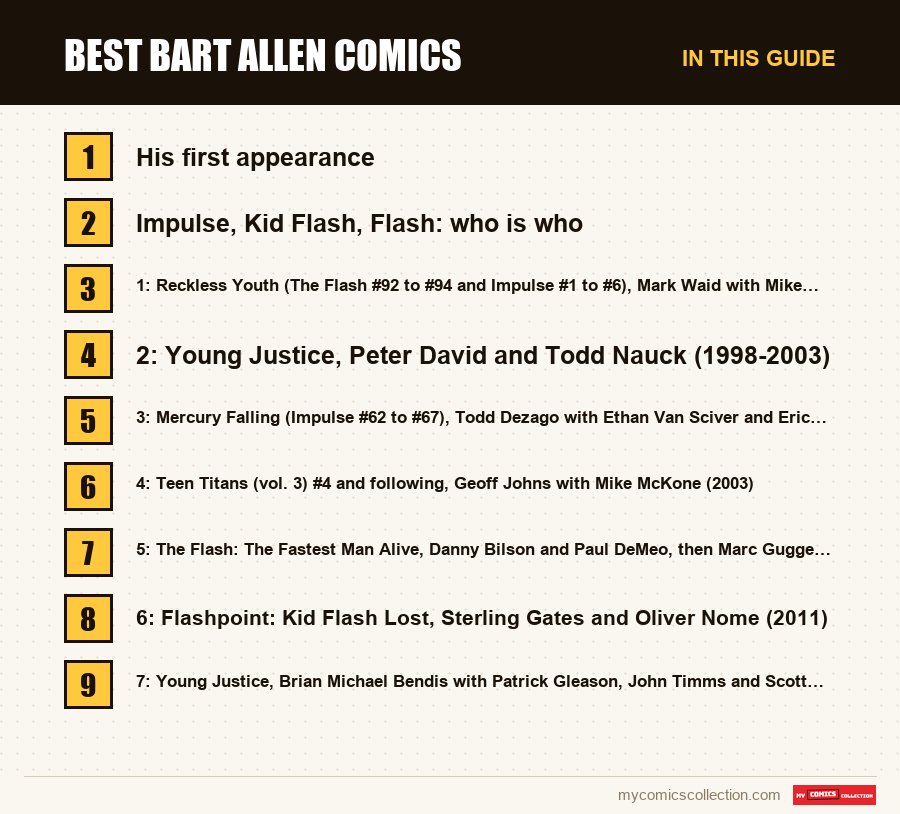
5: The Flash: The Fastest Man Alive, Danny Bilson and Paul DeMeo, then Marc Guggenheim (2006-2007)
This 13-issue series makes Bart the Flash. Danny Bilson and Paul DeMeo launch it in 2006, with Ken Lashley on art for issue #1; Marc Guggenheim signs the conclusion. It ends at issue #13, cover-dated August 2007, with Bart's death, killed by the Rogues.
What this series brings to the character: the passage into adulthood under the name Flash. It targets readers ready to leave the lightness of Impulse for a darker tone. How to read it: in one sitting, from #1 to #13, knowing the ending is brutal. The Rogues have Captain Cold as their central figure, and that guide details his stories.
6: Flashpoint: Kid Flash Lost, Sterling Gates and Oliver Nome (2011)
This three-issue miniseries, from August to October 2011, puts Bart at the center of a Flashpoint tie-in. Sterling Gates writes, Oliver Nome draws, with Scott Kolins and Trevor Scott on the last issue. Lost in time after the upheaval of the timeline, Bart teams up with a hero from another world, Hot Pursuit, to get home.
For the character, it is a story entirely turned toward Bart, far from the teams. It is for Flashpoint readers who want a short story centered on him. How to read it: in one sitting, in three issues, after reading the main miniseries if you want the context.
7: Young Justice, Brian Michael Bendis with Patrick Gleason, John Timms and Scott Godlewski (2019-2020)
The 2019 relaunch runs twenty issues. Brian Michael Bendis writes it, with David F. Walker on script from #13, and three main artists follow one another. Bart is part of the reassembled team, among characters his own age.
What this series brings: a recent presence of Bart in a team book, useful for whoever wants a modern entry point. It is for readers who prefer contemporary stories. How to read it: with no prerequisites, because the series introduces its characters; the youth stories remain a supplement rather than an obligation.
Where to start based on your profile
- You are discovering the character: The Flash #92 to #94 then Impulse #1 to #6, the natural entry point.
- You like teen teams: Young Justice (1998), then Teen Titans from #4.
- You want the best of the Impulse series: Mercury Falling, issues #62 to #67.
- You prefer dark stories: The Flash: The Fastest Man Alive, through to its conclusion.
- You want a modern, short story: Flashpoint: Kid Flash Lost, three issues, or the 2019 Young Justice series.
Key issues to know
The method: first spot the founding appearances, then the name changes, finally the returns. The following landmarks are verified.
- The Flash (vol. 2) #91 (1994): Bart's brief appearance.
- The Flash (vol. 2) #92 (1994): Impulse's full entrance, by Mark Waid and Mike Wieringo.
- Impulse #1 (April 1995): the start of his series, by Mark Waid and Humberto Ramos.
- Young Justice: The Secret (June 1998): the introduction of the team.
- Impulse #50 (July 1999): the arrival of Ethan Van Sciver on art.
- Teen Titans (vol. 3) #4 (December 2003): the switch to the name Kid Flash.
- The Flash: The Fastest Man Alive #1 (2006) and #13 (August 2007): Bart as Flash, then his death.
- Final Crisis: Legion of 3 Worlds (2008-2009), by Geoff Johns and George Pérez: the character's return in the stories. Bart is not the central hero there.
- Flashpoint: Kid Flash Lost #1 (August 2011): a short series with him as its subject.
Two tips on method: tell apart the issue that introduces a name (Impulse, Kid Flash, Flash) from the one that evolves it, because they do not attract the same buyers; and always check whether you are buying an issue centered on Bart or a team issue where he is only a member. For any purchase, compare the cover date printed on the single issue to its actual release year.
Frequently asked questions
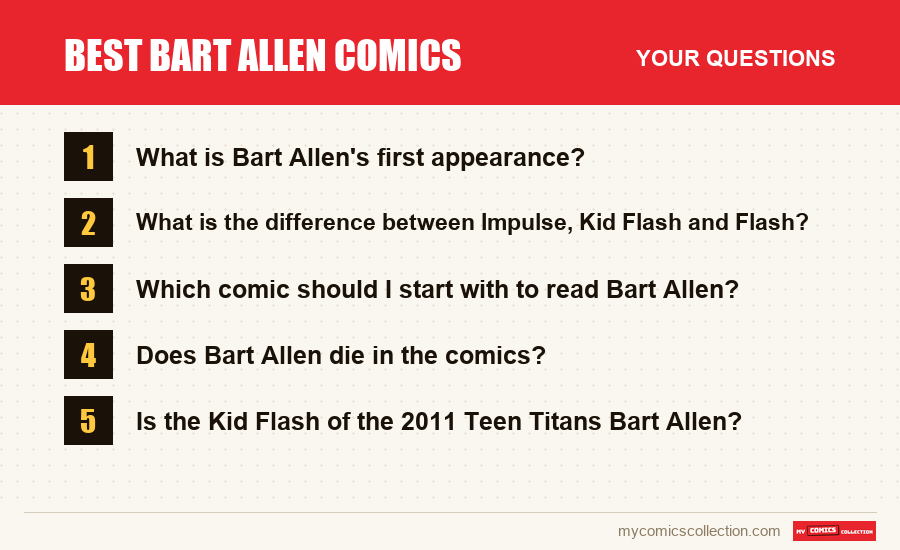
Bart Allen appears briefly in The Flash (vol. 2) #91, then makes his full entrance under the name Impulse in #92, in 1994. He is created by Mark Waid on script and Mike Wieringo on art. His Impulse series then starts with an issue #1 dated April 1995.
They are three names of Bart's in three eras. Impulse applies from 1994 and in the 1995 series. Kid Flash appears in Teen Titans (vol. 3) #4, in December 2003. Flash is his name in The Flash: The Fastest Man Alive, from 2006.
With The Flash #92 to #94 followed by Impulse #1 to #6, by Mark Waid with Mike Wieringo and Humberto Ramos. This read needs no prerequisites, and it sets the character's tone. Then read Young Justice: Peter David writes it, Todd Nauck draws it, from September 1998.
Yes, in The Flash: The Fastest Man Alive #13, cover-dated August 2007, where he is killed by the Rogues. The character later returned in the stories, notably around Final Crisis: Legion of 3 Worlds (2008-2009), then in Flashpoint: Kid Flash Lost in 2011.
No. The amnesiac Kid Flash introduced at the 2011 launch of Teen Titans turns out to be Bar Torr, not Bart Allen. To read Bart, stay with the Impulse, Young Justice and 2003 Teen Titans series, as well as his 2006 and 2011 titles.
Do you have a copy of The Flash #92, Impulse or Teen Titans #4? Get it estimated.
Estimate my comic