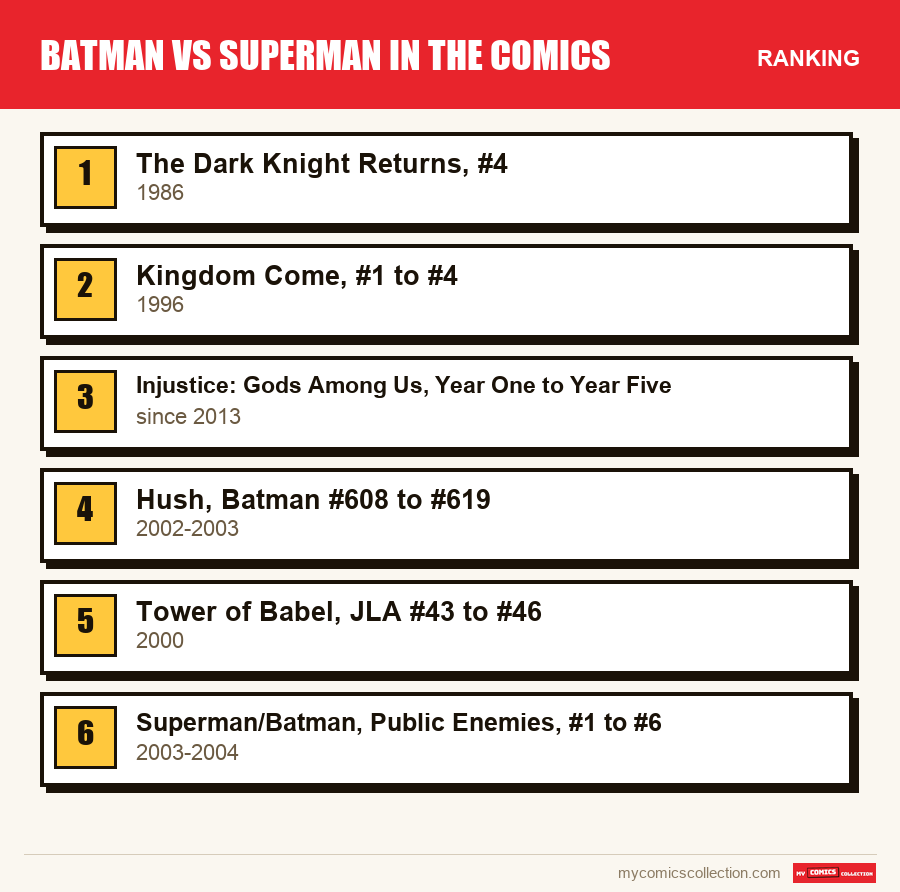
The definitive Batman vs Superman fight in the comics is the one in The Dark Knight Returns #4 (1986), by Frank Miller. Next come Kingdom Come (1996), Injustice: Gods Among Us (since 2013), the Hush arc (2002-2003), Tower of Babel in JLA #43 to #46 (2000) and the Superman/Batman pairing (since 2003). This page ranks all six, tells you who wins and shows you how to read them.
"Who wins, Batman or Superman?" is a reader's question, not a writer's: in the comics, the result always depends on what the author wants to prove about their friendship. We reread the published clashes to rank them by importance, from the most decisive to the most incidental.
As always in this guide, we only state verified information (creators, issue numbers, dates); the analysis is our own, with no reproduction of panels or protected dialogue.
1: The Dark Knight Returns, #4 (1986)
This is the fight that fixed the image the general public has of the rivalry. Batman: The Dark Knight Returns was published by DC Comics in four prestige-format issues in 1986. Frank Miller writes and draws, Klaus Janson inks, and Lynn Varley colors. The fourth chapter is the showdown, set in Crime Alley, the spot where Bruce Wayne lost his parents.
The context matters more than the blows. In this grim future, Superman has become an agent of political power, while Batman, out of retirement, operates outside any law. Miller is not showing two heroes who quarrel, but two conceptions of authority: loyal obedience against individual initiative. Superman is portrayed as sincere, almost tender, which makes the conflict crueler.
Who wins? Batman, but through preparation rather than strength: he has studied his opponent, picked the battlefield, and he leaves the scene in a way that keeps the door open for what follows. We will not spoil more than that. Just remember that the outcome has become the default answer to the question "Can Batman beat Superman?", which explains why this issue shows up on so many reading lists.
There are two ways to read it. In single issues, you need the first printing of all four, each of which is sought after: our entry on The Dark Knight Returns #1 explains how to recognize the right printing. In a collected edition, the complete trade paperback reads in one sitting; the collecting guide details the editions. Either way, read all four issues: the fight without the long build-up that precedes it loses almost all of its meaning.
2: Kingdom Come, #1 to #4 (1996)
Kingdom Come is a four-part miniseries published by DC Comics in 1996. Mark Waid writes, Alex Ross paints. Where Miller chooses a duel, Waid and Ross stage a disagreement between generations of heroes: Superman returns from a long retirement to find a world where the new vigilantes strike without restraint, and Batman, now an aging strategist, refuses to see his return as a solution.
The interesting part is the role reversal. In The Dark Knight Returns, Batman is the insurgent and Superman the institution. Here, Superman wants to rebuild a common cause, but his methods stifle, and Batman becomes the moral counterweight, with a team of his own. The conflict takes the form of a clash of projects more than an exchange of blows, even though the miniseries does contain real fight scenes between factions.
Who wins? The miniseries refuses to name a victor by force: the question is who gives up what to avoid a greater catastrophe. It is the best pick if the physical fight matters less to you than the battle of ideas. Alex Ross's painting, with its highly photographic texture, turns every page into a canvas and explains why the series is reread as much as it is looked at.
To read it: the collected edition is the right option, since the miniseries fits in a single volume and its large panels are reproduced at the right size. The single issues exist and are easy to find, but the story does not justify hunting them down before you have read the narrative.
3: Injustice: Gods Among Us, Year One to Year Five (since 2013)
In 2013, DC published Injustice: Gods Among Us digitally, a series written by Tom Taylor and tied to the NetherRealm Studios video game released the same year. The starting point is radical: after the destruction of Metropolis, Superman stops holding back and imposes a world order by force, while Batman, who knows him better than anyone, takes the lead of the resistance.
It is the only clash on this list that stretches across five years of story, from Year One to Year Five. The conflict is therefore not a scene, it is a war. Batman pays the price of the old friendship: every detail Superman knows about him becomes a weapon, and vice versa. Taylor writes a duel between intimates, which changes everything about what the fight means.
Who wins? No victory here is simple, and we leave the pleasure of discovering it to the reader. The series asks a question the other fights dodge: what becomes of Superman's ideal when he decides to be just rather than good? If you want a story that takes the violence of a political superhuman seriously, this is the most direct read.
To read it: since the series first appeared digitally, the print editions collect the chapters into single issues and then into trade paperbacks by year. Reading straight through in collected editions is more pleasant than following it chapter by chapter. Read the years in order, without skipping: the rise in tension rests on accumulation.
4: Hush, Batman #608 to #619 (2002-2003)
The Hush arc runs in the monthly Batman series, from issue 608 to issue 619, between 2002 and 2003. Jeph Loeb writes, Jim Lee pencils, Scott Williams inks. The story is an investigation through Batman's rogues' gallery, with a masked adversary who knows his identity. The fight with Superman sits in the middle of the arc: Poison Ivy takes control of Superman and sends him after Batman.
This fight is the most instructive on the list for understanding the balance of power in the comics. Superman is not acting of his own free will, which removes the moral weight from the scene and turns it into a tactical exercise: how does a man without powers stop the most powerful being in his city? The answer comes down to equipment and anticipation, two qualities Loeb gives Batman and which come back in most of the stories where he wins.
Who wins? Batman, thanks to preparation done in advance, and Superman comes to his senses. The result is less striking than in the other entries, but the scene is memorable for Jim Lee's very dynamic artwork, which helped build the arc's reputation among collectors.
To read it: the complete arc is available in two trade paperbacks, or in single issues of Batman #608 to #619. Our article on Batman #608 by Jim Lee details the first issue, and the arc's market value is covered in the feature on Hush.
Do you collect this series?
Track what you own, what you are missing and what your collection is worth. 7-day trial.
Start my trial →
5: Tower of Babel, JLA #43 to #46 (2000)
In the JLA series, the Tower of Babel arc fills issues 43 to 46, in 2000. Mark Waid writes, Howard Porter draws. Ra's al Ghul seizes the contingency plans Batman had prepared against each of his teammates, in case one of them became dangerous, and turns them against the Justice League.
It is not a fight between the two men, it is a conflict of trust, and as such it belongs on the list. Superman discovers that his closest friend has imagined how to stop him. The wound is not physical: it concerns what Batman judged necessary to plan for. The arc thus sheds light on every other entry in this ranking, by showing that for Batman, distrust is a form of responsibility.
Who wins? Ra's al Ghul is pushed back, but the League questions Batman's place among them; it is the relationship with Superman that bears the heaviest consequence. If you want to understand why the two heroes do not always get along, this arc is the best explanation in four issues.
To read it: Tower of Babel exists in a collected edition and needs no prerequisite beyond knowing who the League is. The four single issues can be found individually, which makes it an inexpensive entry point in terms of storage space for collectors who want a witness to the Waid era on JLA.
6: Superman/Batman, Public Enemies, #1 to #6 (2003-2004)
The Superman/Batman series was born in 2003 at DC Comics. Its first arc, Public Enemies, covers issues 1 to 6. Jeph Loeb writes and Ed McGuinness draws, with a highly stylized line that moves away from Jim Lee's realism. Lex Luthor, now President of the United States, turns public opinion against Superman, and the duo has to act together against a political power that has turned hostile.
We put it in sixth place because it is the counterpart to the others: the two heroes do not fight each other, they fight side by side, and the series turns their difference into an engine of humor and camaraderie. It is the balancing point of the list. After reading Miller, Waid or Taylor, this volume is a reminder that friendship is the starting point of all the earlier conflicts.
Who wins? Together, against Luthor. The rest of the series, which runs for several years, develops this principle in monthly single issues, which makes it a good hunting ground for anyone who likes completing a run without chasing rarity.
To read it: the collected edition of the arc is enough. The print run of the monthly series is affordable, and you should check the variant covers before buying, as there are many. For French-language readers, also see the feature on the period French-language issues of Superman and Batman.
Why they fight: what the comics say
The two characters were born less than a year apart: Superman in Action Comics #1 in 1938, Batman in Detective Comics #27 in 1939. For years, they move in separate series. Their first joint adventure appears in Superman #76, in 1952, under the title "The Mightiest Team in the World". In other words, their partnership is a late editorial decision, and their opposition was born of that partnership.
What the fights tell us is a difference in how each relates to power. Superman believes his strength should serve as a model: he acts openly, in the light, and asks to be believed. Batman acts under cover, in the shadows, and trusts only what he has verified. Each blames the other for what he admires: Superman finds that Batman does too much without accountability, Batman finds that Superman does not see how dangerous his power is.
This tension also appears in a less-cited miniseries, World's Finest (1990), by Dave Gibbons and Steve Rude: a team-up story where the two heroes get along badly, but work well. It shows the other side of the relationship. The authors who write their clashes extend this pattern by giving it a context: politics for Miller, generations for Waid and Ross, state violence for Taylor.
If you are interested in the screen adaptation, our analysis of the film Batman v Superman: Dawn of Justice breaks down what the movie borrows from the comics, without us repeating the details here.
Collecting them: the issues that matter
Method matters more than the list. Start by separating three categories. The first group is the historical witnesses: Superman #76 (1952) keeps the record of their inaugural team-up, while Detective Comics #27 and Action Comics #1 remain the distant horizon of the two lineages. The second is the fight issues: The Dark Knight Returns #4 is the centerpiece, and Kingdom Come #1 to #4 follows it. The third is the long-running series such as Superman/Batman, which you complete one issue at a time.
For each one, check the printing. Hit series like The Dark Knight Returns were reprinted within their first year, and a second-printing copy does not sell like a first. Compare the notices printed on the title page, look at the barcode and the edition line, then cross-check against several sold listings, not just active ones.
Finally, prioritize according to your goal. If you read, favor the collected editions and keep a single symbolic single issue, the fourth of The Dark Knight Returns. If you collect, buy the complete run in good condition rather than a single issue in high grade. The Batman crossovers offer a complementary list to extend your collection beyond the duel.
Frequently asked questions
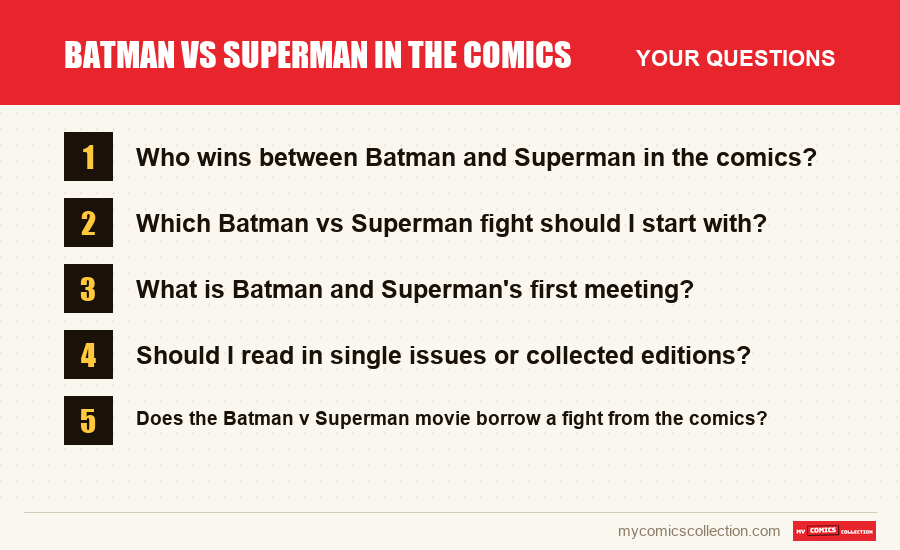
It depends on the author. In The Dark Knight Returns #4 (1986), Batman wins through preparation and equipment. In Kingdom Come, no physical victory settles it. In Injustice, the conflict lasts five years of story. Most of the time, the result serves the thesis of the story more than a ranking of power.
Open with Frank Miller and his Dark Knight Returns, whose fourth chapter from 1986 contains the duel. It sets the stakes that the other stories pick up. Follow it with Kingdom Come, by Mark Waid and Alex Ross, then with Injustice, the saga written by Tom Taylor.
The two heroes team up for the first time in Superman #76, dated 1952, under the title "The Mightiest Team in the World". Superman had appeared in Action Comics #1 in 1938 and Batman in Detective Comics #27 in 1939, so their destinies were not linked originally.
Collected editions suit reading: Kingdom Come, Hush and Injustice read in one sitting that way. Single issues are for collectors, with a natural exception for the four issues of The Dark Knight Returns, whose first printing remains the most sought-after piece on this list.
Yes: Zack Snyder's film borrows the idea of a battle-hardened Batman preparing for his duel from the fourth chapter of The Dark Knight Returns (Frank Miller, 1986). The differences from the comics are detailed on our page about the film, which compares the two sources point by point.
Did you find an issue of The Dark Knight Returns or Hush in your boxes? Have it examined before reselling it or sending it for grading.
Estimate my comic