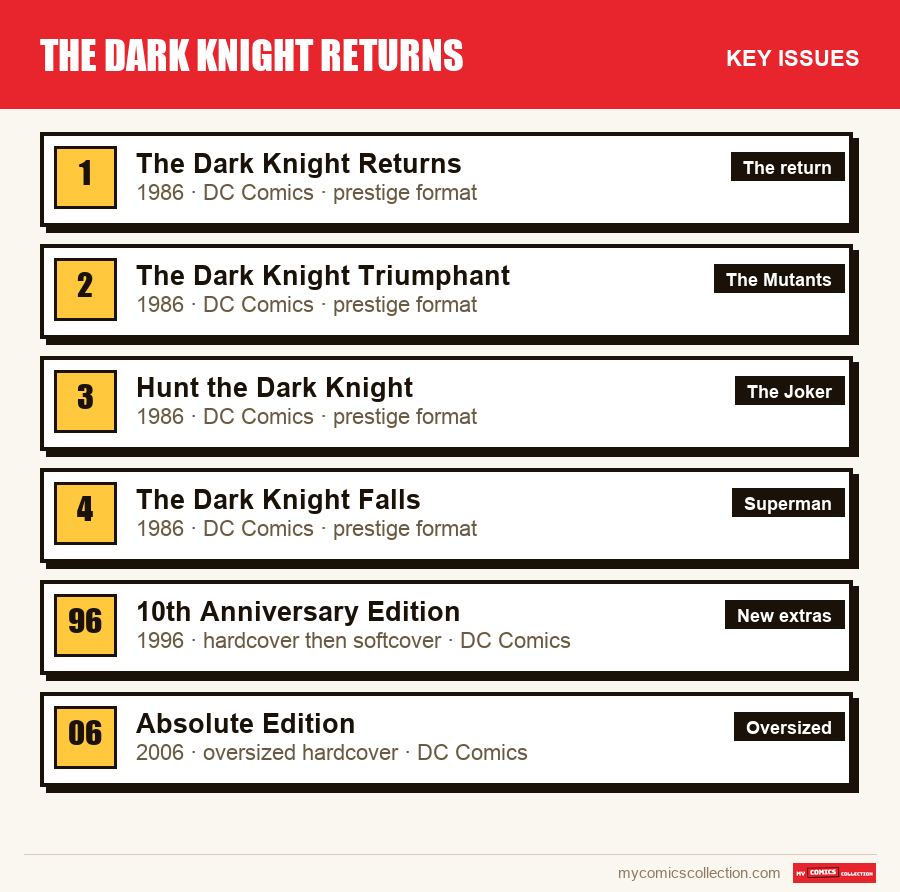
The Dark Knight Returns is a four-issue miniseries published by DC in 1986, written and drawn by Frank Miller, inked by Klaus Janson and colored by Lynn Varley. Each issue carries its own title (The Dark Knight Returns, The Dark Knight Triumphant, Hunt the Dark Knight, The Dark Knight Falls) and comes out in a deluxe format: squarebound, cardstock cover, glossy paper, sold for $2.95. For the collector, three families of objects coexist: the first printings of the four issues, their reprints launched to keep up with demand, then more than ten collected editions, from the 1986 album to the 2026 40th Anniversary Deluxe Edition. Telling them apart means looking at the indicia and the cover, not only the issue number.
Few comics have as many editions as The Dark Knight Returns. Forty years after its release, Frank Miller's story exists in original single issues, in reprints of single issues, in softcover and hardcover collections, in anniversary editions, in a black-and-white version, in oversized format and in box sets. For a reader, any one will do. For a collector, the question is finer: which object do you have in hand, and how do you place it in this genealogy?
This article is about the printed object. The 2012 animated adaptation and its differences from the comic are covered in another article on the site. Here, we describe the four 1986 issues, their unusual format, the successive print runs, then the collected editions in chronological order, with what lets you recognize them and what makes them more or less worth keeping.
What the work is, in two paragraphs
The story takes place in the near future. Bruce Wayne is fifty-five and has not worn the costume in ten years. Gotham is at the mercy of an ultraviolent gang, the Mutants, and both the police and the federal government look unfavorably on the return of a vigilante. Batman goes back into service, recruits a teenager, Carrie Kelley, who becomes the new Robin, then successively faces Two-Face, the leader of the Mutants, the Joker, and finally Superman, sent by Washington to stop him.
The story sits outside DC's regular continuity, which later filed it among its alternate stories. It was followed by several sequels: The Dark Knight Strikes Again in 2001 and 2002, The Dark Knight III: The Master Race, Dark Knight Returns: The Golden Child, as well as a prologue, Dark Knight Returns: The Last Crusade. Frank Miller also considers Batman: Year One as attached to this universe.
The four 1986 issues
The series is published under the general title Batman: The Dark Knight. The name The Dark Knight Returns, which was that of the first issue, was only extended to the whole at the time of the collection. This detail matters: some of the first collections still carry the short title, and the single issues do not all say "Returns" on the cover.
The Dark Knight Returns
Bruce Wayne takes the costume back during a heat wave, as Harvey Dent, declared cured, is released. It is the most sought-after issue of the series, both because it opens the story and because its cover, Batman's silhouette leaping in front of a lightning bolt, has become one of the publisher's most reproduced.
The Dark Knight Triumphant
Batman faces the leader of the Mutants, loses a first fight, then beats him in front of his own troops. Carrie Kelley takes on the role of Robin for good here.
Hunt the Dark Knight
The Joker comes out of his catatonia on learning of Batman's return and commits a massacre on a television set. The final confrontation takes place at a fairground.
The Dark Knight Falls
Batman and Superman fight in Crime Alley, where Bruce's parents were killed. The conclusion stages Batman's apparent death and his followers going underground.
Why the format matters so much
In 1986, a standard American comic is stapled, printed on newsprint and sold for less than a dollar. The Dark Knight Returns comes out in a format DC calls prestige: more pages, glued square spine, light cardboard cover, glossy paper inside. This choice serves Lynn Varley's colors, made of washes and gradients that would have suffered on newsprint. The price of $2.95 per issue was high for the time, and the series nevertheless sold very well.
For preservation, this format has direct consequences. The square spine marks easily: a white vertical line appears as soon as the book has been opened flat. The very dark covers show every rub and every crushed corner. Finally, glossy paper resists yellowing better than the newsprint of standard single issues from the same year, which means the interior is rarely the problem: it is the exterior that decides the condition.
First printings and reprints: how to find your way
Demand exceeded forecasts, and DC restarted printing of some issues right away. The first issue, above all, circulated in several printings. These reprints are not counterfeits or late reissues: they are official 1986 copies, but from a later printing, and the market distinguishes them clearly from the first printing.
Read the indicia
The indicia, that block of legal notices printed in small type, gives the publisher, the date and sometimes the printing number. It is the first place to look. A mention of a later printing settles the matter.
Compare the cover to a reliable reference
Reprints of the period are often distinguished by differences in tint or cover notices. Compare your copy to the record of a confirmed first printing, in a reference index or on the #1 page on this site.
Beware of modern reprints in the same format
DC has put out #1 identically in other contexts, notably in a box set with figurines, with a 48-page prestige-format issue, as well as in collections of reprints of historic issues. These objects reuse the cover, but not the 1986 indicia.
Note the printing in your database
A second-printing copy is not a duplicate of the first. It deserves its own line, with the printing number noted, to avoid selling or insuring it as an original.
The general rule, detailed in our first printing versus reprint guide and in the one devoted to second printings, applies here as elsewhere: at equal condition, the first printing ranks above the later ones, and the gap widens on #1. Later printings nevertheless remain 1986 pieces, in the same format, and are a reasonable way to own the series in period single issues without aiming for the first printing.
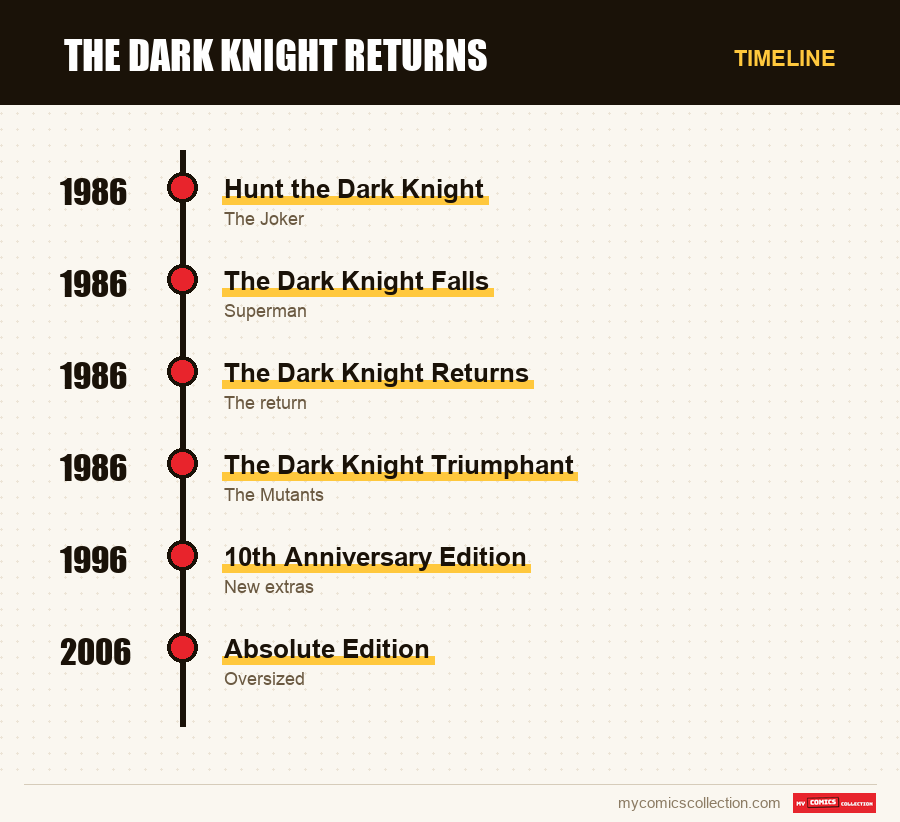
The collected editions, from 1986 to 2026
The collection was published as early as 1986, in softcover and hardcover versions. It was on this occasion that the first issue's title was applied to the whole, even though some of the very first collections still carry the short title Batman: The Dark Knight. This collection did a lot to bring American comics into general bookstores, and it is in this form that most readers discovered the work.
10th Anniversary Edition
For the tenth anniversary, DC publishes a new hardcover edition, then softcover, enriched with excerpts from the preparatory script of the fourth issue and Miller's sketches. A limited slipcased version was offered in parallel, with small poster reproductions, press reviews and a sketchbook. A British edition followed in 1997 from Titan Books.
Absolute Edition
The Absolute edition gathers the work in the slipcased oversized format that DC reserves for its most prestigious titles, accompanied by its sequel The Dark Knight Strikes Again. It is the most comfortable way to read the pages, and the bulkiest format to shelve.
Several editions then follow, each answering a specific use. The 2002 edition accompanies the release of the sequel. The 2015 Noir edition presents the pages in black and white, without Lynn Varley's colors, which lets you see Miller's line and Janson's inking laid bare. The same year, a Deluxe edition gathers the work and its first sequel. In 2016, for the thirtieth anniversary, DC multiplies formats: a softcover anniversary edition, an edition packaged with the animated film, a Gallery Edition that reproduces the pages at original size, and a Collector's Edition. Finally, in 2026, a 40th Anniversary Deluxe Edition comes out in softcover and hardcover.
Which object to aim for depending on your profile
To read, any recent softcover collection will do, and the Noir edition offers an interesting second read to anyone who already knows the work. To own the period object, the four 1986 single issues remain the reference, and a set mixing first printing and reprints is a reasonable option. For the centerpiece, the first printing of #1 in very fine condition is the issue the whole market watches, and it alone justifies professional grading if the copy is clean. For the prestige library, the Absolute or the Gallery Edition are the most striking, provided you have the space.
One last piece of advice: the series was printed extremely heavily, in all its forms. What makes the difference is not the scarcity of the work, but the scarcity of a specific copy in very fine condition, and the ability to prove what it is. Keeping the single issues away from light, in sleeves suited to the prestige format, protects their value better than any buying strategy.
How the work fits into a Batman collection
In a collection devoted to the character, The Dark Knight Returns sits next to Batman: Year One, published the following year in the pages of the Batman series by the same Frank Miller, with David Mazzucchelli on art. The two stories answer each other: one shows the vigilante's first year, the other his last battle. Collectors who follow the character's key issues often pair them, and Year One has its own page on this site, as does the Batman hub.
The work has also left traces beyond its pages: the character of Carrie Kelley was taken up in DC's main continuity years later, and several films borrowed images or situations from the 1986 story. For the collector, this mostly means demand does not fall back: each new adaptation brings readers back to the work, and therefore to its editions.