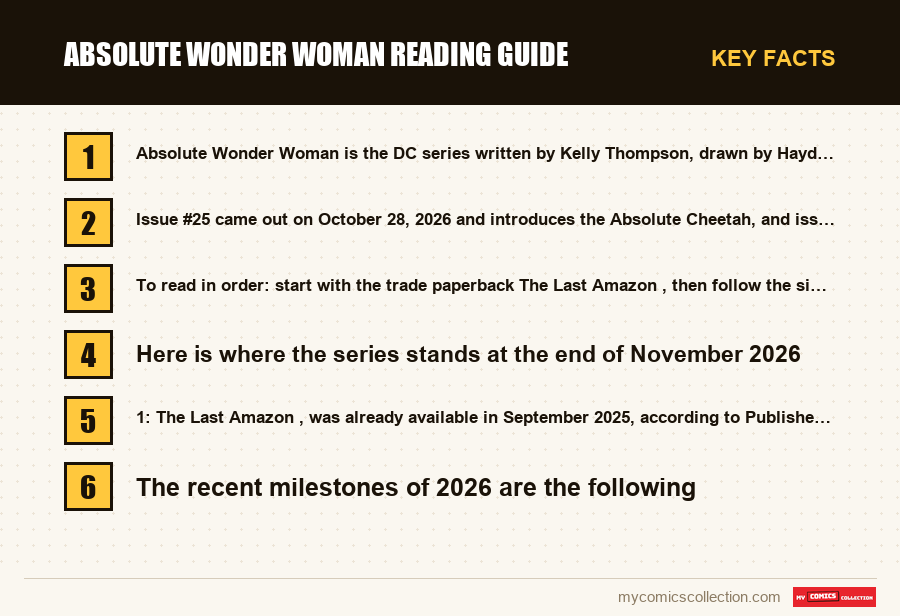
Absolute Wonder Woman is the DC series written by Kelly Thompson, drawn by Hayden Sherman and colored by Jordie Bellaire, part of the Absolute line, and this Absolute Wonder Woman reading guide shows where the series stands at the end of 2026. Diana grows up in hell under Circe's care. Issue #25 came out on October 28, 2026 and introduces the Absolute Cheetah, and issue #26 is announced for November 25. To read in order: start with the trade paperback The Last Amazon, then follow the single issues, including the February 2026 annual.
A Diana without Themyscira, without Amazons around her and without a message of peace: this version can throw a reader off, and it raises three practical questions, namely where to jump in, what the reading order is and how to store the books. Here is where the series stands at the end of November 2026.
The facts in this article come from DC's announcements and preview pages as relayed by the trade press (Comic-Watch, Bleeding Cool, Publishers Weekly); the split into reading stages and the storage advice are our own analysis.
What has been announced
The Absolute Wonder Woman series belongs to DC's Absolute line, which reimagines its biggest characters from a blank page. Kelly Thompson writes it, Hayden Sherman draws it and paints the main cover, Jordie Bellaire handles colors, Becca Carey letters it and Chris Conroy serves as editor. Publishers Weekly credits Kelly Thompson with Diana's reinvented origin and powers, and Hayden Sherman with the new costume.
The opening hardcover, Absolute Wonder Woman Vol. 1: The Last Amazon, was already available in September 2025, according to Publishers Weekly. Its starting point: Diana, an Amazon child, is banished to hell and raised by the witch Circe. There she picks up a dark magic that comes on top of the courage and strength of a warrior princess. The excerpt the magazine published shows Diana reuniting with the pilot Steve Trevor while a monstrous threat looms over Gateway City.
The recent milestones of 2026 are the following.
- On January 28, 2026, issue #16 opens the Season of the Witch arc: a new enemy turns another witch, Zatanna, against Diana.
- On February 11, 2026, the Absolute Wonder Woman 2026 Annual #1 arrives as a one-shot. Kelly Thompson writes, Mattia De Iulis draws, Jordie Bellaire colors and Becca Carey letters; Hayden Sherman and Jordie Bellaire do the main cover, and Hayden Sherman a wraparound variant.
- On October 28, 2026, issue #25, billed as a milestone issue, brings in the Absolute Cheetah. Diana's search for Barbara Minerva ends in violence.
- Issue #26 is announced for November 25, 2026: Etta Candy follows a lead on Cale to an unexpected place.
Between those milestones, the Heretic arc set up the Absolute version of Ares starting with issue #23 and brought in Circe, who forges new weapons for Diana with Hephaestus, before the gods' arrival in Gateway City shapes the issues that follow.
Point 1: A Diana without Themyscira, raised by Circe
What sets this series apart from every common version of the character is what it takes away: no paradise island, no sisterhood, no announced mission of peace. DC's pitch puts it this way: once those elements are removed, what remains is Absolute Wonder Woman. The story does not retouch the old origin, it lays down a different one.
The consequence for readers is direct: no prior knowledge of Diana's adventures in mainline continuity is required. A reader who has skipped twenty years of Wonder Woman books can begin with the The Last Amazon trade and have nothing to catch up on. The ties to Circe, Zatanna or Ares are reinterpretations of mythological figures that the title redefines in its own way, so knowing their classic versions is useful, though never necessary.
To place Circe among Diana's rogues' gallery, our page on the history of Circe in comics recalls her usual appearances: the contrast with this role as a dark maternal figure sheds light on one of Kelly Thompson's most striking choices.
For a reader who picks up the series mid-run at the end of November 2026, the clearest path splits into four stages. First the The Last Amazon trade, which establishes Diana, Circe, Steve Trevor and Gateway City. Next the intermediate issues up to #15, where the roles of Etta Candy and Barbara Minerva around Diana take shape. Then the sequence of issue #16, the February annual and issue #17: the witch Zatanna, followed by the interlude drawn by Mattia De Iulis. Finally the Heretic arc, from issue #23 through issue #25 and beyond, which brings together Ares, Circe, Hephaestus and Cheetah.
Point 2: Gateway City and Kelly Thompson's method
Gateway City serves as the proving ground: the city is where the monstrous threat appears as early as the first volume, where Diana fights with human means as much as magical ones, and where the gods' arrival is concentrated in the Heretic arc. Choosing a constant urban setting gives the series the tone of a local saga, closer to a fantasy noir than to a grand worldwide adventure.
The narrative thread is the price of every victory. The February 2026 annual shows it well: according to Comic-Watch's preview, Diana defeats the Tetracide, described as the inaugural monstrous creature of this darker world, with as few casualties as possible and with help from Etta Candy and Barbara Minerva; the ordeal also gives back a part of herself that was missing. The series timeline published by Popverse ties this annual to Diana's brief spell in the form of Medusa.
This pattern, a costly victory followed by questions about the gods, runs from issue #16 to issue #25. It explains why the issues read better by arc than one at a time: Season of the Witch (Zatanna), the annual's detour (the Tetracide and mythological crimes to be settled), then Heretic (Ares, Circe, the weapons forged with Hephaestus, Cheetah).
For readers interested in the writer's whole catalog, the page Kelly Thompson: where to start places this work among her other series.
The human cast matters as much as the mythology. Steve Trevor remains the pilot Diana meets again in volume 1; Etta Candy, mentioned in the February annual and in issue #26 for her lead on Cale, carries the investigative side; Barbara Minerva links the annual to issue #25. This continuity of characters from one arc to the next gives the series its identity, and it is the reason to read the issues in order rather than pick out a single arc.
On the credits side, three names recur on the regular issues cited here: Kelly Thompson writes, Hayden Sherman draws and does the covers, Jordie Bellaire colors, and Becca Carey letters. The annual's detour hands the art to Mattia De Iulis while keeping Jordie Bellaire on colors, which preserves a unified palette despite the change in style.
Do you collect this series?
Track what you own, what you are missing and what your collection is worth. 7-day trial.
Start my trial →
Point 3: Cheetah, Ares, Hephaestus: mythology rewritten
DC presents issue #25 as the end of a phase: Diana's search for Barbara Minerva concludes violently and the Absolute Cheetah makes her entrance, described as "not quite what anyone expected." Comic-Watch's summary suggests she is the Absolute version of the role held by Barbara Minerva.
The earlier issues of the Heretic arc prepared that entrance: the gods' arrival in Gateway City and Diana's new weapons, made with Circe and Hephaestus, form the raw material of the battle. To compare with the enemy's classic lineage, our page on the history of Cheetah in comics details her successive incarnations.
For a reader, the chronology is simple: volume 1 and the issues that follow it up to #15, then issue #16 and the Zatanna arc, the annual in February, Heretic from issue #23, and then issue #25 as the pivot to remember.
What this means for a collector
Issue #25 is where the buying decisions concentrate. Comic-Watch's listing counts a long run of alternate covers: Terry and Rachel Dodson, Mark Brooks, a glow-in-the-dark version by Babs Tarr, Bryan Hitch and Hayden Sherman as connecting covers, a blank sketch cover, Alexander Lozano as a foil edition, along with retailer exclusives signed by Santa Fung. Each category answers a different collecting logic.
Here is a reasoned method, with no price speculation at all.
- Decide what the object is for. A reader's collection is happy with the main covers by Hayden Sherman and Jordie Bellaire; an artist collection hunts for variants; a thematic collection favors issue #25 as the pivotal moment.
- Check the exact cover. Connecting covers (Bryan Hitch, Hayden Sherman) only make sense together: buying one without the other leaves an incomplete set.
- Check the condition. Glow-in-the-dark covers and retailer exclusives need careful handling: corners, spine and any printing flaws should be photographed before you buy.
- Store with a method. Acid-free bag, backing board, stored upright without pressure in a comic box, away from direct light.
The annual of February 11, 2026, drawn by Mattia De Iulis, deserves a place of its own: the artist is not Hayden Sherman, and the issue works as a graphic interlude. File it between issues #16 and #17 if you follow release order, or right after volume 1 if you sort by artist.
On the collected edition side, the The Last Amazon trade paperback remains the simplest entry point for anyone who prefers the book format. For an overview of the Absolute line, our key issues of the Absolute Universe put the titles in perspective, and the guide to the Absolute line built around Absolute Batman offers a point of comparison if you follow several series.
A word on preserving issues of an ongoing series: a comic bought on release day starts out in good condition, but it only stays that way if it goes into a bag without delay. The series ships monthly; file the issues in numerical order and put connecting covers in neighboring bags so you can display them together without handling them. Effect covers, like Babs Tarr's glow-in-the-dark version, should not sit in bright light for long, since it wears out the ink and the paper.
Finally, note down the details of each cover when you buy: artist name, variant label, printing number if the shop's tag gives it. That information makes later sorting, resale or appraisal easier, and keeps you from mixing up two similar variants of the same issue.
What remains to be confirmed
The information in this section comes from the publisher's announcements, as relayed by the trade press; a release date can move. What is not yet settled at the end of November 2026:
- the date of issue #26 (November 25, 2026) and its exact contents;
- how the Heretic arc continues after issue #25: its length was not confirmed in the sources we read;
- the number of issues collected in the upcoming volumes;
- the precise identity and place of the Absolute Cheetah in the rest of the series;
- the exact dates of some of the arc's intermediate issues: the preview pages cited disagree, which is why we do not date them here.
Frequently asked questions
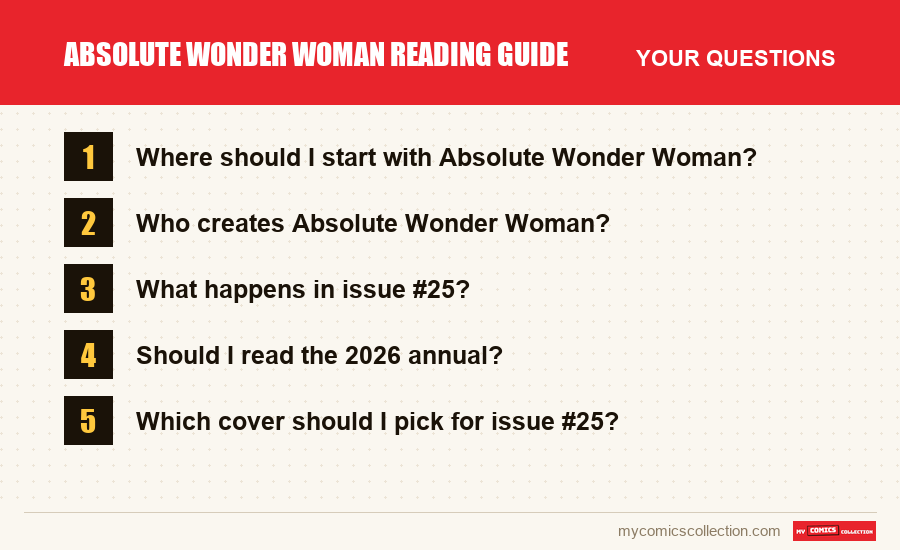
With the trade Absolute Wonder Woman Vol. 1: The Last Amazon, which sets out Diana's origin: banished to hell, raised by Circe, reuniting with Steve Trevor in Gateway City. No prior Wonder Woman reading is required, since the series starts from a blank page in DC's Absolute line.
Kelly Thompson writes the series, Hayden Sherman draws it, Jordie Bellaire handles colors, Becca Carey the lettering and Chris Conroy the editing. The February 2026 annual was drawn by Mattia De Iulis, with Kelly Thompson writing and Jordie Bellaire on colors.
Released on October 28, 2026, this milestone issue brings Diana's search for Barbara Minerva to a violent end and introduces the Absolute Cheetah. It belongs to the Heretic arc, which enters a new phase after the gods' arrival in Gateway City.
Yes if you follow the whole series. Published on February 11, 2026, the Absolute Wonder Woman 2026 Annual #1 is a one-shot by Kelly Thompson and Mattia De Iulis: Diana takes on the Tetracide with help from Etta Candy and Barbara Minerva, following her transformation into Medusa.
It depends on your collection. The main cover by Hayden Sherman and Jordie Bellaire suits reading copies; the variants (Dodson, Brooks, Babs Tarr, Bryan Hitch, Alexander Lozano) are for artist fans. Check the exact reference before buying, especially for connecting covers.
Do you have issues of Absolute Wonder Woman or Wonder Woman to organize or appraise? Get a free estimate.
Estimate my comic