French publishers in the 1970s and 1980s did not just Frenchify the names of the characters: they renamed the collections themselves. A survey carried out on August 30, 2026 on a general auction site, on the French market side and in euros, and not on the American market like most of the measurements published here, gives 55 advertisements for the query "DC Aredit Artima comics pocket", with a minimum of €3.00, a median of €6.00 and a maximum of €28.50. These amounts are those claimed by sellers on this date, not completed transactions. None of these advertisements offer a copy passed through the hands of an independent verification organization. And the five least expensive ads carry five different collector's titles, all French: “L'Insolite”, “Aventures Fiction”, “Démon”, and two issues of “Faucon Noir”. Searching for these series by their original title yields nothing.
The reader who approaches a Franco-Belgian collection of comics translated with the reflexes of the American market comes up against an immediate wall. He knows a title, he types it, he gets nothing. Not because the series never circulated in France, but because it circulated there under a name which has no legible connection with the original. It is not an approximate translation, it is not a clumsy transposition: it is a new baptism. The French publisher took stories, placed them in an in-house collection, and gave this collection a title chosen for its strength on a station display, not for its fidelity. The result, forty or fifty years later, is an editorial landscape that no query from English accounts for.
This section usually publishes statements taken on the American market, in dollars, on series identified by their original title. The following statement is different on both counts: it concerns French advertisements and the amounts are in euros. The distinction matters, because the same story has neither the same price nor the same visibility depending on whether it is sold under its American title or under the name of the pocket collection which hosted it in France. What follows does not seek to establish a price level: the number observed in the detailed cases is too low for that, and a measurement taken on a single day says nothing of an evolution. The following seeks to describe an identification mechanism.
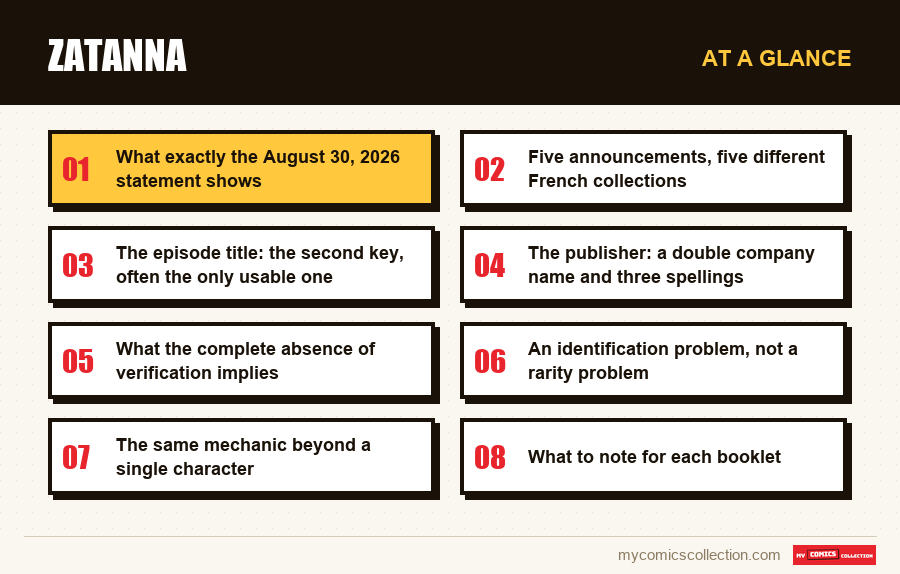
What exactly the August 30, 2026 statement shows
The query “DC Aredit Artima comics pocket” returns 55 ads on August 30, 2026. The lowest amount requested is €3.00, the median value is €6.00, and the most expensive ad displays €28.50. These three numbers must be read for what they are: claims of sellers at a given moment, on a general market, in euros. No one paid these amounts. The maximum at €28.50 in particular measures nothing other than the optimism of the person who grabbed it; a single copy displayed high does not constitute a market level, and I have no record of a sale concluded to support it. As the observation takes place over a single day, it does not allow any statement about an increase or a decrease: there is no second measurement point to which to compare this one.
One figure deserves to be isolated: of the 55 announcements, none concerns a copy passed by an independent verification body. Zero out of fifty-five. In the American market, the proportion of verified copies is often used as a benchmark to distinguish a structured segment from an informal segment. Here, the marker is completely absent. This does not mean that these fascicles are without interest; this means that the declared condition, completeness and sometimes even content are entirely based on what the seller writes in their advertisement, without any third party having checked it.
Five announcements, five different French collections
The Unusual No. 19-€3.00
Advertisement labeled "L'INSOLITE N°19 LE SPECTER IMPRISONNE: Comics Pocket AREDIT / ARTIMA", at €3.00, amount claimed on August 30, 2026. The title of the collection is French and does not appear in any of my American statements; which original series it corresponds to, the announcement does not say, and I do not deduce it.
Adventures Fiction n° 51-€4.00
“ADVENTURES FICTION N°51 OCEAN OF DEATH: Comics Pocket AREDIT / ARTIMA”, priced at €4.00. Here again a purely French collection title, followed by an episode title which describes the story contained in the booklet.
Demon No. 5-€4.00
“DEMON N°5 THE LAST GREFF: Comics Pocket AREDIT / ARTIMA”, at €4.00. The word “Démon” here is a French collection name, written without accent in the ad. Nothing in the wording makes it possible to establish alone which American title it refers to.
Black Falcon n° 21 and n° 25-€4.00 each
“BLACK FALCON ARÉDIT COMICS POCKET N°21 1981” and “BLACK FALCON ARÉDIT COMICS POCKET N°25 1982”, both at €4.00. The only collection represented twice in the five least expensive ads, and the only one whose labels bear a year.
Five announcements, five distinct collection titles. This is the structuring data of this statement, even more than the amounts. On the American market, a query on a publisher brings up massively titles that are repeated, because the series are long and the issues numerous. Here, the first handful of results shows as many collections as listings. The French editorial landscape of these issues is fragmented, and above all: none of the announcements summarize this fragmentation. No one, in these wordings, says which collections exist, how many numbers they have, nor how they relate to each other. The buyer discovers the names one by one, through the advertisements he comes across.
A practical consequence follows directly from this observation: a search based on an original title will never find these booklets. Neither “L’Insolite”, nor “Aventures Fiction”, nor “Faucon Noir” are identifiable translations of an English-speaking title; these are local editorial creations. No search based on the American name brings them up, and no automatic match fills the gap.
The opposite is also true, and it is even more annoying: a French collector who already owns these issues cannot compare them to his international records until he has established the correspondence by hand, issue by issue. Nothing in the ad, nothing on the cover as described, does this job for him.
The episode title: the second key, often the only usable one
Three of the five labels noted carry, after the number, a second mention in capital letters: “THE SPECTER IMPRISONED”, “OCEAN OF DEATH”, “LA DERNIERE GREFFE”. These are not seller additions. These are the episode titles printed on the booklets themselves. Each copy therefore bears two superimposed titles: that of the collection, which applies to the entire pocket series, and that of the story, which only applies to that issue.
This double title changes everything for identification. The collection title, as we have seen, is a dead end: it does not refer to anything identifiable outside France. The episode title describes a story. It has been translated from something, and it retains a trace of the content-a situation, a place, a narrative event. It is through him, and most often only through him, that a French booklet can be linked to a story known elsewhere. The reasoning goes from the particular to the general: we start from history to find the series, and not from the series to find history.
We still need to draw the right conclusions. A translated episode title is not mechanically retranslated into English: the translator of the time took liberties, tightened it up, dramatized it. Two very different French titles may cover the same story in two competing collections, and the same French title may have been reused. The episode title is therefore a search key, not proof of identity. He directs; he does not conclude. When the match is not established with certainty, the correct response is to record it as uncertain rather than deciding.
It is also important to note what the statement does not say. Two of the five advertisements, the two “Falcon Noir”, do not mention any episode title, but a year: 1981 for No. 21, 1982 for No. 25. The secondary key is therefore not systematically available in the wording of the advertisement, even when it appears on the booklet. Depending on the seller, you get the title of the story, or the year, or both, or neither. Identifying information depends on the thoroughness of the writer.
The publisher: a double company name and three spellings
The name of the publisher, in these five advertisements, never appears in a single form. It presents itself as a double company name, two names joined by an oblique slash, “AREDIT / ARTIMA”, in three of the descriptions. In the other two, only one of the two names is mentioned, and it bears an accent: “ARÉDIT”. Three forms therefore coexist within a sample of five advertisements: the unstressed pair, the single accented noun, and implicitly the single unstressed noun that the pair contains.
For research, this variation is costly. An ad engine that distinguishes accented characters will return different sets depending on the form entered. A query on the pair does not bring up ads that only mention one of the two names. An accented query may miss labels entered without an accent, and vice versa. You must therefore treat the publisher's name as a family of spellings and query each one, rather than as a single string. The same reasoning applies to the mention “comics pocket”, which appears here sometimes in capitals, sometimes in mixed case, and which functions as a format label more than as a collection name.
There is a larger lesson behind this typographic detail. In a structured market, the publisher is a stable entity that serves as a reliable entry point. On this segment, he is himself a variable. The collector who relies on the name of the publisher to scan the offer systematically underestimates what exists, and he does not notice it, since a search which turns up nothing resembles a search which has seen everything.
What the complete absence of verification implies
Zero copies verified out of fifty-five advertisements: the figure is clear and deserves to be taken seriously. In this segment, the actual content of a booklet is not attested by anyone other than the seller. Neither the completeness of the pages, nor the condition of the cover, nor even the exact identity of the story contained is subject to external control. It's all about the description.
This situation has a direct consequence on the way of building a collection of these editions. When a third party certifies the condition, the buyer can purchase based on a label. Here, he buys on the basis of text and photographs. The rigor of the wording therefore becomes a criterion in its own right: an announcement which gives the title of the collection, the number, the title of the episode and the year transmits four points of identification; an ad that gives the title and number only conveys two. For an equivalent amount, and the five ads detailed here are all between three and four euros, the first is better than the second, not because the object is better, but because what we will know about it after the purchase will be more complete.
We must be careful not to go further. Five ads do not constitute a sample from which we can draw a price level: it is too small a number for that, and I refrain from concluding that these collections are “worth” three or four euros. What I see is that these five were showing in this range on August 30, 2026, which is an observation, not an assessment.
Collecting this series?
Track what you own, what you are missing and what your collection is worth. 7 day trial.
Start my trial →An identification problem, not a rarity problem
Original title finds nothing
A series renamed in French is invisible to any search based on its original name. The collector wrongly concludes that it has never been published in France, even though it is circulating under a title of which he is unaware.
The year is not always here
Two of the five advertisements have a year (1981, 1982), the other three do not. Without a date, attaching an issue to a publication period requires a source external to the announcement.
Publisher name varies
Double company name joined by an oblique slash in three advertisements, single name accented in two others: three spellings for five advertisements. Each unquestioned form is a part of the offer that we will never see.
No external controls
Zero out of fifty-five ads offer a copy verified by an independent organization. The condition and content are based entirely on the seller's description, with no second expertise possible before receipt.
The numbering is specific to the collection
A No. 19, a No. 51, a No. 5, a No. 21 and a No. 25 appear in five different collections. These numbers are only valid in their collection: they do not refer to any original numbering and cannot serve as a common key.
No listing in ads
Five collection titles appear in five advertisements, and there is no indication of how many more there are. The market does not provide its own inventory: it is up to the collector to replenish it through his or her finds.
The same mechanic beyond a single character
What is at stake here goes far beyond the case of a particular character. As soon as a foreign catalog is reorganized by a local publisher into in-house collections, the correspondence between the original edition and the translated edition ceases to be obvious. The collector who follows a character through several publishers and several countries encounters the same obstacle at each border: the titles do not correspond to each other, the numbering starts from scratch, and the editorial groupings do not overlap with the original ones.
This is true of the most documented characters as well as the most discreet. A reader who approaches the history of Batman in comics with a French corpus established in the 1980s we find ourselves with booklets whose connection to the original series requires work of matching story by story. The difficulty is not the rarity of the objects (the amounts noted here, between three and four euros on the five least expensive advertisements, do not indicate anything resembling rarity) but the absence of a bridge between two naming systems.
The same logic applies to later and better marked series. A working collector Sandman's story or who seeks to identify Sandman key numbers has a corpus whose titles have resisted crossing borders much better. The comparison is instructive: the more recent a series is and published under its original title, the less the problem of identification arises. It is indeed the editorial practice of renaming, specific to an era and a format, which creates the gap: not the nature of the stories.
This invites a different collection method depending on the segments. For modern editions, the title is enough to identify. For these French pocket collections, the title is never enough: you need at least the collection + number couple, and preferably the episode title and the year in addition. The guide dedicated to building a Zatanna collection addresses the question from the side of identifiable series; the fascicles described here fall under another regime, where registration precedes identification instead of following it.
What to note for each booklet
The title of the French collection and the title of the episode, separately. These are two fields, not just one. “The Unusual” on one side, “The Imprisoned Specter” on the other; “Adventures Fiction” and “Ocean of Death”; “Demon” and “The Last Transplant”. Merging the two into a single line makes the sheet unusable: you can no longer group by collection, nor search by story. Two separate fields, entered as they appear on the booklet, including capital letters if that is how they are printed.
The correspondence with the original series, when we manage to establish it, and its degree of certainty. It is the most precious and fragile field. When an episode title allows a booklet to be linked to a known story, it must be recorded immediately, with the mention of what made it possible to establish the link. And when the correspondence remains doubtful, it must be written as such rather than letting a hypothesis harden into certainty in a basis. An unestablished match, noted as unestablished, is better than a guessed match.
The publisher with its exact spelling, as it appears on the object. Pair of names joined by an oblique bar, or single name, with or without accent: the form noted on the booklet is data in itself. It allows, later, to reconstruct the requests which will come up from neighboring copies. Recording a standardized form instead of the actual form loses exactly the information that is used to find the rest of the collection.
The year shown on the booklet, and nothing else in its place. The two “Faucon Noir” listed give 1981 and 1982. The three other advertisements do not indicate any date. When the year appears on the object, we record it; when it is not there, we leave the field empty rather than putting an estimate there. An empty field is filled later; an approximate date is no longer distinguishable from a certain date six months after the seizure.
The price actually paid, including shipping, and the date of payment. Not the amount displayed in the ad: the amount that was paid, shipping costs included, with the date. Amounts claimed in this segment on August 30, 2026 ranged from €3.00 to €28.50 with a median of €6.00, but none of these numbers are transactions. Only the prices actually paid, dated and accumulated over time, end up constituting a series of measurements about which we can say something: which a statement taken on a single day will never allow.
Frequently asked questions
Because the French collection has a name which is neither a translation nor an adaptation of the original title. The five cheapest ads in the August 30, 2026 statement have five entirely French titles, which do not appear in any American statement. No automatic correspondence exists between the two naming systems: you must search directly for the names of French collections, or go through the title of the episode.
The first title is that of the pocket collection, common to all issues of the French series; the second is that of the story contained in this specific issue. “The Unusual” and “The Imprisoned Specter” therefore designate two different things on the same object. The collection title is used for storage, the episode title for story identification.
No. The 55 listings range from €3.00 to €28.50, median €6.00, but these are asking prices on August 30, 2026, not completed sales. The isolated maximum reflects a seller's request and nothing more. And out of the five detailed announcements, the number is far too small to derive a price level: I refuse to do so.
It shifts the entire burden of description onto the seller. None of the 55 advertisements offers a copy controlled by an independent organization: the condition, completeness and content are not attested by anyone else. Concretely, the quality of the wording (presence of the number, the episode title, the year) becomes the main indicator available before the purchase.
Treating it as a family of shapes, not a single string. Three spellings coexist in the five advertisements noted: the double company name joined by an oblique slash, and the name alone with accent. You have to run a query by form and merge the results, otherwise part of the offer remains invisible, and an empty search deceptively resembles an exhaustive search.
Keep correspondence somewhere
An identified booklet whose correspondence is not noted anywhere is a booklet to be re-identified next time. French collection, number, episode title, publisher's spelling, year when it existed, price paid including shipping: six fields that transform one-off investigative work into lasting knowledge of your collection.